
Sep 14, 2026
By Transpire Insight
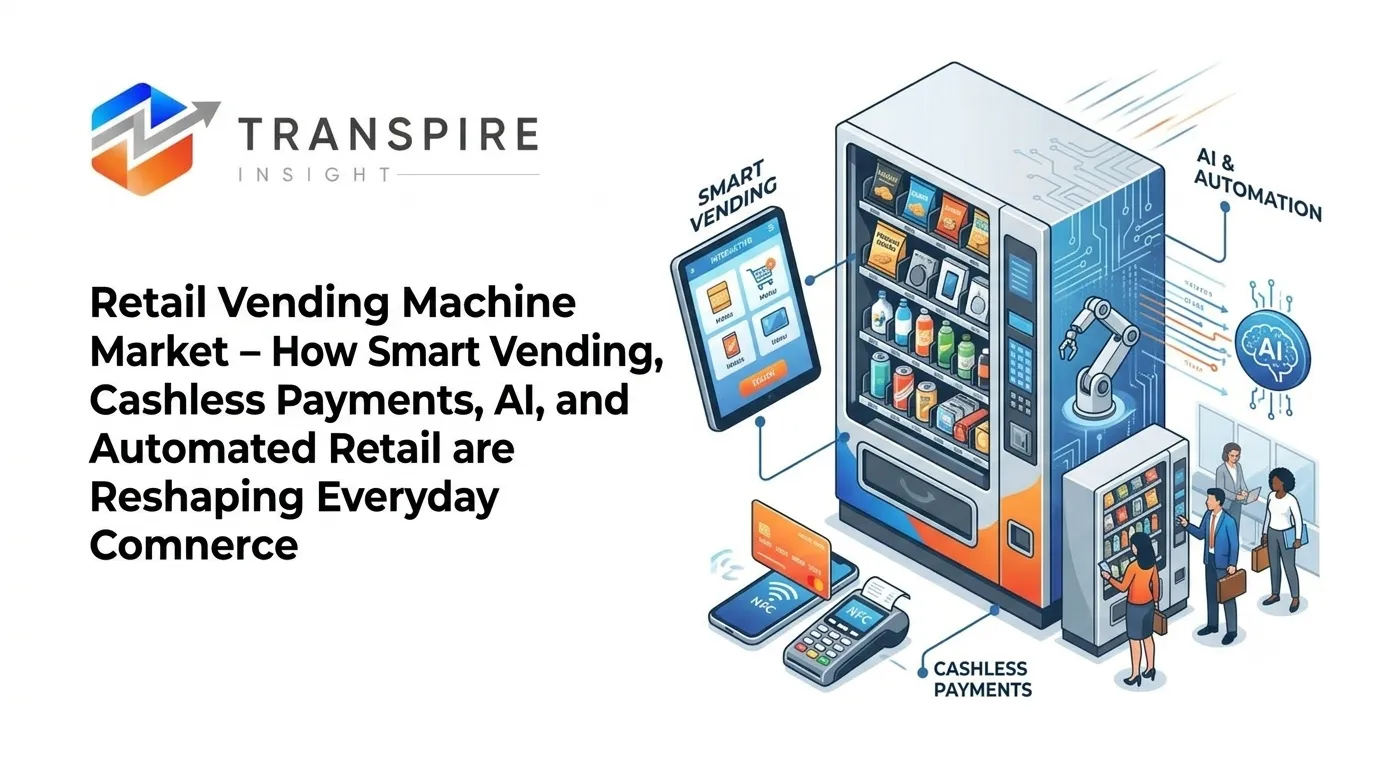
According to Transpire Insight, the global retail vending machine market is estimated at approximately USD 24.35 billion in 2025 and is expected to reach around USD 26.71 billion in 2026. The market is projected to reach approximately USD 51.20 billion by 2033, expanding at an estimated CAGR of 9.70% during the forecast period 2026–2033.
The retail vending machine market is undergoing a structural shift as automated retail moves beyond conventional snack and beverage dispensing toward connected, cashless, data-enabled, and increasingly intelligent commerce. Modern vending machines are becoming compact retail points capable of selling products continuously, collecting transaction information, monitoring inventory, and operating with limited on-site intervention.
The transformation is being driven by a simple change in consumer behavior: shoppers increasingly want products to be available exactly when and where they need them. Offices, transportation hubs, hospitals, universities, residential complexes, factories, hotels, gyms, and public facilities can all provide environments where customers value immediate purchasing without queues or conventional checkout processes
Cashless payment adoption is accelerating this transition. India's Unified Payments Interface processed 24,161.69 crore transactions during FY2025–26 and had 703 banks live on the network as of March 2026, illustrating the scale of digital payment infrastructure available for high-frequency retail transactions.
At the same time, vending operators are increasingly connecting machines to cloud platforms. Sales information, inventory levels, machine status, payment activity, and equipment alerts can be transmitted remotely, allowing operators to manage geographically distributed fleets with greater visibility.
Artificial intelligence is adding another layer to this development. AI can potentially support demand forecasting, product assortment decisions, predictive maintenance, replenishment planning, customer recommendations, and operational analytics.
The result is a market shifting from traditional vending equipment toward connected micro-retail infrastructure.
Market Overview
Retail vending machines are automated point-of-sale systems that allow consumers to select and purchase products with limited or no direct interaction with a cashier. The market encompasses beverage machines, snack machines, refrigerated units, fresh-food systems, coffee machines, specialized product dispensers, and increasingly sophisticated smart-retail formats.
The traditional vending model remains important, particularly for packaged food and beverages. However, the technology landscape is broadening as operators use vending infrastructure to serve increasingly specific consumer requirements.
Food and beverage vending continues to represent a core application because products such as packaged snacks, bottled beverages, coffee, confectionery, and ready-to-consume food can be distributed efficiently through automated systems.
The market is also expanding into specialized retail categories. Depending on location and regulatory requirements, vending formats can provide personal-care products, travel essentials, electronics accessories, convenience goods, wellness products, and other frequently needed items.
Workplace vending remains commercially attractive because employees often require convenient access to beverages, snacks, meals, and other products without leaving a corporate campus or industrial facility.
Transportation vending is becoming increasingly relevant at airports, railway stations, metro systems, bus terminals, highway facilities, and other locations where consumers may have limited time and high demand for convenience.
Residential vending represents another emerging opportunity. Apartment communities, student housing, co-living developments, and large residential complexes can use compact retail units to provide products within the property itself.
The market is consequently becoming more dependent on location-specific retail strategies. The right machine, product mix, temperature configuration, payment technology, and replenishment schedule can vary significantly according to the environment.
Latest Market Statistics
The global retail vending machine market is expected to maintain a positive growth trajectory as retailers, foodservice operators, property owners, and specialized vending companies explore low-footprint and continuously available retail formats.
Transpire Insight estimates that the market was approximately USD 24.35 billion in 2025 and could reach around USD 26.71 billion in 2026. By 2033, market value is projected to approach USD 51.20 billion as operators increasingly combine automated dispensing with digital payments, IoT connectivity, remote monitoring, and intelligent inventory management.
The most important change is not simply the increasing number of machines. It is the improvement in economic productivity per machine.
Connected vending can allow operators to understand which products sell, how quickly inventory moves, when machines require servicing, whether refrigeration systems are operating properly, and which locations generate stronger demand.
This creates a more sophisticated operating model in which decisions can increasingly be made using machine-level data rather than fixed assumptions.
Cashless payment is another major structural development. Contactless cards, mobile wallets, QR payments, and other digital methods reduce friction for small-value purchases and can make vending more attractive to consumers who no longer routinely carry cash.
The market is also experiencing format diversification. Traditional standalone machines are increasingly being complemented by micro-markets, smart refrigerators, self-service retail units, and other unattended formats.
This broadens the addressable market beyond the conventional vending-machine category.
Major Growth Drivers
Expansion of cashless payments: Digital payment infrastructure is making low-value unattended purchases faster and more convenient. India's UPI ecosystem illustrates how familiar consumers have become with instant digital transactions.
Demand for 24-hour convenience: Consumers increasingly expect access to food, beverages, and everyday products beyond conventional retail hours.
Retail labor constraints: Automated formats can allow businesses to maintain product availability while reducing dependence on permanent cashier staffing at every retail point.
Urbanization and high-footfall environments: Dense workplaces, transportation hubs, educational campuses, hospitals, and residential developments can support compact automated retail models.
Growth of smart vending technology: IoT connectivity, telemetry, cloud platforms, digital displays, and AI-based analytics are expanding the operational capabilities of vending machines.
Diversification of product categories: Moving beyond snacks and beverages into fresh food, wellness products, convenience goods, and specialty items creates new revenue opportunities.
Key Applications
Food and beverage retail remains the largest and most established application are a. Vending machines can provide packaged meals, snacks, cold beverages, coffee, confectionery, and other ready-to-consume products.
Workplaces and corporate campuses use automated retail to provide convenient access to food and beverages for employees.
Transportation infrastructure represents a high-potential application because travelers often need rapid access to refreshments, convenience products, or travel necessities.
Educational institutions can use vending systems across universities, colleges, training centers, and other campuses.
Healthcare facilities provide opportunities for food, beverages, personal-care items, and selected convenience products within hospitals and healthcare campuses.
Hospitality and tourism represents another important application, with hotels, resorts, entertainment venues, and tourist destinations using automated retail to extend guest convenience.
Industrial facilities such as factories, ware houses, logistics centers, and manufacturing campuses can use vending machines to provide workers with food, beverages, safety-related consumables, or other everyday products.
Government Initiatives and Retail Modernization
The growth of automated retail is closely connected to broader developments in digital payments, smart infrastructure, urban development, and technology-enabled commerce.
India provides a particularly relevant example. According to the Press Information Bureau, UPI processed 24,161.69 crore transactions during FY2025–26, with annual transaction value reaching approximately ₹314 lakh crore and 703 banks connected to the network by March 2026. Person-to-merchant transactions represented 63% of UPI transaction volume, highlighting the platform's importance in frequent retail payments.
This digital-payment environment can support unattended commerce because vending transactions typically require fast, low-friction payment.
Public investment in airports, railway systems, metro networks, smart-city infrastructure, hospitals, commercial districts, educational campuses, and transportation facilities can also create additional locations where automated retail can operate.
At the same time, vending operators must comply with applicable rules governing food safety, taxation, consumer protection, payment security, accessibility, product labeling, and location-specific licensing.
The regulatory environment is therefore becoming increasingly relevant as vending expands into fresh food, health-oriented products, and other categories requiring more sophisticated operating controls.
Technology Overview
The retail vending machine market is increasingly defined by the interaction between hardware , payment systems, connectivity, software , and data.
Cashless payment systems support cards, contactless transactions, mobile wallets, QR-based payments, and other digital methods. These technologies reduce the operational dependence on cash collection and can improve transaction speed.
IoT connectivity allows machines to communicate with centralized platforms. Operators can potentially monitor sales, inventory, temperature, machine status, and payment activity without physically visiting each location.
Cloud-based fleet management allows large numbers of machines to be managed through common dashboards, making it easier to compare location performance and identify machines requiring attention.
Refrigerated vending systems expand product possibilities by enabling the sale of chilled beverages, fresh meals, dairy products, and other temperature-sensitive items.
Touchscreen interfaces and digital displays can turn machines into interactive retail environments, enabling dynamic product presentation, digital promotions, pricing updates, and recommendation features.
Computer vision is an emerging technology that can potentially assist product recognition, inventory tracking, consumer interaction, and automated checkout.
Remote diagnostics can help identify equipment faults before a service technician is dispatched.
The market is therefore transitioning toward software -defined vending fleets, where each machine functions as a connected edge device within a larger retail network.
Top Market Trends
The retail vending machine industry is evolving as operators seek better economics, stronger consumer engagement, and greater operational visibility.
Technological Advancements
The most significant technological development in the retail vending machine market is the shift from mechanical automation to digital intelligence.
IoT-enabled machines can continuously provide information about their operational condition. This can enable operators to distinguish between machines that are performing normally and those requiring immediate intervention.
AI-based demand forecasting can potentially analyze historical sales, product velocity, location characteristics, day-of-week patterns, seasonal behavior, and other factors to improve replenishment planning.
Computer vision can offer another layer of automation by identifying products, recognizing machine conditions, and supporting more advanced checkout experiences.
Energy-management technology is also becoming increasingly relevant. Modern refrigeration, lighting, displays, and electronic components can be optimized to reduce power consumption during low-demand periods.
Digital signage creates additional commercial value because the machine can become both a sales point and a localized advertising platform.
The combined effect is significant: vending machines are becoming data-generating retail assets rather than isolated dispensing devices.
Artificial Intelligence and Smart Vending
Artificial intelligence could become one of the most important technologies in the next generation of vending.
A machine placed inside a fitness center may have completely different purchasing patterns from a machine located in an airport. AI can potentially analyze these variations and recommend different assortments.
Demand models can potentially account for local events, weather patterns, time of day, seasonal demand, previous sales, and product availability.
AI can also support predictive maintenance. Changes in machine temperature, compressor activity, payment behavior, or other operational signals may provide early indicators of equipment problems.
Customer-facing AI could eventually provide personalized recommendations or promotional offers through mobile applications and loyalty programs.
The broader opportunity is to develop self-optimizing vending networks in which machines continuously provide data that improves assortment, replenishment, maintenance, and customer engagement.
However, these systems need strong cybersecurity, reliable data, clear privacy practices, and human oversight.
Investment and Growth Opportunities
The expansion of smart vending is creating opportunities for machine manufacturers, vending operators, payment companies, software providers, food manufacturers, logistics providers, commercial-property owners, and advertisers.
One major opportunity is connected fleet management. Operators managing hundreds or thousands of machines can potentially improve profitability by using data to optimize replenishment schedules and service routes.
The healthy and functional vending segment offers another opportunity. Offices, gyms, universities, hospitals, and workplaces can support products positioned around nutrition, convenience, and wellness.
Fresh-food vending provides additional potential where refrigeration, inventory monitoring, and food-safety controls can support higher-value products.
Specialized vending is another emerging opportunity. Machines can be designed around specific environments, such as travel essentials at airports, electronics accessories at transport hubs, convenience products at residential developments, or workplace supplies at industrial sites.
The expansion of digital payments also creates opportunities in emerging markets. India's UPI ecosystem, for example, has become deeply integrated into high-frequency merchant payments, creating a favorable environment for cashless automated commerce.
Market Segmentation
The retail vending machine market can be segmented based on machine type, product category, technology, payment mode, location, and application.
By machine type, the market includes beverage vending machines, snack machines, refrigerated vending machines, fresh-food vending machines, coffee machines, combination machines, and specialized automated retail units.
By product category, the market includes beverages, snacks, packaged foods, fresh meals, confectionery, coffee, functional nutrition, personal-care products, convenience goods, electronics accessories, and other specialty items.
By technology, the market includes traditional electronic vending, smart vending, IoT-connected machines, AI-enabled systems, computer-vision solutions, and cloud-managed vending networks.
By payment mode, categories include cash, credit and debit cards, contactless payments, mobile wallets, QR payments, NFC transactions, and integrated digital-payment platforms.
By location, the market includes offices, factories, ware houses, educational institutions, healthcare facilities, transportation hubs, residential communities, hotels, entertainment venues, gyms, retail centers, and public spaces.
By application, the market includes workplace convenience, commercial retail, hospitality, transportation, healthcare , education, industrial operations, residential retail, and other unattended-commerce environments.
Leading and Fastest-Growing Segments
The beverage vending segment is expected to remain a major component because beverages are highly suitable for automated distribution and generate frequent purchase occasions.
The snack and packaged-food segment will continue to provide a strong revenue foundation, while healthier and functional products can expand vending's appeal to new consumer groups.
The smart vending segment represents one of the strongest growth are as because operators increasingly require connectivity, remote management, digital payments, and real-time machine information.
The cashless payment segment is likely to become increasingly dominant as consumers shift away from cash for everyday transactions.
The fresh-food segment presents a particularly attractive opportunity because it can increase the value of each machine while extending vending into meal-oriented occasions.
The specialized-product segment is also expected to develop as location-specific machines provide targeted products in environments where conventional retail is inconvenient.
Competitive Landscape
Competition in the retail vending machine market is increasingly based on machine reliability, payment flexibility, product availability, location strategy, technology integration, energy efficiency, and operating economics.
Machine manufacturers compete through hardware reliability, refrigeration performance, security, payment compatibility, digital displays, connectivity, and ease of maintenance.
Operators compete primarily through location quality, product selection, machine uptime, pricing, replenishment efficiency, and customer experience.
Technology providers are becoming increasingly influential by supplying payment platforms, telemetry, cloud software , fleet-management systems, analytics, computer vision, and remote diagnostic capabilities.
A major competitive advantage is emerging from integrated ecosystems. Operators increasingly prefer solutions in which payments, machine monitoring, inventory information, analytics, and service management can communicate through a unified platform.
This trend is particularly visible in large-scale deployments. In April 2026, SECO reported approximately 170,000 installed cashless vending payment terminals within its ecosystem and described the integration of contactless payment, telemetry, and cloud analytics as a means of improving fleet visibility and operational performance.
The strategic emphasis is therefore shifting from selling machines to delivering connected retail infrastructure.
Challenges and Restraints
Despite strong growth prospects, the retail vending machine market faces several challenges.
Initial capital requirements can be substantial for smart machines incorporating refrigeration, displays, payment terminals, sensors, connectivity, and advanced security.
Location selection remains one of the most important determinants of commercial performance. A technologically advanced machine may still underperform if placed in a low-traffic or poorly matched environment.
Machine downtime can directly reduce revenue. Operators need responsive maintenance networks and reliable components to maximize machine availability.
Perishable inventory creates additional complexity for fresh-food vending because products require temperature management, shelf-life control, stock rotation, and appropriate monitoring.
Payment security becomes increasingly important as machines connect directly to financial networks and cloud platforms.
Cybersecurity is also a growing concern. Connected vending fleets can become part of a broader Internet of Things environment and therefore require appropriate security controls.
Data privacy must be considered where customer identities, loyalty accounts, payment information, or behavioral data are collected.
Product assortment management can also be challenging because the optimal selection differs by location and can change over time.
These challenges mean that successful vending operators must focus on the entire operating model rather than simply increasing machine count.
Regional Market Outlook
The retail vending machine market is developing across major regions as digital payments, urbanization, automated commerce, and consumer expectations for convenience continue to evolve.
North America remains an important market because of its established vending infrastructure, high digital-payment adoption, large workplace market, and extensive use of automated retail across transportation, healthcare , education, and commercial locations.
Europe represents a mature vending environment with strong adoption of cashless payments, coffee vending, workplace retail, connected machines, and energy-efficient equipment. The region is increasingly focused on modernizing existing vending fleets rather than relying solely on new machine deployment.
Asia-Pacific represents a major long-term growth opportunity. High urban density, technology adoption, strong consumer familiarity with automated retail in several markets, expanding digital payments, and rising disposable income are supporting opportunities across Japan, China, South Korea, India, Australia, and Southeast Asia.
India is particularly significant because of the scale of its digital merchant-payment infrastructure. UPI accounted for approximately 85% of India's digital-payment volume in FY2025–26, while 703 banks were live on the platform by March 2026.
Latin America offers opportunities through urbanization, transportation development, digital-payment adoption, commercial modernization, and growing interest in convenient food and beverage access.
Middle East & Africa are also expected to experience increasing adoption as airports, hotels, hospitals, shopping centers, tourism facilities, and smart-city developments expand.
Regional differences in payment behavior, consumer preferences, climate requirements, product regulations, and retail infrastructure will continue to influence machine design and operating models.
Future Market Opportunities
One of the strongest opportunities lies in smart vending fleets managed through centralized cloud platforms. This can allow operators to move from periodic, manual servicing toward demand-driven management.
AI-based inventory optimization provides another significant opportunity. Predictive algorithms can potentially identify fast-moving products, slow-moving inventory, replenishment requirements, and location-specific demand.
Fresh and healthy vending is expected to gain increasing attention as consumers seek convenient food products in workplaces, healthcare facilities, gyms, universities, and transportation environments.
Micro-market solutions provide another important growth avenue. Rather than placing one machine in isolation, operators can create compact unattended retail are as that combine smart refrigerators, shelves, self-checkout systems, vending technology, and digital payments.
Specialty vending can further broaden the market into travel, electronics accessories, personal care , workplace supplies, and other location-specific categories.
Personalized vending represents a longer-term opportunity as loyalty systems and AI enable more tailored recommendations and promotions.
Role of Automation and Advanced Manufacturing
Automation is transforming both vending-machine manufacturing and daily machine operations.
Precision manufacturing can improve the quality of machine cabinets, refrigeration components, payment interfaces, electronic systems, and dispensing mechanisms.
Automated inspection can identify production defects before machines enter commercial operation.
At the fleet level, software can automate sales reporting, inventory alerts, payment reconciliation, maintenance notifications, and route planning.
Connected machines can also support remote diagnostics, reducing unnecessary site visits and allowing service teams to prioritize machines requiring immediate attention.
As the installed base becomes more connected, vending operators can potentially optimize routes according to actual product demand rather than fixed schedules.
The long-term operating model is therefore moving toward automated, data-driven fleet management.
Personalized and Precision Retail
Personalization is expected to become increasingly important as vending machines generate more location and transaction data.
A machine located at a gym may require protein-oriented snacks, hydration products, or functional beverages, while an airport machine may need travel essentials, beverages, packaged meals, and convenience products.
AI systems can potentially identify these differences and help operators adjust product assortments accordingly.
Time-sensitive personalization can also play a role. A workplace machine may have different demand during morning, lunch, and evening periods.
Digital displays can support targeted promotions based on time, inventory levels, or location.
The longer-term opportunity is precision vending, where assortment, pricing, promotions, replenishment, and machine configuration are increasingly matched to actual customer behavior.
Key Strategic Developments
Companies operating in the retail vending machine market are expected to focus on:
These strategies demonstrate that competition is shifting from conventional vending equipment toward connected, intelligent, flexible, and data-driven unattended retail systems.
Recent Industry Developments
The industry's transition toward smart vending accelerated further during 2026.
On April 3, 2026, SECO reported that its contactless vending ecosystem had reached approximately 170,000 deployed terminals. The company described the next stage of development as an integration of payment systems with telemetry and cloud analytics, allowing operators to manage vending machines as connected assets rather than isolated transaction points.
On April 23, 2026, SECO demonstrated an integrated smart-vending ecosystem at VendItalia 2026, combining connected vending equipment, contactless payments, edge-to-cloud data collection, and analytics designed to provide information about machine performance, user behavior, and sales activity.
India's digital-payment infrastructure also reached a major milestone in 2026. Official figures show that UPI processed 24,161.69 crore transactions during FY2025–26, generated approximately ₹314 lakh crore in transaction value, and had 703 banks live on the network by March 2026.
These developments are significant because they show that the vending industry is increasingly being shaped by digital payments, connectivity, data visibility, and centralized fleet intelligence rather than by dispensing hardware alone.
Market Expert View
From a market perspective, the retail vending machine market is positioned for continued transformation because it sits at the intersection of automated retail, digital payments, foodservice, IoT, artificial intelligence, logistics, convenience commerce, and smart infrastructure.
The basic appeal of vending remains unchanged: consumers can obtain a product quickly without entering a conventional store or interacting with a cashier.
What has changed is the technology surrounding that transaction.
A modern vending machine can potentially collect data, communicate with cloud platforms, accept multiple digital-payment methods, monitor its own operating condition, and support dynamic merchandising.
This creates an entirely different economic model from traditional vending.
The most successful operators are therefore likely to focus not simply on increasing machine deployment but on improving machine productivity, uptime, inventory velocity, payment reliability, and location-specific performance.
Another important development will be the expansion of unattended retail formats beyond conventional vending. Smart refrigerators, micro-markets, compact self-service stores, and specialized dispensing systems can all use similar digital infrastructure.
The market is consequently moving toward a broader concept of automated convenience retail.
Future Outlook
The future of the retail vending machine market is expected to be shaped by cashless payments, IoT connectivity, artificial intelligence, predictive inventory management, micro-retail, personalized merchandising, fresh-food vending, energy efficiency, and automated fleet operations.
Traditional snack and beverage machines will continue to represent a major part of the market, but smart machines are expected to capture a growing share of investment.
Digital payments will become increasingly important as consumers expect frictionless transactions. India's UPI ecosystem provides a strong example of the scale at which digital merchant payments can become embedded in everyday purchasing behavior.
AI is likely to improve demand forecasting, assortment management, machine diagnostics, maintenance scheduling, and customer engagement.
Micro-markets and hybrid unattended formats can further expand the market by allowing operators to offer a wider range of products without establishing a conventional retail store.
The long-term market opportunity is not simply "more vending machines." It is the development of distributed, intelligent retail networks capable of serving consumers continuously and adapting to real-world demand.
Conclusion
The retail vending machine market is evolving from a conventional automated-dispenser business into a connected retail ecosystem built around digital payments, real-time data, intelligent inventory management, remote monitoring, and always-available consumer access.
Advances in cashless transactions, IoT telemetry, cloud fleet management, artificial intelligence, computer vision, refrigeration, energy management, and digital merchandising are expanding what vending machines can offer to consumers and operators.
Recent industry activity in 2026 demonstrates the direction of this transformation. Large-scale cashless deployments are increasingly being combined with telemetry and cloud analytics, while India's rapid expansion of digital merchant payments is creating a strong foundation for frictionless automated commerce.
The next stage of the market will increasingly depend on the ability of manufacturers and operators to combine machine reliability, payment security, product freshness, intelligent inventory control, efficient replenishment, energy performance, personalization, and strategic location management.
As consumers continue to prioritize convenience and retailers search for lower-footprint ways to reach customers, next-generation vending machines are expected to become an increasingly important part of the global unattended-retail and automated-commerce landscape.


Send us a brief description of your challenge and we'll get back to you within 24 hours.

 [email protected]
 APAC:+91 7666513636
 Address


