
Oct 14, 2026
By Transpire Insight
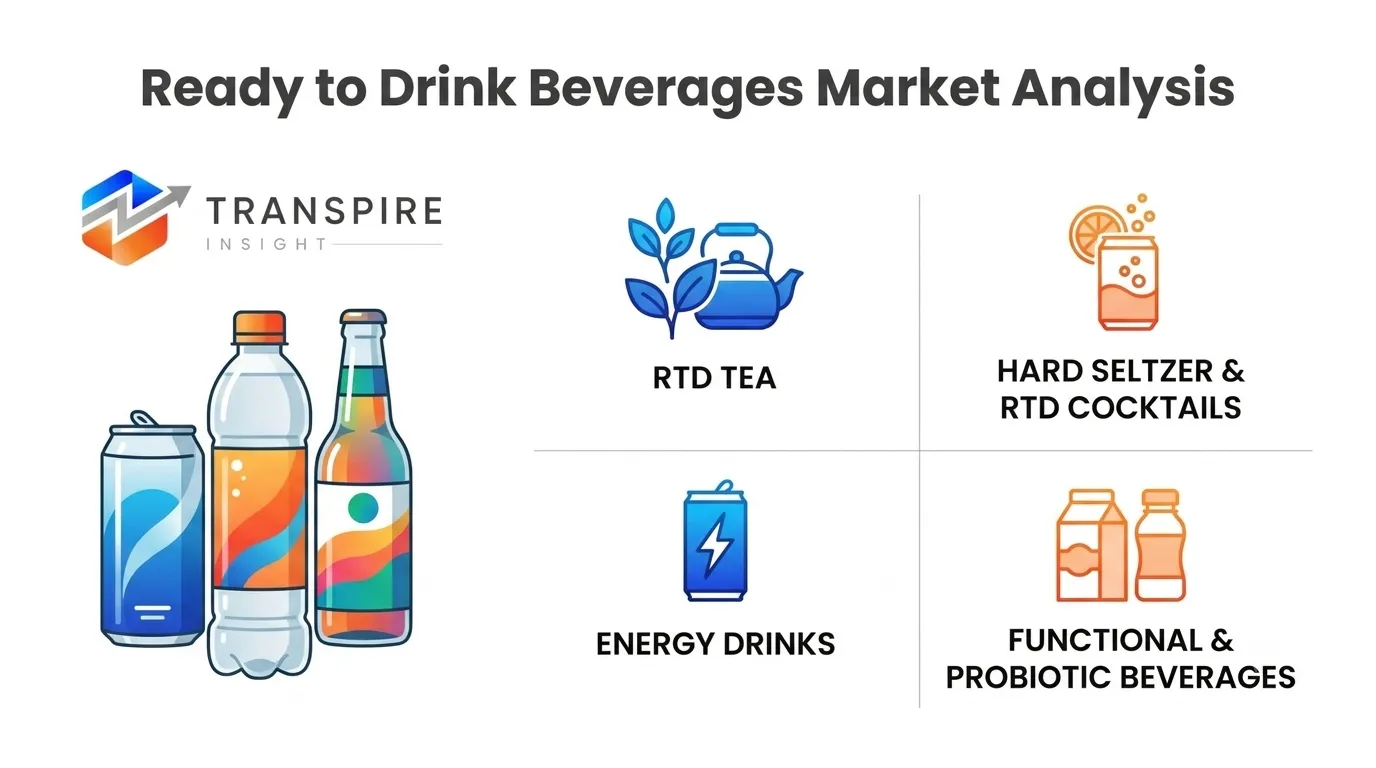
The global Ready-to-Drink Beverages Market is expanding as consumers increasingly prioritize convenience, portability, functional benefits, variety, and products suited to specific consumption occasions. RTD tea, coffee, energy drinks, functional beverages, dairy-based drinks, plant-based beverages, and alcoholic RTDs are reshaping beverage portfolios across developed and emerging markets.
Ready-to-Drink Beverages Market Overview
Ready-to-drink beverages are pre-packaged drinks designed for consumption without additional preparation.
The category includes:
Transpire Insight estimates the global Ready-to-Drink Beverages Market at approximately USD 805.6 billion in 2025, increasing to around USD 848.4 billion in 2026 and reaching nearly USD 1.41 trillion by 2033, representing an estimated CAGR of 6.60%.
Latest Global Market Developments
Consumers increasingly seek beverages that can be purchased and consumed immediately without preparation.
Products positioned around hydration, energy, gut health, vitamins, electrolytes, and other functional attributes are attracting increased attention.
NielsenIQ's August 2026 analysis found alcoholic RTDs growing strongly across Western Europe, with value increasing 11.2% and volume increasing 11.1%.
Different products are being positioned for workouts, commuting, social occasions, work breaks, relaxation, and everyday hydration.
Cold coffee, canned coffee, and other ready-to-consume coffee formats provide alternatives to traditional café consumption.
RTD teas are increasingly marketed around refreshment, low sugar, botanical ingredients, and wellness-oriented positioning.
Tata Consumer Products reported 23% revenue growth in its RTD business in Q4 FY2026, alongside expansion into electrolyte beverages.
PET bottles, cans, cartons, resealable formats, and smaller convenience packs allow beverage companies to target different consumption occasions.
Why Ready-to-Drink Beverages Matter?
RTD beverages combine convenience with increasingly specialized consumer needs.
The category provides opportunities across:
The ability to rapidly introduce new flavors, functional ingredients, package sizes, and formulations gives beverage manufacturers considerable room for innovation.
Key Factors Driving the Market
1. Convenience Culture
Consumers increasingly prefer products that require no preparation.
2. Health and Wellness
Demand is expanding for functional, lower-sugar, fortified, electrolyte, and wellness-oriented beverages.
3. Urbanization
Busy urban lifestyles create demand for portable beverages.
4. Product Innovation
Brands are continuously introducing new flavors, ingredients, formats, and functional claims.
5. Premiumization
Consumers are increasingly willing to pay more for specialized coffee, tea, functional beverages, craft RTDs, and differentiated formulations.
Five High-Potential Markets
1. United States
The U.S. is a major RTD market spanning energy drinks, coffee, tea, functional beverages, sports drinks, and alcoholic RTDs.
2. China
China provides substantial opportunities because of its large consumer base, urbanization, and expanding packaged-beverage industry.
3. India
India is developing rapidly across RTD tea, coffee, functional beverages, electrolyte products, and packaged refreshment categories. Tata Consumer's 23% RTD revenue growth in Q4 FY2026 illustrates the momentum of the category.
4. Japan
Japan has a mature RTD ecosystem with strong consumer familiarity with bottled tea, coffee, functional beverages, and vending-based consumption.
5. United Kingdom
The U.K. offers opportunities across energy drinks, functional beverages, RTD coffee, premium soft drinks, and alcoholic RTDs.
Competitive Landscape
Top 5 Companies
Opportunities for Small Investors
Challenges & Restraints
Raw-material prices, packaging costs, sugar and sweetener regulations, intense brand competition, distribution expenses, shelf-space constraints, changing consumer preferences, and product-development costs can affect profitability.
Alcoholic RTDs also face taxation, age restrictions, labeling requirements, and different regulatory environments across countries.
Conclusion
The Ready-to-Drink Beverages Market is evolving from a convenience category into a broad platform for functional nutrition, hydration, energy, wellness, premiumization, and occasion-based consumption.
Current market research shows Asia Pacific's substantial market position, while 2026 company results from India demonstrate strong momentum in RTD categories.
At the same time, NielsenIQ's 2026 analysis demonstrates that alcoholic RTDs are responding to changing drinking occasions and consumer preferences, particularly across Western Europe.
The strongest future opportunities are likely to emerge around functional beverages, electrolytes, low-sugar formulations, RTD coffee and tea, premium products, localized flavors, and sustainable packaging formats.


Send us a brief description of your challenge and we'll get back to you within 24 hours.

 inquiry@transpireinsight.com
 APAC:+91 7666513636
 Address


