
Aug 17, 2026
By Transpire Insight
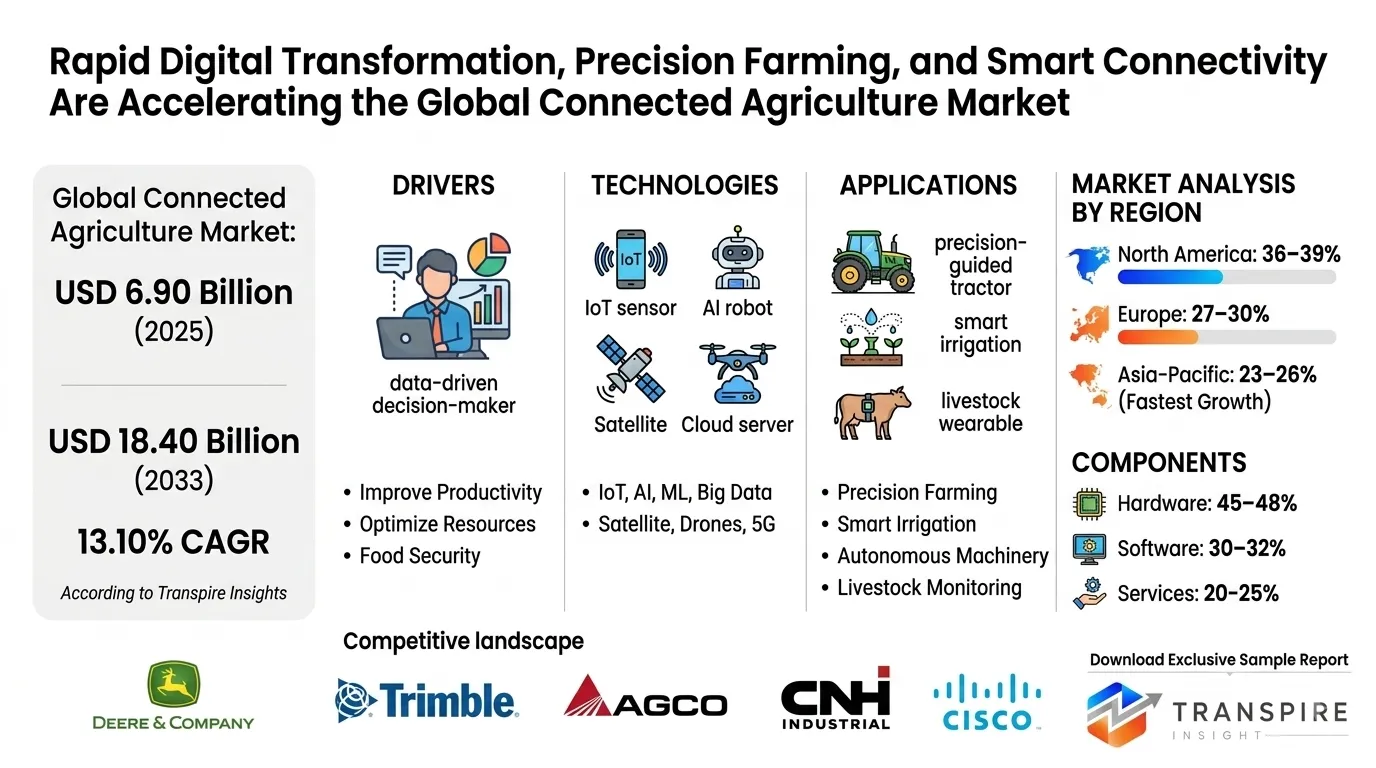
The Connected Agriculture Market is undergoing rapid expansion as the agricultural sector embraces digital technologies to improve productivity, optimize resource utilization, and strengthen food security. Connected agriculture integrates Internet of Things (IoT), Artificial Intelligence (AI), cloud computing, satellite communication, drones, GPS technology, big data analytics, machine learning, and smart sensors to create an interconnected farming ecosystem capable of delivering real-time operational intelligence. According to Transpire Insights, increasing demand for precision agriculture, rising labor shortages, climate variability, and growing investment in smart farming technologies are transforming connected agriculture into one of the fastest-growing segments within the global agritech industry.
According to Transpire Insights, the Global Connected Agriculture Market was valued at approximately USD 6.90 billion in 2025 and is projected to reach around USD 18.40 billion by 2033, expanding at a CAGR of approximately 13.10% during the forecast period. Growing adoption of precision farming, intelligent irrigation systems, autonomous agricultural machinery, livestock monitoring solutions, and cloud-based farm management platforms is expected to drive sustained market growth throughout the forecast period.
One of the primary drivers of market expansion is the increasing pressure to improve agricultural productivity. The global population is projected to exceed 9.7 billion by 2050, requiring food production to increase by nearly 50–60% while agricultural land continues to decline on a per-capita basis. Connected agriculture enables farmers to maximize yields through data-driven decision-making while minimizing waste of water, fertilizers, pesticides, fuel, and labor. Smart farming technologies help producers monitor field conditions continuously and respond quickly to changing environmental factors.
Artificial Intelligence is significantly improving agricultural decision-making. AI-powered platforms analyze satellite imagery, drone surveillance, weather forecasts, historical yield records, pest outbreaks, and soil characteristics to generate predictive recommendations for planting, irrigation, fertilization, and harvesting. Industry studies suggest AI-enabled farm management systems can improve crop productivity by approximately 10–20%, reduce fertilizer application by nearly 15–25%, and decrease pesticide usage by 20–30% through precise input management.
Precision irrigation continues driving market growth, particularly in regions facing increasing water scarcity. Agriculture accounts for approximately 70% of global freshwater withdrawals, making efficient irrigation a critical priority. Connected irrigation systems combine IoT sensors, weather forecasting, cloud analytics, and automated controllers to deliver water only where and when required. Modern smart irrigation technologies can reduce agricultural water consumption by approximately 30–50% while maintaining or improving crop yields, making them increasingly attractive across drought-prone agricultural regions.
Autonomous agricultural machinery is becoming another major contributor to connected farming. GPS-guided tractors, autonomous harvesters, robotic weeders, AI-powered sprayers, and intelligent seeders improve operational precision while reducing labor dependence. Global labor shortages in agriculture continue encouraging investment in automation, particularly across North America, Europe, Australia, and parts of Asia. Autonomous tractors equipped with RTK-GPS systems can achieve positioning accuracy within 2-3 centimeters, improving planting precision while reducing fuel consumption and field overlap.
Drone technology is expanding rapidly throughout connected agriculture. Agricultural drones equipped with multispectral cameras, thermal imaging systems, LiDAR, and spraying equipment enable rapid crop monitoring, disease detection, yield estimation, irrigation assessment, and precision pesticide application. Modern agricultural drones can survey 100–200 hectares per day, allowing farmers to identify crop stress significantly earlier than conventional field inspections.
Livestock monitoring represents another rapidly growing application. Connected livestock systems utilize RFID tags, GPS collars, wearable biosensors, and AI-powered health monitoring platforms to track animal movement, feeding behavior, reproductive cycles, body temperature, and disease symptoms. Large dairy farms can monitor thousands of animals simultaneously, improving herd health while reducing mortality and veterinary costs. Early disease detection through wearable sensors has demonstrated reductions in livestock treatment costs of approximately 15–25%.
Download the exclusive Connected Agriculture Market sample report today to uncover expert insights, emerging trends, and the opportunities defining the future of the industry.
Increasing Adoption of Precision Farming, Smart Livestock Monitoring, and Cloud-Based Farm Management Is Strengthening the Global Connected Agriculture Market
One of the most significant market trends is the widespread deployment of precision farming technologies. Precision agriculture enables farmers to monitor field variability and apply agricultural inputs according to actual crop requirements instead of treating entire fields uniformly. Globally, more than 380 million hectares of farmland are estimated to utilize at least one precision agriculture technology. Variable-rate application systems can improve fertilizer efficiency by approximately 20–30%, reduce chemical input costs by 15–25%, and increase overall crop productivity by nearly 10–18%, depending on crop type and environmental conditions.
Connected irrigation systems continue gaining importance as water scarcity becomes a growing global challenge. Smart irrigation combines soil moisture sensors, automated valves, weather forecasting, and cloud-based analytics to optimize irrigation schedules. Compared with conventional irrigation methods, connected systems can reduce water consumption by 30–50% while lowering pumping energy costs by approximately 15–20%. Increasing adoption across horticulture, orchards, vineyards, cereal crops, and greenhouse farming is strengthening long-term market demand.
Livestock monitoring has emerged as another high-growth application. Dairy farms, poultry operations, and cattle ranches increasingly utilize RFID tags, GPS collars, wearable biosensors, and AI-powered monitoring platforms to track animal health and productivity. Modern livestock management systems can monitor several thousand animals simultaneously, enabling early detection of illness, reproductive cycles, feeding behavior, and movement patterns. Studies indicate that digital livestock monitoring can reduce herd mortality by 10–15%, while improving milk production efficiency by approximately 8–12% through timely health interventions.
Cloud-based farm management platforms are becoming the operational backbone of connected agriculture. These platforms integrate information from machinery, weather stations, drones, satellites, irrigation systems, financial records, and sensor networks into centralized dashboards accessible through smartphones and computers. Large commercial farms increasingly rely on cloud platforms to manage hundreds of connected devices while improving production planning, inventory management, regulatory reporting, and sustainability monitoring.
Market Analysis
North America accounts for approximately 36–39% of global market revenue, supported by advanced farm mechanization, strong rural connectivity, widespread GPS-guided equipment adoption, and high investment in AI-powered agricultural technologies. The United States and Canada continue leading implementation of autonomous machinery, cloud-based farm management software, precision irrigation, and satellite-enabled crop monitoring.
Europe contributes nearly 27–30% of global demand and remains one of the most technologically advanced connected agriculture markets. Government sustainability initiatives, environmental regulations, precision nutrient management programs, and strong digital infrastructure continue supporting adoption across Germany, France, the Netherlands, Italy, Spain, and the Nordic countries.
Asia-Pacific represents approximately 23–26% of global market revenue and is projected to record the fastest growth throughout the forecast period. China, India, Japan, Australia, and South Korea are investing heavily in smart farming technologies, rural digital connectivity, agricultural drones, AI-based crop monitoring, and precision irrigation systems. Government-supported agricultural modernization programs continue encouraging technology adoption among both commercial and smallholder farmers.
By component, hardware solutions including IoT sensors, GPS equipment, drones, weather stations, automated irrigation systems, and connected machinery account for approximately 45–48% of total market revenue. Software platforms and cloud-based analytics contribute around 30–32%, while managed services, technical support, consulting, and integration services comprise the remaining market share.
From an application perspective, precision crop farming represents nearly 40–45% of overall market demand due to increasing deployment of digital crop monitoring, smart irrigation, and precision nutrient management technologies. Livestock monitoring solutions account for approximately 20–25%, while greenhouse automation, aquaculture monitoring, farm asset tracking, and supply chain management collectively contribute the remaining market share.
Competitive Landscape
Competition within the Connected Agriculture Market is increasingly centered on integrated digital ecosystems rather than standalone agricultural equipment. Companies are developing comprehensive platforms that combine IoT connectivity, AI analytics, satellite monitoring, autonomous machinery, farm management software, and cloud computing into unified agricultural solutions.
Leading companies including Deere & Company, Trimble Inc., AGCO Corporation, CNH Industrial, Topcon Positioning Systems, Hexagon AB, Cisco Systems, IBM Corporation, Microsoft Corporation, and Bayer AG collectively generate annual revenues exceeding USD 400 billion, enabling substantial investment in agricultural innovation, software development, artificial intelligence, and connected farming technologies.
Strategic partnerships between agricultural equipment manufacturers, cloud computing providers, telecommunications companies, satellite operators, and agritech startups continue reshaping the competitive landscape. Integration between machinery manufacturers and software developers allows farmers to manage planting, irrigation, fertilization, harvesting, logistics, and financial reporting from unified digital platforms.
Research and development remains a key competitive differentiator. Major connected agriculture technology providers typically invest 6–10% of annual revenue in R&D focused on autonomous farm equipment, AI-driven crop analytics, predictive maintenance, machine vision, advanced sensor technologies, and digital farm management platforms. Continuous innovation is improving system accuracy, interoperability, and scalability across farms of varying sizes.
Financial Impact
Connected agriculture is creating measurable economic value throughout the agricultural value chain by reducing production costs, improving operational efficiency, and increasing crop productivity. Although implementation requires investment in sensors, communication infrastructure, software platforms, drones, and automated equipment, many farms achieve favorable returns through improved resource utilization and reduced operational waste.
Precision fertilizer management enabled by connected agriculture can reduce fertilizer expenditure by 15–25%, while AI-supported irrigation management lowers water-related operating costs by 20–40%. Predictive maintenance systems for agricultural machinery reduce equipment downtime by approximately 25–35%, extending machinery lifespan while lowering maintenance expenses.
Public and private investment in agricultural digitalization continues expanding globally. Governments, venture capital firms, technology companies, and international development organizations collectively invest tens of billions of dollars annually in rural broadband infrastructure, AI-enabled farming, agricultural robotics, satellite services, precision irrigation, and digital farm management technologies. Financial institutions are also introducing specialized financing programs that improve technology accessibility for farmers adopting connected agriculture solutions.
Artificial Intelligence, IoT, 5G Connectivity, and Autonomous Farming Are Transforming the Global Connected Agriculture Market
The Connected Agriculture Market is experiencing a technological revolution as digital communication, intelligent automation, cloud computing, and data-driven decision-making reshape modern farming practices. Agriculture is rapidly evolving from conventional equipment-based operations into fully connected ecosystems where machinery, sensors, drones, satellites, weather stations, livestock monitoring systems, and farm management software continuously exchange information in real time. According to Transpire Insights, future agricultural competitiveness will increasingly depend on the ability to collect, analyze, and utilize digital information for improving productivity, conserving natural resources, and minimizing operational risks.
Artificial Intelligence (AI) has become one of the most influential technologies supporting connected agriculture. AI algorithms analyze enormous volumes of agricultural data collected from satellite imagery, weather forecasts, IoT sensors, machinery, drones, and historical production records to generate accurate recommendations for farmers. Modern AI platforms can predict disease outbreaks, estimate crop yields, recommend irrigation schedules, optimize fertilizer application, and forecast harvesting periods with increasing precision. Industry studies indicate that AI-powered farm management systems can improve operational efficiency by approximately 15–25%, reduce crop losses by nearly 20–30%, and improve overall farm profitability by 10–18% through more informed decision-making.
Machine Learning models continue improving prediction accuracy as they process larger agricultural datasets. These systems continuously learn from seasonal weather variations, soil conditions, pest activity, crop performance, and machinery operations. AI-based disease recognition systems can identify plant diseases with an accuracy exceeding 92–96%, allowing farmers to implement targeted treatments before infections spread across production fields.
Proceed to Checkout to purchase the exclusive Connected Agriculture Market report and gain instant access to in-depth market intelligence, strategic analysis, and future growth opportunities.
Internet of Things (IoT) Is Creating Intelligent Farming Networks
The Internet of Things has become the technological backbone of connected agriculture by enabling continuous communication between agricultural assets and digital management platforms. Modern farms increasingly deploy wireless soil moisture sensors, nutrient monitoring devices, weather stations, automated irrigation controllers, livestock wearables, grain storage sensors, and connected agricultural machinery.
Large commercial farms may operate 2,000–5,000 connected IoT devices, generating millions of data points annually regarding crop growth, soil conditions, equipment performance, environmental changes, and livestock health. Continuous monitoring enables immediate response to changing field conditions while minimizing unnecessary resource consumption.
Soil monitoring sensors provide real-time information regarding moisture levels, temperature, salinity, pH, and nutrient availability. Farmers utilizing sensor-based nutrient management systems report fertilizer savings of approximately 15–25% while improving nutrient absorption efficiency. Similarly, connected irrigation controllers automatically adjust watering schedules according to soil moisture and weather forecasts, reducing water consumption by 30–50% compared with conventional irrigation methods.
5G Connectivity and Edge Computing Are Accelerating Digital Farming
The rollout of 5G communication networks is significantly improving connected agriculture by enabling faster data transmission, lower communication latency, and greater device connectivity. Traditional rural communication networks often experience bandwidth limitations that restrict real-time monitoring and autonomous machinery operations. 5G networks support simultaneous communication among thousands of connected devices within large agricultural operations while enabling near-instantaneous data processing.
Autonomous tractors, robotic harvesters, agricultural drones, and AI-powered monitoring systems increasingly depend on high-speed wireless communication to coordinate farming activities. Low-latency 5G connectivity allows autonomous equipment to respond rapidly to changing field conditions while improving operational safety and precision.
Edge computing has become another important innovation. Instead of transmitting all farm data to centralized cloud servers, edge computing processes information directly on agricultural devices or local gateways. This approach reduces communication delays while enabling immediate responses for irrigation control, machinery navigation, livestock monitoring, and disease detection. Early industrial deployments indicate that edge computing can reduce response times by approximately 40–60%, improving the effectiveness of real-time agricultural decision-making.
Automation, Robotics, and Drone Technologies Are Improving Farm Productivity
Agricultural automation continues advancing rapidly as labor shortages encourage greater investment in intelligent machinery and robotic farming systems. Self-driving tractors, robotic weeders, autonomous harvesters, precision seeders, and AI-controlled sprayers are increasingly replacing manual operations across commercial farming operations.
GPS-guided autonomous tractors achieve positioning accuracy within 2–3 centimeters, reducing planting overlap while optimizing seed placement and fertilizer distribution. Automated steering systems improve fuel efficiency by approximately 8–12% while reducing operator fatigue during extended farming operations.
Agricultural robotics are becoming particularly valuable within fruit, vegetable, and greenhouse production. Computer vision systems enable harvesting robots to identify mature produce while minimizing crop damage. Depending on crop type, robotic harvesting systems improve labor productivity by 25–40% while maintaining product quality.
Drone adoption continues expanding throughout connected agriculture. Modern agricultural drones equipped with multispectral cameras, thermal sensors, LiDAR technology, and precision spraying equipment perform crop health assessments, weed mapping, irrigation analysis, and nutrient monitoring. Advanced spraying drones can treat 20–35 hectares per hour, while reducing pesticide consumption by approximately 20–30% through targeted application techniques.
Smart Livestock Management and Digital Sustainability Are Driving Future Growth
Connected agriculture extends beyond crop farming into intelligent livestock production. Wearable biosensors, RFID tags, GPS collars, automated feeding systems, and AI-powered herd management platforms continuously monitor animal behavior, health conditions, reproductive cycles, milk production, and feed efficiency.
Large dairy operations may monitor more than 10,000 animals using connected livestock platforms that generate continuous health and productivity data. Early disease detection through wearable monitoring systems reduces veterinary intervention costs by approximately 15–25% while improving animal welfare and production efficiency.
Environmental sustainability has become a central objective of connected agriculture technologies. Smart farming systems optimize fertilizer application, irrigation scheduling, pesticide usage, machinery operation, and energy consumption to minimize environmental impacts while maintaining agricultural productivity.
Precision nutrient management reduces nitrogen runoff into rivers and groundwater while lowering greenhouse gas emissions associated with fertilizer production. Connected machinery also minimizes fuel consumption through optimized route planning and automated field operations, contributing to lower carbon emissions.
Customize the exclusive Connected Agriculture Market report today to receive tailored insights, country-specific analysis, and business-focused market intelligence.
Leading Companies Driving Innovation and Global Competition in the Connected Agriculture Market
The Connected Agriculture Market is highly competitive and continues to evolve as agricultural equipment manufacturers, cloud computing providers, telecommunications companies, precision farming specialists, software developers, and sensor manufacturers invest heavily in digital farming technologies. The market is shifting from standalone agricultural equipment toward integrated digital ecosystems where connected devices, artificial intelligence, IoT platforms, satellite services, cloud analytics, autonomous machinery, and farm management software operate together to improve agricultural productivity and sustainability. According to Transpire Insights, the top 10 companies account for approximately 60–65% of the global connected agriculture technology market, supported by strong R&D capabilities, extensive distribution networks, and strategic collaborations across the agricultural value chain.
Deere & Company remains the global leader in precision agriculture equipment and connected farming technologies. The company offers autonomous tractors, intelligent harvesters, AI-powered precision spraying systems, GPS-guided planting equipment, and cloud-connected farm management platforms serving agricultural producers worldwide. During FY2025, Deere generated annual revenue exceeding USD 50 billion, with digital agriculture representing one of its fastest-growing strategic business segments. The company operates in more than 100 countries and continues expanding investments in autonomous farming technologies.
Trimble is one of the world's leading providers of precision agriculture technologies, offering GPS guidance systems, automated steering, IoT-enabled monitoring, cloud-based farm management software, drone integration, and geospatial analytics. During 2025, Trimble generated annual revenue of approximately USD 3.9 billion, with agriculture continuing to be one of its fastest-expanding business segments.
AGCO Corporation is a global manufacturer of advanced agricultural equipment marketed through brands including Fendt, Massey Ferguson, Valtra, and Precision Planting. The company has significantly expanded its digital agriculture portfolio by integrating automation, machine learning, and precision farming technologies into its equipment lineup. AGCO reported annual revenue of approximately USD 13–14 billion during 2025 while serving customers across more than 140 countries.
CNH Industrial is a major supplier of connected agricultural equipment through its Case IH and New Holland Agriculture brands. The company provides precision farming systems, autonomous machinery, telematics, GPS guidance, intelligent harvesting equipment, and digital farm management solutions. During 2025, CNH Industrial generated annual revenue exceeding USD 24 billion, with agriculture representing its largest operating segment.
Cisco plays an important role in connected agriculture by supplying networking infrastructure, IoT connectivity solutions, cybersecurity technologies, cloud networking, and edge computing platforms supporting smart farming operations. The company generated annual revenue exceeding USD 55 billion during FY2025, with IoT infrastructure remaining a strategic growth area. Cisco's secure communication platforms enable reliable connectivity between sensors, machinery, drones, livestock monitoring systems, weather stations, and cloud-based farm management platforms. The company's edge computing technologies improve real-time agricultural data processing while minimizing communication delays in remote farming environments.
Schedule a meeting with our market experts to discuss the exclusive Connected Agriculture Market report and identify the best research solution for your organization.
Conclusion
The Connected Agriculture Market is becoming a cornerstone of modern agricultural transformation as digital technologies reshape crop production, livestock management, irrigation, machinery operation, and supply chain management. Continuous advances in AI, IoT, robotics, satellite monitoring, cloud computing, blockchain, and autonomous equipment are enabling farmers to make faster, more accurate, and data-driven decisions that improve operational efficiency and long-term sustainability.
Growing investment in precision agriculture, smart irrigation, digital farm management, renewable energy integration, and connected machinery will continue expanding market opportunities across developed and emerging agricultural economies. As food demand rises and climate-related challenges become more complex, connected agriculture will play an increasingly important role in improving productivity while conserving natural resources and reducing environmental impacts.


Send us a brief description of your challenge and we'll get back to you within 24 hours.

 inquiry@transpireinsight.com
 APAC:+91 7666513636
 Address


