
Oct 14, 2026
By Transpire Insight
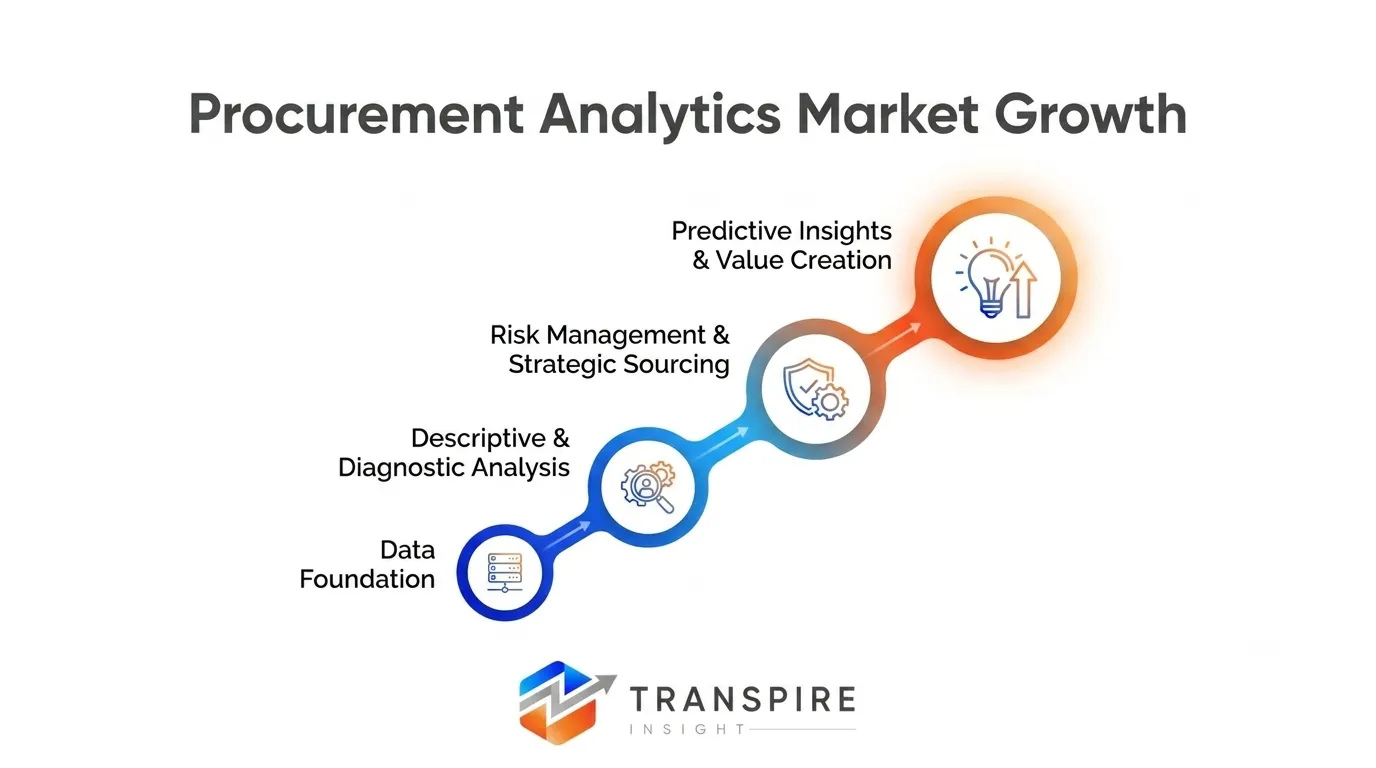
The Procurement Analytics Market is becoming increasingly important as enterprises seek real-time visibility into spending, supplier performance, contracts, procurement risk, and supply-chain disruptions. Artificial intelligence, predictive analytics, automation, and increasingly agentic procurement workflows are moving procurement analytics from retrospective reporting toward continuous decision support.
Procurement Analytics Market Overview
Procurement analytics uses data from purchasing systems, supplier records, invoices, contracts, logistics platforms, and enterprise systems to generate actionable insights.
Major applications include:
Transpire Insights estimates that the global Procurement Analytics Market was valued at approximately USD 5.70 billion in 2025, increased to around USD 7.04 billion in 2026, and is projected to reach approximately USD 30.80 billion by 2033, representing a CAGR of approximately 23.47%.
Latest Global Market Developments
Procurement organizations are increasingly applying AI to spend classification, supplier discovery, contract analysis, risk monitoring, and purchasing recommendations.
A 2026 GEP/Hackett Group study found that 89% of procurement leaders expect high-to-extensive change in information and analytics over the next five years.
The same research found that 77% expect significant change in technology applied across the source-to-pay lifecycle.
Procurement teams are beginning to investigate AI agents capable of monitoring markets, identifying suppliers, preparing sourcing events, and supporting routine purchasing workflows.
Companies increasingly analyze financial, geographic, geopolitical, logistics, quality, and concentration risks.
AI-based document analysis can help procurement teams identify pricing clauses, renewal dates, obligations, and non-compliance.
Cloud analytics platforms provide procurement teams with continuously updated visibility into spend and supplier performance.
Analytics can connect procurement activity with budgets, working capital, cost savings, and financial forecasting.
Why Procurement Analytics Matters?
Procurement represents a significant portion of enterprise expenditure, making visibility into purchasing decisions strategically important.
Analytics can help organizations:
Key Factors Driving the Market
1. AI Adoption
AI can automate analysis of large volumes of procurement information.
2. Supply-Chain Volatility
Companies require earlier visibility into supplier and logistics risks.
3. Cost Optimization
Persistent pressure on margins is encouraging organizations to identify procurement savings.
4. Supplier Complexity
Large enterprises often manage thousands of suppliers across multiple regions.
5. Digital Procurement
Cloud source-to-pay platforms are creating larger volumes of structured procurement data.
Five High-Potential Markets
1. United States
The U.S. represents a major market because of its large enterprise base, sophisticated procurement organizations, and rapid enterprise-AI adoption.
2. Germany
Germany provides opportunities across automotive, manufacturing, chemicals, engineering, and industrial procurement.
3. United Kingdom
The U.K. has strong adoption potential across financial services, retail, healthcare, and government procurement.
4. India
India offers substantial growth potential as enterprises digitize procurement and global organizations expand shared-service operations.
5. Singapore
Singapore's role as a regional business and supply-chain hub creates demand for procurement intelligence across Asia.
Competitive Landscape
Top 5 Companies
Opportunities for Small Investors
Challenges & Restraints
Poor data quality, fragmented ERP systems, inconsistent supplier information, cybersecurity concerns, integration costs, employee adoption, and limited analytics expertise can slow implementation.
AI adoption also requires strong governance because procurement recommendations can influence supplier selection, contracts, pricing, and organizational spending.
Conclusion
The Procurement Analytics Market is transitioning from reporting-oriented procurement intelligence toward predictive and AI-assisted decision-making.
The 2026 GEP/Hackett research demonstrates the scale of this transformation, with 89% of surveyed procurement leaders expecting substantial change in information and analytics.
The next stage of growth will increasingly involve agentic AI, real-time supplier-risk monitoring, contract intelligence, predictive spend analytics, and automated procurement workflows.


Send us a brief description of your challenge and we'll get back to you within 24 hours.

 inquiry@transpireinsight.com
 APAC:+91 7666513636
 Address


