
Oct 02, 2026
By Transpire Insight
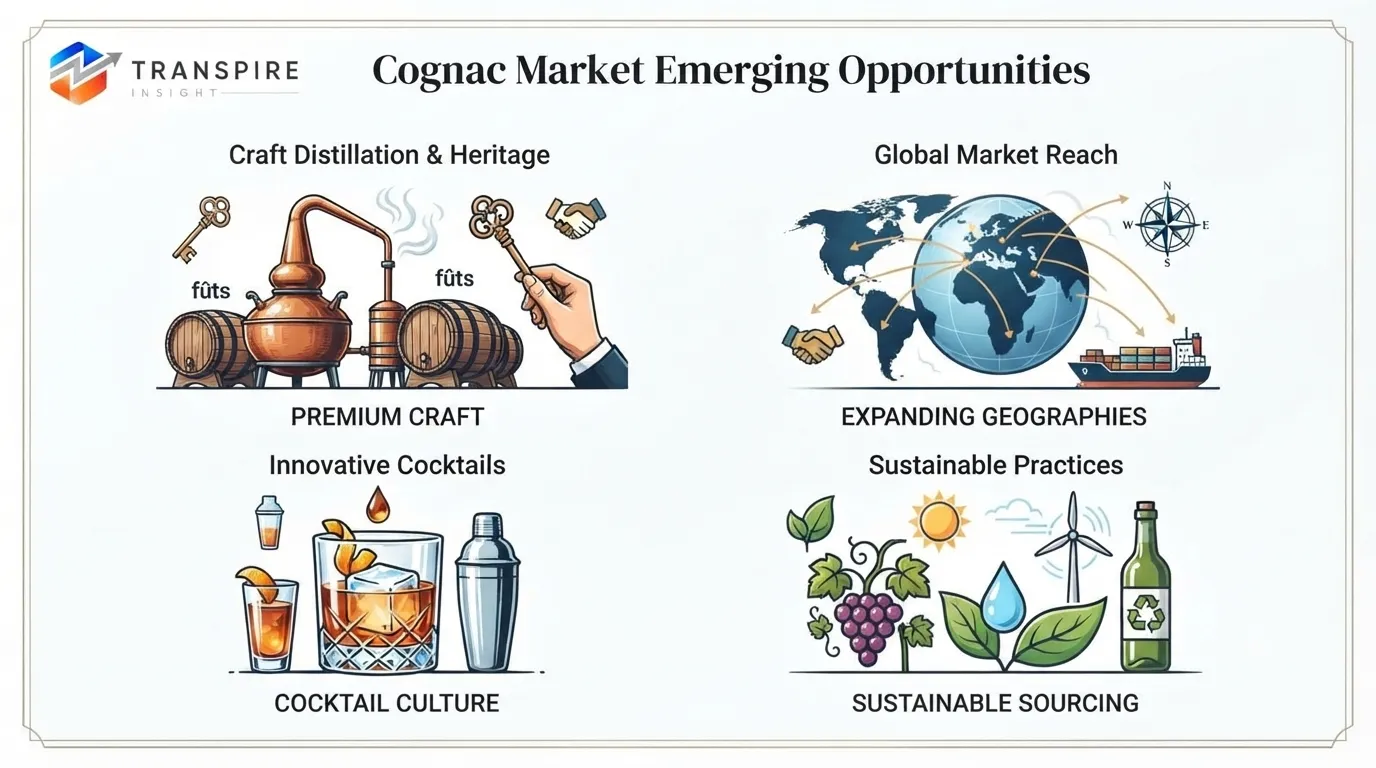
Cognac continues to occupy a distinctive position within the global premium spirits industry, supported by centuries of production heritage, strict geographical designation and strong recognition among consumers seeking aged and luxury alcoholic beverages. Although the category has experienced pressure from changing economic conditions and weaker demand in several major markets, premiumization and renewed interest in authentic spirits are creating opportunities for long-term market development.
The next phase of the Cognac market is expected to be shaped by premium and super-premium expressions, cocktail culture, younger legal-drinking-age consumers, digital commerce, experiential marketing and expanding interest in heritage-led spirits. Producers are also adapting their strategies to changing consumer expectations while maintaining the traditional production identity associated with Cognac.
September 2026: Cognac is a geographically protected French brandy produced in the Cognac region of southwestern France. Its production follows specific requirements covering grape varieties, distillation, maturation and geographical origin. This strong connection between product and place gives Cognac a distinctive position within the global spirits market.
The industry includes large international houses, independent producers, family-owned distilleries, winegrowers and specialized luxury spirits companies. The Cognac ecosystem remains concentrated around several internationally recognized brands, while smaller houses continue to compete through craftsmanship, terroir, limited releases and differentiated aging profiles.
According to the Bureau National Interprofessionnel du Cognac, the industry had 251 Cognac houses and 4,252 winegrowers and distillers at the end of July 2026. The organization also reported 143.6 million exported bottles in 2025 and annual sales of approximately €2.22 billion. Nearly 96.8% of Cognac by value is consumed outside France, highlighting the industry's dependence on international markets.
Market Size
The global Cognac market was estimated at approximately USD 4.9 billion in 2026 and is projected to reach around USD 5.9 billion by 2030, representing an estimated CAGR of approximately 4.7% during 2026–2030.
Market estimates differ considerably depending on whether studies measure Cognac alone or combine Cognac with other categories such as Armagnac and Spanish brandy. Grand View Research estimates the Cognac-only market at approximately USD 4.9 billion in 2026 and forecasts the market to reach around USD 5.55 billion by 2030 at a 3.0% CAGR. Broader Cognac-and-brandy research places the combined category at significantly higher values.
The difference between estimates is primarily caused by variations in product definitions, distribution coverage, geographic scope and inclusion of adjacent brandy categories.
Despite short-term volatility, the long-term market outlook remains supported by premium spirits consumption, luxury positioning, cocktail culture, hospitality expansion and demand for authentic products.
Premiumization Remains a Major Market Driver
Premiumization is one of the most important structural trends in Cognac.
Consumers increasingly show interest in products that communicate quality, heritage and craftsmanship. Older Cognac expressions, limited editions and prestigious bottles can command significantly higher prices than standard offerings.
The premiumization trend is also encouraging producers to expand their portfolios beyond traditional entry-level products.
VS remains important for accessibility and cocktails, while VSOP and XO expressions provide opportunities to target consumers interested in more mature flavor profiles.
Super-premium and prestige Cognac releases are particularly important for luxury positioning.
Companies are increasingly using exclusive packaging, limited quantities and distinctive aging stories to create differentiation.
Heritage and Craftsmanship Strengthen Brand Value
Cognac benefits from a powerful heritage story.
Production methods are closely connected to the Cognac region, traditional distillation practices and long maturation periods.
This heritage gives producers an opportunity to communicate authenticity.
Consumers purchasing premium spirits are often interested not only in the liquid but also in the history behind the product.
This creates opportunities for brands to highlight vineyards, cellar practices, master blenders and family heritage.
Independent Cognac houses can particularly benefit from this strategy because craftsmanship and small-scale production can create differentiation from global brands.
Cocktail Culture Expands Cognac Consumption
Cognac has historically been associated with neat consumption and traditional serving occasions.
However, cocktails are becoming increasingly important.
The BNIC reports that nearly 80% of Cognac is consumed in cocktails globally.
This creates opportunities to introduce Cognac to consumers who may not traditionally purchase the category.
Bartenders can use VS and VSOP Cognacs in classic and contemporary cocktails.
The growth of cocktail bars, premium restaurants and mixology culture is therefore expanding the number of occasions in which Cognac can be consumed.
Younger Consumers Are Changing Category Marketing
The next generation of legal drinking-age consumers is influencing how premium spirits are marketed.
Younger consumers often discover brands through social media, music, entertainment, restaurants and cocktail culture.
Cognac brands are therefore increasingly developing cultural partnerships and digital campaigns.
The objective is to maintain heritage while making the category relevant to contemporary lifestyles.
This is particularly important because Cognac has historically been perceived by some consumers as an older-generation spirit.
Modern branding can reposition Cognac as both traditional and contemporary.
Luxury Positioning Supports High-End Demand
Cognac has a strong connection with luxury.
Prestige products can function as collectible items, gifts and status-oriented purchases.
Packaging plays an important role in this segment.
Crystal decanters, artistic bottles and limited-edition releases can increase perceived exclusivity.
Luxury hotels, premium restaurants, duty-free stores and high-end retailers are therefore important distribution environments.
The growing global luxury hospitality industry provides additional opportunities for premium Cognac brands.
China Remains Important but Challenging
China has historically been one of the most important markets for Cognac.
However, recent trade and economic conditions have created significant pressure.
French Cognac shipments in 2025 declined sharply, with industry data indicating 141 million bottles shipped and export value declining approximately 25.3% year over year. Chinese measures affecting European Cognac contributed to the pressure.
The situation demonstrates the importance of geographic diversification.
Cognac producers are increasingly required to balance their exposure across North America, Asia, Europe and emerging markets.
United States Remains a Major Market
The United States is one of the world's most important Cognac markets.
The category has a long cultural connection with American consumers and hospitality.
However, the U.S. market also experienced volume pressure in 2025.
Industry data showed declines among major brands, although individual companies have been developing new marketing and pricing strategies.
The U.S. remains important because of its large premium spirits consumer base, developed cocktail culture and extensive retail network.
E-Commerce Creates New Distribution Opportunities
Online alcohol retail is changing the way consumers discover premium spirits.
Digital platforms can provide detailed product descriptions, tasting information and brand storytelling.
For premium Cognac, e-commerce also provides opportunities to reach consumers interested in specialized products that may not be available in conventional stores.
Digital channels can support limited releases and collector-focused products.
However, alcohol regulations vary substantially between countries and states, making compliance essential.
Travel Retail Remains Relevant
Duty-free and travel-retail channels have historically been important for Cognac.
International airports provide access to affluent travelers and consumers seeking premium products.
Travel retail also provides opportunities for exclusive packaging and limited editions.
Changes in international travel patterns can therefore influence demand.
On-Trade Consumption Supports Brand Discovery
Restaurants, hotels, bars and clubs remain important for Cognac.
Consumers may first encounter a brand through a cocktail or premium pour before purchasing a bottle for home consumption.
Bartender recommendations can influence brand awareness.
For this reason, leading Cognac producers continue to invest in hospitality partnerships and bartender education.
VSOP and XO Categories Remain Important
Cognac is commonly divided into age classifications including VS, VSOP and XO.
VS products generally appeal to accessible consumption and cocktail applications.
VSOP occupies an important middle ground between affordability and premium positioning.
XO represents a more mature and premium category.
The premium end of the market provides significant opportunities for value growth because consumers may spend considerably more per bottle.
Sustainability Is Becoming More Important
Environmental considerations are increasingly relevant to the Cognac industry.
Cognac production depends on vineyards, water, energy, packaging materials and long-term agricultural conditions.
Climate variability can affect grape production.
Producers are therefore examining vineyard sustainability, energy efficiency, water management and packaging weight.
Sustainable packaging can also appeal to environmentally conscious consumers.
North America Represents a Major Market
North America is one of the leading regional markets for Cognac.
Grand View Research estimates that North America accounted for approximately 38.8% of global Cognac revenue in 2023.
The region benefits from strong premium spirits consumption, developed hospitality infrastructure and a large cocktail culture.
The United States remains the central market within the region.
Europe Maintains Strong Cultural and Production Importance
Europe plays a unique role because France is the origin of Cognac production.
European markets also have established spirits industries and mature distribution systems.
France itself is not the largest consumption market by value because the majority of Cognac is exported.
European markets nevertheless remain important for tourism, luxury retail and premium hospitality.
Asia Pacific Offers Long-Term Growth Potential
Asia Pacific remains strategically important.
China, Singapore, Japan, South Korea and other markets have established consumer bases for premium spirits.
Although China has recently presented challenges, other Asian markets can provide diversification opportunities.
Growing disposable incomes and luxury consumption in several Asian economies could support demand for premium Cognac over the longer term.
India also presents an emerging opportunity as premium alcohol consumption, luxury hospitality and cocktail culture expand.
Competitive Landscape
The global Cognac industry is highly concentrated.
Four major brands — Hennessy, Martell, Rémy Martin and Courvoisier — account for approximately 83% of global Cognac volumes and nearly 87% of global market value, according to figures cited by Rémy Cointreau from IWSR.
Hennessy remains the largest individual brand. LVMH reported that its Hennessy Cognac represented approximately 48% of Cognac-region shipment volume in 2025, although its shipments declined substantially compared with 2024.
At the same time, independent houses and premium specialists are competing through terroir, limited releases and craftsmanship.
Top 10 Companies in Cognac Market
1. Hennessy / LVMH
Headquarters: Cognac, France
Hennessy is one of the world's most recognized Cognac brands and operates within the LVMH group.
The company has an extensive global distribution network and strong positions in the United States, China and other international markets.
Its portfolio covers multiple quality levels, from widely distributed expressions to highly prestigious releases.
Hennessy continues to invest heavily in brand storytelling, luxury marketing and cultural partnerships.
2. Martell / Pernod Ricard
Headquarters: Cognac, France
Martell is one of the oldest major Cognac houses and forms part of the Pernod Ricard portfolio.
The brand competes across several Cognac categories and has a strong international presence.
Its positioning combines historical heritage with contemporary marketing.
Martell's global distribution network allows it to participate in both retail and hospitality channels.
3. Rémy Martin / Rémy Cointreau
Headquarters: Cognac, France
Rémy Martin is one of the leading premium Cognac houses and is owned by Rémy Cointreau.
Its portfolio includes Rémy Martin and the prestigious LOUIS XIII brand.
The company emphasizes Fine Champagne Cognac, with eaux-de-vie sourced from Grande Champagne and Petite Champagne.
Rémy Cointreau continues to focus heavily on premiumization and luxury positioning.
4. Courvoisier / Campari Group
Headquarters: Jarnac, France
Courvoisier is a major Cognac brand that became part of the Campari Group.
The company offers a broad portfolio spanning accessible and premium expressions.
Its connection with luxury hospitality and international spirits distribution supports global expansion.
The brand also explores innovative finishing and product-development approaches.
5. Camus Cognac
Headquarters: Cognac, France
Camus is an independent family-owned Cognac house.
The company differentiates itself through terroir-focused production and specialized Cognac expressions.
Its independence allows the brand to emphasize craftsmanship and product individuality.
Camus also participates in premium and luxury segments.
6. Maison Ferrand
Headquarters: Cognac, France
Maison Ferrand is a premium spirits producer associated with Cognac Ferrand and a wider portfolio of spirits.
The company has developed a strong position in the premium and craft spirits segment.
Its focus on quality, innovation and mixology has helped expand its visibility among bartenders and premium consumers.
7. Louis Royer
Headquarters: Jarnac, France
Louis Royer is a historic Cognac house with a long-established production heritage.
The company offers several Cognac expressions across different quality categories.
Its international distribution provides access to consumers seeking traditional French Cognac.
8. Meukow
Headquarters: Cognac, France
Meukow is recognized for its distinctive branding and international presence.
The company offers VS, VSOP, XO and other premium Cognac products.
Its visual identity and product design are important components of its differentiation strategy.
9. Thomas HINE & Co.
Headquarters: Jarnac, France
HINE is a historic Cognac house known for premium and vintage Cognac expressions.
The company emphasizes craftsmanship and aging expertise.
Its portfolio is particularly relevant to consumers interested in premium and collectible Cognac.
10. Maison Delamain
Headquarters: Jarnac, France
Delamain specializes in high-quality Cognac, particularly premium and aged expressions.
The company focuses strongly on craftsmanship and traditional production.
Its positioning targets consumers interested in authentic, high-end Cognac rather than mass-market offerings.
Outlook: Could Premiumization Create the Next Growth Cycle for Cognac?
The Cognac market is entering a period of strategic adjustment.
The category has experienced significant pressure from weaker demand in several major markets, higher pricing, trade restrictions and changing consumer behavior.
However, Cognac retains several structural advantages.
Its geographical identity is exceptionally strong.
Its production process requires long maturation periods.
Its leading brands possess substantial global recognition.
And premium Cognac remains closely connected to luxury, hospitality and celebration.
Future growth is therefore likely to be less dependent on simple volume expansion and more dependent on value creation.
Premiumization, limited releases, collectible products and experiential marketing can increase consumer engagement.
Cocktail culture provides another route to younger consumers.
Digital commerce and social media can help brands communicate their heritage to new audiences.
Geographic diversification will also remain important.
The recent weakness in China demonstrates the risks associated with dependence on a small number of major export markets. Expanding demand in North America, Southeast Asia, India, the Middle East and other emerging premium-spirit markets could provide additional opportunities.
Sustainability will become increasingly important as producers manage vineyards, packaging and climate-related risks.
At the same time, traditional craftsmanship will remain central to Cognac's identity.
The strongest long-term opportunities are likely to emerge where producers successfully combine heritage with modern consumer experiences.
Cognac is not simply competing with other brandies. It is increasingly competing within the broader premium spirits and luxury-beverage landscape.
As consumers continue to seek authenticity, craftsmanship, exclusivity and memorable drinking experiences, Cognac can use its centuries-old heritage as a foundation for modern category development.
The next phase of the Cognac market is therefore likely to be defined by premiumization, diversification, digital engagement, cocktail culture, luxury hospitality and innovation built around traditional craftsmanship.
For producers and investors, the market's future will depend on balancing volume recovery with long-term brand equity while responding to changing consumer behavior across increasingly diverse international markets.


Send us a brief description of your challenge and we'll get back to you within 24 hours.

 inquiry@transpireinsight.com
 APAC:+91 7666513636
 Address


