
Sep 14, 2026
By Transpire Insight
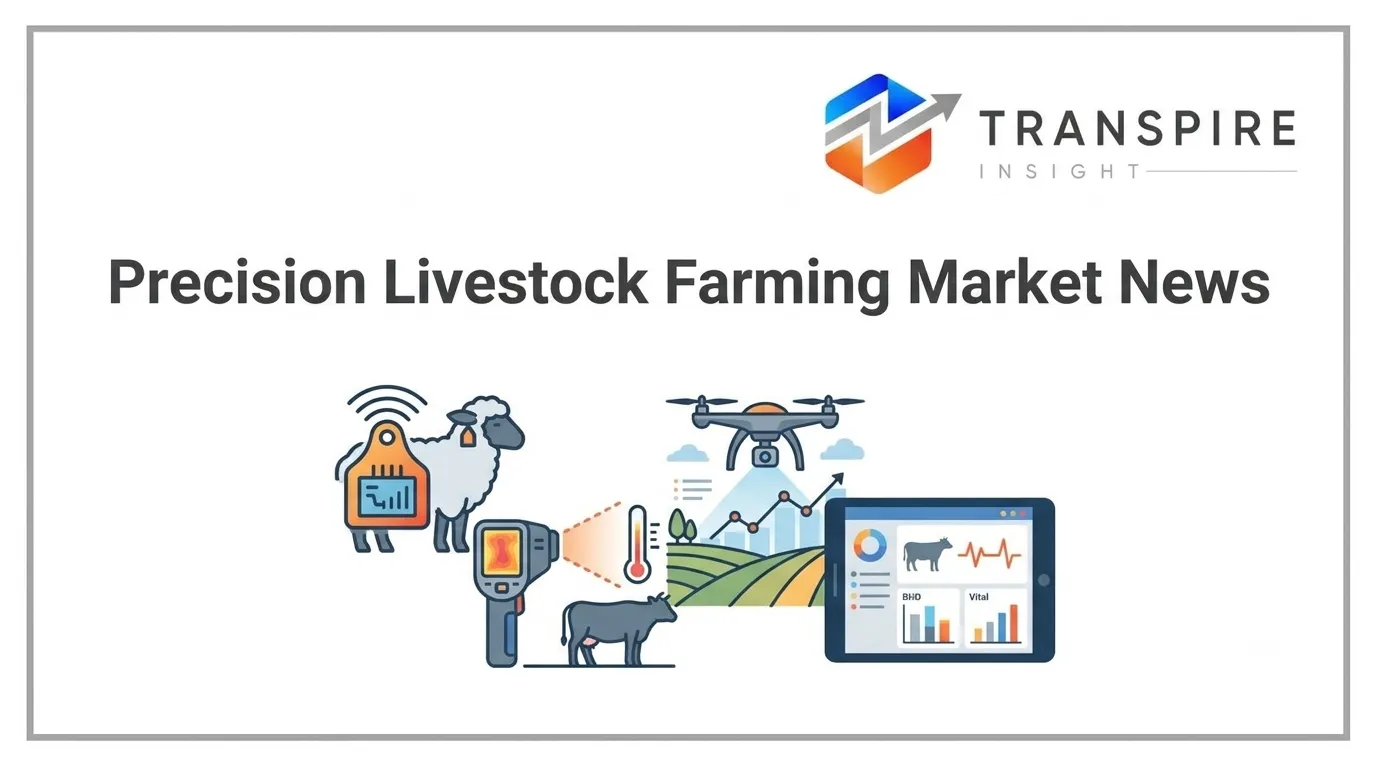
Precision livestock farming is entering a more advanced phase as artificial intelligence, connected sensors, computer vision, wearable devices and automated farm equipment become increasingly integrated into animal production. Producers are adopting real-time monitoring and data-driven management tools to improve animal health, productivity, welfare, feeding efficiency and resource utilization. The market is gaining momentum as livestock operators face labor shortages, disease-management requirements, sustainability pressures and the need for greater production efficiency.
Precision Livestock Farming Market Expands with Growing Adoption of Smart Animal Monitoring
The global precision livestock farming market is developing rapidly as livestock producers increasingly move from conventional observation-based management toward connected and data-supported production systems. Precision livestock farming combines sensors, livestock identification technologies, automated equipment, artificial intelligence, software platforms and data analytics to monitor animals and farm environments in real time. These technologies are being used across dairy, poultry, swine and other livestock operations to improve health management, feeding, reproduction, environmental control and productivity.
According to Transpire Insight, the global precision livestock farming market is estimated at approximately USD 8.6 billion in 2025 and is expected to reach around USD 9.5 billion in 2026, with the market projected to approach USD 21.4 billion by 2033, representing an estimated CAGR of approximately 12.27% during 2026–2033. Market expansion is being supported by the growing use of livestock monitoring devices, automated feeding systems, robotic milking technologies, identification and tracking solutions, environmental monitoring systems and AI-powered analytics. Independent market assessments also identify AI, IoT and sensor technologies as major forces shaping the sector.
AI-Based Monitoring Strengthens Real-Time Livestock Management
Artificial intelligence is becoming one of the most important technologies within precision livestock farming because it allows producers to process large volumes of information collected from animals and farm environments. AI systems can examine movement, feeding, activity, body condition and other behavioral indicators to identify changes that may require attention.
Recent research published in 2026 highlights the increasing combination of accelerometers with artificial intelligence, computer vision and physiological sensors. The integration of several sensing technologies can improve the ability to classify animal behavior and support more comprehensive monitoring. However, researchers also identify energy efficiency, device cost, larger datasets and real-time sensor integration as important areas requiring continued development.
The growing availability of AI-based analytics is therefore shifting precision livestock farming from simple data collection toward predictive and decision-support systems capable of generating actionable information for producers.
Smart Sensors and Wearable Devices Expand Animal Health Monitoring
Wearable devices are becoming increasingly important because they allow livestock producers to collect information continuously at the individual-animal level. Smart collars, ear tags, accelerometers and other monitoring devices can track movement, activity, feeding behavior and physiological indicators.
The development of advanced livestock sensors is also supporting applications such as early disease identification, reproductive management, lameness detection and behavioral analysis. Recent research is moving toward multimodal systems that combine several data streams instead of relying on one sensor type. This approach is intended to improve monitoring accuracy and provide a broader picture of animal health and welfare.
As wearable technologies become smaller, more energy-efficient and better connected, their adoption is expected to increase across commercial livestock operations.
Automation Improves Farm Productivity and Labor Efficiency
Automation is becoming another major component of precision livestock farming. Robotic milking systems, automated feeding equipment, livestock weighing systems, environmental-control technologies and automated monitoring platforms are helping farms manage repetitive activities with greater consistency.
Labor availability is an important factor supporting this transition. Livestock operations increasingly require technologies that can reduce manual workloads while maintaining production quality and animal welfare. Automated systems can also operate continuously and generate operational information that can be analyzed through connected farm-management platforms.
The increasing integration of robotics with sensors and software is consequently creating a more connected production environment in which farm equipment can collect information, perform routine tasks and support management decisions.
Why does Precision Livestock Farming Matter?
Precision livestock farming has direct implications for animal health, productivity, welfare and resource management. Traditional livestock management often depends on periodic observation, manual recordkeeping and the experience of farm personnel. Although these approaches remain important, they can make continuous monitoring difficult, particularly on large commercial farms.
Precision systems provide a different approach by collecting information throughout the production cycle. Changes in movement, feeding, activity or environmental conditions can generate alerts and allow producers to investigate potential problems earlier.
The technology can also support more efficient use of feed, water, labor and energy. Better information about individual animals can allow producers to make more targeted decisions rather than applying the same management approach across an entire herd or flock.
Digital Technologies Support Sustainable Livestock Production
Precision livestock farming is increasingly connected with the wider sustainability objectives of modern agriculture. Producers are under growing pressure to improve output while managing feed consumption, water use, waste, animal welfare and environmental performance.
Precision feeding systems can help optimize feed delivery, while environmental monitoring technologies can continuously measure conditions such as temperature and humidity. Automated systems can then support adjustments based on the actual requirements of animals and facilities.
AI-based decision-support technologies are also being developed to improve disease detection, reproductive management, behavior analysis and resource allocation. Recent reviews describe the evolution of PLF from basic monitoring technologies toward sophisticated AI-driven decision-support systems designed to improve efficiency, sustainability and animal welfare.
Key Trends in the Precision Livestock Farming Market
Artificial intelligence is increasingly being applied to livestock behavior, health and productivity monitoring. Deep-learning models can process information from sensors and cameras to recognize patterns and identify abnormalities that may otherwise be difficult to detect through conventional observation.
Smart collars, electronic ear tags, accelerometers and other wearable devices are becoming important tools for continuous animal monitoring. These systems can provide individual-level information and support health, reproduction and behavioral management.
The integration of cameras, accelerometers, physiological sensors, microphones, RFID technologies and environmental monitoring devices is becoming a major technology direction. Combining different sources of information can improve the quality of animal monitoring and strengthen AI-based decision-making.
Livestock producers are increasingly interested in technologies that identify health changes before visible symptoms become severe. Automated monitoring can recognize changes in activity, feeding behavior, movement and other indicators, supporting earlier intervention and potentially reducing productivity losses.
Automated feeding, robotic milking, livestock weighing and environmental management systems are gaining importance as producers seek to reduce manual workloads and improve operational consistency. The combination of robotics, sensors and software is creating increasingly integrated livestock-management environments.
Regional Development
The development of the global precision livestock farming market varies across regions because of differences in livestock production, farm size, labor availability, technology infrastructure, agricultural investment and regulatory requirements. North America remains one of the strongest regional markets because of its highly commercialized livestock sector and comparatively high adoption of automation, sensors and digital farm-management technologies. Grand View Research estimates that North America accounted for approximately 28.6% of global market revenue in 2024.
Europe is another important market, supported by strong attention to animal welfare, food safety, traceability, environmental performance and farm automation. Precision livestock technologies are increasingly being used to provide continuous information about animal health and production while helping farms meet increasingly sophisticated management requirements. A recent market assessment identifies Europe as the largest regional market in 2025, although estimates vary across research methodologies.
Asia Pacific is expected to record strong growth as livestock production expands and producers increasingly adopt digital technologies. Countries including China, India, Japan and Australia are developing opportunities for smart livestock monitoring, automated feeding, animal identification and health-management systems. Rising demand for dairy and meat products, increasing awareness of animal welfare and the need to improve farm productivity are expected to support regional adoption.
The region is also becoming increasingly relevant for precision livestock research and technology development as agricultural organizations, technology providers and research institutions explore sensor-driven livestock management.
Challenges & Restraints
Despite strong growth prospects, the precision livestock farming market faces several challenges. The initial investment required for sensors, automated equipment, connectivity infrastructure and software platforms can remain significant, particularly for small and medium-sized farms. This can create a gap between technology adoption among large commercial operations and smaller producers.
Data interoperability is another important challenge. Livestock farms may use equipment from multiple technology providers, and integrating different systems can require additional software, hardware and technical expertise. Producers increasingly need platforms capable of combining data from identification devices, sensors, cameras, feeding equipment and farm-management systems.
Sensor reliability also remains important because livestock environments can expose equipment to dust, moisture, temperature fluctuations, physical impact and continuous movement. Research continues to highlight energy efficiency, device cost and real-time integration as important barriers to large-scale adoption.
In addition, producers need sufficient digital skills to interpret the information generated by precision systems. Technology alone cannot guarantee improved productivity if farm personnel cannot translate data into appropriate management decisions.
Competitive Landscape
The global precision livestock farming ecosystem includes companies active in automated milking, animal identification, livestock monitoring, farm-management software, feeding systems, sensors and animal-health technologies. Major participants include DeLaval, Lely, GEA Group, Afimilk, Allflex, BouMatic, Nedap, Neogen and other agricultural technology providers. Independent industry assessments also identify these companies among important participants in the competitive landscape.
The competitive environment is increasingly moving toward integrated platforms that combine hardware, software and analytics. Rather than providing isolated monitoring devices, technology companies are increasingly seeking to connect animal information with farm-management workflows.
Artificial intelligence, computer vision, cloud-based analytics, automation and data interoperability are therefore becoming important competitive differentiators. Companies that can provide reliable systems while keeping installation, maintenance and data-management requirements manageable are expected to strengthen their market position.
DeLaval is one of the major technology providers serving the dairy automation and precision livestock ecosystem. Its portfolio includes automated milking, feeding, herd-management and animal-monitoring technologies designed to improve dairy productivity and animal care.
The company's automation strategy reflects the broader shift toward connected dairy operations in which equipment, animal information and management software work together. DeLaval's autonomous feeding technology, including the Optimat system, demonstrates the industry's movement toward combining sensors, software and robotics to automate feeding operations.
Lely is an important participant in dairy automation, with technologies covering robotic milking, feeding and farm-management operations. Its systems are designed to automate repetitive farm activities while providing producers with greater visibility into animal and production performance.
The company's continued development of robotic dairy technologies illustrates the growing importance of automation within precision livestock farming. As farms seek to address labor availability and improve operational efficiency, integrated robotic systems are expected to remain an important part of the market.
GEA Group is a major technology provider serving dairy and livestock production through automated milking, feeding and related farm technologies. Its role in precision livestock farming is supported by the increasing demand for automation and digital systems that connect equipment with animal-management information.
The company's technology portfolio positions it within the broader transition toward integrated livestock operations where automation and data analytics are increasingly combined to support productivity and animal welfare.
Afimilk specializes in dairy-management and precision livestock technologies designed to collect and analyze information related to milk production, animal activity, reproduction and herd performance.
The company's focus on herd analytics reflects the growing importance of converting animal-level information into practical management decisions. As producers increasingly seek earlier identification of health and reproductive changes, data-driven herd-management technologies are expected to remain important.
Allflex is active in livestock identification and animal-management technologies, providing electronic identification solutions that form an important foundation for precision livestock farming.
Animal identification enables information collected from sensors and management systems to be associated with individual animals. This makes identification technology particularly important as livestock operations move toward more detailed health, traceability, productivity and welfare monitoring.
Market Expert View
As per industry analysis, the next stage of precision livestock farming is expected to move beyond standalone monitoring devices toward integrated systems that combine sensors, artificial intelligence, automation and decision-support capabilities.
Recent research indicates that combining accelerometers with computer vision and physiological sensors can strengthen precision livestock applications, while newer research in computer vision is exploring foundation-model approaches for individual animal tracking and behavioral monitoring.
The increasing focus on edge computing is also important because livestock monitoring systems often need to process information close to the farm rather than relying entirely on remote cloud infrastructure. Recent research has demonstrated approaches designed to make advanced computer-vision models more suitable for resource-constrained edge devices, highlighting the industry's movement toward real-time, on-farm intelligence.
Industry participants are therefore expected to prioritize interoperability, lower-power sensors, reliable connectivity, predictive analytics and easy-to-use management interfaces. The ability to convert continuous animal data into timely and practical decisions will remain one of the most important factors shaping adoption.
Conclusion
The global precision livestock farming market is entering a more advanced stage as artificial intelligence, sensors, automation, computer vision and connected farm-management systems become increasingly integrated into livestock production. The transition from periodic manual observation toward continuous, data-driven monitoring is creating opportunities to improve animal health, productivity, welfare and resource efficiency.
The expansion of smart wearables, automated feeding, robotic milking, livestock identification, computer vision and predictive analytics is expected to support market growth through the coming years. At the same time, adoption will depend on overcoming technology costs, interoperability limitations, connectivity challenges and the need for greater digital expertise among producers.
Recent developments in AI-enabled livestock monitoring and multimodal sensing indicate that precision livestock farming is moving toward a more intelligent operating model in which animal data can be collected, analyzed and converted into management decisions in near real time. As livestock producers face increasing pressure to improve productivity while maintaining animal welfare and resource efficiency, precision livestock farming is expected to become an increasingly important component of the global agricultural technology ecosystem.


Send us a brief description of your challenge and we'll get back to you within 24 hours.

 inquiry@transpireinsight.com
 APAC:+91 7666513636
 Address


