
Sep 23, 2026
By Transpire Insight
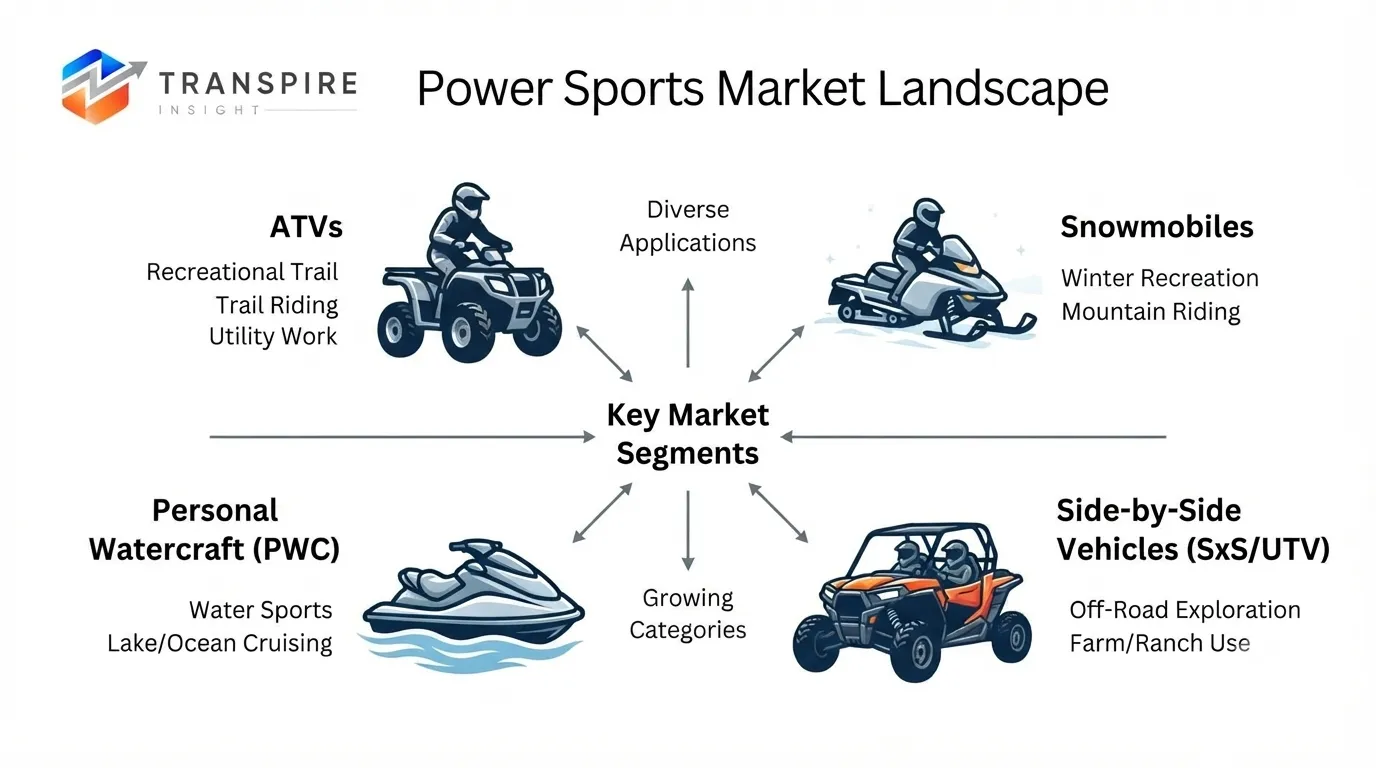
Power sports are becoming increasingly connected to outdoor recreation, adventure tourism, utility applications and premium mobility. Manufacturers are responding to changing consumer preferences by introducing more capable vehicles, connected features and alternative propulsion systems.
The growing popularity of off-road recreation, rising disposable income, expanding tourism activities and increasing interest in electric power sports vehicles are creating new opportunities across motorcycles, all-terrain vehicles, side-by-side vehicles, snowmobiles and personal watercraft.
September 2026: Power sports vehicles occupy an important position within the global recreational and utility vehicle industry. Motorcycles, ATVs, side-by-sides, snowmobiles and personal watercraft are used for leisure, sports, tourism, agriculture, property management and specialized commercial activities.
The market is evolving as consumers increasingly seek vehicles that combine performance with comfort, connectivity and practical utility.
Manufacturers are also expanding their electric portfolios while continuing to improve internal-combustion platforms. Digital dashboards, GPS systems, ride analytics and advanced driver-assistance technologies are gradually becoming more common.
Market Size
The global power sports market was valued at approximately USD 29.4 billion in 2025 and is projected to reach around USD 45.1 billion by 2035, expanding at a CAGR of approximately 4.4% during 2026–2035.
Current market research places the market close to USD 29 billion in 2025 and forecasts approximately USD 44.5 billion by 2035. North America currently represents the largest regional market, while Asia Pacific is expected to achieve the fastest growth.
Outdoor Recreation Is Becoming a Major Market Driver
Growing participation in outdoor recreation is one of the strongest factors supporting power sports demand.
Consumers are increasingly spending on activities such as trail riding, adventure tourism, recreational boating, motorcycle touring and winter sports.
Power sports vehicles offer an experience-oriented form of transportation, making them particularly attractive to consumers seeking recreation rather than conventional commuting.
Tourism operators are also using ATVs, side-by-sides, snowmobiles and personal watercraft for guided experiences.
This creates additional demand outside traditional individual ownership.
Side-by-Side Vehicles Gain Importance
Side-by-side vehicles are becoming one of the most attractive areas of the market.
These vehicles combine recreational performance with practical capabilities such as towing, hauling and transporting multiple passengers.
Their versatility allows them to serve both consumers and commercial users.
Agricultural operators can use side-by-sides for field inspection and transportation, while construction and property-management companies can use them for moving equipment across difficult terrain.
The ability to configure these vehicles with enclosed cabins, cargo beds and specialized accessories is further expanding their addressable market.
Current industry research estimates the side-by-side segment at approximately USD 9.7 billion in 2025 and forecasts continued growth through 2035.
Premium Motorcycles Continue to Support Revenue Growth
Motorcycles remain a central component of the global power sports industry.
The premium motorcycle segment is benefiting from consumer interest in performance, touring capability, advanced electronics and distinctive design.
Manufacturers are introducing motorcycles with sophisticated suspension systems, improved braking technology, ride modes, connectivity and advanced instrumentation.
In mature markets, volume growth can be moderate, but revenue can continue increasing through premiumization and higher average selling prices.
This trend is particularly important in North America, Europe and developed Asian markets.
Electric Power Sports Vehicles Create New Opportunities
Electrification is becoming an increasingly important long-term trend.
Electric motorcycles, ATVs and other recreational vehicles offer potential advantages including lower operating noise, simplified drivetrain architecture and reduced local emissions.
Electric adoption remains smaller than conventional gasoline-powered vehicles, but manufacturers are investing in battery technology and electric drivetrains.
Current industry estimates indicate that electric power sports unit volumes could more than double between 2025 and 2035.
The transition will depend on battery costs, charging infrastructure, vehicle range and consumer willingness to pay.
Connected Technologies Improve the Riding Experience
Connected technology is becoming another important differentiator.
GPS navigation, smartphone connectivity, vehicle diagnostics and ride-tracking systems allow manufacturers to offer more personalized riding experiences.
Fleet operators can use connected systems to monitor vehicle locations, utilization and maintenance requirements.
Predictive maintenance could also become increasingly important as connected vehicles generate more operational data.
Utility Applications Diversify Demand
Power sports vehicles are increasingly used beyond recreation.
Agriculture, forestry, construction, emergency services, tourism and property management can all use off-road vehicles.
This diversification can help reduce the industry's dependence on discretionary consumer spending.
In particular, side-by-side vehicles are increasingly positioned as practical utility platforms rather than purely recreational products.
North America Remains the Largest Regional Market
North America generated approximately USD 15.5 billion in power sports revenue in 2025 and is expected to remain the largest regional market through 2035.
The United States is the primary demand center because of its large installed vehicle base, extensive recreational infrastructure and strong dealer network.
Canada also represents an important market for snowmobiles and off-road vehicles.
Asia Pacific, however, is expected to grow considerably faster. Rising incomes, premium motorcycle demand and expanding recreational activities are creating new opportunities across India, China, Japan and Southeast Asia.
Competitive Landscape Is Highly Established
The power sports market is dominated by several large manufacturers with extensive product portfolios.
Competition is based on engine performance, reliability, design, technology, dealer networks, financing and brand reputation.
Polaris held more than 21% of the global market in 2025 according to current industry estimates, while the five largest players collectively represented approximately 69% of the market.
Top 10 Companies in Power Sports Market
1. Polaris
Headquarters: Medina, Minnesota, USA
Polaris is a major power sports manufacturer with strong positions in off-road vehicles, snowmobiles and motorcycles. Its broad portfolio allows it to address recreational and utility applications.
2. BRP
Headquarters: Valcourt, Quebec, Canada
BRP is known for Sea-Doo personal watercraft, Ski-Doo snowmobiles and Can-Am off-road vehicles. Its diversified portfolio gives it exposure to several major power sports categories.
3. Honda Motor
Headquarters: Tokyo, Japan
Honda maintains a significant global motorcycle and powersports presence. Its reputation for reliability and broad international distribution supports continued market participation.
4. Yamaha Motor
Headquarters: Iwata, Japan
Yamaha operates across motorcycles, marine products, ATVs and other recreational vehicles. The company's engineering capabilities support product development across multiple categories.
5. Harley-Davidson
Headquarters: Milwaukee, Wisconsin, USA
Harley-Davidson maintains a strong position in heavyweight motorcycles and premium motorcycle culture. The company is also expanding its technology and electric-mobility capabilities.
Outlook: Could Electric and Connected Vehicles Redefine Power Sports?
The power sports industry is moving toward a combination of premiumization, electrification and connectivity.
Traditional gasoline-powered vehicles are likely to remain important for years, particularly in high-performance and long-distance applications.
However, electric models could gain share as battery technology improves and consumers become more comfortable with alternative propulsion.
The combination of recreational demand, utility applications and technological innovation should support continued market expansion.
Power sports are therefore likely to evolve from relatively simple recreational machines into increasingly connected, digitally managed and technologically sophisticated mobility platforms.


Send us a brief description of your challenge and we'll get back to you within 24 hours.

 inquiry@transpireinsight.com
 APAC:+91 7666513636
 Address


