
Oct 14, 2026
By Transpire Insight
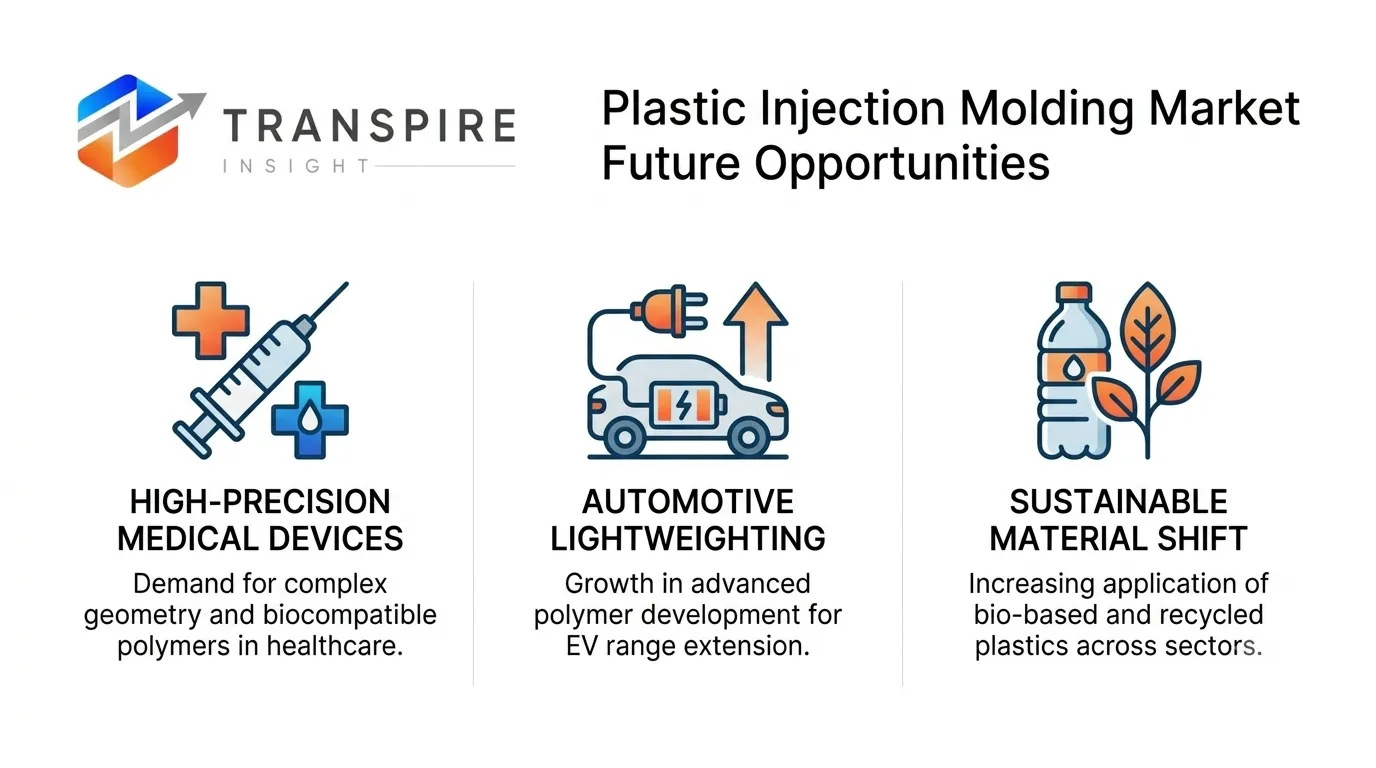
The global Plastic Injection Molding Market remains a fundamental part of modern manufacturing, supplying high-volume components for automotive, packaging, healthcare, electronics, consumer goods, and industrial applications. Automation, electric vehicles, precision molding, recycled materials, and digitally controlled production are increasingly changing the economics of the industry.
Plastic Injection Molding Market Overview
Plastic injection molding is a high-volume manufacturing process in which molten polymer is injected into a mold cavity, cooled, and removed as a finished component.
The technology supports production of:
Transpire Insight estimates that the global Plastic Injection Molding Market was valued at approximately USD 12.03 billion in 2025, reached nearly USD 12.49 billion in 2026, and is projected to reach approximately USD 16.30 billion by 2033, representing a CAGR of approximately 3.86% from 2026 to 2033.
Latest Global Market Developments
Vehicle manufacturers are increasing the use of lightweight polymer components for interiors, electrical systems, under-the-hood applications, and EV-related components.
EVs require specialized housings, connectors, battery-related components, thermal-management parts, and lightweight structural elements.
Energy-efficient machines can reduce electricity consumption while providing improved process control and repeatability.
Medical-device manufacturers increasingly require validated molds, scientific molding, tight tolerances, and controlled production environments.
Robots, sensors, machine vision, automated material handling, and real-time process monitoring are increasingly integrated into molding lines.
Processors are increasingly adapting equipment and processes to handle recycled polymers while maintaining dimensional and visual quality.
Injection-molded closures, dispensing systems, caps, and specialty packaging components continue to generate high-volume demand.
Recent industry investment includes additional injection-molding capacity in India, reflecting growing demand from packaging, consumer products, and industrial manufacturing.
Why Plastic Injection Molding Matters?
Injection molding allows manufacturers to produce large quantities of consistent components at relatively low unit costs after tooling has been established.
Its commercial advantages include:
Key Factors Driving the Market
1. Automotive Lightweighting
Manufacturers increasingly replace selected metal components with engineered plastics to reduce vehicle weight.
2. Packaging Expansion
High-volume packaging applications continue to support molding demand.
3. Medical Manufacturing
The growing healthcare-device ecosystem is creating demand for precision molding.
4. Electronics Production
Electrical housings, connectors, consumer-electronic components, and industrial electronics require increasingly precise molded parts.
5. Smart Manufacturing
Connected molding machines can improve production monitoring, predictive maintenance, quality control, and material efficiency.
Five High-Potential Markets
1. China
China remains a major global manufacturing center with substantial automotive, electronics, packaging, and consumer-product production.
2. India
India is expanding manufacturing capacity across automotive, healthcare, electronics, packaging, and consumer products.
3. United States
The U.S. provides opportunities through reshoring, medical manufacturing, aerospace, automotive, and high-value industrial components.
4. Germany
Germany's automotive and industrial manufacturing base supports demand for high-precision injection molding.
5. Japan
Japan remains important for precision manufacturing, electronics, automotive components, and advanced molding technologies.
Competitive Landscape
Top 5 Companies
Opportunities for Small Investors
Challenges & Restraints
Volatile resin prices, tooling costs, energy consumption, plastic-related regulations, skilled-labor requirements, recycling challenges, and intense price competition can constrain profitability.
Processors must also balance sustainability requirements with product performance, particularly when incorporating recycled polymers into demanding applications.
Conclusion
The Plastic Injection Molding Market is moving toward automation, precision, energy efficiency, recycled-material processing, and higher-value applications.
Current industry analysis indicates that packaging remains important while automotive, healthcare, electronics, and EV manufacturing are creating additional opportunities.
The next phase of industry development will increasingly depend on smart machines, robotics, precision tooling, sustainable materials, process analytics, and specialized manufacturing capabilities.


Send us a brief description of your challenge and we'll get back to you within 24 hours.

 inquiry@transpireinsight.com
 APAC:+91 7666513636
 Address


