
Sep 18, 2026
By Transpire Insight
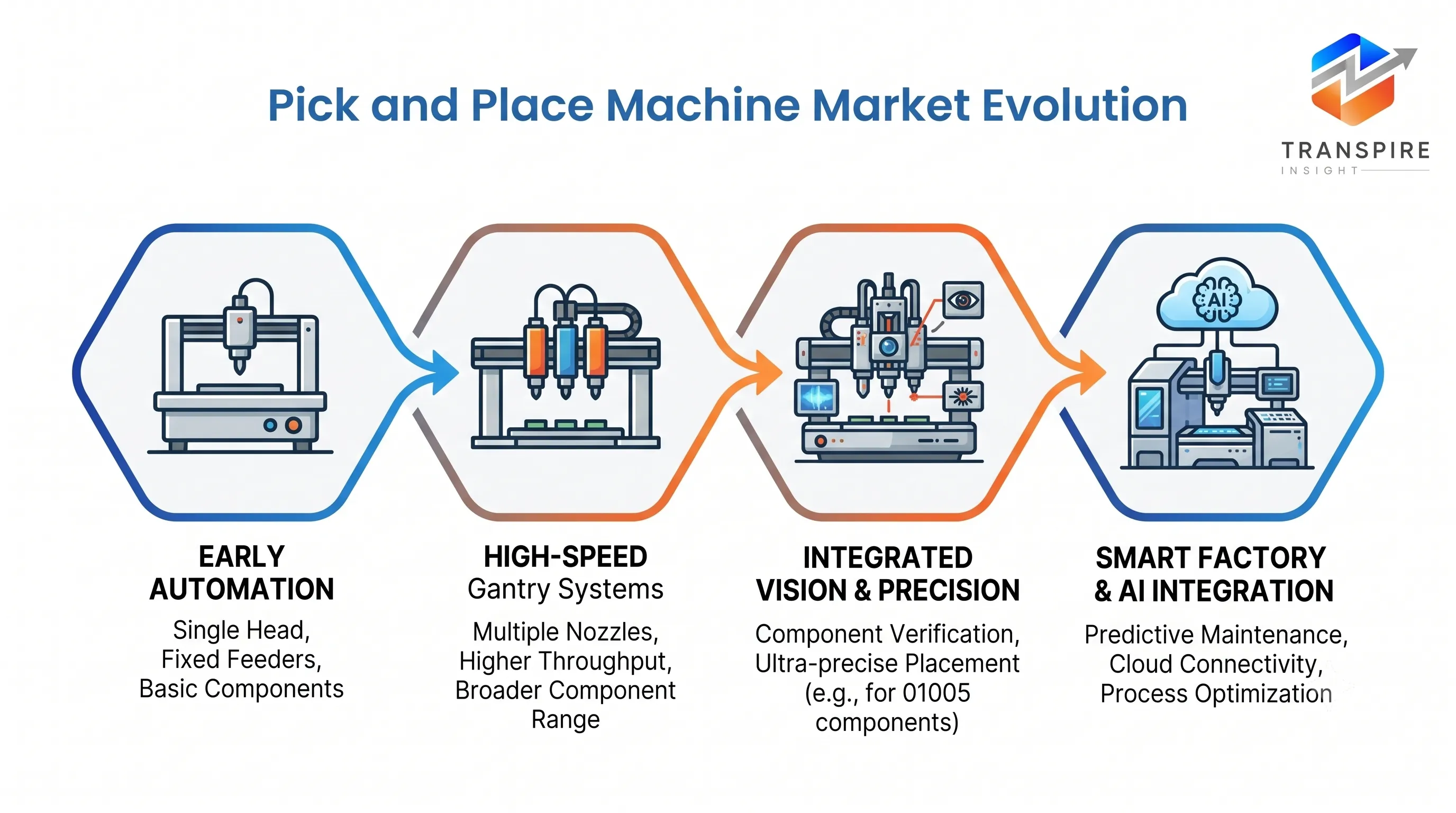
The global electronics manufacturing industry is entering a more automated phase. As components become smaller and product cycles become shorter, pick and place machines are evolving from high-speed assembly equipment into intelligent production platforms capable of precision placement, inspection, traceability and flexible manufacturing.
The growing demand for miniaturized electronics, electric vehicles, connected devices and automated factories is creating a new opportunity for advanced pick and place systems.
September 2026: Electronics manufacturers are increasing their reliance on automated component-placement technologies as production lines become more complex. Surface-mount technology (SMT) remains central to this transformation, particularly as manufacturers need to place increasingly small components at higher speeds while maintaining accuracy and quality.
Modern pick and place machines are no longer evaluated only on placement speed. Manufacturers increasingly consider feeder flexibility, machine uptime, vision capabilities, software connectivity, changeover time and the ability to handle different component sizes.
This shift is particularly important in consumer electronics, automotive electronics, medical devices, telecommunications equipment and industrial automation. The expansion of electric vehicles and connected products is also increasing the electronic content of manufactured products.
Market Size
The global pick and place machine market was estimated at USD 2.8 billion in 2025 and is projected to reach approximately USD 4.6 billion by 2035, expanding at a CAGR of 4.9% during the forecast period from 2026 to 2035. Asia Pacific represents the largest regional market and is also expected to remain the fastest-growing region.
Miniaturization Is Changing Machine Requirements
The electronics industry is moving toward smaller packages, higher component density and more complex boards. Components such as 0201 and 01005 packages require highly accurate placement systems, reliable feeders and sophisticated vision technologies.
As component dimensions shrink, even small placement deviations can create quality problems. Manufacturers therefore increasingly require machines that can detect component orientation, correct positioning and maintain consistent placement across long production runs.
This is pushing equipment suppliers to invest in improved cameras, motion-control systems, software and automated calibration.
The trend also benefits machines capable of handling multiple product configurations. Electronics manufacturers frequently need to produce several board designs on the same production line, making rapid changeovers increasingly valuable.
Automation Is Becoming a Competitive Requirement
Traditional manual and semi-automatic component placement cannot provide the speed and repeatability required by high-volume electronics manufacturing.
Automatic pick and place machines accounted for approximately 35.9% of market revenue in 2025, equivalent to around USD 1 billion, and are projected to grow at approximately 5.5% annually through 2035.
The economic argument extends beyond labor savings. Automated machines can reduce placement errors, improve production consistency and provide manufacturers with greater control over process data.
Connected manufacturing systems are also becoming more important. Industry 4.0 architectures allow production equipment to exchange information with factory-management, inspection and quality systems. Pick and place equipment is consequently becoming part of a broader digital production environment rather than operating as an isolated machine.
Consumer Electronics Remains a Major Demand Center
Consumer electronics continues to be one of the most important applications for pick and place machines because smartphones, wearables, tablets, computers and connected devices require large quantities of precisely assembled electronic components.
Frequent product launches and short product lifecycles also encourage manufacturers to invest in flexible equipment. A machine that can rapidly switch between different component types and board designs can improve factory utilization.
At the same time, automotive electronics are becoming increasingly significant. Electric vehicles, advanced driver-assistance systems, battery-management systems, infotainment systems and connected vehicle architectures all require sophisticated electronic assemblies.
This creates demand for placement machines capable of handling higher-value components while maintaining strict quality standards.
Asia Pacific Is Strengthening Its Manufacturing Advantage
Asia Pacific generated approximately USD 800 million in pick and place machine market revenue in 2025 and is projected to record the fastest regional growth through 2035. China accounted for roughly one-third of regional revenue, while India was valued at approximately USD 100 million and is expected to grow at around 5.4% annually.
The region benefits from its extensive electronics manufacturing ecosystem. China, Japan, South Korea and Taiwan have established supply chains covering semiconductors, displays, consumer electronics and industrial equipment.
India is also becoming increasingly relevant as electronics manufacturing expands. Government programs supporting semiconductor and electronics production can encourage additional assembly capacity and consequently increase demand for automated manufacturing equipment.
Competitive Landscape Is Moving Beyond Speed
Competition in the pick and place machine market is increasingly based on complete manufacturing capability rather than machine speed alone.
Fuji led the market with approximately 9% share in 2025, while Fuji, Panasonic, Yamaha, Hanwha and Juki together represented around 35% of market revenue.
Manufacturers compete through placement accuracy, feeder technology, modular machine architecture, software integration, service networks and productivity.
The growing importance of connected factories may further strengthen established suppliers because customers increasingly prefer equipment that can integrate with existing production-management systems.
Top 10 Companies in Pick and Place Machine Market
Headquarters: Chiryu, Japan
Fuji is one of the leading suppliers of SMT placement equipment and remains particularly strong in high-speed automated electronics manufacturing. Its competitive position is supported by placement technology, feeder systems and integrated production solutions.
Headquarters: Kadoma, Japan
Panasonic provides electronics manufacturing equipment as part of its broader smart-factory portfolio. Its solutions focus on connecting placement, material handling and production-control processes.
Headquarters: Iwata, Japan
Yamaha Motor combines surface-mount technology with robotics and automation capabilities. Its YRM-series platforms demonstrate the industry's movement toward high-speed, flexible placement systems capable of handling a broad range of component sizes.
Headquarters: Seoul, South Korea
Hanwha competes in electronics manufacturing equipment with placement systems designed for speed, accuracy and production flexibility. Its technology portfolio supports manufacturers seeking scalable SMT automation.
Headquarters: Tokyo, Japan
JUKI is an established provider of SMT placement and assembly equipment. Its competitive focus includes production reliability, flexible manufacturing and solutions suitable for a range of electronics applications.
Outlook: Could Intelligent Placement Systems Redefine Electronics Manufacturing?
Pick and place machines are likely to become increasingly important as electronics manufacturers move toward smaller components, higher board density and more flexible production.
The next phase of market development will be shaped by machine intelligence, vision systems, software integration and predictive maintenance rather than placement speed alone. Manufacturers that can connect placement equipment with inspection, logistics and production-management systems may gain stronger productivity advantages.
With Asia Pacific maintaining its manufacturing leadership and automotive, consumer electronics and industrial applications increasing their electronic content, demand for automated placement systems is expected to remain strong.


Send us a brief description of your challenge and we'll get back to you within 24 hours.

 inquiry@transpireinsight.com
 APAC:+91 7666513636
 Address


