

Global Pick and Place Machine Market Size & Forecast:
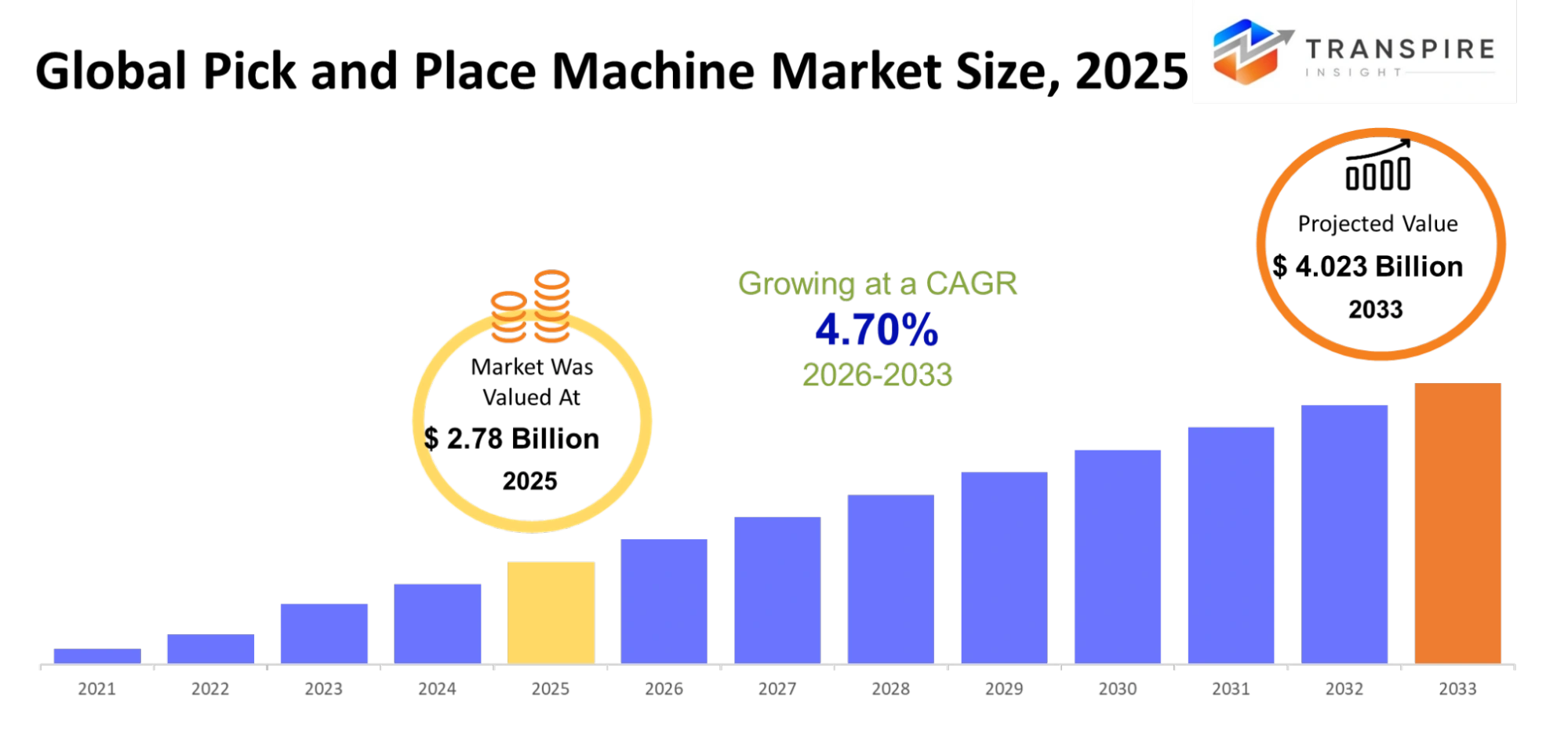
Global Pick and Place Machine Market Size 2025: USD 2.78 Billion
Global Pick and Place Machine Market Size 2026: USD 2.916 Billion
Global Pick and Place Machine Market Size 2033: USD 4.023 Billion
Global Pick and Place Machine Market CAGR: 4.70%
Global Pick and Place Machine Market Segments: By Machine Type (Manual, Semi-Automatic, Fully Automatic), By Technology (Surface Mount Technology, Through-Hole Technology), By Application (Consumer Electronics, Automotive Electronics, Industrial Electronics), By End-User (Electronics Manufacturing Services, OEMs).
To learn more about this report,  Download Free Sample Report
Global Pick and Place Machine Market Summary:
The Global Pick and Place Machine Market was valued at USD 2.78 billion in 2025 and is forecast to reach USD 4.023 billion by 2033, at a CAGR of 4.70% from 2026 to 2033. Pick and place machines are the core placement equipment in printed circuit board assembly lines. They pick electronic components from feeders and place them onto PCBs at high speed and with the positional accuracy that surface mount assembly demands. Without them, modern electronics production at any meaningful scale is not possible.
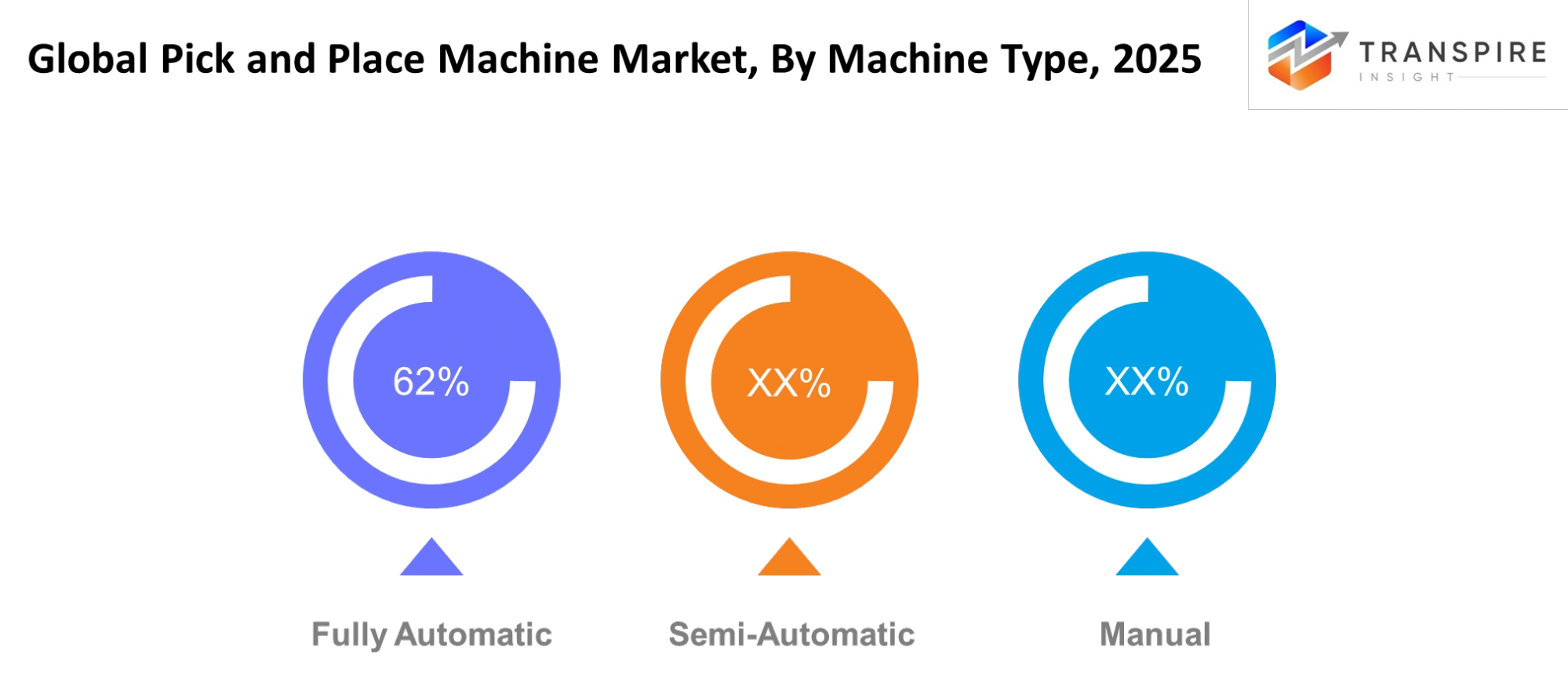
The revenue from the market is generated by fully automatic machines which represent 62 percent of total earnings. The concentration exists because electronics manufacturing operations which produce electronic devices, need to achieve fast and dependable performance more than any other requirement. A high-end, fully automatic pick-and-place machine can place tens of thousands of components per hour with placement accuracy measured in microns. At that performance level, manual or semi-automatic alternatives exist only for small-batch work or prototype work, or highly specialized work where automatic systems require too much investment.
Surface-mount technology has remained the primary assembly method for several decades. The miniaturization of electronic components has pushed the industry toward ever-smaller package sizes, and SMT is the process that makes placing 0201 and 01005 passives on a board feasible at production rates. Through-hole technology persists for components that need the mechanical strength or power handling that surface mount cannot match, but it is a shrinking share of new designs.
The consumer electronics market constitutes the largest application segment because smartphones tablets wearables and connected home devices experience such high production volumes. The automotive electronics sector has steadily increased its market share because modern vehicles now contain more electronic components. Industrial electronics which include PLCs and drives and power conversion equipment represent a less volatile market segment compared to consumer electronics.
Key Market Trends & Insights:
- Fully automatic pick and place machines account for approximately 62% of Global Pick and Place Machine Market revenue, with demand tied directly to the output volumes of large-scale PCB assembly operations.
- Surface mount technology remains the dominant process, and component miniaturization is pushing machine accuracy requirements tighter with each new product generation.
- Automotive electronics content per vehicle has grown consistently, adding a more durable, less cycle-sensitive demand source alongside consumer electronics.
- Electronics Manufacturing Services providers continue to invest in equipment upgrades as they compete for contracts requiring finer pitch placement and faster changeover between product types.
- Vision system and software capabilities are now a meaningful differentiator between machine platforms, with real-time inspection and closed-loop correction becoming expected features on mid-range and high-end machines.
Global Pick and Place Machine Market Segmentation
By Machine Type
- Manual: Manual pick and place machines require an operator to position and place each component by hand, typically with the assistance of a vision system that shows the operator where each part belongs on the board. They are used in prototyping environments, very low-volume production, and specialized repair or rework applications where the cost of an automated system cannot be justified. Placement rates are slow by production standards, but the flexibility and low capital requirement make them a practical choice for labs, universities, and small electronics shops. Their share of the Global Pick and Place Machine Market is small and declining as the entry price of semi-automatic systems has come down.
- Semi-Automatic: Semi-automatic pick and place machines automate the placement motion but require operator involvement for component loading, board handling, or both. They occupy the middle ground between fully manual and fully automated production and are commonly found in contract manufacturers handling short runs, in OEM facilities assembling low-to-mid volume products, and in operations where product variety makes constant changeover impractical on a full production line. The segment also captures a share of the educational and training market. Semi-automatic machines have benefited from improvements in feeder design and software that have reduced setup time and expanded the component range they can handle.
- Fully Automatic: Fully automatic pick and place machines are the largest segment of the Global Pick and Place Machine Market, representing approximately 62% of total revenue. These machines operate without operator intervention during the placement cycle, drawing components from tape, tube, or tray feeders and placing them on boards at rates that range from tens of thousands to over 100,000 components per hour on high-speed chip shooters. Production-grade fully automatic machines are the backbone of smartphone assembly lines, automotive PCB production, and any other operation where throughput and placement accuracy at scale are non-negotiable. Investment in this segment is closely tied to electronics production capital expenditure cycles, which means demand can shift noticeably in years when major consumer electronics programs are in buildout versus steady-state production.
To learn more about this report, Download Free Sample Report
By Technology
- Surface Mount Technology: Surface mount technology is the process by which components are mounted directly onto the surface of a PCB rather than inserted through holes. SMT dominates modern PCB assembly because it allows higher component density, smaller board footprints, and faster automated placement than through-hole methods. Pick and place machines built for SMT must handle an increasingly wide range of component sizes, from large connectors and shields down to the smallest passive components in volume production. The push toward finer pitch BGA packages, QFN devices, and chip-scale packages has driven machine manufacturers to invest in better vision systems, more precise placement heads, and improved nozzle designs. Nearly all high-volume electronics manufacturing runs SMT as its primary assembly process.
- Through-Hole Technology: Through-hole technology involves inserting component leads through holes drilled in the PCB and soldering them on the opposite side. It persists for components that require strong mechanical attachment, high current handling, or specific connector geometries that SMT versions do not yet reliably provide. Power supplies, some connectors, electrolytic capacitors in certain applications, and legacy industrial designs are the main through-hole holdouts. Automated through-hole insertion equipment is a separate machine category from SMT pick and place, and the two are often found together on assembly lines that need both. The through-hole share of new PCB designs continues to shrink as component manufacturers extend SMT equivalents further into previously through-hole-only categories.
By Application
- Consumer Electronics: Consumer electronics is the largest application segment in the Global Pick and Place Machine Market. Smartphones, tablets, laptops, wearables, smart speakers, gaming devices, and connected home products all depend on high-speed SMT assembly, and the production volumes involved drive substantial equipment investment. The consumer electronics cycle is the main source of volatility in pick and place machine demand: a major new smartphone platform entering mass production can pull significant capital expenditure from contract manufacturers simultaneously. Component miniaturization in consumer devices has also been the primary driver of accuracy and speed improvements in pick and place machine design over the past two decades.
- Automotive Electronics: Automotive electronics have become a larger share of the Global Pick and Place Machine Market as vehicles carry more electronic content. Advanced driver assistance systems, infotainment, body control modules, battery management systems in hybrid and electric vehicles, and the distributed networks of sensors and actuators that modern vehicles require all need PCB assemblies. Automotive electronics assembly has more demanding reliability and traceability requirements than consumer electronics, which affects machine selection and process control. Equipment used in automotive lines must meet process standards, handle higher-temperature solder alloys in some cases, and support full traceability of component placement for warranty and recall purposes. Demand from this segment is steadier and less cyclical than consumer electronics.
- Industrial Electronics: Industrial electronics covers programmable logic controllers, variable frequency drives, power conversion equipment, industrial sensors, and the PCB assemblies found in manufacturing and process control equipment. This segment buys pick and place equipment in smaller quantities than consumer or automotive, but the machines run longer production cycles on fewer product changeovers, and reliability over a multi-year production run is the primary selection criterion. Industrial electronics manufacturers often specify machines with robust mechanical construction and long parts availability commitments rather than the newest high-speed platform. The segment's demand is tied to broader capital equipment cycles in manufacturing rather than consumer product launch calendars.
By End-User
- Electronics Manufacturing Services: Electronics Manufacturing Services providers are the largest end-user category in the Global Pick and Place Machine Market. EMS companies operate contract PCB assembly operations for OEM customers across consumer electronics, automotive, medical, and industrial markets. Because they must handle a wide range of board types and component mixes for different customers, EMS facilities tend to maintain multiple machine types and invest in flexible, fast-changeover equipment. Large EMS operators run high-utilization lines and replace equipment on defined capital cycles. The EMS segment is particularly sensitive to the investment appetite of the major consumer electronics programs, since a few very large OEM customers drive a significant portion of EMS capital spending decisions.
- OEMs: Original equipment manufacturers that assemble their own PCBs in-house represent the second end-user category. OEM in-house assembly is more common in automotive, industrial, and medical electronics, where proprietary process knowledge, supply chain control, or regulatory requirements make outsourcing to a contract manufacturer less attractive. OEM facilities tend to run narrower product mixes than EMS providers, which allows them to optimize their pick and place equipment selection around a more predictable component range. Capital replacement cycles at OEM facilities are often longer than at EMS companies, and machine selection is influenced heavily by the incumbent supplier relationships established during previous line buildouts.
Country Insights
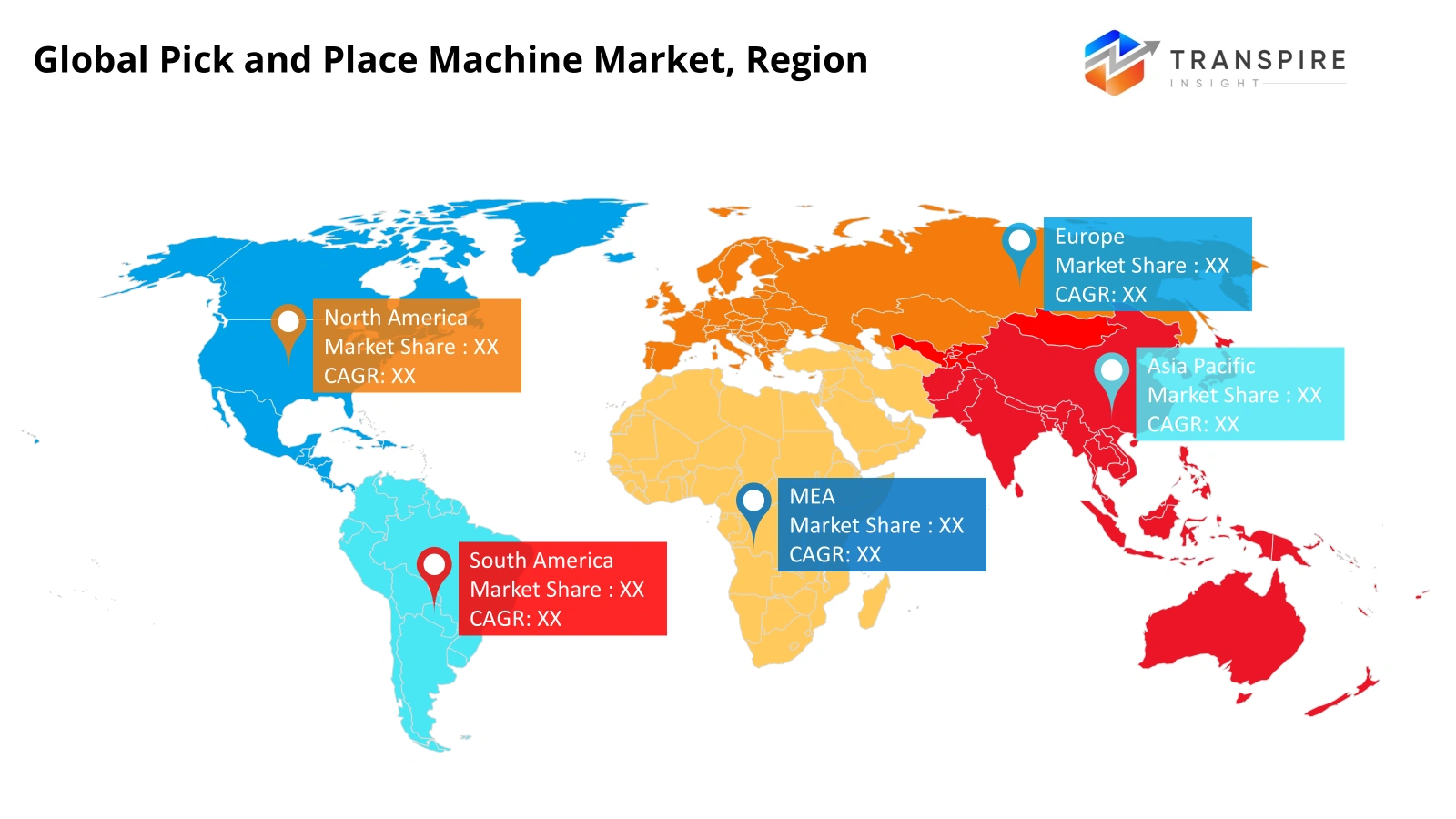
Asia-Pacific is the dominant region in the Global Pick and Place Machine Market, accounting for the largest share of both machine consumption and production. China is by far the largest single market. Its scale of electronics manufacturing, from smartphones and consumer devices to automotive electronics and industrial equipment, means that the capital expenditure decisions of Chinese EMS operators and OEMs move the global market. Japan and South Korea host major machine manufacturers alongside their own electronics production bases, and Taiwan's PCB assembly industry is substantial and technically demanding.
Southeast Asia has grown as an assembly location, with Vietnam, Malaysia, Thailand, and Indonesia all receiving investment from OEMs and EMS companies looking to diversify production away from China. These markets are building out pick and place capacity as their electronics assembly sectors mature, and they have become a meaningful destination for both new equipment and refurbished machines.
North America, led by the United States, is a smaller but technically active market. Defense electronics, medical devices, and industrial equipment manufacturers maintain domestic PCB assembly operations and invest in pick and place equipment on regular cycles. The reshoring of some electronics production to the US, supported by federal incentives in the semiconductor and electronics space, has added some incremental demand for assembly equipment.
Europe's market is concentrated in Germany, the Netherlands, Sweden, and the UK, where industrial electronics, automotive electronics, and high-reliability applications support steady equipment demand. European machine manufacturers, including some of the major players in this report, have historically competed on software capability and process flexibility rather than raw placement speed.
To learn more about this report, Download Free Sample Report
Recent Development News
Machine manufacturers in the Global Pick and Place Machine Market have been investing in software-side capabilities, particularly in machine learning-based component recognition and placement verification systems. These allow machines to handle a wider variety of non-standard or poorly oriented components without manual intervention, which reduces line stoppages in high-mix production environments.
There is also activity around modular platform architectures, where the same base machine can be configured with different head assemblies for chip shooting, fine-pitch placement, or odd-form component handling. This approach reduces the number of distinct machine platforms a manufacturer needs to maintain while giving EMS customers more flexibility in how they configure a line.
Report Metrics
|
Report Metrics |
Details |
|
Market size value in 2025 |
USD 2.78 Billion |
|
Market size value in 2026 |
USD 2.916 Billion |
|
Revenue forecast in 2033 |
USD 4.023 Billion |
|
Growth rate |
CAGR of 4.70% from 2026 to 2033 |
|
Base year |
2025 |
|
Historical data |
2021 - 2024 |
|
Forecast period |
2026 - 2033 |
|
Report coverage |
Revenue forecast, competitive landscape, growth factors, and trends |
|
Country scope |
Global |
|
Key company profiled |
Fuji Corporation, Yamaha Motor Co. Ltd., Panasonic Corporation, ASM Assembly Systems GmbH & Co. KG, Juki Corporation, Hanwha Precision Machinery, Mycronic AB, Universal Instruments Corporation, Europlacer Ltd., Nordson Corporation, Samsung Techwin Co. Ltd., Assembleon (Kulicke & Soffa), Autotronik SMT GmbH, NeoDen Technology, Manncorp Inc. |
|
Customization scope |
Free report customization (country, regional & segment scope). Avail customized purchase options to meet your exact research needs. |
|
Report Segmentation |
By Machine Type (Manual, Semi-Automatic, Fully Automatic), By Technology (Surface Mount Technology, Through-Hole Technology), By Application (Consumer Electronics, Automotive Electronics, Industrial Electronics), By End-User (Electronics Manufacturing Services, OEMs). |
Key Pick and Place Machine Company Insights
The Global Pick and Place Machine Market is served by a concentrated group of established Japanese and European machine builders alongside a growing tier of Asian manufacturers that have entered the market at lower price points. The Japanese manufacturers, including Fuji, Yamaha, Juki, and Panasonic, have long-standing positions in high-volume consumer electronics lines and maintain extensive global service networks that matter a great deal to EMS operators who cannot afford extended machine downtime.
European manufacturers such as ASM Assembly Systems, Mycronic, and Europlacer have carved out positions in high-mix, lower-volume applications where software flexibility and placement versatility matter more than raw chip-shooting speed. Their machines are common in automotive electronics, medical devices, and industrial assembly operations where product variety is high and run lengths are shorter. The competitive dynamic between these two groups has intensified as Japanese manufacturers have improved their high-mix capabilities and European builders have extended their speed ranges upward.
Company List
- Fuji Corporation
- Yamaha Motor Co. Ltd.
- Panasonic Corporation
- ASM Assembly Systems GmbH & Co. KG
- Juki Corporation
- Hanwha Precision Machinery
- Mycronic AB
- Universal Instruments Corporation
- Europlacer Ltd.
- Nordson Corporation
- Samsung Techwin Co. Ltd.
- Assembleon (Kulicke & Soffa)
- Autotronik SMT GmbH
- NeoDen Technology
- Manncorp Inc.
Global Pick and Place Machine Market Report Segmentation
By Machine Type
- Manual
- Semi-Automatic
- Fully Automatic
By Technology
- Surface Mount Technology
- Through-Hole Technology
By Application
- Consumer Electronics
- Automotive Electronics
- Industrial Electronics
By End-User
- Electronics Manufacturing Services
- OEMs
Frequently Asked Questions
Find quick answers to common questions.
The Global Pick and Place Machine Market is expected to reach approximately USD 4.023 billion by 2033.
Key segments include Machine Type (Manual, Semi-Automatic, Fully Automatic), Technology (Surface Mount Technology, Through-Hole Technology), Application (Consumer Electronics, Automotive Electronics, Industrial Electronics), and End-User (Electronics Manufacturing Services, OEMs).
Major players include Fuji Corporation, Yamaha Motor Co. Ltd., Panasonic Corporation, ASM Assembly Systems GmbH & Co. KG, Juki Corporation, Hanwha Precision Machinery, Mycronic AB, Universal Instruments Corporation, Europlacer Ltd., Nordson Corporation, Samsung Techwin Co. Ltd., Assembleon (Kulicke & Soffa), Autotronik SMT GmbH, NeoDen Technology, and Manncorp Inc.
The Global Pick and Place Machine Market size is approximately USD 2.78 billion in 2025.
The Global Pick and Place Machine Market is expected to grow at a CAGR of 4.70% from 2026 to 2033.
- Fuji Corporation
- Yamaha Motor Co. Ltd.
- Panasonic Corporation
- ASM Assembly Systems GmbH & Co. KG
- Juki Corporation
- Hanwha Precision Machinery
- Mycronic AB
- Universal Instruments Corporation
- Europlacer Ltd.
- Nordson Corporation
- Samsung Techwin Co. Ltd.
- Assembleon (Kulicke & Soffa)
- Autotronik SMT GmbH
- NeoDen Technology
- Manncorp Inc.
Recently Published Reports
-
Apr 2026
Handling and Lifting Equipment Market
Handling and Lifting Equipment Market Size, Share & Analysis Report By Product (Cranes and Hoists, Forklifts, Conveyor Systems, Aerial Work Platforms, Others), By Application (E-Commerce, Automotive and Railway, Food and Beverages, Aviation, Others), and Geography (North America, Europe, Asia-Pacific, Middle East and Africa, South and Central America), 2021 - 2031
-
Apr 2026
HVAC Equipment Market
HVAC Equipment Market Size, Share & Analysis Report By Heating Equipment Type (Boilers and Furnaces, Heat Pumps, and Unitary Heaters), By Ventilation Equipment (Air Handling Units, Humidifiers and Dehumidifiers, Air Filters, and Fan Coiling Units), By Air Conditioning Equipment (Unitary Air Conditioners, Room Air Conditioners, Packaged Terminal Air Conditioners, and Chillers), By End User (Commercial, Residential, Industrial, and others), and Geography (North America, Europe, Asia-Pacific, Middle East and Africa, South and Central America), 2021 – 2031
-
Apr 2026
Refrigeration Valves Market
Refrigeration Valves Market Size, Share & Analysis Report By Type (Solenoid Valves, Expansion Valves, Check Valves, Service Valves, Others), By Application (Commercial Refrigeration, Industrial Refrigeration, Transport Refrigeration, Residential Refrigeration, Air Conditioning Systems), By End User (Food and Beverage Industry, Pharmaceutical Industry, HVAC Industry, Chemical Industry, Others), and Geography (North America, Europe, Asia-Pacific, Middle East and Africa, South and Central America), 2021 – 2031
-
Apr 2026
E-Commerce Packaging Materials Market
E-Commerce Packaging Materials Market By Material Type (Corrugated Boxes, Paper & Paperboard, Foam & Cushioning Materials, Plastic Packaging, Flexible Packaging, Protective Packaging, Others), By Product(Primary Packaging, Secondary Packaging, Tertiary Packaging), By Packaging Function (Protective Packaging, Branding & Presentation Packaging, Transit & Logistic Packaging, Sustainable Packaging, Tamper Evidence Packaging), By End-User (Retail & Consumer Goods, Electronic Appliances, Food & Beverages, Healthcare & Pharmaceutical, Fashion & Apparel, Home & Furnishing, Others); By Industry Analysis, Size, Share, Growth, Trends, and Forecasts 2021-2033