
Sep 14, 2026
By Transpire Insight
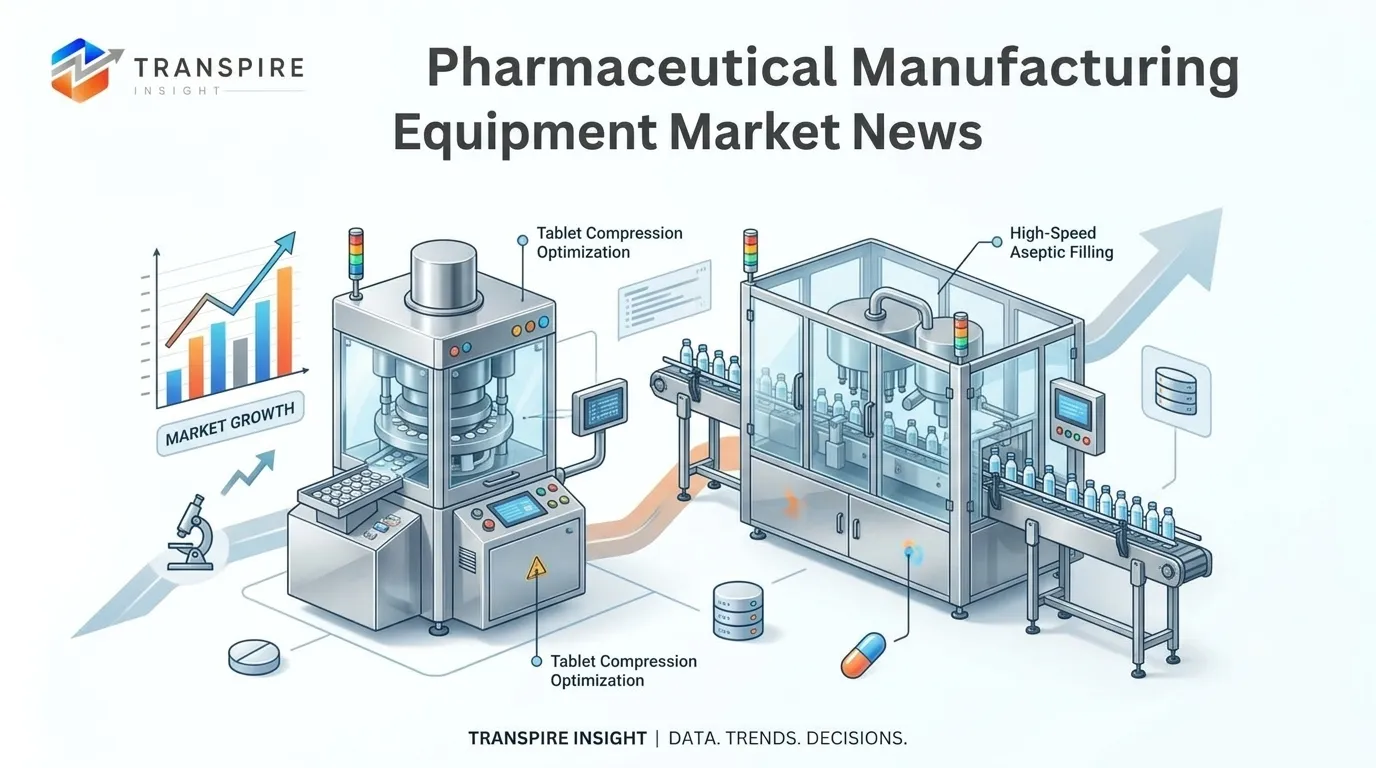
According to Transpire Insight, the global pharmaceutical manufacturing equipment market is estimated at approximately USD 12.84 billion in 2025 and is expected to reach around USD 13.72 billion in 2026. The market is projected to reach approximately USD 23.94 billion by 2035, expanding at an estimated CAGR of 6.38% during the forecast period 2026–2035.
The pharmaceutical manufacturing equipment market is undergoing a fundamental transformation as pharmaceutical and biopharmaceutical companies invest in production systems capable of delivering higher capacity, tighter quality control, greater flexibility, and more intelligent manufacturing.
Pharmaceutical manufacturing equipment covers the machinery used across the drug-production lifecycle, including formulation, blending, granulation, drying, compression, encapsulation, coating, sterile filling, filtration, lyophilization, inspection, packaging, and automated material handling. The market also encompasses highly specialized bioprocessing equipment such as bioreactors, single-use systems, chromatography platforms, and advanced filtration technologies.
The industry's direction is being shaped by several changes at the same time. Pharmaceutical manufacturers are expanding capacity for conventional medicines while also investing in biologics, vaccines, sterile injectables, biosimilars, and other increasingly complex products. This is creating demand for equipment with more precise environmental control, enhanced automation, stronger contamination-management capabilities, and sophisticated process monitoring.
The manufacturing model itself is also changing. Batch processing remains dominant across much of pharmaceutical production, but continuous manufacturing is receiving increasing attention because it can integrate multiple production stages and support greater process visibility. The FDA's ICH Q13 guidance provides scientific and regulatory considerations for development, implementation, operation, and lifecycle management of continuous manufacturing for drug substances and drug products.
At the same time, pharmaceutical supply-chain resilience has become a strategic priority. In the United States, the FDA launched its PreCheck Pilot Program on February 1, 2026, designed to improve regulatory predictability during development of new domestic pharmaceutical manufacturing facilities.
On June 29, 2026, the agency selected seven companies for the pilot.
India is pursuing a similar manufacturing-expansion strategy. Government data show that cumulative investment under the country's pharmaceutical Production Linked Incentive scheme had reached ₹41,943 crore by December 2025, substantially above the committed investment target of ₹17,275 crore.
These developments are increasing the importance of modern pharmaceutical manufacturing equipment as strategic infrastructure rather than simply capital machinery.
Market Overview
Pharmaceutical manufacturing equipment consists of the machinery, production systems, automation platforms, and specialized technologies used to manufacture finished medicines and pharmaceutical ingredients.
The market serves manufacturers of tablets, capsules, injectables, vaccines, biologics, oral liquids, topical products, inhalation products, sterile medicines, and other dosage forms.
Solid-dose manufacturing equipment remains one of the industry's most established categories. Tablet presses, granulators, mills, blenders, fluid-bed dryers, capsule fillers, and coating machines are widely used for large-scale pharmaceutical production.
Liquid and semisolid equipment includes mixing vessels, homogenizers, emulsification systems, filtration units, transfer pumps, filling machines, and specialized processing equipment.
Sterile manufacturing equipment represents a high-value and technically demanding segment. Aseptic filling machines, isolators, restricted-access barrier systems, sterilization technologies, vial and syringe fillers, automated inspection systems, and controlled material-transfer technologies are required to minimize contamination risks.
The rapid expansion of biopharmaceutical manufacturing is creating demand for an entirely different equipment ecosystem. Bioreactors, single-use assemblies, cell-processing equipment, chromatography systems, tangential-flow filtration, depth filtration, and advanced aseptic filling are becoming increasingly important as biologic medicines expand.
Pharmaceutical packaging equipment is another major category. Modern packaging lines combine blistering, bottle filling, labeling, serialization, vision inspection, aggregation, cartoning, case packing, and automated material handling.
The market is also increasingly defined by process-control systems. Temperature, pressure, flow, speed, humidity, vibration, and other process variables can be monitored digitally, generating data that can support quality assurance, maintenance, and production optimization.
This means the competitive value of pharmaceutical equipment is increasingly determined by its ability to operate as part of a connected manufacturing environment.
Latest Market Statistics
The global pharmaceutical manufacturing equipment market is expected to maintain positive growth as drug manufacturers increase production capacity and modernize existing facilities.
Transpire Insight estimates that the market was approximately USD 12.84 billion in 2025 and could reach around USD 13.72 billion in 2026. By 2035, the market is projected to approach USD 23.94 billion, reflecting sustained investment in production infrastructure, automation, biologics, sterile manufacturing, and pharmaceutical packaging.
The most important structural change is the shift from purchasing individual machines toward developing integrated pharmaceutical production platforms.
Pharmaceutical companies increasingly want equipment that can connect with manufacturing execution systems, laboratory systems, quality platforms, enterprise software, and plant-level automation.
This creates demand for equipment that is not only mechanically capable but also digitally interoperable.
Another important trend is the increasing emphasis on manufacturing flexibility. Drug manufacturers may need to change formulations, batch sizes, production volumes, or products without undertaking extensive modifications to the physical plant.
Equipment capable of fast changeover, automated cleaning, digital recipe control, modular configuration, and flexible production can therefore offer significant lifecycle advantages.
The market is also becoming more closely linked to real-time quality management. Rather than relying entirely on laboratory testing after production, manufacturers increasingly want process data that can provide earlier indications of deviations.
This is strengthening interest in process analytical technology, automated inspection, inline monitoring, and intelligent control systems.
Major Growth Drivers
Expansion of pharmaceutical production: Rising demand for medicines and increasing manufacturing localization are encouraging pharmaceutical companies to build new capacity and modernize established facilities.
Growth of biologics and biosimilars: Complex biological medicines require specialized processing equipment, advanced purification systems, controlled environments, and highly precise filling technologies.
Increasing sterile-drug production: Injectables, vaccines, and biologics are driving investment in contamination-controlled processing, aseptic filling, and automated inspection.
Manufacturing automation: Robotics, automated controls, machine vision, and digital material handling are improving manufacturing consistency and productivity.
Regulatory requirements: Pharmaceutical facilities require validated equipment, controlled processes, traceability, cleaning systems, and appropriate data management.
Supply-chain resilience: Domestic manufacturing initiatives are encouraging investment in new pharmaceutical facilities and associated equipment.
Continuous manufacturing: Drug manufacturers are increasingly exploring integrated manufacturing systems with real-time monitoring and process control. FDA's Q13 guidance provides an established framework for continuous manufacturing development and lifecycle management.
Plant modernization: Aging pharmaceutical facilities are creating demand for equipment replacement, automation upgrades, digital retrofits, and advanced quality-control technologies.
Key Applications
Solid oral dosage manufacturing remains a major application because tablets and capsules continue to represent substantial pharmaceutical production volumes.
Injectable manufacturing is an important high-value application requiring specialized filling, sterilization, containment, inspection, and packaging systems.
Biopharmaceutical production uses bioreactors, single-use processing systems, filtration platforms, chromatography equipment, and specialized downstream-processing technologies.
Vaccine manufacturing requires controlled upstream production, purification, formulation, sterile filling, inspection, and packaging.
Liquid pharmaceutical production depends on mixing, homogenization, filtration, filling, and packaging equipment.
Topical and semisolid manufacturing requires specialized mixing, emulsification, homogenization, filling, and packaging technologies.
Pharmaceutical packaging includes blister machines, bottle fillers, labeling equipment, serialization systems, automated inspection, cartoning, and secondary packaging.
Government Initiatives and Pharmaceutical Manufacturing Modernization
Government policy is increasingly influencing pharmaceutical manufacturing-equipment investment because production localization requires new factories, modern processing lines, validated equipment, quality systems, and advanced automation.
In India, the pharmaceutical PLI program was created to strengthen domestic manufacturing of high-value medicines, complex generics, APIs, drug intermediates, and other strategic pharmaceutical products. As of December 2025, cumulative investment under the scheme had reached ₹41,943 crore.
India is also strengthening biologics manufacturing. The Biopharma SHAKTI initiative announced in 2026 has an outlay of ₹10,000 crore over five years, with the stated objective of developing a globally competitive domestic ecosystem for biologics and biosimilars.
The initiative includes support for biopharma research, development, manufacturing, clinical-trial infrastructure, and a broader delivery-device and packaging ecosystem, creating potential downstream demand for specialized pharmaceutical manufacturing equipment.
In the United States, the FDA's PreCheck program is intended to strengthen domestic pharmaceutical supply chains by engaging with companies earlier during new manufacturing-facility development.
These initiatives demonstrate a broader policy shift: pharmaceutical manufacturing capacity is increasingly being treated as strategic infrastructure, which can directly increase investment in equipment.
Technology and Equipment Overview
The pharmaceutical manufacturing equipment market includes several major technological categories.
Tablet presses are increasingly equipped with automated compression control, weight monitoring, force measurement, speed optimization, and digital process records.
Granulation and drying systems support control over particle characteristics and formulation consistency.
Capsule-filling equipment provides precise filling and increasingly integrates automated inspection and process monitoring.
Mixing and homogenization equipment ensures consistent distribution of active ingredients and excipients in liquid and semisolid formulations.
Bioreactors provide controlled environments for growing cells or microorganisms used in biological-drug production.
Single-use systems are increasingly important in biopharmaceutical facilities because they can support flexible production and reduce certain cleaning and sterilization requirements.
Filtration and purification equipment is essential in downstream biologics manufacturing.
Aseptic filling systems support sterile drug production and can be combined with isolators, restricted-access systems, automated transfers, and inspection technologies.
Lyophilization equipment supports the stabilization of temperature-sensitive pharmaceutical products.
Automated inspection systems can detect defects in vials, syringes, ampoules, tablets, capsules, containers, labels, and packaging.
The market is increasingly shifting toward fully connected production lines in which machinery, automation, quality control, and data systems operate together.
Future Importance
The future of the pharmaceutical manufacturing equipment market will be closely tied to continuous manufacturing, biologics, sterile production, smart factories, automation, flexible facilities, real-time quality control, and predictive maintenance.
Pharmaceutical equipment is increasingly becoming a source of operational data. Sensors embedded in manufacturing systems can continuously monitor variables that previously depended heavily on manual checks.
This creates an opportunity to identify deviations earlier and improve process understanding.
Continuous manufacturing is particularly significant because it can integrate multiple process stages into a coordinated production flow. The FDA's Q13 guidance specifically addresses the development, operation, and lifecycle management of continuous manufacturing systems.
Another long-term shift is toward modular manufacturing. Flexible processing platforms can help manufacturers accommodate changing product portfolios without rebuilding entire production lines.
This is particularly relevant as pharmaceutical pipelines increasingly include specialized medicines with smaller production volumes.
The market is therefore moving toward equipment that combines precision, flexibility, connectivity, and intelligent control.
Top Market Trends
Expansion of Continuous Manufacturing: Pharmaceutical manufacturers are increasingly evaluating continuous processes as an alternative or complement to conventional batch production, supported by an established regulatory framework.
Rapid Growth of Biopharmaceutical Equipment: Biologics and biosimilars are creating demand for bioreactors, single-use technologies, purification systems, filtration platforms, and sterile filling equipment.
Increasing Automation and Robotics: Robotics are expanding across material handling, packaging, inspection, warehousing, and selected sterile-processing applications.
Growth of AI-Enabled Production: Artificial intelligence is increasingly being considered for predictive maintenance, anomaly detection, process optimization, quality inspection, and production scheduling.
Shift Toward Flexible Manufacturing: Equipment platforms that support rapid changeovers, multiple products, smaller batches, and modular production are becoming increasingly valuable.
Technological Advancements
Technology is transforming pharmaceutical manufacturing equipment in several ways.
Process analytical technology can provide more direct visibility into critical manufacturing parameters and selected quality attributes.
Advanced process-control systems can automatically adjust manufacturing conditions according to defined process requirements.
Robotic automation reduces repetitive manual work and can improve consistency in material handling, packaging, and inspection.
Machine vision allows high-speed inspection of products and packaging.
Digital twins can simulate equipment behavior and production processes before physical changes are introduced.
Single-use bioprocessing enables flexible facility configurations and can reduce some cleaning-related requirements.
Modular equipment design can allow manufacturers to increase or adapt production capacity without major structural changes.
These technologies are helping create the pharmaceutical smart factory, where production equipment, quality systems, data infrastructure, and automation are increasingly integrated.
Artificial Intelligence and Smart Pharmaceutical Manufacturing
Artificial intelligence is emerging as an important layer within pharmaceutical manufacturing equipment.
Modern plants generate large volumes of operational data, creating an opportunity for machine-learning systems to identify patterns that may not be immediately visible through conventional monitoring.
Predictive maintenance is one of the clearest applications. AI can potentially combine operating hours, vibration, temperature, motor performance, historical failures, and other machine variables to estimate when equipment may require maintenance.
Process optimization is another opportunity. Algorithms can examine relationships between process settings and product-quality outcomes, helping engineers identify operating conditions associated with improved consistency.
Automated quality inspection can use advanced vision algorithms to identify defects in high-volume production.
AI can also support production scheduling and demand planning, particularly for manufacturers managing multiple products, facilities, and production lines.
However, pharmaceutical AI systems require strict validation and governance. Data integrity, auditability, model performance, change control, cybersecurity, and human oversight are critical.
The future is therefore likely to emphasize validated AI-assisted manufacturing rather than unrestricted automation.
Investment and Growth Opportunities
The pharmaceutical manufacturing equipment market is creating opportunities for equipment manufacturers, automation providers, process-control companies, robotics suppliers, cleanroom specialists, packaging companies, and engineering-service providers.
One major opportunity is biopharmaceutical production equipment. Expansion of biologics and biosimilars is creating demand for sophisticated upstream and downstream processing technologies.
The sterile manufacturing segment also offers significant potential as pharmaceutical companies expand injectable and vaccine capacity.
Continuous manufacturing systems represent another important opportunity as companies seek more integrated processes and real-time control.
Plant modernization represents a major addressable market. Existing facilities can be upgraded through new sensors, automation, machine vision, digital controls, advanced inspection, and predictive-maintenance systems.
Packaging automation is another growth opportunity as pharmaceutical manufacturers increasingly require serialization, inspection, traceability, and high-speed packaging.
The growth of manufacturing capacity in India and other emerging pharmaceutical hubs is expected to increase demand for local installation, validation, technical support, spare parts, and equipment lifecycle services.
Market Segmentation
The pharmaceutical manufacturing equipment market can be segmented based on equipment type, manufacturing process, product type, application, and end user.
By equipment type, the market includes tablet presses, capsule fillers, granulators, mixers, dryers, coating systems, bioreactors, filtration systems, filling equipment, lyophilizers, sterilization equipment, inspection systems, packaging machinery, and process-control equipment.
By manufacturing process, the market includes solid-dose manufacturing, liquid manufacturing, semisolid manufacturing, sterile processing, biologics production, continuous manufacturing, and other pharmaceutical processes.
By product type, major categories include tablets, capsules, injectables, vaccines, biologics, oral liquids, topical medicines, inhalation products, and other formulations.
By application, major areas include formulation, processing, filling, sterilization, inspection, packaging, material handling, and quality control.
By end user, the market includes pharmaceutical companies, biopharmaceutical manufacturers, contract manufacturing organizations, contract development and manufacturing organizations, research facilities, and government manufacturing units.
Leading and Fastest-Growing Segments
The solid-dose manufacturing equipment segment is expected to retain a significant market position because of the large installed base of tablet and capsule production facilities.
The sterile-processing segment represents a high-value growth opportunity because injectable medicines, vaccines, and biologic therapies require sophisticated contamination-control and filling infrastructure.
The biopharmaceutical equipment segment is expected to remain among the most strategically attractive areas because biologics require specialized upstream and downstream equipment.
The automated inspection and packaging segment is expected to expand as manufacturers place greater emphasis on traceability, product quality, serialization, and production efficiency.
The continuous manufacturing segment represents an emerging opportunity as pharmaceutical companies explore more integrated and digitally controlled production models.
The AI-enabled equipment segment is also expected to gain importance as pharmaceutical manufacturers increasingly explore predictive maintenance and intelligent process monitoring.
Competitive Landscape
Competition in the pharmaceutical manufacturing equipment market is increasingly focused on precision, reliability, automation, regulatory readiness, interoperability, flexibility, validation support, and lifecycle services.
Equipment manufacturers are increasingly required to provide complete solutions rather than isolated machinery.
Pharmaceutical customers may require equipment installation, qualification, validation documentation, integration, software support, operator training, preventive maintenance, and long-term spare-parts availability.
For biologics production, technical expertise in aseptic processing, single-use systems, purification, filtration, and contamination control can be an important competitive differentiator.
In solid-dose manufacturing, production speed, compression precision, energy efficiency, changeover time, cleanability, and equipment uptime remain key factors.
Digital connectivity is becoming increasingly important across all categories. Equipment capable of communicating with manufacturing execution systems, quality systems, laboratory platforms, and enterprise applications can provide stronger value to pharmaceutical manufacturers.
The competitive landscape is therefore moving toward integrated manufacturing ecosystems supported by long-term technical expertise.
Challenges and Restraints
Despite strong growth prospects, the market faces several challenges.
High capital expenditure remains a major barrier, particularly for smaller manufacturers investing in sophisticated bioprocessing, sterile filling, automation, or advanced packaging.
Validation requirements can extend implementation schedules because new equipment must be appropriately qualified and integrated into validated manufacturing processes.
Regulatory complexity is another major concern. Equipment must be suitable for its intended application and support compliant manufacturing operations.
FDA guidance emphasizes the importance of selecting equipment that is appropriate for its intended use and capable of meeting applicable current good manufacturing practice requirements.
Legacy integration can create difficulties when advanced equipment needs to interact with older control systems.
Technical workforce shortages are increasingly relevant as facilities require professionals with skills spanning automation, process engineering, data systems, validation, cybersecurity, robotics, and equipment maintenance.
Supply-chain disruptions can also affect delivery schedules for highly specialized machinery and critical replacement components.
Long equipment lifecycles may delay adoption of newer technologies because pharmaceutical companies frequently operate established equipment for many years.
Nevertheless, capacity expansion, regulatory modernization, biologics growth, and automation are creating strong investment incentives.
Regional Market Outlook
The pharmaceutical manufacturing equipment market is developing across all major pharmaceutical-production regions.
North America remains an important market because of its advanced pharmaceutical and biopharmaceutical manufacturing infrastructure, high-value drug production, sophisticated automation capabilities, and substantial investment in domestic manufacturing.
The FDA's PreCheck initiative provides additional momentum to new domestic pharmaceutical-facility development by encouraging earlier engagement between regulators and manufacturers.
Europe represents a mature pharmaceutical manufacturing region supported by biologics production, advanced engineering, stringent quality requirements, and increasing interest in continuous and digitally controlled production.
Asia-Pacific represents a major growth opportunity because of expanding pharmaceutical manufacturing, generic-drug production, contract manufacturing, biologics, healthcare investment, and supply-chain localization.
India is particularly significant. Its pharmaceutical PLI scheme had generated ₹41,943 crore in cumulative investment by December 2025, while new initiatives such as Biopharma SHAKTI are targeting expansion of domestic biologics and biosimilars capabilities.
Latin America is benefiting from pharmaceutical localization, generic-drug manufacturing, healthcare investment, and contract manufacturing.
Middle East & Africa are gradually developing pharmaceutical production capabilities as governments seek greater supply security and stronger domestic healthcare infrastructure.
Across emerging markets, demand for equipment is increasingly linked to both pharmaceutical consumption and deliberate investment in local production capacity.
Future Market Opportunities
One of the strongest opportunities lies in modular pharmaceutical manufacturing. Modular production platforms can help companies increase capacity more rapidly while offering greater flexibility for changing product requirements.
Continuous manufacturing represents another significant opportunity because integrated processing can improve process visibility and may reduce certain production and facility requirements.
Biopharmaceutical and biosimilar equipment is likely to remain a major area of investment as countries expand local biologics production.
AI-enabled predictive maintenance provides another opportunity by potentially reducing unplanned downtime and improving equipment utilization.
Automated inspection systems can strengthen quality assurance while allowing manufacturers to maintain high production speeds.
Modernization of existing plants is expected to remain a large opportunity because manufacturers can improve productivity without completely rebuilding facilities.
Localized equipment support is also becoming increasingly valuable as pharmaceutical manufacturing expands into India, Southeast Asia, the Middle East, and other emerging production centers.
Role of Automation and Advanced Manufacturing
Automation is becoming central to pharmaceutical equipment design.
Robotic systems can perform repetitive material handling, packaging, inspection, palletizing, and selected sterile operations.
Automated process-control systems can precisely manage temperature, pressure, flow, mixing speed, humidity, and other manufacturing parameters.
Automated cleaning technologies can support consistent equipment sanitation.
Machine vision can inspect pharmaceutical products and packaging at high throughput.
Automated warehouse systems can improve material tracking and reduce manual movement.
Continuous systems can integrate multiple process stages and enable closer monitoring of manufacturing conditions.
The FDA identifies advanced manufacturing technologies, including continuous manufacturing, as an important area of pharmaceutical-manufacturing development and notes their potential to improve reliability and address manufacturing challenges.
The future pharmaceutical facility is consequently likely to become increasingly automated, connected, monitored, and adaptable.
Personalized and Precision Manufacturing
The pharmaceutical industry's product mix is becoming more diverse as biologics, biosimilars, specialized therapies, and smaller-volume products expand.
This is increasing demand for manufacturing equipment that can operate efficiently across different products and batch sizes.
Manufacturers increasingly value fast changeover, digital recipes, modular systems, automated cleaning, flexible batch configurations, and high levels of process control.
Digital simulations can allow engineers to evaluate production configurations before installation, while automated equipment can preserve validated parameters across repeated manufacturing cycles.
The long-term opportunity is therefore a transition from rigid high-volume manufacturing toward precision production platforms capable of adapting to a more diverse pharmaceutical pipeline.
Key Strategic Developments
Companies operating in the pharmaceutical manufacturing equipment market are expected to focus on:
These strategies demonstrate that competition is moving beyond individual machines toward integrated, intelligent, flexible, and digitally connected pharmaceutical manufacturing platforms.
Recent Industry Developments
The pharmaceutical manufacturing equipment landscape has been shaped by several important developments during 2026.
On February 1, 2026, the FDA launched the PreCheck Pilot Program to improve regulatory predictability for new domestic pharmaceutical manufacturing facilities and support stronger U.S. drug-supply-chain resilience.
On June 29, 2026, the FDA selected seven companies for participation in the pilot program, marking a concrete step toward integrating regulatory engagement earlier into pharmaceutical-facility development.
In India, government reporting published in March 2026 showed that pharmaceutical PLI investment had reached ₹41,943 crore by December 2025, substantially exceeding the committed investment target. This indicates continued expansion of pharmaceutical production infrastructure and associated equipment requirements.
The Indian government is also developing Biopharma SHAKTI, a ₹10,000-crore, five-year initiative intended to strengthen domestic biologics and biosimilars manufacturing and help position India as a global biopharmaceutical manufacturing hub.
These developments highlight a broader industry transition toward manufacturing localization, biopharmaceutical expansion, advanced processing, and technologically sophisticated production infrastructure.
Market Expert View
From a market perspective, the pharmaceutical manufacturing equipment market is positioned for continued transformation because it sits at the intersection of pharmaceutical production, biotechnology, automation, industrial engineering, artificial intelligence, regulatory compliance, and healthcare supply-chain resilience.
The most important shift is that pharmaceutical equipment is increasingly being evaluated as part of an entire production ecosystem.
A modern tablet press, bioreactor, filling machine, packaging system, or inspection unit is expected to operate within an environment of digital records, process analytics, automated controls, cybersecurity, equipment monitoring, and quality management.
Biopharmaceutical manufacturing is likely to remain one of the strongest sources of higher-value equipment demand because biological medicines generally require more specialized production environments and sophisticated purification and contamination-control technologies.
Another major growth factor is pharmaceutical localization. Government programs in India and the United States demonstrate that manufacturing capacity is increasingly being treated as strategically important, strengthening the case for new facilities and plant modernization.
The competitive environment is therefore likely to favor equipment companies that can combine engineering expertise, automation, digital connectivity, validation support, reliable service, and long-term lifecycle management.
Future Outlook
The future of the pharmaceutical manufacturing equipment market is expected to be shaped by continuous manufacturing, biopharmaceutical expansion, sterile production, robotics, artificial intelligence, smart factories, flexible production, digital quality management, and supply-chain localization.
Solid-dose equipment will remain a core segment because tablets and capsules continue to represent a substantial portion of global pharmaceutical manufacturing.
However, higher-value opportunities are likely to emerge from bioprocessing equipment, aseptic filling, single-use systems, advanced purification, intelligent inspection, and continuous production technologies.
AI is expected to play a growing role in predictive maintenance, process optimization, anomaly detection, production planning, and quality monitoring.
Continuous manufacturing is likely to gain wider attention as manufacturers seek greater integration and process control and as regulatory experience with advanced manufacturing continues to develop.
Emerging manufacturing markets are expected to remain important sources of growth as governments invest in pharmaceutical self-reliance, domestic production, API capacity, biologics, and healthcare infrastructure.
The industry is therefore moving toward a model in which equipment capability, digital intelligence, manufacturing flexibility, regulatory readiness, and lifecycle services are increasingly inseparable.
Conclusion
The pharmaceutical manufacturing equipment market is becoming a critical foundation of the global pharmaceutical industry's transition toward more automated, flexible, digitally connected, and resilient drug production.
Advances in tablet manufacturing, sterile filling, bioreactors, single-use processing, continuous manufacturing, robotics, machine vision, process analytics, and intelligent maintenance are changing the way medicines are manufactured at scale.
At the same time, government initiatives are accelerating pharmaceutical capacity expansion and localization. India's ₹10,000-crore Biopharma SHAKTI initiative and the U.S. FDA's PreCheck program demonstrate how biopharmaceutical capability and domestic manufacturing resilience are becoming strategic priorities.
The next generation of pharmaceutical manufacturing equipment will increasingly need to combine precision engineering, automation, real-time monitoring, digital interoperability, validation, flexible production, cybersecurity, energy efficiency, and predictive maintenance.


Send us a brief description of your challenge and we'll get back to you within 24 hours.

 inquiry@transpireinsight.com
 APAC:+91 7666513636
 Address


