
Sep 23, 2026
By Transpire Insight
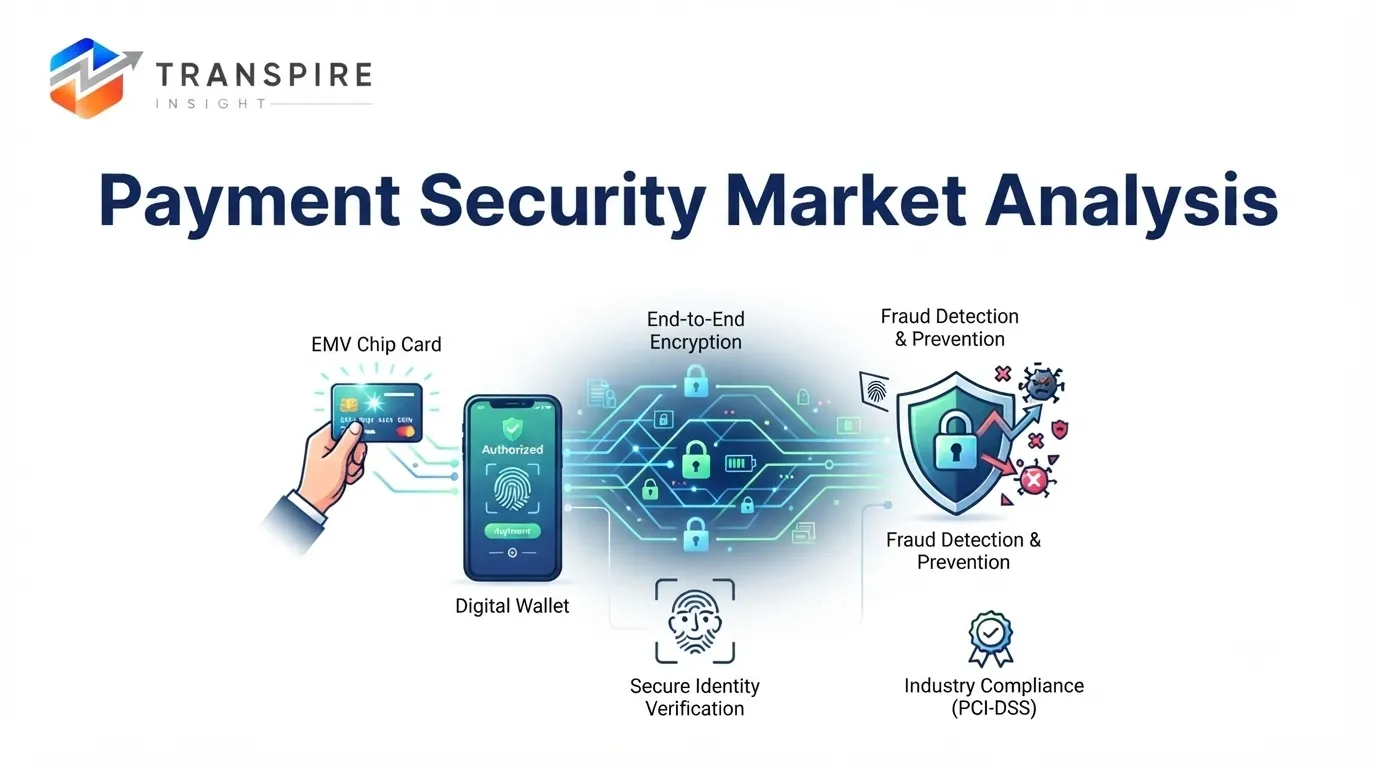
The rapid growth of digital payments is changing the way consumers and businesses move money, but it is also creating new opportunities for fraud, identity theft, account takeover and payment-data breaches.
Financial institutions, merchants and technology providers are therefore investing in encryption, tokenization, authentication and fraud-prevention technologies to protect increasingly complex payment ecosystems.
September 2026: Digital payments have become an integral part of modern commerce.
Consumers increasingly use cards, mobile wallets, instant-payment systems, online banking and other digital payment methods.
At the same time, payment networks are becoming more interconnected.
The expansion of e-commerce and real-time payments has created more transaction opportunities but also provides cybercriminals with additional targets.
Payment security technologies help protect transaction data, authenticate users and identify suspicious activity.
Market Size
The global payment security market was estimated at approximately USD 35.6 billion in 2025 and is projected to reach around USD 149 billion by 2034, expanding at a CAGR of approximately 17.1% during 2026–2034.
Current market estimates vary considerably because some definitions include only dedicated payment-security software, while others include fraud prevention, encryption, tokenization and broader transaction-security infrastructure. Fortune Business Insight estimates the 2025 market at USD 34.8 billion and projects USD 145.91 billion by 2034.
Digital Payments Are the Main Market Driver
The rapid adoption of digital payments is creating a strong foundation for payment-security growth.
E-commerce, mobile wallets and real-time payment platforms generate enormous transaction volumes.
Every additional transaction creates a requirement for authentication, encryption and fraud monitoring.
As payment ecosystems become more digital, security is increasingly becoming a fundamental part of payment infrastructure rather than an optional feature.
Fraud Detection Becomes More Sophisticated
Fraudsters are using increasingly advanced techniques to target payment systems.
Account takeover, synthetic identities, phishing, automated attacks and social engineering can bypass traditional security controls.
Payment-security providers are therefore incorporating machine learning and behavioral analytics.
These systems can evaluate transaction characteristics and identify unusual patterns.
Real-time detection is becoming especially important because fraudulent transactions can occur within seconds.
Tokenization Protects Sensitive Data
Tokenization is one of the major technologies supporting payment security.
Instead of storing sensitive payment information directly, tokenization replaces it with a substitute value that has limited usefulness outside its intended environment.
This can reduce the exposure of sensitive payment information.
Tokenization is particularly relevant for mobile payments, digital wallets and recurring transactions.
Encryption Remains Fundamental
Encryption continues to be a basic component of secure payment infrastructure.
It protects information as it moves between customers, merchants, payment processors and financial institutions.
As payment systems become more interconnected, encryption technologies must operate across multiple platforms and environments.
The integration of encryption with tokenization and authentication can provide multiple layers of protection.
Biometric Authentication Expands
Biometric authentication is becoming increasingly common in digital payments.
Fingerprint recognition, facial recognition and behavioral authentication can provide additional security beyond traditional passwords.
Mobile devices have accelerated biometric adoption because many smartphones already contain biometric sensors.
The technology can also improve customer convenience by reducing reliance on passwords.
Artificial Intelligence Changes Fraud Prevention
Artificial intelligence is becoming one of the most important technologies in payment security.
AI systems can process large numbers of transactions and identify unusual behavior rapidly.
Machine-learning models can be trained to detect patterns associated with fraud.
However, AI also creates new risks.
Fraudsters can use generative AI to create more convincing phishing campaigns and social-engineering attacks.
This means payment-security providers must use AI both defensively and proactively.
E-Commerce Creates Significant Demand
Online retail is a major end-use environment for payment-security technologies.
Consumers expect transactions to be fast and convenient, but merchants must also protect customer information.
Security systems must therefore operate without creating excessive friction.
Risk-based authentication is becoming increasingly important because it allows payment providers to apply stronger verification only when a transaction appears suspicious.
BFSI Remains a Leading End-Use Industry
Banks, financial institutions and insurance companies remain major users of payment-security technologies.
These organizations process large transaction volumes and operate under strict regulatory requirements.
They also face substantial financial and reputational consequences when payment systems are compromised.
Investment in fraud detection, authentication and transaction monitoring is therefore expected to remain strong.
North America Maintains Market Leadership
North America remains the largest regional market.
Fortune Business Insight estimates that North America accounted for approximately 35.8% of global payment-security revenue in 2025.
The region benefits from advanced financial infrastructure, widespread card and digital-payment adoption and a large concentration of fintech and cybersecurity companies.
Asia Pacific is expected to experience strong growth because of rapid mobile-payment adoption, expanding e-commerce and increasing fintech investment.
Competitive Landscape
The payment-security market includes major cybersecurity companies, payment technology providers, financial technology companies and cloud platforms.
Competition is based on fraud-detection accuracy, transaction-processing speed, integration capabilities, regulatory compliance and the ability to protect multiple payment channels.
Major companies include IBM, Visa, Mastercard, Broadcom, Fiserv, Thales, Entrust, Fortinet, Akamai and Cybersource.
Top 10 Companies in Payment Security Market
1. IBM
Headquarters: Armonk, New York, USA
IBM provides cybersecurity, artificial intelligence and risk-management technologies that can support payment-security environments.
Its enterprise focus allows financial institutions to integrate security and governance across complex IT systems.
2. Visa
Headquarters: San Francisco, California, USA
Visa operates one of the world's largest payment networks and invests heavily in transaction security, fraud prevention and tokenization.
Its scale provides extensive access to payment-security data and infrastructure.
3. Mastercard
Headquarters: Purchase, New York, USA
Mastercard develops payment technologies and security solutions supporting card payments, digital transactions and authentication.
The company's cybersecurity capabilities are increasingly important as payment fraud becomes more sophisticated.
4. Fiserv
Headquarters: Milwaukee, Wisconsin, USA
Fiserv provides payment processing, financial technology and merchant solutions.
Its role across payment infrastructure gives it significant exposure to transaction-security requirements.
5. Thales
Headquarters: Meudon, France
Thales provides cybersecurity, digital identity and payment-security technologies.
Its expertise in encryption, authentication and secure digital infrastructure supports financial institutions and payment providers.
Outlook: Could Payment Security Become More Intelligent and Invisible?
The payment security market is moving toward continuous and increasingly automated protection.
Future systems are likely to combine AI-based fraud detection, behavioral analytics, tokenization, biometrics and adaptive authentication.
Security providers will increasingly need to protect payment systems without creating friction for legitimate customers.
The expansion of instant payments will make real-time fraud detection particularly important because there is less time to intervene before a transaction is completed.
As digital commerce expands, payment security could become an invisible but essential layer of the global financial infrastructure.
The companies that can combine high security with fast transaction processing and seamless customer experiences are likely to gain the strongest competitive positions.


Send us a brief description of your challenge and we'll get back to you within 24 hours.

 inquiry@transpireinsight.com
 APAC:+91 7666513636
 Address


