
Sep 22, 2026
By Transpire Insight
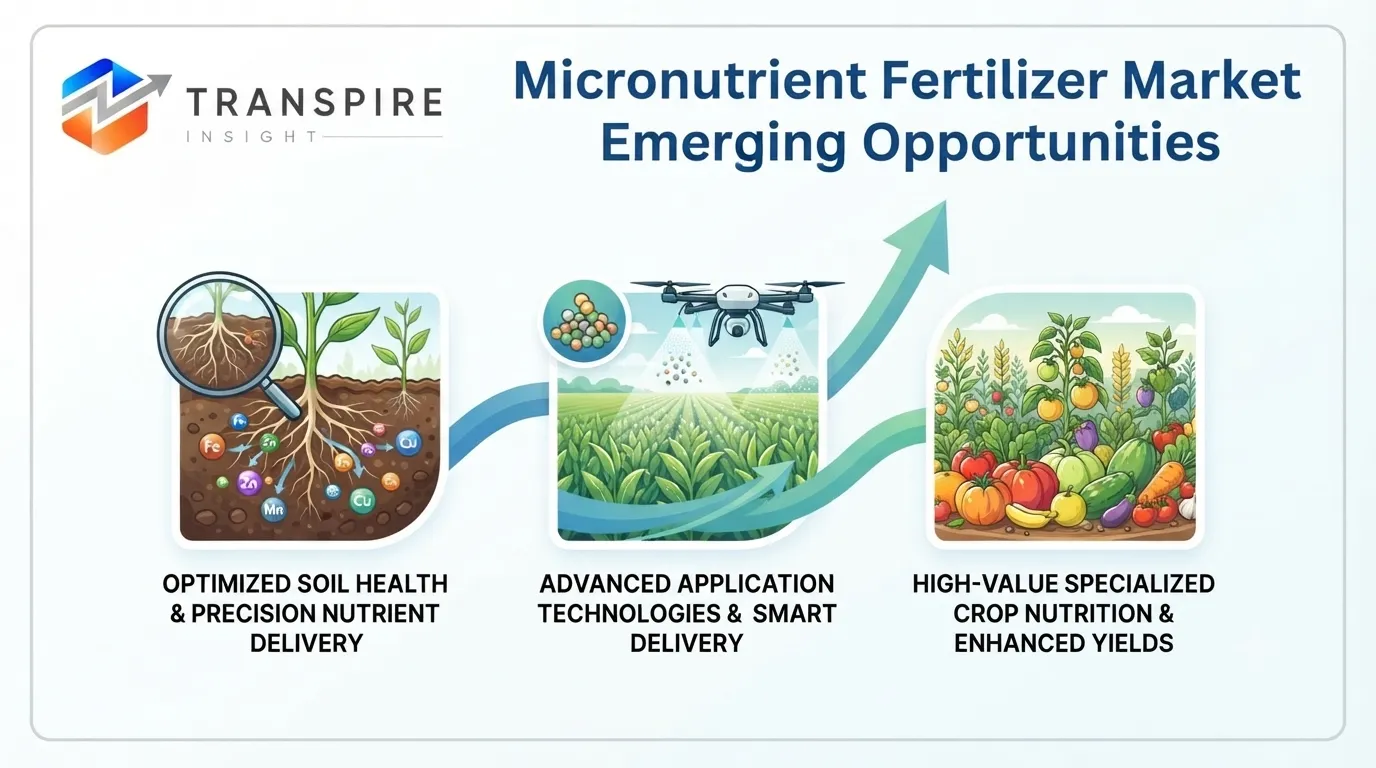
The global micronutrient fertilizer market is becoming increasingly important as agricultural producers confront soil nutrient depletion, declining soil quality, higher crop-yield expectations, and the need for more efficient fertilizer application.
The global market is estimated at approximately USD 6.4 billion in 2025 and could reach around USD 14.3 billion by 2035, representing an estimated CAGR of approximately 8.6%. Recent market research places the market at about USD 6.2 billion in 2025 and USD 14 billion in 2035.
Key Growth Drivers
Micronutrients including zinc, iron, manganese, boron, copper, molybdenum, and chlorine play important roles in crop development. Although required in smaller quantities than nitrogen, phosphorus, and potassium, deficiencies can significantly affect crop quality and productivity.
Soil degradation, intensive farming, and nutrient imbalance are increasing the need for targeted micronutrient supplementation. Precision agriculture is further changing fertilizer management by enabling farmers to apply nutrients according to field-specific requirements.
Precision Agriculture
GPS-guided equipment, soil mapping, sensors, satellite imagery, and digital farm-management platforms are allowing farmers to identify nutrient deficiencies more accurately.
Growing Crop Productivity Requirements
Population growth and pressure on agricultural land are encouraging farmers to increase productivity without proportionally increasing cultivated acreage.
Zinc and Iron Deficiency
Zinc and iron remain particularly important micronutrients in many agricultural regions. Their commercial importance supports continued investment in specialized fertilizer formulations.
Regional Outlook
Asia Pacific represents a major growth opportunity because of its large agricultural base, increasing fertilizer consumption, and growing awareness of balanced crop nutrition.
North America benefits from highly mechanized farming and widespread adoption of precision agriculture.
Europe is supported by sustainability-focused agricultural policies and increasing attention to fertilizer efficiency and environmental impact.
Top 10 Companies
ICL Specialty Fertilizers
ICL offers specialty fertilizer solutions designed for different crops, soils, and application conditions. Its portfolio positions the company well as agriculture shifts toward more targeted nutrient management.
Haifa Group
Haifa Group specializes in specialty fertilizers and fertigation technologies. Its focus on soluble fertilizers and precision nutrient delivery supports the move toward efficient fertilizer application.
The Mosaic Company
Mosaic is a major global fertilizer producer with significant expertise in crop nutrition. Its scale and distribution network provide a strong platform for expanding specialty nutrient solutions.
Tessenderlo Kerley
Tessenderlo Kerley has a strong presence in crop nutrition products, including specialty nutrient solutions. Its technologies address farmers seeking improved nutrient efficiency.
Koch Agronomic Services
Koch Agronomic Services focuses on technologies that improve fertilizer efficiency and nutrient utilization. Its portfolio supports the broader transition toward precision crop nutrition.
Outlook
The micronutrient fertilizer industry is expected to move increasingly toward customized and precision-based formulations. Farmers will demand products that provide measurable crop benefits while reducing nutrient waste.
With the market potentially reaching around USD 14.3 billion by 2035, micronutrient fertilizers could become a more integrated component of modern crop-management systems.


Send us a brief description of your challenge and we'll get back to you within 24 hours.

 inquiry@transpireinsight.com
 APAC:+91 7666513636
 Address


