
Sep 14, 2026
By Transpire Insight
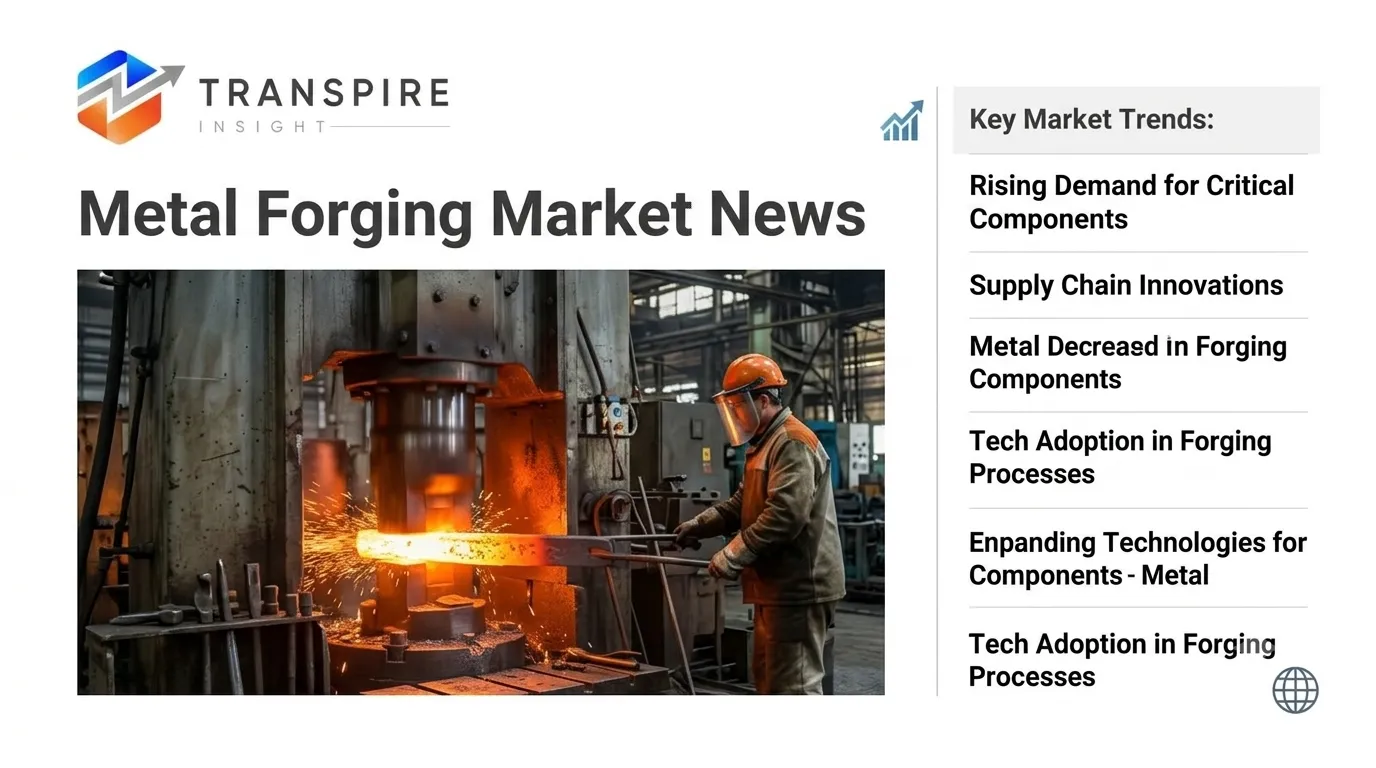
According to Transpire Insight, the global metal forging market is estimated at approximately USD 89.30 billion in 2025 and is expected to reach around USD 95.60 billion in 2026. The market is projected to reach approximately USD 166.90 billion by 2035, expanding at an estimated CAGR of 6.41% during the forecast period 2026–2035.
The metal forging market is entering a new phase of industrial transformation as manufacturers across automotive, aerospace, defense, energy, construction equipment, rail, marine, agriculture, and heavy machinery increasingly demand components that combine high strength, dimensional reliability, fatigue resistance, and weight efficiency.
Metal forging is a manufacturing process in which heated or cold metal is shaped through controlled compressive forces. Unlike manufacturing approaches that simply remove material from a larger block, forging can influence the internal grain flow of a component, supporting mechanical properties that are particularly valuable in highly loaded applications.
The market is being influenced by several major industrial shifts occurring simultaneously. Aerospace manufacturers are increasing production of aircraft and engines, automotive companies are redesigning vehicle architectures around electrification, defense manufacturers are expanding domestic supply chains, and energy infrastructure is requiring increasingly robust mechanical components.
At the same time, forging companies are under pressure to improve productivity and reduce manufacturing waste. Energy consumption, raw-material utilization, die life, process consistency, and labor availability are becoming increasingly important factors in forging economics.
Automation is emerging as one of the most significant responses to these pressures. A June 2026 industrial study comparing manual and robotized hot-die forging found that robotic operation increased tested tool life by 35% and improved dimensional repeatability under the investigated production conditions. The findings demonstrate how automation can influence not only labor efficiency but also tooling economics and process consistency.
The market is therefore moving from conventional high-volume metal forming toward precision forging, digitally monitored production, advanced alloy processing, automated cells, lightweight component engineering, and increasingly sustainable manufacturing.
Market Overview
Metal forging encompasses a broad family of forming processes used to create components from steel, aluminum, titanium, magnesium, nickel alloys, and other metals.
Depending on the design and production requirement, manufacturers can use open-die forging, closed-die forging, impression-die forging, ring forging, precision forging, cold forging, warm forging, and hot forging.
The selection of a forging method depends on factors such as component geometry, material characteristics, required mechanical properties, production volume, dimensional tolerance, surface requirements, and downstream machining requirements.
One of the most important applications remains automotive manufacturing. Forged components are used in areas such as shafts, steering components, suspension systems, gears, drivetrain parts, wheel-related components, and structural systems.
The transition toward electric vehicles is changing the composition of automotive forging demand rather than eliminating the need for forged components. EV architectures introduce new requirements around motor systems, shafts, reduction gears, structural components, thermal-management hardware, and other highly loaded parts.
Aerospace represents another strategically important application. Aircraft engines and structural systems require materials and manufacturing processes capable of meeting stringent mechanical, dimensional, fatigue, and traceability requirements.
The importance of aerospace forging is becoming particularly visible in 2026. On April 13, 2026, Safran announced a €150 million investment in a new 30,000-metric-ton hydraulic forging press at its Gennevilliers site. The company expects the investment to create 130 jobs and support a production ramp-up that could nearly double the site's activities by 2035.
Defense manufacturing is also becoming an increasingly important demand source. Forged components are used across aircraft, naval equipment, military vehicles, propulsion systems, artillery-related components, and other defense applications.
The Indian defense industry provides a notable example of this structural demand. India's defense production reached a record ₹1.78 lakh crore in FY2025–26, while private-sector participation increased to approximately ₹42,000 crore.
The market is therefore benefiting from both traditional industrial demand and new investment in strategically important manufacturing sectors.
Latest Market Statistics
The global metal forging market is expected to maintain a positive growth trajectory as industries increasingly prioritize component reliability, lightweighting, precision manufacturing, and localized production.
Transpire Insight estimates that the market reached approximately USD 89.30 billion in 2025 and could increase to around USD 95.60 billion in 2026. By 2035, the market is projected to approach USD 166.90 billion.
Growth is being supported by expanding automotive production, aircraft manufacturing, defense expenditure, infrastructure modernization, power-generation equipment, industrial machinery, and renewable-energy systems.
One of the most important changes is the increasing emphasis on value-added forging. Customers are seeking components that require less downstream machining, provide tighter dimensional control, use material efficiently, and meet increasingly complex performance requirements.
This is encouraging manufacturers to invest in precision forging equipment, simulation software, advanced dies, automated material handling, inline inspection, and process-monitoring systems.
Another significant shift is the growing importance of lightweight alloys. Aluminum, titanium, magnesium, and advanced high-strength steels can allow manufacturers to reduce component weight while retaining the mechanical properties required for demanding applications.
For automotive manufacturers, this can support vehicle efficiency and range. In aerospace, weight reduction can contribute to aircraft performance. In industrial equipment, lighter components can reduce operating loads and improve equipment efficiency.
The market is therefore increasingly influenced by the combination of strength, lightweighting, precision, and production efficiency.
Major Growth Drivers
Expansion of aerospace manufacturing: Growing aircraft production and engine programs are increasing demand for precision-forged components capable of meeting demanding mechanical and safety requirements.
Growth of defense manufacturing: Rising investment in defense production and supply-chain localization is creating demand for high-strength forged components for aircraft, naval systems, military vehicles, propulsion, and other applications.
Vehicle electrification: EVs are creating new component requirements while reducing or eliminating some traditional internal-combustion components, shifting forging demand toward new vehicle architectures.
Industrial infrastructure expansion: Construction equipment, energy systems, rail infrastructure, mining machinery, and industrial equipment require durable components capable of operating under high loads.
Demand for lightweight components: Manufacturers increasingly seek materials and geometries that reduce weight without compromising structural performance.
Automation and precision manufacturing: Robotics, process simulation, sensors, machine monitoring, and digital quality systems are improving forging consistency and productivity.
Supply-chain localization: Governments and industrial companies are increasingly interested in domestic or regional production of critical components, creating opportunities for forging capacity closer to major end markets.
Key Applications
Automotive represents a major application area for forged components. High-strength parts are used throughout vehicle powertrain, steering, suspension, chassis, and structural systems.
Aerospace requires highly controlled forging processes for aircraft-engine components, landing systems, structural parts, and other applications where material integrity is critical.
Defense uses forged components across propulsion, vehicles, artillery-related systems, naval equipment, aircraft, and other high-reliability applications.
Construction equipment represents another significant application because excavators, loaders, cranes, mining machinery, and other heavy equipment require components capable of handling substantial mechanical loads.
Oil and gas uses forged components in valves, pressure systems, drilling equipment, wellhead systems, and other applications requiring mechanical and pressure resistance.
Power generation provides demand through turbines, shafts, generators, heavy rotating equipment, and other infrastructure components.
Rail and transportation use forged wheels, axles, suspension components, couplings, and other safety-critical parts.
Renewable energy is becoming increasingly relevant through wind turbines, power-generation equipment, transmission infrastructure, and other large mechanical systems.
Government Initiatives and Advanced Manufacturing Modernization
Government support for advanced manufacturing, defense localization, infrastructure, and industrial technology is creating favorable conditions for the metal forging industry.
India's National Defence Industries Conclave 2026 focused specifically on advanced manufacturing technologies, including automation, artificial intelligence, robotics, additive manufacturing, digital twins, and smart materials. The initiative is intended to strengthen India's defense-manufacturing ecosystem and expand the participation of MSMEs, private manufacturers, innovators, and research institutions.
India's draft Defence Acquisition Procedure 2026 also emphasizes greater indigenous manufacturing and higher domestic content in defense procurement, creating a policy environment that can support local production of strategically important components.
In June 2026, the Indian government also established a major aluminum-processing investment through a 10,000-ton extrusion press at Yantra India Limited in Nagpur, aimed at increasing domestic production of high-strength precision aluminum products for aerospace and defense applications.
Although extrusion and forging are different manufacturing processes, these investments demonstrate the broader policy direction toward advanced domestic metal-forming capabilities.
Environmental policy is also becoming more relevant. The European Union's Carbon Border Adjustment Mechanism entered its definitive regime in 2026 and applies to carbon-intensive sectors including iron, steel, and aluminum. This is increasing pressure on metal-intensive manufacturing supply chains to better understand and reduce embedded emissions.
For forging manufacturers, the result is a stronger strategic focus on energy efficiency, scrap utilization, process optimization, material traceability, and lower-carbon production.
Technology and Process Overview
The metal forging market includes several important manufacturing technologies.
Open-die forging is used for larger components and lower-volume applications where flexibility in shape and size is important. It is particularly relevant to heavy equipment, power generation, aerospace, marine, and specialized industrial components.
Closed-die forging uses dies that constrain the metal into a defined geometry and is well suited to higher-volume production of complex components.
Hot forging involves forming metal at elevated temperatures, improving material formability and allowing manufacturers to create complex shapes from difficult-to-form alloys.
Warm forging operates at intermediate temperatures and can provide a balance between material formability, dimensional accuracy, and surface quality.
Cold forging is performed without heating the workpiece to forging temperatures and can provide excellent dimensional control and surface finish for suitable materials and geometries.
Ring rolling and ring forging are important for large circular components used in aerospace, energy, industrial machinery, and other applications.
Precision forging is becoming increasingly important as manufacturers seek to reduce machining requirements and improve material utilization.
The market is also incorporating forging simulation software. Digital modeling can help engineers evaluate metal flow, die filling, temperature behavior, deformation, stress, and potential defects before physical production begins.
This can reduce trial-and-error development and improve die design.
Top Market Trends
The metal forging market is evolving as manufacturers respond to rising demand for precision, efficiency, lightweighting, resilience, and sustainability.
Technological Advancements
Technology is one of the strongest forces transforming the metal forging market.
Servo-controlled forging equipment can provide greater control over force, stroke, timing, and energy consumption compared with less sophisticated systems.
Robotic handling systems can perform repetitive high-temperature material movement, improving worker safety and production consistency.
Process sensors can monitor temperature, force, displacement, vibration, and other parameters during forging.
Digital twins can replicate production processes virtually and help manufacturers evaluate process adjustments before applying them to physical equipment.
Machine vision can inspect forged components for dimensional or surface abnormalities after production.
Ultrasonic and other non-destructive testing methods are particularly important for high-reliability components where internal defects may not be visible through conventional inspection.
Finite-element simulation allows manufacturers to study metal flow and deformation before producing physical parts.
The growing combination of these technologies is transforming forging from a largely experience-driven process into a more measurable and data-rich manufacturing operation.
Artificial Intelligence and Smart Forging
Artificial intelligence is expected to become increasingly important in the metal forging market.
Forging processes generate large amounts of data related to temperature, force, cycle time, die condition, material behavior, machine vibration, and dimensional results.
AI models can potentially identify patterns associated with defects, die wear, dimensional drift, equipment problems, or changing material behavior.
Predictive maintenance is another important application. Rather than servicing forging presses and tooling according to fixed schedules, manufacturers could increasingly use machine data to estimate when maintenance is likely to be required.
AI can also support process optimization. Algorithms can evaluate relationships between heating temperature, deformation rate, forging pressure, cooling conditions, and final component properties.
In automated facilities, AI could eventually coordinate material handling, production scheduling, quality inspection, and equipment maintenance.
However, AI adoption requires reliable historical data and appropriate process validation. High-temperature manufacturing remains complex, and AI recommendations need to be verified against engineering requirements and physical process behavior.
Investment and Growth Opportunities
The expansion of advanced manufacturing is creating opportunities for forging companies, steel and alloy suppliers, press manufacturers, automation companies, die producers, simulation-software providers, inspection specialists, and industrial technology firms.
One major opportunity is aerospace forging capacity. The aviation sector requires highly reliable components and increasingly complex alloy systems, creating demand for large presses, precision forging, advanced heat treatment, and sophisticated inspection.
The defense sector also offers substantial potential. India's record defense-production levels and continued emphasis on domestic manufacturing are increasing opportunities for companies capable of meeting demanding quality and traceability requirements.
Electric vehicle components represent another growth opportunity. While electrification can reduce demand for some conventional engine and transmission forgings, it can increase demand for high-strength shafts, gears, structural components, motor-related parts, and specialized systems.
Renewable-energy equipment provides additional potential through wind-turbine components, power-generation equipment, large bearings, shafts, and infrastructure.
Advanced forging automation is also an attractive investment area because automation can address labor constraints while improving repeatability and workplace safety.
Emerging manufacturing economies provide further opportunities as governments seek stronger domestic industrial supply chains.
Market Segmentation
The metal forging market can be segmented based on material, forging process, technology, component type, application, and end user.
By material, the market includes carbon steel, alloy steel, stainless steel, aluminum, titanium, magnesium, nickel-based alloys, and other specialty materials.
By forging process, the market includes open-die forging, closed-die forging, impression-die forging, precision forging, cold forging, warm forging, hot forging, and ring forging.
By technology, major categories include conventional presses, hydraulic presses, mechanical presses, screw presses, servo presses, automated forging systems, and digitally monitored forging systems.
By component type, the market includes shafts, gears, axles, connecting components, rings, wheels, structural parts, fasteners, valves, turbine components, and other engineered forgings.
By application, major areas include automotive, aerospace, defense, construction equipment, energy, oil and gas, rail, marine, agriculture, industrial machinery, and renewable energy.
Leading and Fastest-Growing Segments
The steel forging segment is expected to remain a major component of the market because steel continues to provide the strength, toughness, cost profile, and availability required across diverse industrial applications.
The aluminum forging segment represents a major growth opportunity where lightweighting is important, particularly in aerospace, automotive, transportation, and selected industrial applications.
The titanium and nickel-alloy segment is expected to maintain strong strategic importance in aerospace and high-temperature environments where performance requirements justify premium materials.
The closed-die forging segment remains important for medium- and high-volume component production where repeatability and dimensional consistency are critical.
The precision forging segment is expected to gain importance as manufacturers seek to reduce machining requirements and improve material utilization.
The automotive segment will remain a major demand center, while aerospace, defense, energy, and advanced industrial applications are expected to contribute increasingly to higher-value forging demand.
Competitive Landscape
Competition in the metal forging market is increasingly focused on material expertise, forging capacity, dimensional precision, automation, tooling capability, quality assurance, energy efficiency, and the ability to produce complex components at scale.
Large forging companies often differentiate themselves through extensive press capacity, global production networks, alloy expertise, heat-treatment capabilities, engineering services, and advanced inspection infrastructure.
Smaller specialized manufacturers can compete through niche capabilities, faster customization, low-volume production, specialized alloys, close customer relationships, and application expertise.
Aerospace and defense customers place particularly high importance on traceability, certification, process consistency, quality systems, and long-term supply reliability.
The competitive environment is also being influenced by capital investment. Safran's €150 million 2026 forging-press project illustrates how major aerospace manufacturers are investing directly in additional forming capacity to support future production requirements.
Automation is becoming another competitive differentiator. Companies able to operate forging cells with robotics, sensors, digital process control, and automated inspection can potentially improve productivity while reducing variability.
Challenges and Restraints
Despite strong growth prospects, the metal forging market faces several structural challenges.
High capital requirements are a major barrier. Large forging presses, heating systems, dies, material-handling equipment, heat-treatment lines, and inspection systems require substantial investment.
Energy consumption is another important concern, particularly in hot forging. Heating metal to forging temperatures can require significant energy, making furnace efficiency and electricity or fuel costs important factors in production economics.
Tooling costs can be substantial for closed-die production. Complex components may require multiple dies and substantial development work before reaching stable production.
Raw-material price volatility can affect profitability because steel, aluminum, titanium, nickel alloys, and other materials represent major production costs.
Skilled labor shortages can create operational challenges, particularly for specialized forging, die design, metallurgy, maintenance, and inspection functions.
Process complexity can also increase defect risk. Variations in material temperature, deformation rate, die condition, lubrication, or cooling can influence component properties.
Decarbonization pressure is becoming more important for energy-intensive manufacturers. The EU's CBAM framework places carbon costs on selected imported products in sectors including iron, steel, and aluminum, increasing the importance of understanding embedded emissions across metal supply chains.
Nevertheless, automation, simulation, energy-efficiency improvements, and advanced process monitoring can help manufacturers address several of these constraints.
Regional Market Outlook
The metal forging market is developing across major regions as industrial manufacturing, automotive production, aerospace capacity, defense spending, and infrastructure development continue to expand.
Asia-Pacific represents a major market because of its extensive automotive and industrial manufacturing base, large forging capacity, expanding defense production, infrastructure development, and increasing investment in advanced manufacturing.
China, India, Japan, South Korea, and other Asian manufacturing economies are increasingly investing in precision manufacturing and localized supply chains.
India is gaining particular strategic importance. National defense production reached ₹1.78 lakh crore in FY2025–26, while the private sector's contribution rose to approximately ₹42,000 crore. The country is also promoting automation, robotics, AI, digital twins, and other advanced manufacturing technologies through initiatives such as the National Defence Industries Conclave 2026.
North America remains an important market supported by aerospace and defense production, automotive manufacturing, energy infrastructure, heavy equipment, and industrial modernization.
Europe represents a highly developed forging ecosystem with strong aerospace, automotive, industrial machinery, and energy applications. At the same time, European manufacturers are facing increased pressure to reduce industrial emissions and improve carbon transparency. The EU's CBAM entered its definitive regime in January 2026 for selected carbon-intensive products.
Latin America offers opportunities through automotive production, mining, energy infrastructure, oil and gas, agriculture, and industrial equipment.
Middle East & Africa are expected to experience increasing demand as energy projects, infrastructure, defense investment, transportation development, and industrial diversification expand.
Future Market Opportunities
One of the strongest future opportunities lies in large-scale aerospace forging. Rising aircraft production and the need for high-performance engine components are encouraging investment in larger presses and advanced alloy-processing capabilities. Safran's 2026 investment demonstrates the scale of this capacity trend.
The defense forging segment provides another significant opportunity as countries invest in domestic production of strategic components and reduce dependence on external supply chains.
EV-related forging is likely to become increasingly important as vehicle manufacturers develop new architectures and require lightweight, high-strength components.
Wind-energy and renewable infrastructure can create demand for large forged rings, shafts, bearings, and structural components.
Precision forging offers another strong opportunity because reducing machining requirements can improve material utilization and lower manufacturing costs.
There is also substantial potential in forging-as-a-digital-service, where manufacturers provide customers with simulation, design optimization, process development, digital quality documentation, and lifecycle support alongside physical components.
Role of Automation and Advanced Manufacturing
Automation is becoming one of the most important forces changing forging operations.
Robots can perform high-temperature material handling, transfer workpieces between stations, manipulate dies, remove finished components, and support automated inspection.
The industrial comparison published in 2026 found that robotized hot-die forging improved tool life by 35% under the tested conditions while also improving dimensional repeatability.
This type of improvement has implications beyond labor savings. Longer die life can reduce tooling replacement frequency, maintenance interruptions, and production variability.
Digital process monitoring can also track temperature, force, cycle time, machine vibration, and other parameters.
Advanced simulation can predict metal flow and die filling before physical production.
Automated inspection can verify dimensional tolerances and identify defects.
The future forging plant is therefore likely to become increasingly automated, sensor-rich, digitally modeled, and data-driven.
Personalized and Precision Forging
The increasing complexity of industrial components is driving greater demand for customized forging solutions.
Aerospace customers may require highly specific titanium or nickel-alloy geometries, while automotive customers may prioritize lightweight steel or aluminum components.
Energy and defense applications can require large-scale specialized forgings with stringent mechanical and inspection requirements.
Digital design and simulation allow manufacturers to adapt forging processes to these individual component requirements.
This can reduce development iterations and improve the relationship between the component's final geometry and its forging process.
The market is therefore moving toward precision-engineered forgings developed around specific performance requirements, rather than treating forging as a standardized mass-production process.
Key Strategic Developments
Companies operating in the metal forging market are expected to focus on:
These strategies demonstrate that competition is moving beyond production volume toward precision, automation, material engineering, energy efficiency, and strategic manufacturing capability.
Recent Industry Developments
The metal forging industry has recorded several important developments during 2026 that illustrate the direction of the global market.
On April 13, 2026, Safran Aircraft Engines announced a €150 million investment to install a 30,000-metric-ton hydraulic press at its Gennevilliers forging facility. The new press is expected to create 130 jobs from 2026 and enter operation in 2029, with production at the site expected to nearly double by 2035. The facility is intended to support commercial and military aircraft-engine programs.
On June 15, 2026, research published in Archives of Civil and Mechanical Engineering compared manual and robotized hot-die forging under industrial conditions. The robotized process increased tested tool life from 3,210 to 4,333 forged parts, equivalent to a 35% improvement, while also improving dimensional repeatability.
India's defense-manufacturing ecosystem is also expanding. On June 17, 2026, the Ministry of Defence reported record defense production of ₹1.78 lakh crore during FY2025–26, including approximately ₹42,000 crore from the private sector. The increase is relevant to forging because defense platforms require a wide range of high-strength metal components and precision-manufactured parts.
On June 19, 2026, the Indian Ministry of Defence signed a ₹425 crore contract with Bharat Forge for 12 sets of 1.25 MW marine gas-turbine generators for the Indian Navy, with minimum indigenous content of 60%. The contract demonstrates the expansion of domestic advanced manufacturing into strategic naval power-generation systems.
The manufacturing environment is also becoming more focused on carbon performance. The European Union's CBAM definitive regime began on January 1, 2026, placing carbon-pricing requirements on imports in selected sectors including iron, steel, and aluminum. The policy is increasing pressure on metal-intensive manufacturers to improve carbon accounting and production efficiency.
Together, these developments indicate that metal forging is increasingly being shaped by aerospace capacity expansion, automation, defense localization, strategic manufacturing, and industrial decarbonization.
Market Expert View
From a market perspective, the metal forging market is positioned for continued transformation because it sits at the intersection of automotive manufacturing, aerospace, defense, energy, industrial machinery, infrastructure, advanced materials, and digital manufacturing.
The fundamental advantage of forging remains its ability to produce high-strength components capable of handling significant mechanical loads.
However, the competitive definition of forging is changing.
Manufacturers are increasingly expected to deliver tighter tolerances, lower material waste, shorter development cycles, greater traceability, improved energy efficiency, and increasingly complex geometries.
Automation will play a critical role in this transition. The value of a robotic forging cell is not limited to reducing manual handling. Stable process conditions can influence die life, consistency, quality, and production planning.
Aerospace and defense are likely to remain especially valuable because customers in these sectors place a premium on material integrity, reliability, certification, and supply continuity.
Automotive demand will remain substantial, but electrification is likely to shift the composition of forging demand toward lightweight and electrically relevant components.
Another important change is the growing importance of regional manufacturing resilience. Governments and major industrial customers increasingly want access to critical components without depending excessively on distant supply chains.
This creates opportunities for forging manufacturers capable of combining scale, automation, metallurgy, engineering expertise, and reliable domestic production.
Future Outlook
The future of the metal forging market is expected to be shaped by precision manufacturing, lightweight alloys, aerospace expansion, defense localization, EV component development, industrial automation, renewable-energy infrastructure, and low-carbon production.
Steel is expected to remain fundamental to the industry, while aluminum, titanium, magnesium, and nickel-based alloys are likely to gain importance in applications where weight reduction, temperature resistance, or specialized mechanical properties are critical.
Aerospace and defense are expected to remain important sources of higher-value forging demand as aircraft production, strategic equipment programs, and domestic manufacturing initiatives expand.
Automation and robotics will increasingly reshape production economics. Digital simulation, AI-assisted optimization, predictive maintenance, and automated inspection could reduce variability and improve productivity.
Decarbonization will become increasingly important, particularly in Europe and other markets where carbon-related requirements influence industrial supply chains.
Emerging manufacturing economies are expected to provide additional opportunities as automotive, aerospace, defense, energy, construction equipment, and industrial sectors expand.
The industry is consequently moving toward a future in which forging capacity alone is no longer enough; material science, automation, digital engineering, energy performance, and manufacturing resilience will increasingly determine competitiveness.
Conclusion
The metal forging market is evolving from a traditional metal-forming industry into an advanced manufacturing ecosystem that supports some of the world's most demanding industrial applications.
Automotive electrification, aircraft production, defense modernization, energy infrastructure, industrial machinery, and renewable-energy development are creating continued demand for components that combine strength, durability, precision, and weight efficiency.
At the same time, automation, digital simulation, artificial intelligence, advanced inspection, lightweight alloys, and energy-efficient processing are transforming how forged components are designed and produced. Recent 2026 research demonstrates that robotic forging can improve tool life and dimensional consistency, while major aerospace investments show that large-scale forging capacity remains strategically important.
Government policies are reinforcing this transformation through defense localization, advanced-manufacturing initiatives, domestic supply-chain development, and increasingly stringent carbon requirements.


Send us a brief description of your challenge and we'll get back to you within 24 hours.

 inquiry@transpireinsight.com
 APAC:+91 7666513636
 Address


