
Oct 14, 2026
By Transpire Insight
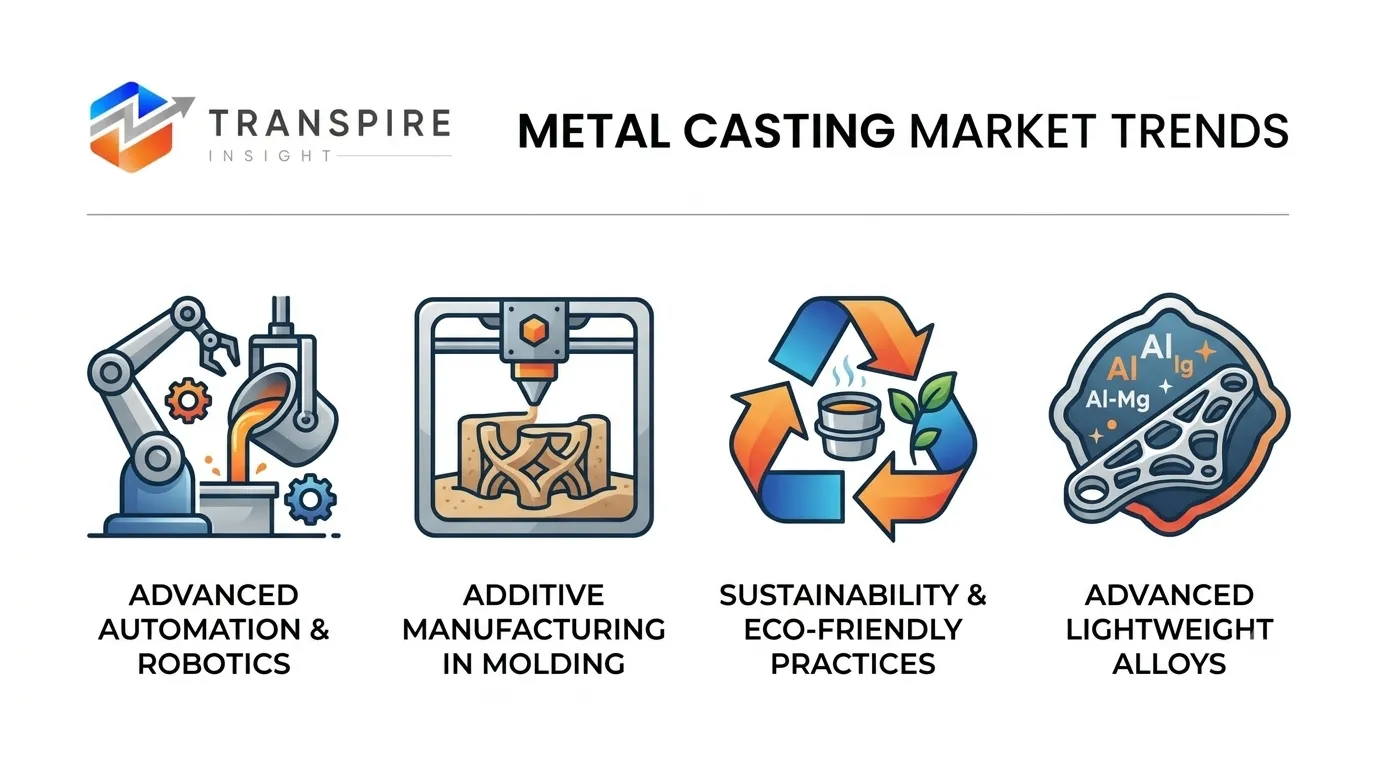
The global Metal Casting Market remains essential to automotive, industrial machinery, construction equipment, aerospace, energy, and infrastructure manufacturing. At the same time, advanced casting technologies, lightweight alloys, automation, digital process monitoring, and increasing demand for complex components are changing traditional foundry operations.
Metal Casting Market Overview
Metal casting involves pouring or injecting molten metal into a mold to create components with specific geometries and mechanical characteristics.
Major processes include:
Common materials include:
Transpire Insight estimates that the global Metal Casting Market was valued at approximately USD 154.7 billion in 2025, increased to around USD 161.9 billion in 2026, and is expected to reach approximately USD 223.5 billion by 2033, representing a CAGR of approximately 4.68%.
Latest Global Market Developments
The American Foundry Society projected approximately 8% year-over-year growth in North American casting sales for 2026, following approximately USD 53.7 billion in industry revenue during 2025.
Vehicle production continues to require castings for structural, powertrain, suspension, braking, and other components.
Automotive lightweighting is encouraging greater use of aluminum and other lightweight alloys.
Electric vehicles require different combinations of housings, structural parts, thermal-management components, and motor-related castings.
Manufacturers are exploring larger integrated cast components to reduce part counts and simplify vehicle assembly.
Robotics, automated pouring, machine vision, and process monitoring are improving consistency and workplace safety.
Casting simulation can help identify filling, solidification, porosity, and thermal problems before physical production.
Foundries are investing in efficient furnaces, heat recovery, improved process controls, and lower-emission technologies.
Why Metal Casting Matters?
Casting enables manufacturers to produce complex components in materials capable of handling substantial mechanical, thermal, and structural requirements.
It supports:
Key Factors Driving the Market
1. Automotive Production
Vehicles remain one of the largest applications for cast components.
2. Industrial Machinery
Industrial equipment requires durable housings, frames, gears, pump bodies, and structural components.
3. Infrastructure Development
Construction and infrastructure investment creates demand for cast components and machinery.
4. Lightweighting
Aluminum and magnesium castings can reduce component weight.
5. Advanced Foundry Technology
Automation and simulation are improving production efficiency and quality.
Five High-Potential Markets
1. China
China's automotive, machinery, infrastructure, and industrial manufacturing base makes it a major casting market.
2. India
India is expanding automotive, industrial, railway, defense, and infrastructure manufacturing.
3. United States
The U.S. offers opportunities through reshoring, automotive production, aerospace, defense, and infrastructure.
4. Germany
Germany's automotive and industrial-equipment sectors sustain demand for advanced casting.
5. Japan
Japan remains important for automotive, robotics, machinery, and precision manufacturing.
Competitive Landscape
Top 5 Companies
Opportunities for Small Investors
Challenges & Restraints
Energy costs, metal-price volatility, environmental requirements, skilled-labor shortages, furnace emissions, quality-control requirements, and expensive equipment can challenge foundry profitability.
Conclusion
The Metal Casting Market continues to provide the manufacturing foundation for numerous industries, while its technology base is becoming increasingly automated and digitally controlled.
The American Foundry Society's 2026 forecast indicates stronger-than-expected North American casting activity, while Asia Pacific remains the largest global production region.
Future opportunities will increasingly center on lightweight alloys, EV components, large-format casting, automated foundries, digital simulation, energy efficiency, and high-precision production.


Send us a brief description of your challenge and we'll get back to you within 24 hours.

 inquiry@transpireinsight.com
 APAC:+91 7666513636
 Address


