
Sep 16, 2026
By Transpire Insight
The global student accommodation market is expanding through rising higher-education enrolment, international student mobility, urbanisation, limited housing availability and increasing demand for safe, convenient and professionally managed student living, creating significant opportunities across established and emerging education markets.
The global student accommodation sector has become an increasingly important part of the higher-education and real-estate ecosystem. Growing numbers of students are pursuing university education away from their home cities and countries, creating sustained demand for purpose-built student accommodation (PBSA), university-managed residences, private rentals, co-living spaces and other specialized housing formats.
According to Transpire Insight, the global student accommodation market was valued at approximately USD 63.00 billion in 2025, is estimated to reach USD 68.00 billion in 2026, and is projected to reach approximately USD 115.00 billion by 2033, representing a 7.80% CAGR from 2026 to 2033.
The sector encompasses purpose-built student accommodation, university-managed accommodation, private rental housing and other formats such as homestays. Modern student residences increasingly provide furnished rooms, high-speed internet, study areas, fitness facilities, security, communal spaces and digital property-management services, making accommodation an increasingly integrated part of the student experience.
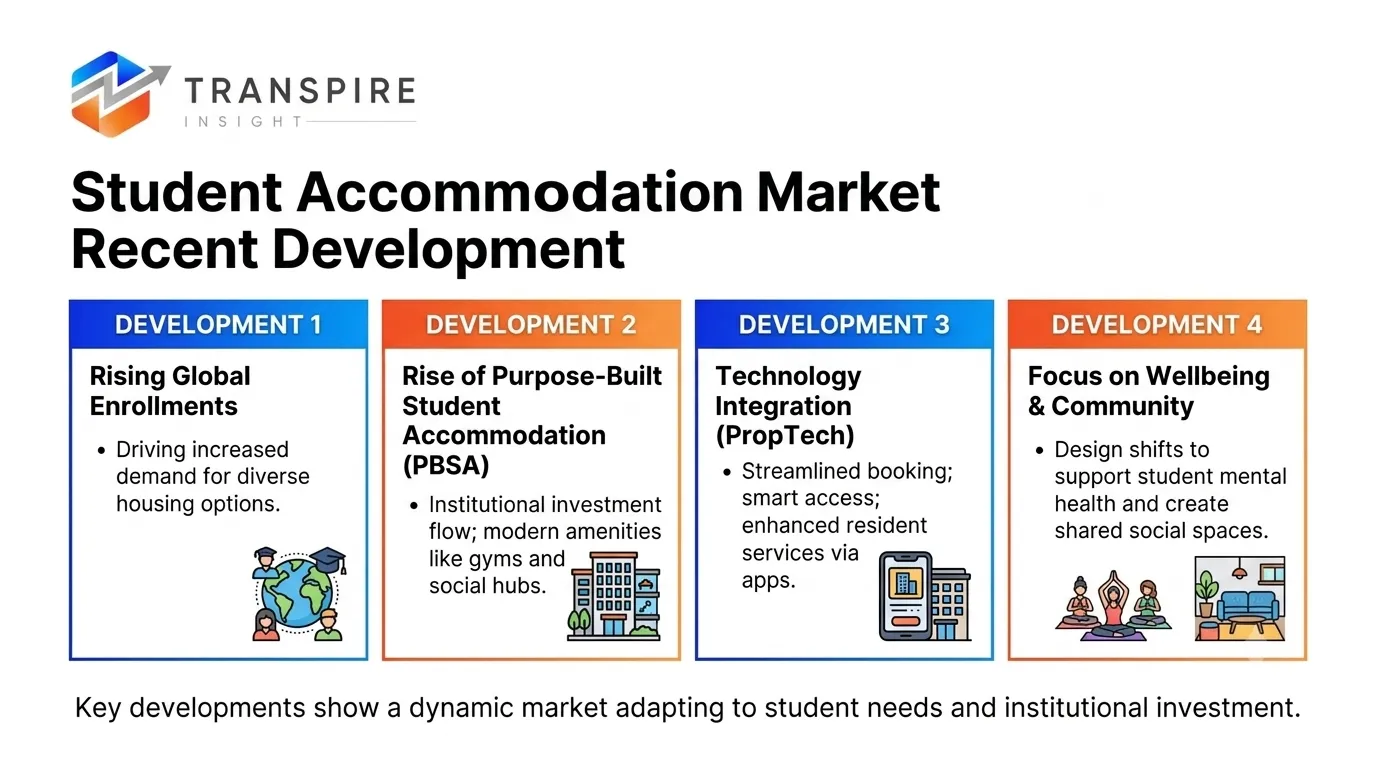
Latest Global Market Developments
Why Student Accommodation Matters?
Student accommodation is an important component of the higher-education infrastructure because housing availability can directly influence students' ability to study in particular cities and institutions. When universities expand enrolment without corresponding growth in accommodation, students face increased competition for private rental properties, longer commuting distances and higher housing costs.
Purpose-built accommodation addresses many of these challenges by providing housing specifically designed for students. Modern residences can combine bedrooms or studios with study areas, communal kitchens, fitness centres, laundry facilities, social spaces, security systems and digital services. This creates an environment that supports both academic activity and student life.
Student accommodation is also becoming increasingly important to universities seeking to attract international students. Students arriving from overseas often prefer professionally managed housing because it provides greater certainty regarding location, furnishings, utilities, security and tenancy arrangements.
The sector also has significant implications for real estate investors. Student housing can provide recurring rental income supported by relatively predictable academic calendars, while constrained supply around major universities can create strong occupancy and rental demand. However, recent market developments show that demand is not uniform across every university city. In the UK, for example, the increasing number of students choosing to remain at home has contributed to weaker occupancy in some PBSA locations, demonstrating the importance of selecting markets based on local student demographics and university strength.
Key Factors Driving Student Accommodation
The growing global student population is creating a larger underlying requirement for accommodation. Universities in major education destinations continue to attract students from both domestic and international markets, increasing demand for rooms close to campuses.
The effect is particularly strong in cities where universities have expanded enrolment but housing construction has not kept pace with student numbers.
International education remains one of the strongest structural drivers of student accommodation demand. Students studying overseas typically require accommodation outside their family homes and often prefer furnished and professionally managed residences.
The United States, United Kingdom, Australia and Canada remain major destinations, while emerging education markets in Asia and Europe are also attracting increasing numbers of international students.
Insufficient dedicated student housing is creating significant development opportunities in many university cities. Australia illustrates this structural imbalance, with CBRE estimating potential excess demand of around 185,000 PBSA rooms.
The shortage is also visible in the UK, where new PBSA supply has remained constrained despite strong student demand and institutional investment.
Students increasingly expect accommodation to provide more than a basic bedroom. High-speed internet, security, communal facilities, study environments, gyms, laundry services and social spaces are becoming important differentiators.
PBSA therefore competes not simply on room availability but on the overall student-living experience.
Student accommodation has developed into a recognized real-estate asset class, attracting institutional investors, private-equity firms, pension funds, property developers and specialist operators.
Investment activity is particularly strong in markets where universities have large enrolments, international students represent a significant share of demand and the existing accommodation stock is insufficient.
Five High-Potential Markets Shaping Global Student Accommodation
The United States is one of the world's most important student accommodation markets, supported by its extensive higher-education system, large university populations and substantial international student base.
The country hosted approximately 1.18 million international students during the 2024–25 academic year, creating substantial demand for accommodation near major universities.
Student housing demand is concentrated around large university markets where limited residential supply can create strong competition for rooms. Purpose-built developments increasingly provide private bedrooms, shared living spaces, study facilities, fitness centres and technology-enabled property management.
Future development is expected across university partnerships, off-campus PBSA, student-focused mixed-use projects, redevelopment of older housing stock and professionally managed private student communities.
The United Kingdom is one of the world's most established purpose-built student accommodation markets. Its large university system, international student population and mature institutional investment environment have created a sophisticated PBSA industry.
PBSA investment reached approximately £4.3 billion in 2025, representing a 10% increase from the previous year, while approximately £2.1 billion was invested during Q1 2026.
However, the market is becoming more differentiated. Recent evidence shows that a growing number of students are choosing to live at home because of affordability pressures, contributing to weaker occupancy in some locations.
Future opportunities are therefore expected to concentrate around leading universities, strong employment centres, international student hubs and locations where accommodation supply remains structurally constrained.
Australia is one of the highest-potential student accommodation markets because of its large international education sector and shortage of dedicated student housing.
CBRE estimates that the country has potential excess demand of approximately 185,000 PBSA rooms, while only around 7% of students are currently served by PBSA.
Sydney, Melbourne, Brisbane, Perth and Adelaide remain important markets because of their large university populations and concentration of international students.
The future market is likely to see increased development of university-linked residences, private PBSA, affordable student housing and amenity-rich accommodation. Australia's supply shortage creates significant opportunities for institutional developers, although high construction costs and planning requirements remain important constraints.
Canada represents another important student accommodation market because of its large higher-education system, international student population and housing shortages in major university cities.
Toronto, Vancouver, Montreal, Calgary and Ottawa have significant concentrations of students and universities, creating demand for housing within convenient distance of campuses and public transportation.
The Canadian market is increasingly focused on professionally managed accommodation and purpose-built developments, particularly in cities where conventional rental housing is expensive or difficult for students to secure.
Future growth is expected from university partnerships, urban PBSA, student-focused co-living and redevelopment of properties near major education institutions.
India represents one of the most promising long-term student accommodation markets because of its enormous higher-education population, expanding private education sector and rapid urbanisation.
Major education hubs such as Bengaluru, Delhi-NCR, Pune, Hyderabad, Mumbai, Chennai and Ahmedabad attract large numbers of students from across the country. Traditional hostels remain important, but professionally managed student residences and co-living formats are increasingly developing alongside them.
India also has substantial scope for institutional investment because organized student housing remains relatively underdeveloped compared with mature markets such as the United States, United Kingdom and Australia.
Future growth is expected across affordable PBSA, managed hostels, co-living, technology-enabled accommodation platforms and housing developed through university or private-sector partnerships.
Competitive Landscape
Major companies active across student accommodation, purpose-built student housing, real-estate investment and professionally managed student living include:
The competitive landscape includes specialist student-housing operators, institutional investors, real-estate developers and university accommodation partners. Competition increasingly centres on location, affordability, occupancy, amenities, sustainability and the ability to provide a strong student experience.
Top 5 Companies in the Student Accommodation Market
Headquarters: Bristol, United Kingdom
Unite Students is one of the largest student accommodation operators in the United Kingdom, focusing specifically on purpose-built accommodation for university students.
The company operates a large portfolio across major UK university cities and increasingly works with universities through nomination and partnership agreements. Its strategy focuses on locations with strong student demand, high-quality accommodation and long-term university relationships.
The company's scale gives it significant exposure to the UK's structurally undersupplied student-housing market, although recent changes in student preferences have increased the importance of location and affordability.
Headquarters: Charleston, South Carolina, USA
Greystar is a major global real-estate investment, development and management company with significant exposure to student accommodation.
Its student-housing platform operates across multiple international markets, allowing the company to benefit from increasing demand for professionally managed student residences.
Greystar's international approach is particularly relevant as student accommodation becomes increasingly institutionalized across Europe, North America and Asia-Pacific.
Headquarters: London, United Kingdom
Scape is a major student accommodation operator with properties across key education markets, particularly in the UK and Australia.
The company focuses on purpose-built residences that combine furnished accommodation with shared amenities, study areas, social spaces and student services.
Its presence in Australia is particularly significant because of the country's large student-accommodation shortage and continued international student demand.
Headquarters: London, United Kingdom
GSA Group is an international student accommodation company operating and investing in student housing across several major education markets.
The company's model focuses on creating professionally managed student communities close to universities and transportation networks.
As student accommodation becomes increasingly specialized, operators such as GSA benefit from the growing preference for professionally managed housing that combines accommodation with services and community facilities.
Headquarters: Melbourne, Australia
Campus Living Villages is a global student accommodation provider with a strong focus on university-linked residential communities.
The company develops and manages student accommodation designed around the academic and social needs of university populations.
Its international operating experience provides exposure to markets where universities and private developers increasingly collaborate to expand accommodation capacity.
Opportunities for Small Investors
The student accommodation sector provides several opportunities for small and specialized investors, particularly in university cities where demand is growing faster than organized supply.
Potential opportunities include boutique student residences, professionally managed hostels, student co-living properties, accommodation for international students, small-scale PBSA developments, property-management services and digital booking platforms.
Investors can also explore the conversion of suitable residential or commercial properties into student housing where local planning regulations permit.
Secondary university cities may provide attractive opportunities because property costs can be lower than in major capital cities while student demand remains strong.
However, successful investment depends heavily on location. Investors should evaluate university enrolment, student growth, local accommodation supply, rental affordability, transportation connectivity and the competitive pipeline before committing capital.
Challenges & Restraints
The student accommodation industry faces several challenges despite its long-term growth potential.
High land prices, construction costs, financing expenses and planning requirements can make new PBSA projects difficult to develop at affordable rental levels. These pressures are particularly significant in major university cities where land availability is limited.
Affordability is another major restraint. Rising accommodation costs can encourage students to choose shared housing, commute from family homes or select universities closer to where they live. Recent UK data illustrates this trend, with 31% of accepted 18-year-olds planning to live at home for the 2025–26 academic year, compared with 22% a decade earlier.
Demand is also highly location-specific. A national shortage of student housing does not necessarily mean every university city has an undersupply. Some markets can experience weaker occupancy when student numbers stagnate or when new accommodation enters the market faster than demand.
Other challenges include:
The industry therefore requires a more localized investment approach, with developers increasingly prioritizing universities and cities where student demand is supported by strong enrolment, international mobility and limited accommodation supply.
Conclusion
Student accommodation is transforming from a traditional university-housing function into a specialized global real-estate sector incorporating PBSA, university-managed residences, private rentals, co-living, digital property management and student-focused services.
The United States, United Kingdom, Australia, Canada and India are expected to remain important markets because of their large student populations, international education ecosystems and continuing need for dedicated accommodation. Australia stands out for its substantial PBSA supply gap, while the UK remains a highly institutionalized investment market despite changing student affordability and commuting patterns.
The strongest opportunities in the coming years will be concentrated in markets that combine growing student populations, strong universities, limited housing supply, transportation connectivity and demand for professionally managed accommodation. Developers and operators that can balance affordability, location, student experience and sustainable development are likely to be best positioned for the next phase of global student accommodation growth.


Send us a brief description of your challenge and we'll get back to you within 24 hours.

 inquiry@transpireinsight.com
 APAC:+91 7666513636
 Address


