
Sep 18, 2026
By Transpire Insight
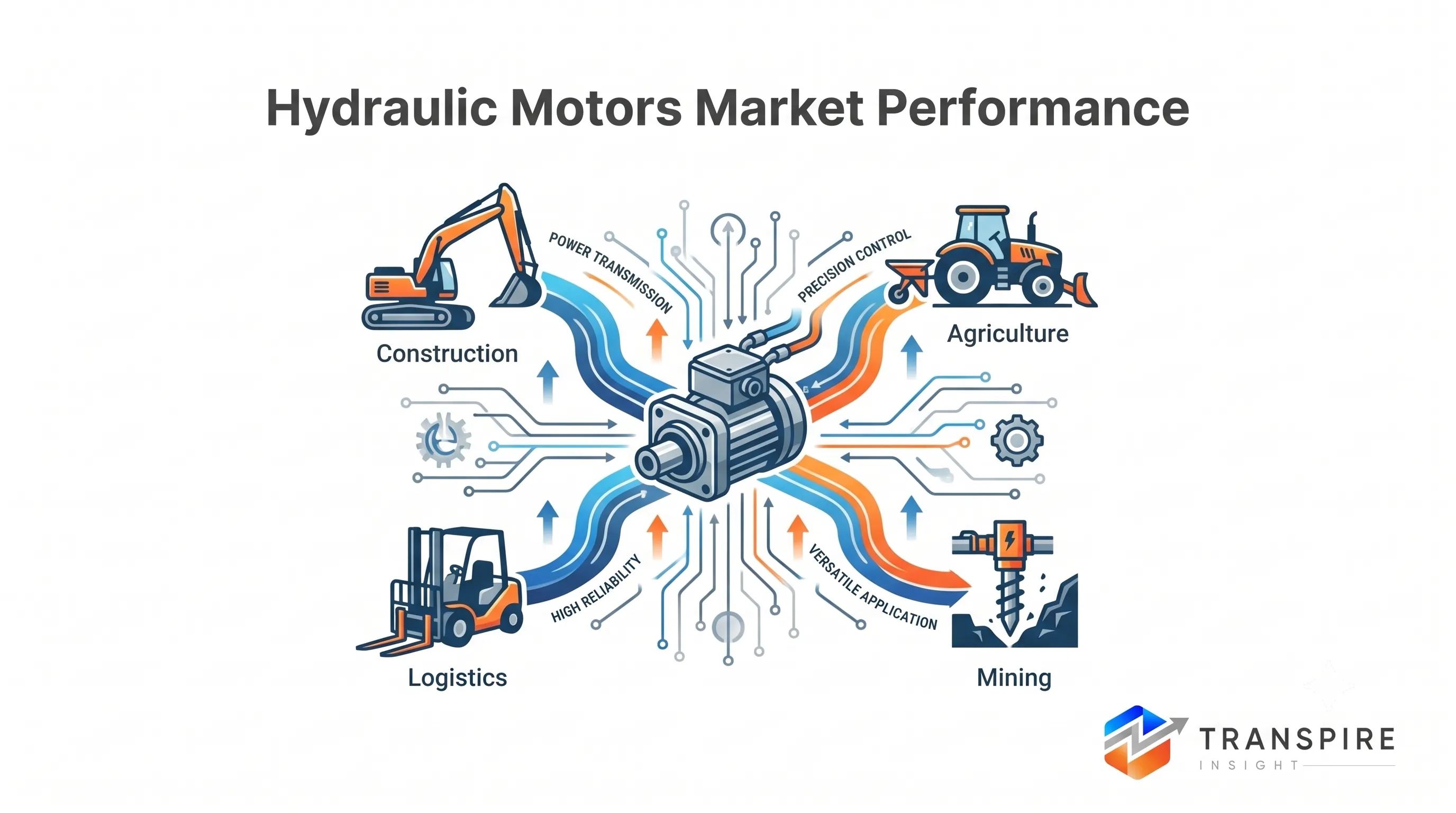
Hydraulic motors remain essential to heavy machinery, construction, agriculture and industrial equipment, but the technology is entering a more connected and efficiency-focused phase. Manufacturers are combining hydraulic power with sensors, electronic controls and digital monitoring to improve machine productivity.
The combination of high power density, automation and digital monitoring is keeping hydraulic motors relevant even as industries move toward more efficient machinery.
September 2026: Hydraulic motors continue to provide reliable rotary motion in applications where high torque, durability and compact power transmission are required.
Construction equipment, mining machinery, agricultural machinery, material-handling systems and industrial equipment remain important demand centers.
However, modern hydraulic systems are changing. Manufacturers increasingly focus on efficiency, electronic control and predictive maintenance.
Market Size
The global hydraulic motors market was estimated at USD 13.3 billion in 2025 and is projected to reach approximately USD 25.4 billion by 2035, growing at a CAGR of 6.9% from 2026 to 2035. North America currently represents the largest regional market, while Asia Pacific is expected to be the fastest-growing region.
Construction Equipment Remains a Core Demand Driver
Hydraulic motors are particularly valuable in construction equipment because they can provide high torque and controlled movement in demanding environments.
Excavators, loaders, cranes, drilling equipment and other heavy machinery rely on hydraulic systems for functions requiring substantial force.
Construction activity in developing economies is therefore closely linked to hydraulic-motor demand.
Infrastructure investment, urbanization and large-scale development projects can create additional demand for equipment equipped with hydraulic drive systems.
Agriculture Is Becoming More Technology Driven
Agricultural machinery is another important market for hydraulic motors.
Modern tractors, harvesters and specialized agricultural equipment increasingly incorporate hydraulic functions for steering, lifting, positioning and other operations.
As farms become more mechanized, equipment manufacturers are seeking hydraulic systems that deliver higher efficiency and greater reliability.
The trend toward precision agriculture may also encourage greater integration of electronic controls and sensors into hydraulic systems.
Digitalization Is Changing Hydraulic Motor Design
Hydraulic motors are increasingly being integrated with sensors and electronic control systems.
Real-time monitoring can provide information about temperature, pressure, speed and operating conditions. This data can help operators identify abnormal performance before a component fails.
Predictive maintenance can reduce unplanned downtime, which is particularly important for mining, construction and industrial equipment where machine stoppage can create significant financial losses.
The integration of digital technologies is therefore creating new value beyond the traditional mechanical performance of hydraulic motors.
Efficiency Is Becoming More Important
Energy efficiency is increasingly important as machinery operators face higher operating costs and stricter environmental expectations.
Manufacturers are developing hydraulic motors and complete hydraulic systems designed to reduce unnecessary energy losses while maintaining performance.
Variable-speed control, improved hydraulic circuits and electronic management can help equipment operate more efficiently under changing loads.
This is particularly relevant for mobile machinery, where energy efficiency can directly affect fuel consumption and operating economics.
Asia Pacific Could Become the Main Growth Engine
Asia Pacific is expected to record the fastest growth in the hydraulic motors market.
Industrialization, infrastructure development, construction activity and agricultural mechanization are supporting demand across China, India and other Asian markets.
The region also contains a large manufacturing base for machinery and hydraulic components, strengthening local supply chains.
As equipment manufacturers increasingly incorporate automation and connected functions, demand for higher-performance hydraulic motors is likely to increase.
Competitive Landscape Is Broad
Eaton led the market with more than 7% share in 2025. Eaton, Parker Hannifin, Bosch Rexroth, Danfoss and Kawasaki Heavy Industries together held approximately 17% of market revenue.
Competition is shaped by motor efficiency, durability, pressure capability, product customization, service support and integration with complete hydraulic systems.
Top 10 Companies in Hydraulic Motors Market
Headquarters: Dublin, Ireland
Eaton is a major power-management and hydraulic technology provider. Its hydraulic portfolio supports mobile and industrial applications requiring efficient and reliable motion control.
Headquarters: Cleveland, Ohio, USA
Parker Hannifin provides hydraulic motors and systems across industrial and mobile applications. Its broad motion-control portfolio allows it to supply integrated hydraulic solutions.
Headquarters: Lohr am Main, Germany
Bosch Rexroth specializes in drive and control technologies, including hydraulic systems and motors. Its focus on automation and connected machinery supports its position in advanced hydraulic applications.
Headquarters: Nordborg, Denmark
Danfoss provides hydraulic and electronic technologies for mobile and industrial equipment. Its portfolio increasingly combines hydraulic power with digital controls and efficiency-focused solutions.
Headquarters: Kobe, Japan
Kawasaki Heavy Industries supplies hydraulic equipment for construction machinery and other demanding applications. Its expertise in high-performance hydraulic systems supports its global position.
Outlook: Could Digital Hydraulics Extend the Market's Growth?
Hydraulic motors are likely to remain essential wherever machinery requires high torque, durability and reliable power transmission.
The next phase of growth will increasingly depend on efficiency, electronic control and connected maintenance rather than conventional hydraulic performance alone.
As construction, agriculture, mining and industrial automation expand, manufacturers that combine hydraulic power with digital intelligence could gain a stronger competitive position.


Send us a brief description of your challenge and we'll get back to you within 24 hours.

 inquiry@transpireinsight.com
 APAC:+91 7666513636
 Address


