
Sep 18, 2026
By Transpire Insight
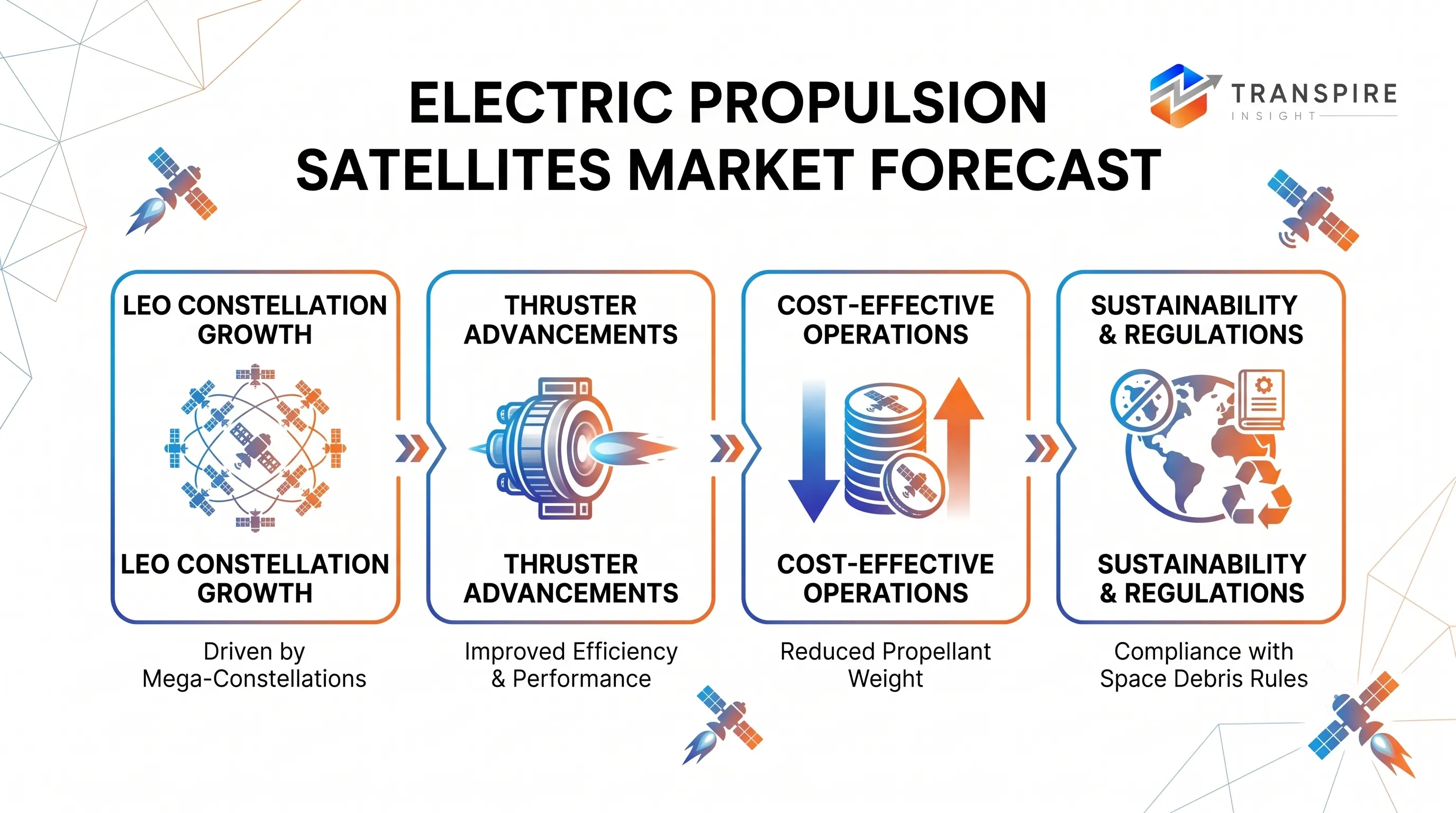
Electric propulsion is becoming a defining technology in the satellite industry as operators prioritize lower propellant consumption, longer mission life, efficient orbital maneuvering and improved spacecraft economics.
The satellite industry is entering an era of unprecedented scale. Commercial communication networks, Earth-observation systems, navigation infrastructure and government missions are increasing the number of spacecraft operating across multiple orbital regimes.
This expansion is creating a critical requirement for propulsion systems that can deliver efficient maneuvering without consuming large quantities of propellant. Electric propulsion is increasingly meeting that requirement.
Unlike conventional chemical propulsion, which generates high thrust over short periods, electric propulsion produces lower thrust but can operate efficiently for extended durations. This makes it particularly useful for station keeping, orbit raising, formation control and other maneuvers where fuel efficiency is more important than rapid acceleration.
Global Market Insight estimates the electric propulsion satellites market at approximately USD 50.3 billion in 2025 and projects it toward USD 179.7 billion by 2035 at a CAGR of around 14%. The market definition is broader than narrower studies focused specifically on electric propulsion hardware, so figures should not be directly compared across different research scopes.
Market Size
The global electric propulsion satellites market is estimated at approximately USD 51 billion in 2025 and could reach nearly USD 180 billion by 2035, representing an estimated CAGR of about 14%.
North America remains a leading regional market because of major satellite manufacturers, defense programs and commercial space investment. Asia Pacific is expected to experience strong growth as satellite manufacturing, communications infrastructure and space programs expand.
Hybrid propulsion architectures currently represent a significant share because spacecraft operators can combine chemical systems for high-thrust maneuvers with electric propulsion for efficient long-duration operations.
Why Electric Propulsion Is Changing Satellite Economics
The main advantage of electric propulsion is propellant efficiency.
Satellites have limited mass budgets, and propellant competes with payloads, power systems and structural components. Reducing propellant requirements can therefore provide spacecraft designers with additional flexibility.
For commercial satellites, this can have direct economic consequences. More mass can potentially be allocated to revenue-generating payloads, while efficient propulsion can extend operational life.
For constellation operators, the benefits can multiply across hundreds or thousands of spacecraft.
LEO Constellations Are Creating Massive Demand
Low Earth orbit is becoming one of the most important areas of satellite activity.
Communications, Earth observation and other LEO constellations require large numbers of spacecraft operating in coordinated orbital configurations.
These satellites need propulsion for orbit maintenance, collision avoidance, formation management and end-of-life disposal.
Electric propulsion is particularly attractive because LEO satellites often have constrained mass budgets and long operational requirements.
Current market research estimates the LEO segment at approximately USD 21.7 billion in 2025 within the broader market definition.
Hall-Effect Thrusters Are Becoming Increasingly Important
Hall-effect thrusters are among the most established electric-propulsion technologies.
They use electromagnetic fields to accelerate ionized propellant, generating efficient thrust suitable for long-duration spacecraft operations.
The technology has gained attention because it provides a useful balance between efficiency, thrust and system maturity.
Manufacturers are also exploring alternative propellants. Xenon has traditionally been widely used, while krypton and other options can potentially reduce propellant costs.
The choice depends on mission requirements, spacecraft power availability and thruster design.
Full-Electric Architectures Are Gaining Momentum
Hybrid systems remain attractive because chemical propulsion provides high thrust when required. However, full-electric spacecraft architectures are gaining attention.
A spacecraft designed primarily around electric propulsion can potentially reduce chemical propulsion hardware and propellant requirements.
The trade-off is maneuvering time. Electric propulsion generally requires longer periods to achieve the same orbital change.
For missions where time is less critical than efficiency, this trade-off can be highly favorable.
Current industry estimates place the full-electric segment at approximately USD 17.6 billion in 2025 under the broader market definition, with a faster projected growth rate than some hybrid applications.
Small Satellites Are Creating New Engineering Requirements
Satellite miniaturization is changing propulsion design.
Small satellites have limited volume, mass and power. Propulsion systems therefore need to be compact while providing sufficient performance.
This has encouraged the development of miniature electric thrusters and integrated propulsion modules.
Small satellite manufacturers also increasingly seek standardized propulsion systems that can be incorporated into multiple spacecraft platforms.
As constellation production becomes more industrialized, standardized propulsion could help reduce cost and simplify spacecraft assembly.
Power Availability Is a Critical Constraint
Electric propulsion depends on electrical power.
Solar arrays and batteries must supply sufficient energy while also supporting communications payloads, onboard computers and other spacecraft functions.
This creates an important engineering relationship between propulsion and spacecraft power systems.
Higher-power satellites can operate stronger electric thrusters, but they also require larger solar arrays and more advanced power-processing equipment.
Future development will therefore focus not only on thruster efficiency but also on the complete propulsion-power architecture.
Propulsion Is Becoming Important for Satellite Sustainability
Satellite operators are facing growing expectations around orbital sustainability.
Spacecraft need reliable end-of-life strategies, particularly in increasingly crowded orbital environments.
Electric propulsion can support controlled orbital changes and disposal maneuvers, helping operators manage spacecraft throughout their lifecycle.
This makes propulsion relevant not only to mission performance but also to responsible space operations.
Commercial Space Is Accelerating Innovation
Commercial satellite companies are becoming major customers for electric propulsion.
Large communications constellations require thousands of spacecraft, creating substantial demand for propulsion systems that are efficient, reliable and scalable.
The commercial market also places strong pressure on manufacturers to reduce unit costs.
This encourages standardized designs, automated production and modular propulsion systems.
Government and defense programs remain important because they can fund advanced propulsion research and demonstration missions. The combination of government technology development and commercial scale is accelerating the industry's evolution.
Competitive Advantage Is Moving Toward Integrated Spacecraft Systems
Electric propulsion is no longer simply a standalone subsystem.
Satellite manufacturers increasingly need to integrate propulsion with power generation, thermal management, attitude control, communications and mission software.
This favors companies capable of delivering complete spacecraft architectures.
At the same time, specialist thruster manufacturers can compete by focusing on efficiency, compactness and advanced propulsion technologies.
Top 10 Electric Propulsion Satellite Companies
1) Boeing
Boeing has extensive experience in spacecraft manufacturing and space systems. Its capabilities allow electric propulsion to be integrated with communications, power and spacecraft architectures.
The company's scale provides opportunities across commercial, civil and defense satellite programs.
2) Lockheed Martin
Lockheed Martin develops spacecraft and advanced space systems for government and commercial missions.
Its expertise in defense and satellite engineering positions it strongly in propulsion applications where reliability, mission flexibility and long operational life are critical.
3) Northrop Grumman
Northrop Grumman participates across spacecraft, propulsion and defense-space technologies.
Its capabilities in satellite platforms and mission systems allow electric propulsion to be incorporated into broader spacecraft architectures rather than treated as an isolated subsystem.
4) Airbus
Airbus is active across satellite manufacturing and advanced spacecraft technologies.
Its European and international presence gives it access to commercial and government programs where electric propulsion is becoming increasingly important.
5) ArianeGroup
ArianeGroup has extensive propulsion engineering capabilities and participates in the European space ecosystem.
Its expertise across launch and space-propulsion technologies creates opportunities as spacecraft operators seek increasingly efficient propulsion solutions.
Future Outlook
The electric propulsion satellites market is expected to experience rapid expansion as commercial constellations, government missions and satellite miniaturization increase demand for efficient orbital maneuvering.
The market could approach USD 180 billion by 2035 under the broader market definition. Growth will be supported by LEO constellations, full-electric spacecraft, compact propulsion systems and higher-power satellite platforms.
Hall-effect thrusters are likely to remain an important technology, while alternative propellants and advanced electric-propulsion architectures could improve cost efficiency.
The competitive landscape will increasingly favor companies that can integrate propulsion with spacecraft power, thermal and control systems. At the same time, specialist propulsion developers will have opportunities to supply increasingly standardized systems to large constellation manufacturers.
Ultimately, electric propulsion is changing the economics of satellite design. Its lower thrust is offset by exceptional efficiency, making it particularly valuable in missions where spacecraft must operate for years rather than minutes. As orbital infrastructure expands, propulsion efficiency will become an increasingly important determinant of satellite performance, mission life and commercial viability.


Send us a brief description of your challenge and we'll get back to you within 24 hours.

 inquiry@transpireinsight.com
 APAC:+91 7666513636
 Address


