
Sep 17, 2026
By Transpire Insight
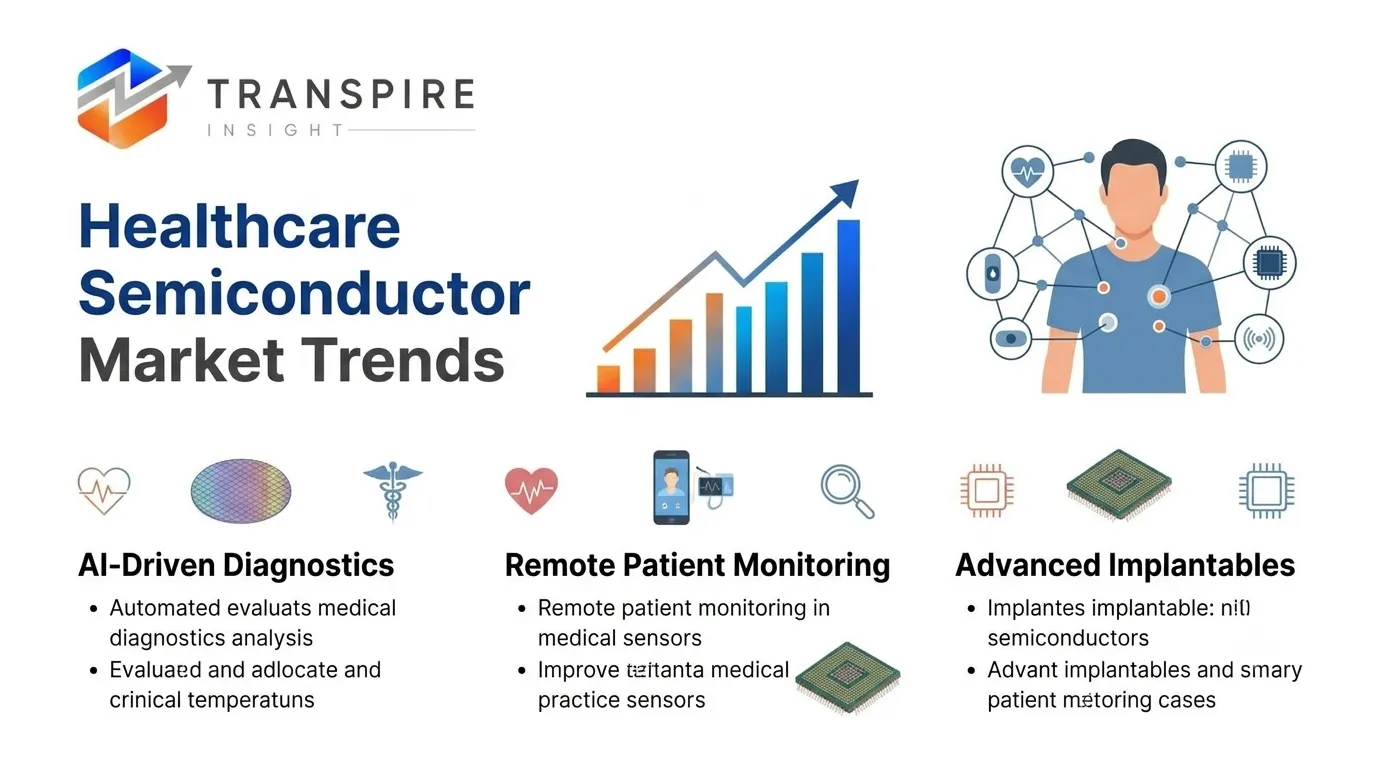
As healthcare becomes increasingly connected, intelligent and data-driven, semiconductor companies are expanding their capabilities across medical imaging, patient monitoring, diagnostics, wearables and next-generation healthcare devices.
As healthcare technology evolves, semiconductors are becoming an increasingly important part of the medical technology ecosystem. Chips are no longer limited to traditional computing and communication applications. They now support medical imaging systems, patient-monitoring equipment, diagnostic devices, wearable health technologies, surgical systems and connected healthcare infrastructure.
That equation is changing.
The global healthcare semiconductor market is gaining momentum as healthcare providers and medical-device manufacturers adopt artificial intelligence (AI), machine learning, connected devices, remote patient monitoring and increasingly compact medical electronics.
The global healthcare semiconductor market was valued at approximately USD 60.9 billion in 2025 and is projected to reach around USD 66.5 billion in 2026 and USD 161.7 billion by 2035, expanding at a CAGR of 10.4% during 2026–2035. The growth is being supported by increasing demand for AI-enabled medical devices, wearable health technologies, remote monitoring and miniaturised electronics.
For semiconductor companies, these developments point to a market that is becoming increasingly difficult to overlook. Healthcare is creating demand for sensors, integrated circuits, processors, connectivity components, power-management solutions and optoelectronic technologies that can operate reliably in increasingly sophisticated medical environments.
For India, the opportunity is particularly significant. The country's medical devices industry was valued at approximately USD 15.2 billion in 2025 and is projected to reach USD 50.1 billion by 2030, according to a 2026 report cited by The Economic Times. At the same time, India's medical-sensor market is projected to increase from USD 113.5 million in 2025 to USD 184.7 million by 2030.
Healthcare Technology Is Becoming a Bigger Semiconductor Opportunity
The role of semiconductors in healthcare extends far beyond individual medical devices. Increasing digitalisation of healthcare is creating demand throughout the technology value chain.
Medical imaging systems require high-performance processors, image sensors, signal-processing components and memory. Patient-monitoring systems depend on sensors, microcontrollers, connectivity chips and power-management components. Wearable devices require small, low-power and highly accurate sensors that can continuously collect physiological information.
At the same time, AI is increasing the processing requirements of healthcare systems. AI-supported imaging, diagnostics and drug discovery require increasingly powerful computing architectures capable of processing large volumes of medical data.
The semiconductor opportunity is therefore expanding alongside the broader transformation of healthcare.
The growth of AI and machine learning, rising chronic-disease prevalence, increasing healthcare IT investment, growing demand for wearable devices and remote patient monitoring, and the continued miniaturisation of medical electronics are among the major factors supporting market expansion.
The Healthcare Semiconductor Application Landscape Is Changing
Healthcare semiconductor demand is becoming increasingly diverse.
Medical imaging remains one of the largest application areas. In 2025, medical imaging accounted for approximately 31.9% of the global healthcare semiconductor market, reflecting the importance of advanced electronics in imaging, diagnostics and treatment planning.
Patient monitoring is another major growth area. Hospitals and healthcare providers are increasingly adopting connected monitoring equipment that can capture vital information continuously and transmit it to clinical systems.
Wearables are expanding the opportunity beyond hospitals. Smart health devices and remote-monitoring technologies can collect information such as heart rate, blood oxygen levels and other physiological signals, creating demand for compact and energy-efficient semiconductor components.
The sensor segment alone was valued at approximately USD 18 billion in 2025 and is expected to grow at a CAGR of 12.4% through the forecast period. The growth reflects rising demand for real-time health data collection, connected medical devices and continuous patient monitoring.
This creates a broader opportunity for semiconductor manufacturers.
A single healthcare ecosystem can require image-processing chips for medical imaging, sensors for wearable devices, microcontrollers for monitoring equipment, connectivity components for telemedicine and AI processors for advanced clinical applications.
Market Size and Statistics
How AI and Connectivity Are Changing Healthcare Semiconductors
Technology is transforming the way healthcare devices collect, process and communicate medical information.
AI-enabled healthcare applications require increasingly powerful processing capabilities. Medical imaging is one of the clearest examples, where algorithms can assist with image analysis and clinical decision-making. Semiconductor components provide the processing power, memory and connectivity required to operate these systems.
The trend is also visible in drug discovery. In August 2026, Huawei's healthcare division said it was expanding collaborations with pharmaceutical companies around AI-supported drug discovery, using its Ascend and Kunpeng chips for computational workloads such as compound screening.
At the device level, the move toward connected healthcare is increasing demand for sensors and communication components. Remote patient monitoring, telemedicine and wearable devices depend on the ability to capture, process and transmit healthcare information outside traditional hospital environments.
This is creating a new requirement for semiconductor manufacturers: chips need to be not only powerful, but also smaller, more energy-efficient, reliable and suitable for long-term operation in healthcare applications.
India Is Building a Larger Semiconductor and MedTech Ecosystem
India's semiconductor push could create additional opportunities for healthcare electronics manufacturers and chip companies.
The government has been expanding its semiconductor policy framework through the India Semiconductor Mission. In 2026, India Semiconductor Mission 2.0 was announced with a focus on semiconductor equipment and materials, indigenous semiconductor intellectual property, research, training and stronger domestic and global supply chains.
The broader semiconductor programme has also attracted significant manufacturing investment. The government says 12 semiconductor manufacturing units have been approved under the programme, with cumulative investment exceeding ₹1.64 lakh crore. These projects cover fabrication, packaging and related semiconductor technologies.
The connection with healthcare is important because sensors, integrated circuits, power electronics, connectivity components and advanced packaging are fundamental to many medical and diagnostic devices.
India is also seeking to expand its domestic MedTech capabilities. At the CII Global MedTech Summit in August 2026, the government highlighted the need to move beyond "Made in India" toward products that are designed, innovated and exported from India. India's MedTech industry is projected to reach approximately USD 20 billion by 2030.
As domestic medical-device manufacturing expands, the requirement for locally developed and supplied semiconductor components could increase alongside it.
How Semiconductor Companies Are Fighting for a Share of Healthcare
For semiconductor companies, the healthcare opportunity is no longer simply about supplying standard components. Medical applications require high reliability, accuracy, energy efficiency and long product lifecycles.
The first battleground is precision.
Healthcare sensors and semiconductor components need to capture and process data accurately. Small errors in monitoring or diagnostics can have significant consequences, increasing the importance of component reliability and performance.
Then comes power efficiency.
Wearable and portable healthcare devices need to operate for long periods using small batteries. Semiconductor manufacturers are therefore developing increasingly efficient sensors, processors, connectivity components and power-management technologies.
The next advantage is miniaturisation.
Healthcare devices are becoming smaller and more portable. Wearables, portable diagnostic equipment and implantable technologies require semiconductor components that can deliver increasing functionality within limited physical space.
Another important factor is AI processing.
As AI becomes increasingly integrated into healthcare, demand is emerging for processors and accelerators capable of handling imaging, diagnostics and other computational workloads closer to where medical data is generated.
Finally, companies need to address regulatory requirements and security. Healthcare devices operate in highly regulated environments, while connected medical systems can create cybersecurity and data-protection risks.
The competition is therefore increasingly moving across five fronts: precision, power efficiency, miniaturisation, AI capability and reliability.
The Risk: Healthcare Semiconductors Face High Reliability and Regulatory Requirements
The healthcare semiconductor opportunity is substantial, but it is also accompanied by significant challenges.
Medical devices typically require stringent validation, safety testing and regulatory compliance. Semiconductor components used in healthcare may need to meet demanding requirements for electrical safety, electromagnetic compatibility, reliability and long-term operation.
Technology obsolescence is another challenge. Semiconductor innovation is moving rapidly, while medical devices can have long development and commercial lifecycles. Manufacturers therefore need to balance technological advancement with long-term component availability.
Supply-chain concentration also remains a concern. Semiconductor manufacturing depends on specialised materials, equipment, fabrication capacity and advanced packaging capabilities. Disruptions in any part of the supply chain can affect medical-device manufacturers.
There is also the challenge of rising development costs.
Companies need to balance three competing pressures:
Healthcare providers want advanced technology → medical devices need to remain affordable → semiconductor manufacturers need to protect margins.
How companies balance these pressures could determine how much of the healthcare semiconductor opportunity ultimately becomes profitable growth.
Top 5 Markets Benefiting From the Healthcare Semiconductor Boom
Medical imaging is one of the largest healthcare semiconductor applications. Advanced imaging systems rely on processors, sensors, signal-processing components, memory and other semiconductor technologies to generate and analyse high-quality medical images.
The medical imaging segment accounted for approximately 31.9% of the global healthcare semiconductor market in 2025.
Companies such as NVIDIA, Texas Instruments, Analog Devices, STMicroelectronics and NXP Semiconductors are positioned across different semiconductor technologies supporting advanced healthcare electronics.
The growth of remote patient monitoring and wearable healthcare devices is increasing demand for compact, low-power sensors and processing components.
Medical sensors are becoming increasingly important for collecting physiological information in real time. India's medical sensors market alone is projected to grow from USD 113.5 million in 2025 to USD 184.7 million by 2030.
Companies such as Texas Instruments, Analog Devices, STMicroelectronics, NXP Semiconductors and onsemi can benefit from increasing demand for sensing, processing and power-management solutions.
Diagnostic equipment is another important opportunity for semiconductor manufacturers.
Modern diagnostic systems require sensors, integrated circuits, processors, optical components and connectivity technologies to improve speed, accuracy and automation.
As healthcare systems seek faster and more decentralised diagnostics, demand for compact and connected diagnostic equipment could create additional semiconductor opportunities.
AI is creating a new category of semiconductor demand within healthcare.
Medical AI applications require computing power for image analysis, diagnostics, clinical decision support and other data-intensive workloads. Semiconductor companies supplying CPUs, GPUs, AI accelerators, memory and high-performance connectivity technologies are therefore increasingly relevant to healthcare.
Companies including NVIDIA, Intel, Qualcomm, Samsung Electronics and Texas Instruments are positioned to participate in different parts of this expanding technology ecosystem.
Miniaturisation is opening new opportunities for semiconductors in implantable devices, surgical systems, portable medical equipment and connected healthcare technologies.
Future medical systems can combine sensors, communication ICs, microcontrollers, processors and power-management technologies within increasingly small form factors. PwC's 2026 semiconductor analysis identifies applications ranging from biosensors and communication ICs to AI-powered vision processing, MEMS-based motion sensors and implantable medical electronics.
As healthcare moves toward more personalised and connected treatment, semiconductor technology will become increasingly embedded within the devices used to diagnose, monitor and treat patients.
Conclusion
The healthcare semiconductor market is emerging as an important growth opportunity at the intersection of healthcare, electronics and artificial intelligence.
The combination of AI-enabled medical devices, advanced imaging, wearable technologies, remote patient monitoring, connected diagnostics and increasingly sophisticated medical electronics is expanding the role of semiconductor components across the healthcare value chain.
The global healthcare semiconductor market is projected to grow from approximately USD 66.5 billion in 2026 to USD 161.7 billion by 2035, while India's expanding medical-device and semiconductor ecosystems create additional opportunities for domestic manufacturing and technology development.
However, high regulatory requirements, technology obsolescence, supply-chain risks, development costs and the need to maintain affordability will remain important challenges.
The companies that can combine high-performance chips, accurate sensing, low-power architectures, AI processing, miniaturisation and healthcare-grade reliability will be better positioned to convert the growing demand for intelligent medical technology into sustainable market share and profitable growth.


Send us a brief description of your challenge and we'll get back to you within 24 hours.

 inquiry@transpireinsight.com
 APAC:+91 7666513636
 Address


