
Sep 19, 2026
By Transpire Insight
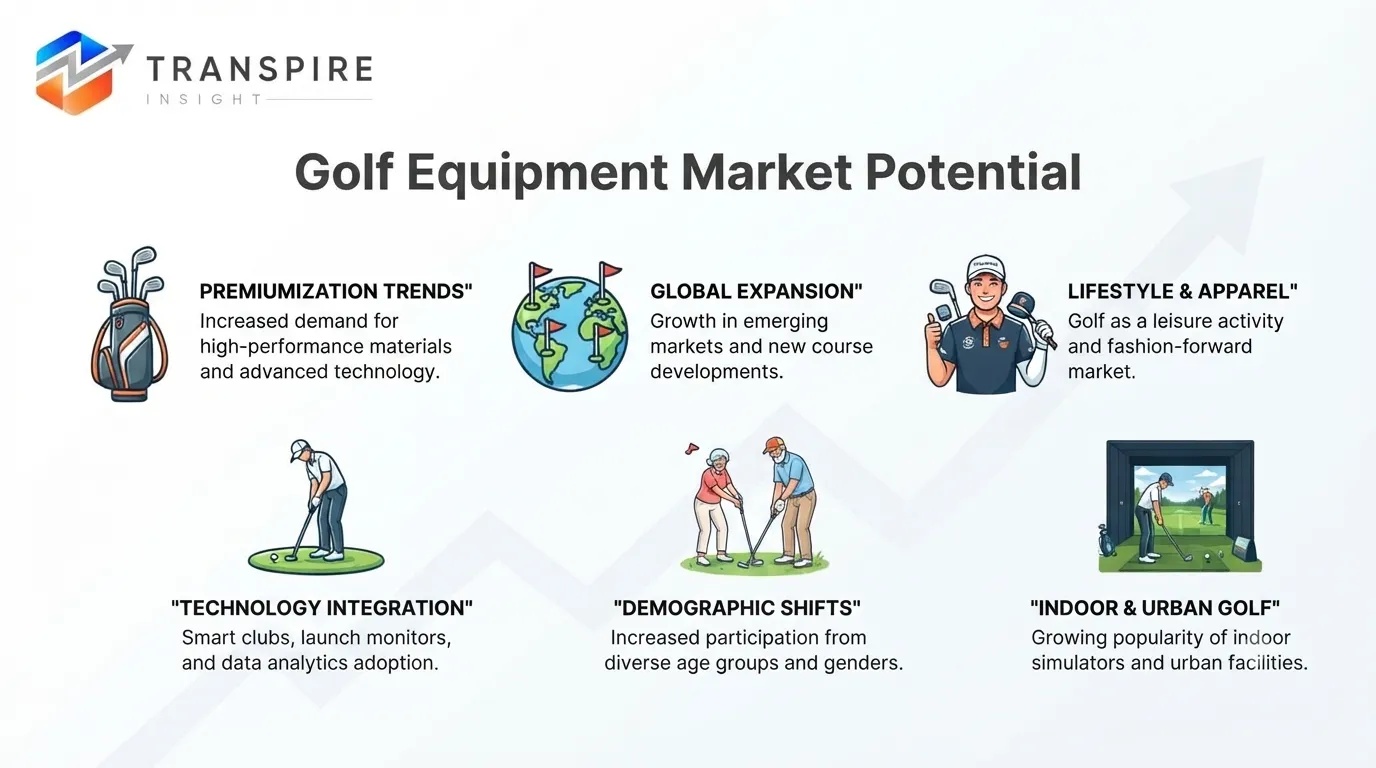
The global golf equipment market is moving beyond traditional club and ball replacement cycles as rising participation, advanced materials, data-driven performance analysis, and product personalization reshape purchasing behavior. Golf equipment manufacturers are increasingly using artificial intelligence, advanced composites, aerodynamic engineering, connected technology, and custom fitting to differentiate products.
The global golf equipment market was valued at approximately USD 8.0 billion in 2025 and is projected to reach around USD 15.3 billion by 2035, growing at a CAGR of approximately 6.7% from 2026 to 2035. North America remained the largest regional market in 2025, while Asia Pacific is expected to be the fastest-growing region.
Golf participation is also broadening. In the United States, approximately 48.1 million people aged six and above played golf in 2025, while off-course participation represented a significant additional pool of consumers.
Golf Equipment Market Trends
Technology-driven club design is one of the strongest trends. Manufacturers are increasingly using carbon composites, artificial intelligence-assisted face engineering, optimized weighting, and aerodynamic structures to improve forgiveness and performance.
Custom fitting is becoming increasingly important. Golfers are seeking equipment tailored to swing speed, launch conditions, playing style, and physical characteristics rather than simply selecting products based on brand reputation.
Connected golf technology is another opportunity. GPS devices, launch monitors, smart sensors, golf watches, and performance-tracking platforms are linking physical equipment with digital performance data.
The rise of recreational and off-course golf is also expanding the addressable consumer base. Indoor golf, golf simulators, driving ranges, and entertainment-oriented golf facilities introduce the sport to consumers who may later transition into conventional course participation.
Golf Equipment Market Segmentation
The market includes golf clubs, golf balls, golf bags, footwear, apparel, gloves, rangefinders, GPS devices, and other accessories.
Golf clubs remain one of the most technologically intensive product categories. Drivers, irons, wedges, and putters continue to undergo regular product-development cycles.
Golf balls represent another high-value category because players often purchase them repeatedly rather than only during major equipment replacement cycles.
Golf bags and accessories benefit from participation growth and premiumization, while GPS devices and rangefinders are gaining importance as golfers increasingly incorporate technology into their playing routines.
Regional Outlook
North America remains the largest market, supported by strong participation, established golf infrastructure, high consumer spending, and a mature equipment ecosystem.
Asia Pacific is expected to register the fastest growth. Rising disposable income, urbanization, golf-course development, increasing participation among younger consumers, and growing interest in golf in markets such as China, Japan, South Korea, and India are creating opportunities.
Europe remains an important market because of its established golfing culture and strong presence of professional and recreational players.
Top 10 Companies in the Golf Equipment Market
Callaway Golf held approximately 8% of the global market in 2025, while the five leading companies collectively accounted for around 30%.
Leading Company Profiles
Callaway Golf
Callaway is a major global golf-equipment brand with a strong presence in clubs, balls, and accessories. Its competitive strategy emphasizes product innovation and advanced materials. Its recent club platforms demonstrate the industry's movement toward AI-assisted design and composite construction.
Acushnet Holdings Corp.
Acushnet operates some of the industry's best-known golf brands, including Titleist and FootJoy. Its strong position in golf balls and clubs provides recurring consumer exposure across several equipment categories.
Adidas Golf
Adidas Golf benefits from the broader Adidas sports ecosystem and focuses heavily on footwear and apparel. Its strength lies in combining performance features with lifestyle-oriented product design.
Bridgestone Golf
Bridgestone has a particularly strong position in golf balls and uses its materials-science expertise to develop products designed around different swing speeds and playing characteristics.
Cobra Golf
Cobra Golf focuses strongly on club innovation and performance-oriented equipment. Its position within the broader golf equipment ecosystem allows it to compete through product development, design, and performance differentiation.
Outlook
Golf equipment is likely to benefit from a combination of participation growth and technology-led replacement demand. The market is no longer driven exclusively by golfers replacing old clubs. Advanced materials, custom fitting, connected devices, AI-supported design, and changing participation formats are creating new reasons to purchase equipment.
The strongest companies will increasingly compete through complete performance ecosystems rather than individual products. As golf becomes more accessible to younger consumers and off-course participation continues to expand, the equipment market could enter a sustained period of structural growth.


Send us a brief description of your challenge and we'll get back to you within 24 hours.

 inquiry@transpireinsight.com
 APAC:+91 7666513636
 Address


