

Global Golf Equipment Market Size & Forecast
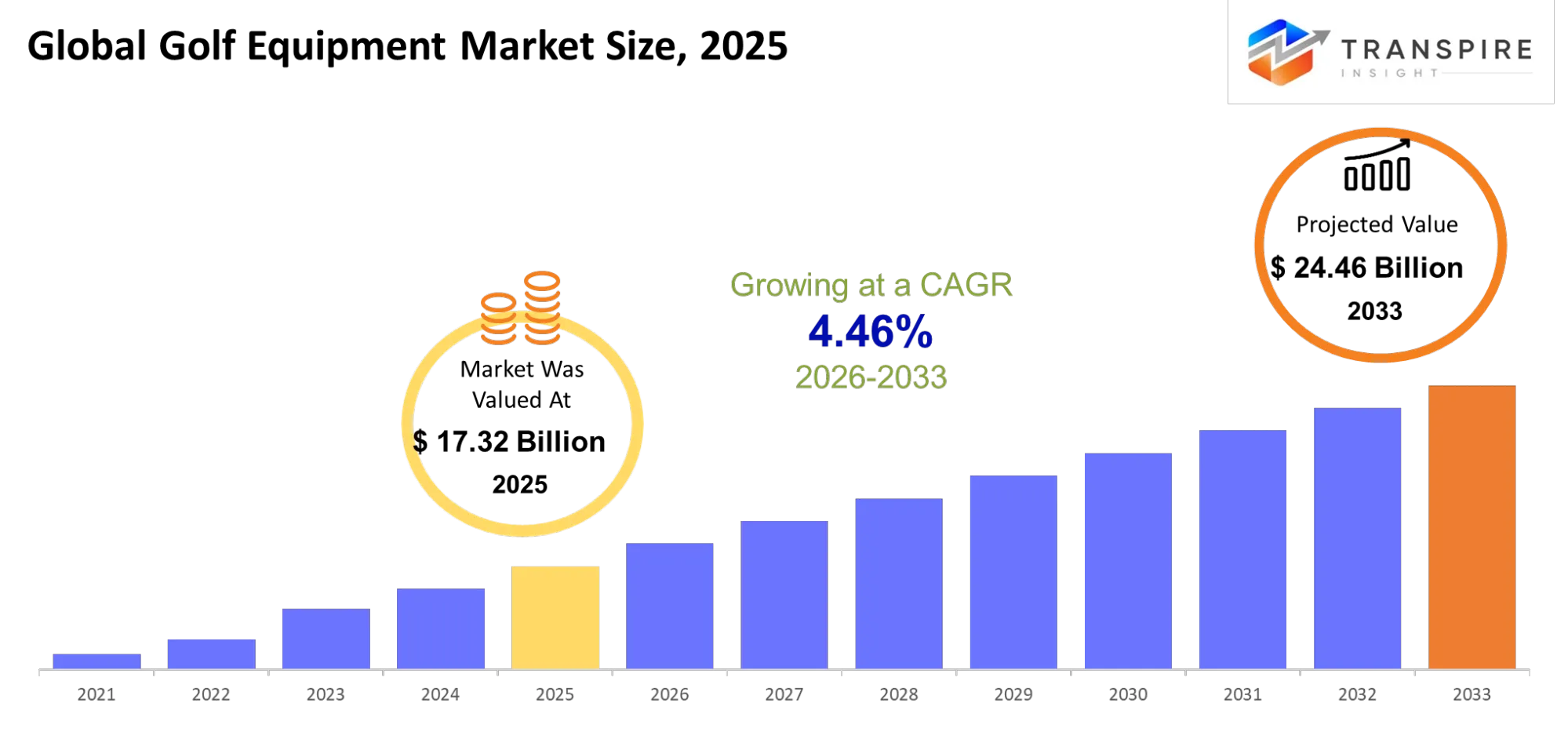
- Global Golf Equipment Market Size 2025: USD 17.32 Billion
- Global Golf Equipment Market Size 2033: USD 24.46 Billion
- Global Golf Equipment Market CAGR: 4.46%
- Global Golf Equipment Market Segments: By Product Type (Golf Clubs, Golf Balls, Golf Bags, Golf Accessories), By Distribution Channel (Online Retail, Specialty Stores, Sports Retail Stores), By End-User (Professional Players, Recreational Players)
To learn more about this report,  Download Free Sample Report
Global Golf Equipment Market Summary
The global golf equipment market was valued at USD 17.32 Billion in 2025. It is expected to reach USD 2.4 billion by 2033, growing at a CAGR of 8.34%. The golf equipment market is involved in the design, production, and selling of clubs, balls, bags, and accessories used by players along both professional tour circuits and private clubs, public courses, as well as off-course leisure facilities. Golfing equipment is very definitely not a single-purchase item - players constantly update their clubs as technology develops, have to buy new balls with every round, and change their bags whenever they feel so inclined, leading to a recurring revenue stream that somewhat protects the market from huge seasonal demand fluctuations.
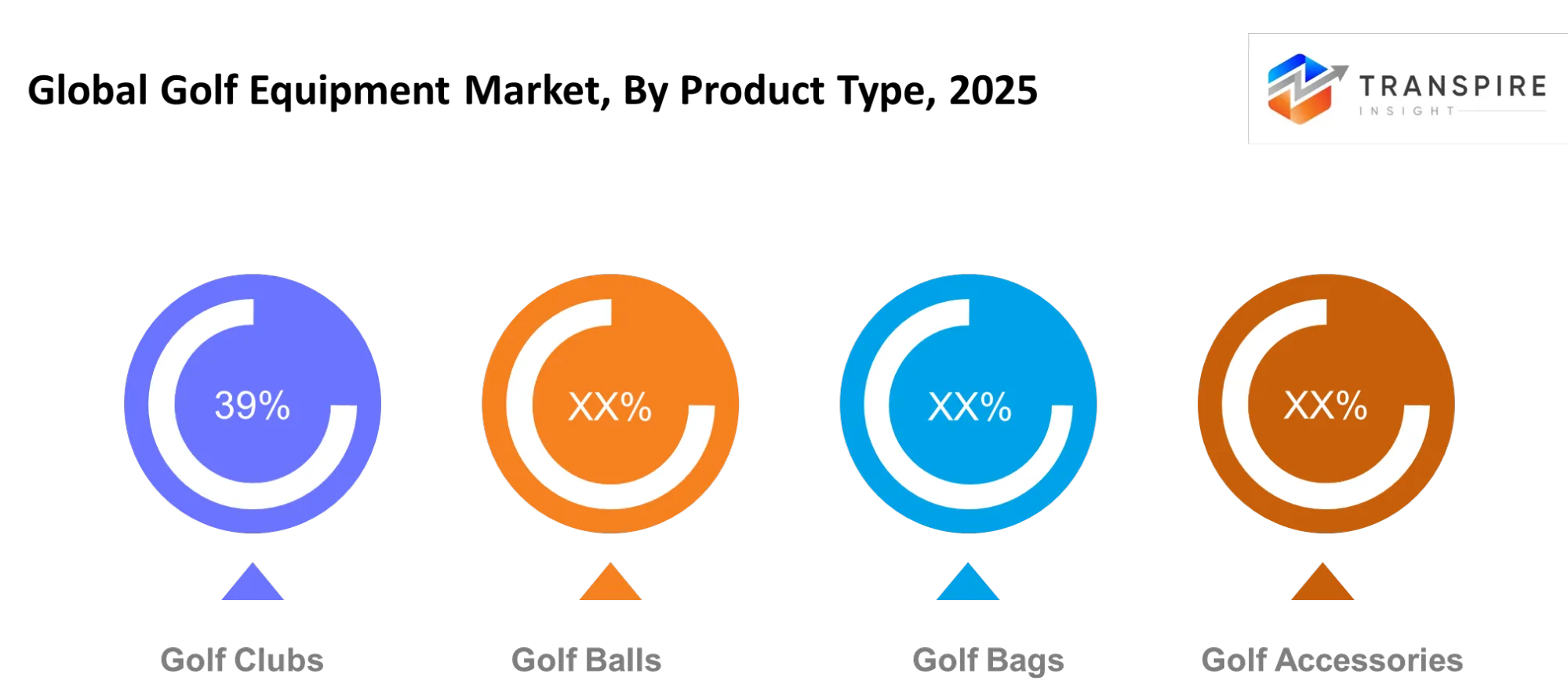
A significant structural change that greatly affected this market was the post-COVID participation surge. Between 2020 and 2022, the amount of rounds played in the United States actually increased by more than 20%, and the number of golfers playing on the course also grew by more than five million in a two-year time frame, based on data from the National Golf Foundation. That huge demand wave effectively translated into huge equipment backlogs. Callaway, Acushnet, and TaylorMade all reported difficulties in their supply chains in 2021 and 2022 as manufacturing couldn't quite meet up with orders. The real-world stimulus behind present-day growth is really an equipment upgrade cycle. The five million plus new golfers who got into the market between 2020 and 2022 started with entry-level equipment first. By 2024 and 2025, a significant amount of that group had moved to their first major equipment upgrade, thus pushing demand for mid-range and high-end clubs. Golf Clubs account for 39% of the total market revenue since each upgrade cycle really starts out with the replacement of drivers and irons. This cohort-driven upgrade trend, combined with ever-growing female and junior participation, as well as the expansion of off-course formats like indoor simulators and TopGolf venues, ensures equipment demand remains structurally higher than it was pre-pandemic through our entire forecast period.
Key Global Golf Equipment Market Insights
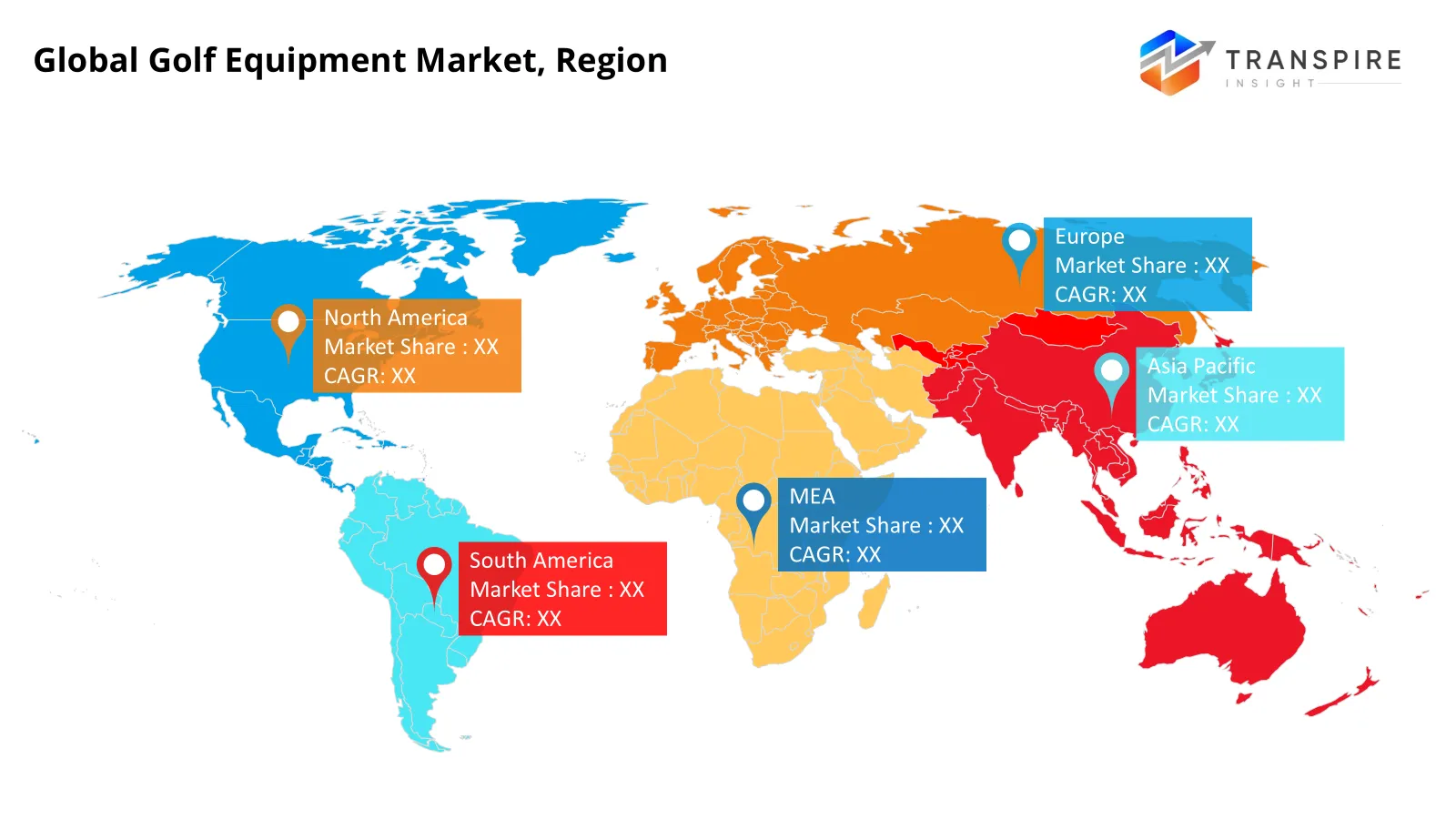
- North America dominates the global golf equipment market with the largest revenue share of 33.65% in 2024, driven by high demand for premium equipment, strong professional tournament culture, and the deep penetration of on-course and off-course golf formats across the United States and Canada.
- Asia-Pacific is the fastest-growing regional market, expanding at a CAGR of 9.41% through 2032, with China, South Korea, Japan, and India all posting accelerating participation rates supported by rising disposable incomes and government investment in golf infrastructure.
- Golf Clubs lead the product type segment, commanding 39% of the global golf equipment market revenue in 2025, supported by frequent upgrade cycles driven by AI-designed clubfaces, carbon composite shafts, and adjustable weight technology.
- Golf Balls represent the second-largest product segment, accounting for approximately 25% of global revenue in 2025, with premium multi-layer ball technology driving consistent repurchase demand from both recreational and competitive players.
- Online retail is the fastest-growing distribution channel, projected to reach a 22% CAGR through 2032, with virtual club-fitting platforms, DTC brand expansion, and comparison tools making online the preferred channel for equipment research and purchase among golfers under 40.
- Recreational Players are the dominant end-user segment, accounting for roughly 78% of equipment revenue, as the mass participation base drives volume across all product categories from entry-level to mid-premium.
- Callaway Golf Company leads the market with over 8% market share in 2025 after completing its strategic return to pure-play golf following the January 2026 sale of a 60% stake in Topgolf to Leonard Green & Partners.
- TaylorMade Golf, privately held under Centroid Investment Partners since 2021, initiated a formal sale process in early 2026 with Denver-based Old Tom Capital emerging as a preferred bidder at a reported USD 3 billion valuation, according to Colorado AvidGolfer and Chosun Biz.
- Smart and connected golf equipment is an emerging segment: over 6 million US golfers used simulation systems in 2025, and LIV Golf announced a partnership with Salesforce in June 2025 to integrate AI tools into tournament operations and fan engagement.
What are the Key Drivers, Restraints, and Opportunities in the Global Golf Equipment Market?
The main motivator is the cohort upgrade cycle set in motion by the massive 2020-2022 participation surge. More than five million new golfers entered the US market during that period - the vast majority buying starter or entry-level equipment. By 2024 and 2025, that group had played enough rounds to warrant their first significant upgrade, especially in drivers and iron sets. This upgrade wave isn't a speculative trend - it's a direct result of known purchase timetables. Every new golfer who bought a starter set in 2021 is statistically very likely to replace clubs within three to five years, creating a quite predictable revenue pulse that equipment brands can model and plan against. This process, combined with the increasing number of female golfers and the expansion of off-course formats, keeps demand for golfing equipment at a high level through our entire forecast period.
The main structural barrier is equipment cost compared to the income profile of the expanded golfer base. Premium drivers from Callaway, TaylorMade, and PING often retail for over USD 500. A full set with premium irons, a driver, a putter, and a bag will easily exceed USD 2,000 at retail. The five million new golfers who started playing between 2020 and 2022 aren't all highly affluent - many were attracted precisely because golf was an outside activity option when other alternatives were unavailable. Converting this cost-sensitive segment into buyers of premium equipment will be a structural challenge that really limits the growth of our average selling prices, even as we hold onto unit volumes.
Our clearest forward opportunity is definitely indoor and off-course golf formats. TopGolf, golf simulators, and entertainment-focused venues have created a whole new entry point for players who might never fully commit to playing on a real golf course - but are happy to buy equipment for use in simulator bays and driving range sessions. The proposed BIRDIE Act in the US, addressing copyright protection for digital representations of golf courses used in simulators, shows that this group is large enough to get noticed by lawmakers. As simulator and entertainment venue penetration really takes hold, our addressable equipment market expands far beyond the approximately 30 million traditional on-course golfers to a larger casual-play demographic estimated at more than 18 million in the US alone.
What Has the Impact of Artificial Intelligence Been on the Global Golf Equipment Market?
golf equipment develops through artificial intelligence because it affects two main areas: product design and player performance. AI-powered computational modeling enables major manufacturers to create optimal clubface designs which include weight distribution and aerodynamic profile elements. Callaway used artificial intelligence to create clubfaces for its Paradym and Ai Smoke driver lines which use machine learning technology to determine optimal face thickness patterns through testing millions of impact scenarios.
AI-powered swing analysis tools together with smart club sensors have transitioned from being premium coaching tools to becoming standard equipment for everyday golfers. Arccos Golf has developed grip caps which contain sensors that track shot information while they connect with GPS mapping software to deliver round analysis and club selection recommendations generated through artificial intelligence. In 2024 more than 500000 American golfers used connected equipment tracking systems. The data created by these systems helps manufacturers develop new products because they can monitor actual equipment use by amateur golfers who play millions of real rounds instead of depending on laboratory tests and tour player reviews.
The actual constraint which restricts AI implementation in the golf equipment industry exists because consumers do not want to spend money on advanced intelligence features which manufacturers add to their physical products. A USD 550 AI-designed driver competes for the same budget as a USD 400 non-AI driver. Most recreational golfers cannot detect the small performance improvements which AI optimization brings to their swing speed because this limitation makes it impossible for premium AI features to increase product pricing. The commercial challenge needs to be solved through fitting experiences and simulator demonstrations together with performance data which needs to be communicated in a straightforward manner.
Key Market Trends
- The 2020–2022 participation surge created a deferred upgrade cycle that is driving equipment replacement demand in 2024–2026, particularly in drivers and iron sets for golfers who bought starter equipment during the pandemic period.
- Female golfer participation rose sharply between 2020 and 2023, with women's equipment sales increasing over 22% in 2023 alone, pushing brands to expand women-specific product lines across clubs, bags, and accessories.
- E-commerce's share of golf equipment sales reached 40% globally in 2023, up from under 20% pre-pandemic, driven by virtual fitting tools, DTC brand strategies, and the comfort of younger golfers with online equipment research.
- Golf simulator sales grew 35% year-over-year in 2023, and over 6 million US golfers actively used simulation systems by 2025, expanding the equipment addressable market beyond traditional on-course participation.
- Callaway completed its return to pure-play golf in January 2026 after selling a 60% stake in Topgolf to Leonard Green & Partners, signaling the end of diversification strategies and a renewed industry focus on core equipment innovation.
- TaylorMade entered a formal sale process in early 2026, with Old Tom Capital reportedly bidding USD 3 billion, reflecting how Korean-owned golf brands are cycling through private equity ownership as valuations mature from their 2021 peak.
- Sustainability commitments accelerated among top manufacturers in 2023–2025, with Acushnet, Callaway, and PING all announcing recycled material integration in product lines and packaging to meet retail partner and consumer ESG expectations.
- LIV Golf's Salesforce partnership in June 2025 introduced AI into professional tournament data management, increasing equipment brand visibility through a new tour circuit that competes directly with the PGA Tour for sponsorship and media attention.
Global Golf Equipment Market Segmentation
By Product Type
The global golf equipment market identifies golf clubs as its leading product category which generates 39 percent of market revenue during the year 2025. The segment maintains its market dominance because it combines high product prices with a steady replacement schedule which results in consistent demand for products. The retail price for complete sets of premium clubs which include driver fairway woods irons wedges and putter can exceed USD 2 000 which makes clubs the main source of income for any equipment sale. The segment develops through technological advancements because AI-designed clubfaces and carbon composite crowns and adjustable weighting systems become better with each new product version which leads golfers to replace their equipment every three to five years instead of using the older replacement schedule which existed before 2018.
To learn more about this report, Download Free Sample Report
By Distribution Channel
The primary channels through which golf equipment gets distributed have always been specialty stores and on-course pro shops because these locations provide professional club fitting services and brand experiences and physical retail stores offer their customers access to expert sales staff.
The entire offline retail sector achieved its biggest distribution market share in 2025 when it reached 53.7% because customers prefer to physically test drivers and feel iron sets and experience launch monitor fitting sessions before making expensive purchases. Online retail has become the fastest-growing distribution channel for the global golf equipment market which will achieve 22% compound annual growth through 2032.
The shift from traditional business operations towards online purchasing channels occurs because swing data together with player profiles enable virtual club fitting systems to provide equipment configuration recommendations needed for online high-value purchase decisions. The Callaway and Acushnet and TaylorMade DTC brand strategies drive customers to their dedicated e-commerce sites which generate better profit margins than their retail partnerships.
By End-User
Recreational players are the dominant end-user segment in the global golf equipment market, accounting for approximately 78% of total revenue in 2025. This segment includes all people who play golf for fun and socializing and exercising instead of competing for money. Recreational players drive volume across all product categories from entry-level starter sets to mid-premium upgrade purchases. The professional players generate less revenue through their volume of products than they create through their market power which drives product development and brand positioning. The equipment contracts and endorsement deals that tour players have and the visibility they gain from tournaments establish consumer beliefs about which clubs and balls achieve peak performance.
The retail demand for products increases when Scottie Scheffler wins a major using a TaylorMade driver and Rory McIlroy switches to TaylorMade irons. Professional players provide manufacturers with actual product performance data which companies use to create their next-generation items. Acushnet's Titleist maintains the strongest professional player penetration with the Pro V1 and Pro V1x maintaining a steady presence in major professional tours throughout the globe. Titleist can charge higher prices for its consumer product lines because its products have established a presence in professional tours.
What are the Key Use Cases Driving the Global Golf Equipment Market?
Golf clubs and balls and bags and accessories face their highest demand from recreational golfers who play on golf courses. The ongoing cycle of replacing and upgrading golf equipment at both private and public courses operates continuously because players consume balls during every round while they upgrade their clubs to match their improved skills and the latest technological developments and they discard their bags once their fashion trends shift. The Golf Clubs and Golf Balls product segments connect to this use case because they generate more than 60 percent of market revenue.
The market needs training and skill development solutions as a complementary demand. Golf simulators and launch monitors and AI-powered swing analysis tools create equipment demand from golfers who practice in indoor facilities and home simulation setups and driving range environments. Players purchase equipment specifically optimized for simulator performance — balls with consistent flight characteristics at lower speeds, clubs configured for indoor launch conditions. Off-course facilities like TopGolf venues also generate accessory demand, including gloves, rangefinders, and GPS devices, from players who may never play traditional on-course golf but engage regularly with the equipment ecosystem.
Professional and semi-professional competitive play through alternative tour formats represents the new use case that has emerged. The professional circuit of LIV Golf which started in 2022 now operates as a new competitive circuit which requires players to sign equipment contracts that differ from standard PGA Tour sponsorship agreements. The alternative competitive ecosystem generates new product partnership agreements between manufacturers and tour operators which build brand visibility through category sponsorship of formats that attract younger audiences and global viewership.
Report Overview Table
|
Report Metrics |
Details |
|
Market size value in 2025 |
USD 17.32 Billion |
|
Market size value in 2026 |
USD 18.2 Billion |
|
Revenue forecast in 2033 |
USD 24.46 Billion |
|
Growth rate |
CAGR of 4.46% from 2026 to 2033 |
|
Base year |
2025 |
|
Historical data |
2021 – 2024 |
|
Forecast period |
2026 – 2033 |
|
Report coverage |
Revenue forecast, competitive landscape, growth factors, and trends |
|
Regional scope |
United States; Canada; Mexico; United Kingdom; Germany; France; Italy; Spain; Denmark; Sweden; Norway; China; Japan; India; Australia; South Korea; Thailand; Brazil; Argentina; South Africa; Saudi Arabia; United Arab Emirates |
|
Key companies profiled |
Callaway Golf Company, Acushnet Holdings Corp. (Titleist), TaylorMade Golf Company, PING Inc., Cobra Golf (Puma SE), Bridgestone Golf Inc., Mizuno Corporation, Srixon (Sumitomo Rubber Industries), Wilson Sporting Goods Company, Honma Golf Ltd., PXG (Parsons Xtreme Golf), XXIO, Cleveland Golf, Scotty Cameron, Odyssey Golf |
|
Customization scope |
Free report customization (country, regional & segment scope). Avail customized purchase options to meet your exact research needs. |
|
Report Segmentation |
By Product Type (Golf Clubs, Golf Balls, Golf Bags, Golf Accessories), By Distribution Channel (Online Retail, Specialty Stores, Sports Retail Stores), By End-User (Professional Players, Recreational Players) |
Which Regions are Driving the Global Golf Equipment Market Growth?
North America holds the top position in the global golf equipment market through its 2024 revenue share of 33.65% because of its market structure. The United States alone accounts for over 30 million on-course golfers and a comparable number of off-course participants who use simulators and driving ranges and visit entertainment venues. The professional tournament calendar, which includes PGA Tour events, the Masters, the US Open, and the Ryder Cup, creates continuous opportunities for equipment marketing and consumer interaction that other regions cannot compete with. US specialty retail infrastructure, which consists of Golf Galaxy and PGA Tour Superstore and thousands of pro shops located in golf courses, provides manufacturers with extensive market access to customers who want to buy high-end equipment. North America serves as the operational base for Callaway, Acushnet, TaylorMade, and PING, which conduct their global product development and marketing activities from this region that serves as their primary site for innovation and product introduction.
Europe stands as the world's second-largest market because it will generate about 28% of global golf equipment revenue throughout 2025. The sport has different geographical distribution patterns between Europe and North America according to one major structural distinction. The United Kingdom and Germany and Sweden and France and the Netherlands serve as the main countries that drive European golf participation and equipment purchases. European golf exists as an established sport that has existed longer than most Asian markets, which leads to consumer behavior that favors high-end products and replacement items instead of equipment for new players. European Union regulations now mandate golf courses to meet sustainability standards while equipment manufacturers must comply with new material requirements, which affects product development choices made by brands that distribute their products in this market.
The Asia-Pacific region leads global golf equipment market development with a 9.41% annual growth rate which will continue until 2032. The transition began recently because multiple economic forces operate simultaneously in various worldwide markets. South Korea's existing high golf penetration — the country has one of the highest per-capita golf participation rates globally — is increasingly being supplemented by Japanese brand exports and domestic equipment manufacturing scale. China serves as the fundamental growth engine that expands its golfer base from an exclusive group to a widespread luxurious recreational activity because of rising upper-middle-class incomes and government golf tourism facility investments and the international recognition of the sport. The development of India as a golf market has started because urban golf club membership is increasing together with growing disposable incomes among residents of major cities. The Asia-Pacific region serves as the most crucial future market for all major golf equipment companies because of its market size and development rate which will continue until the end of the forecasting period.
To learn more about this report, Download Free Sample Report
Who are the Key Players in the Global Golf Equipment Market and How Do They Compete?
The global golf equipment market exhibits a pattern of moderate consolidation at its upper levels while its lower levels show complete market fragmentation. Three companies, which include Callaway Golf and Acushnet Holdings and TaylorMade, together control approximately 50 percent of worldwide equipment sales. PING and Cobra Golf and Bridgestone Golf and Mizuno and Srixon maintain important market positions through their respective product lines and their ability to reach specific areas. Professional player endorsements and technology differences in clubs and balls and retail distribution networks drive competition in the market. Companies face major entry obstacles because they need to invest in factory development and tour player connections and extensive retail operations. The focus of competition now revolves around how companies engage with off-course activities and which digital platforms they decide to support.
Callaway Golf Company returned to its core identity in January 2026, completing the sale of a 60% stake in Topgolf to Leonard Green & Partners. The company used the divestiture to pay off operating lease obligations while acquiring sufficient funds to reduce its debt burden, which exceeded USD 1 billion,thus achieving a position of net cash. Callaway's club ball and accessory business, which operates under Callaway Odyssey OGIO and TravisMathew brands, generates higher profits than the capital-heavy venue operations. Acushnet (Titleist) competes on brand premium and professional player trust, with the Pro V1 golf ball maintaining the highest share of balls in play on professional tours worldwide. Acushnet's Scotty Cameron putter brand commands pricing above USD 400 per unit, showing that premium product positioning enables the brand to maintain exceptional average selling prices throughout its entire product range.
The competition between TaylorMade and its rivals depends on two factors which are the number of athlete endorsements and the frequency of product releases. TaylorMade achieves exceptional tour exposure through its endorsement agreements with Tiger Woods Scottie Scheffler Rory McIlroy and Nelly Korda. The company's decision to seek a new owner in early 2026, with Denver-based Old Tom Capital emerging as a preferred bidder at a reported USD 3 billion valuation, reflects both the company's financial maturity and Korean private equity's desire to exit a position acquired in 2021 for USD 1.71 billion. PING differentiates itself through its custom fitting expertise and its precise manufacturing capabilities which enable the company to provide customers with the widest range of club configuration choices in the market while it develops customer loyalty through its fitting-forward retail system. The Japanese brands Mizuno Honma and XXIO operate in the premium and ultra-premium markets which demand exceptional craftsmanship and top-quality finishes because their products require customers to pay higher prices than what US brands offer.
Global Golf Equipment Market Companies
- Callaway Golf Company
- Acushnet Holdings Corp. (Titleist)
- TaylorMade Golf Company
- PING Inc.
- Cobra Golf (Puma SE)
- Bridgestone Golf Inc.
- Mizuno Corporation
- Srixon (Sumitomo Rubber Industries)
- Wilson Sporting Goods Company
- Honma Golf Ltd.
- PXG (Parsons Xtreme Golf)
- XXIO
- Cleveland Golf
- Scotty Cameron
- Odyssey Golf
Recent Developments
In April 2026, Topgolf Callaway Brands announced the acquisition of a minority stake in a European golf simulator technology firm to expand its digital golf portfolio and indoor gaming footprint. https://www.reuters.com
In March 2026, Acushnet Holdings Corp. completed the acquisition of a premium custom golf club fitting company to strengthen its direct-to-consumer capabilities and enhance personalized equipment offerings. https://www.bloomberg.com
What Strategic Insights Define the Future of the Global Golf Equipment Market?
Over the next five to seven years, the global golf equipment market will be shaped less by participation growth and more by spending depth specifically, how successfully brands convert the five million-plus new golfers who entered between 2020 and 2022 into recurring premium equipment buyers. The underlying force driving this is not marketing; it is the natural progression of golf skill development. Golfers who play regularly for three to five years reach a skill threshold where equipment quality meaningfully affects their scores, creating genuine demand for premium club fitting and higher-specification product purchases.
The risk that headline growth numbers do not capture is private equity ownership concentration. TaylorMade, Acushnet, and Callaway three of the top four global equipment companies are all owned or substantially influenced by financial sponsors with defined exit horizons. When multiple major players in a category simultaneously navigate ownership transitions, management attention shifts from product development to transaction management. This could slow innovation cadence at precisely the moment when AI-driven equipment design and digital fitting technology are creating the most significant product differentiation opportunities the industry has seen in two decades.
The opportunity not yet reflected in most market analyses is the off-course golfer equipment conversion pathway. The 18 million-plus Americans who engage with off-course formats — simulators, entertainment venues, driving ranges — represent a largely untapped equipment upgrade market. These players are golfers by every behavioral measure: they buy balls, use clubs, and engage with the sport's culture. The equipment brands that develop fitting-forward digital experiences tailored to simulator and entertainment venue contexts — rather than assuming these players will eventually transition to on-course formats — will access a demand pool that current distribution strategies largely miss. The strategic recommendation is direct: establish digital fitting infrastructure that meets off-course golfers where they are rather than waiting for them to walk into a traditional pro shop.
Global Golf Equipment Market Report Segmentation
By Product Type
- Golf Clubs
- Golf Balls
- Golf Bags
- Golf Accessories
By Distribution Channel
- Online Retail
- Specialty Stores
- Sports Retail Stores
By End-User
- Professional Players
- Recreational Players
Frequently Asked Questions
Find quick answers to common questions.
The Global Golf Equipment Market size is expected to reach USD 24.46 Billion by 2033.
The key segments of the Global Golf Equipment Market are By Product Type (Golf Clubs, Golf Balls, Golf Bags, Golf Accessories), By Distribution Channel (Online Retail, Specialty Stores, Sports Retail Stores), By End-User (Professional Players, Recreational Players).
Major players in the Global Golf Equipment Market include Callaway Golf Company, Acushnet Holdings Corp. (Titleist), TaylorMade Golf Company, PING Inc., Cobra Golf (Puma SE), Bridgestone Golf Inc., Mizuno Corporation, Srixon (Sumitomo Rubber Industries), Wilson Sporting Goods Company, Honma Golf Ltd., PXG (Parsons Xtreme Golf), XXIO, Cleveland Golf, Scotty Cameron, and Odyssey Golf.
The Global Golf Equipment Market size is USD 17.32 Billion in 2025.
The Global Golf Equipment Market CAGR is 4.46% from 2026 to 2033.
- Callaway Golf Company
- Acushnet Holdings Corp. (Titleist)
- TaylorMade Golf Company
- PING Inc.
- Cobra Golf (Puma SE)
- Bridgestone Golf Inc.
- Mizuno Corporation
- Srixon (Sumitomo Rubber Industries)
- Wilson Sporting Goods Company
- Honma Golf Ltd.
- PXG (Parsons Xtreme Golf)
- XXIO
- Cleveland Golf
- Scotty Cameron
- Odyssey Golf
Recently Published Reports
-
Apr 2026
Bottled Water Market
Bottled Water Market Size, Share & Analysis Report By Product Type (Still Bottled Water, Carbonated Bottled Water, Functional Bottled Water, and Others), By Packaging (PET, Cans, and Others), By Sales Channel (Supermarkets/Hypermarkets, Convenience Stores/Drug Stores, Grocery Stores/Club Stores, Foodservice, and Others) and Geography (North America, Europe, Asia-Pacific, Middle East and Africa, South and Central America), 2021 - 2032
-
Apr 2026
Color Cosmetic Packaging Market
Color Cosmetic Packaging Market Size, Share & Analysis Report By Application (Mascara Packaging, Liquid Packaging, and Liquid Face), By Type (Tubes & Bottles, Pens & Markers, Compacts & Containers, and Droppers & Pumps), and Geography (North America, Europe, Asia-Pacific, Middle East and Africa, South and Central America), 2021 - 2031
-
Apr 2026
External Microphone For Camera Market
External Microphone For Camera Market Size, Share & Analysis Report By Type (Shotgun Microphone, Lavalier Microphone, and Others), By Application (Digital Camera, Professional Video Camera, and Others), and Geography (North America, Europe, Asia-Pacific, Middle East and Africa, South and Central America), 2021 - 2031
-
Apr 2026
Foot Orthotic Insoles Market
Foot Orthotic Insoles Market Size, Share & Analysis Report By Type (Pre-fabricated, and Custom-made), By Material (Thermoplastic, Composite Carbon Fiber, and Others), By Distribution Channel (Drug Stores, Hospitals & Clinics, and Others), and Geography (North America, Europe, Asia-Pacific, Middle East and Africa, South and Central America), 2021 - 2031