
Jul 23, 2026
By Transpire Insight
Description
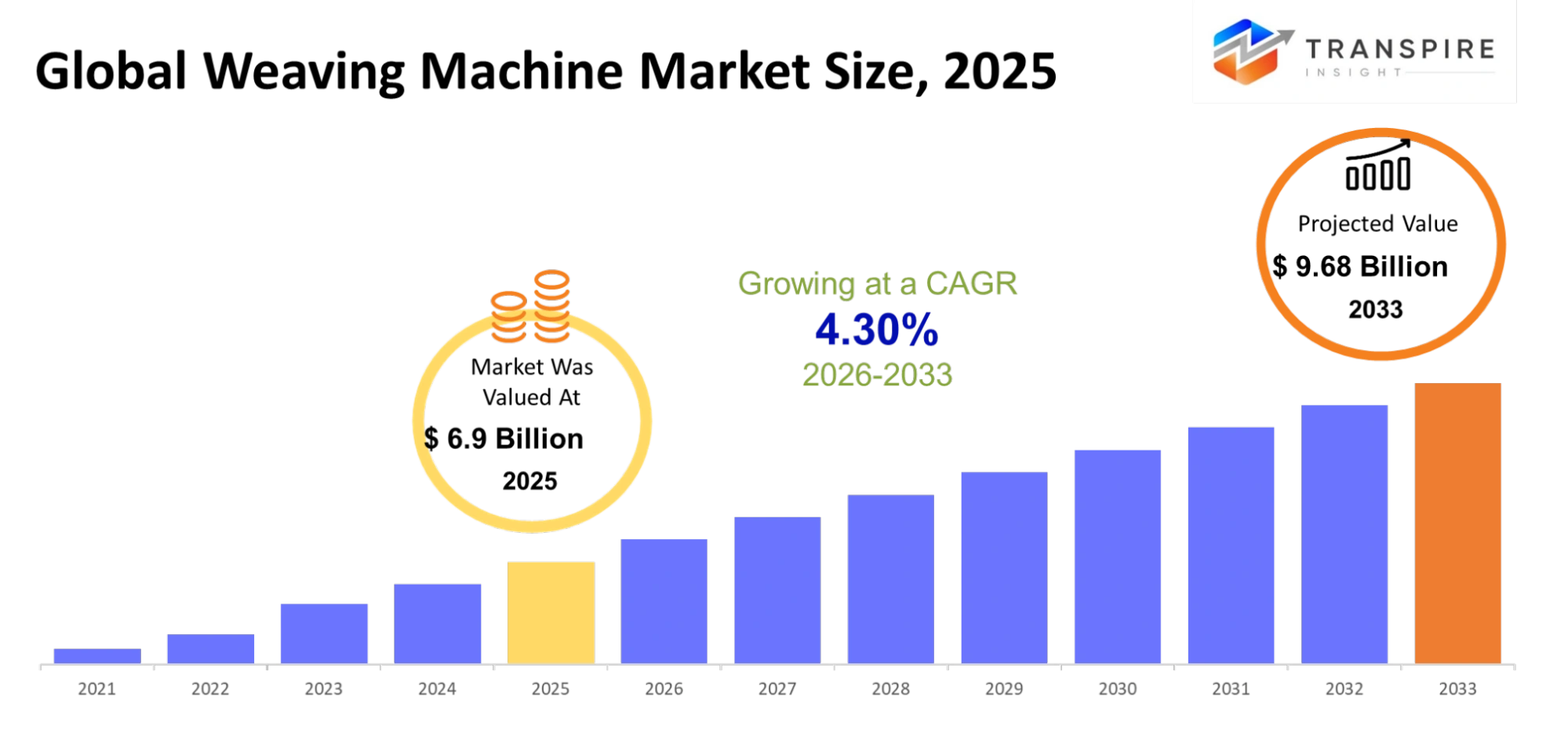
According to a research report published by Transpire Insight, The Global Weaving Machine Market Size is projected to Grow from USD 6.9 Billion in 2026 to USD 12.01 Billion by 2035, at a CAGR of 6.31% during the forecast period 2026-2035. The development of the market is fueled by higher textile production, increased investment in automation of the textile weaving industry, higher demand for technical and functional textiles, and constant modernization of weaving units. The innovations of Industry 4.0 weaving machines, artificial intelligence in machine monitoring, internet of things enabled production lines, efficient energy looms, and computerized weaving systems have been improving efficiency and fabric quality. Moreover, the rising demands from the apparel, automotive, medical textiles, and home furnishings industries, together with fast industrialization in emerging economies, will help fuel market growth in the coming years.
Introduction
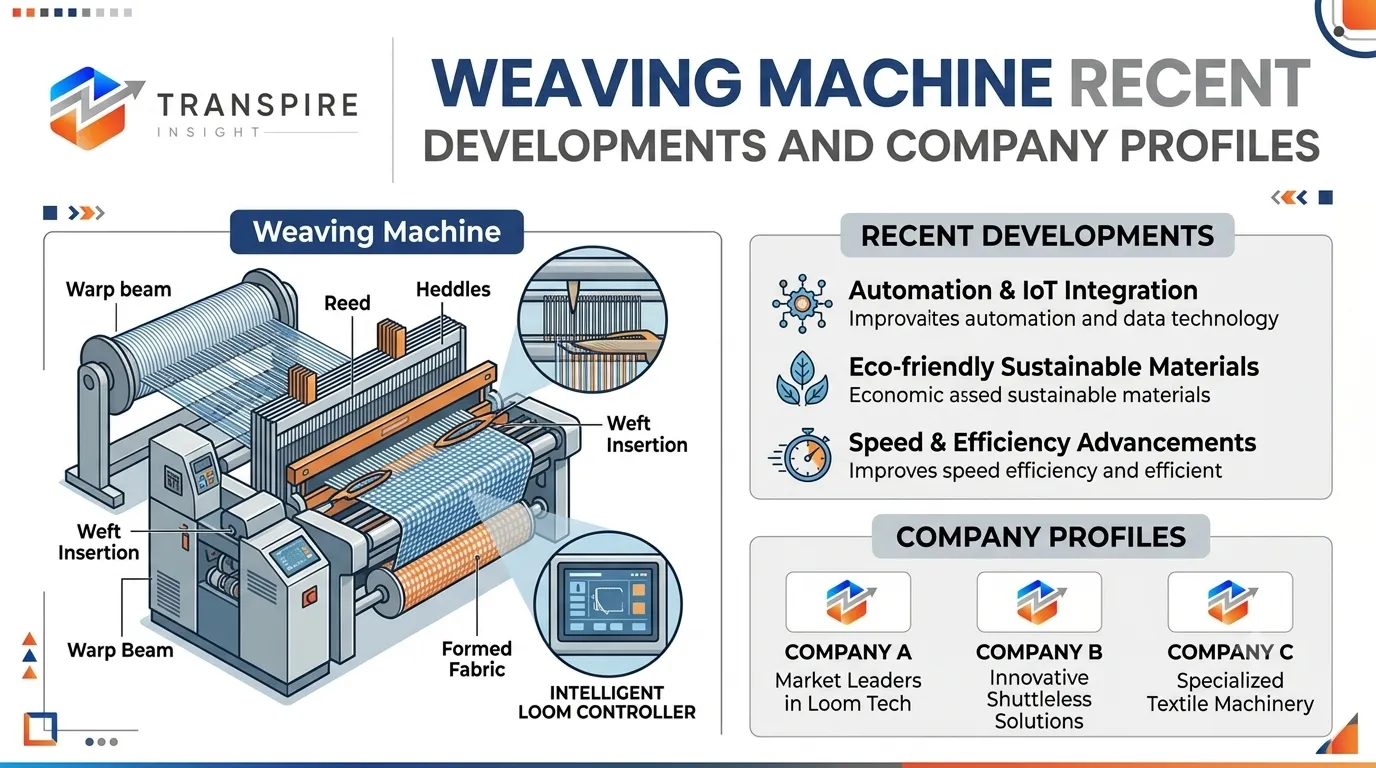
The Weaving Machine Market encompasses equipment used in interweaving of warp and weft yarns for creating woven fabric in applications related to the textile, apparel, furniture, technical textiles, automotive, and industrial industries. Some of the recent advances in weaving machine technology include air jet, water jet, rapier, projectile, and shuttle weaving machines that enable fast and automated weaving processes with accuracy and energy savings.
Recent Development News
Stay Ahead of Emerging Opportunities with Expert Market Insights by Transpire Insight
The insights that have been shared through this blog are based on intensive market research carried out by Transpire Insight, an advisor that works with many global organizations. Thanks to the analysis of extensive data, forecasts made by our specialists, and industry intelligence, our reports allow clients to find strategic growth opportunities in dynamically developing industries. For all those who would like to get more detailed information regarding market segmentation, competitive analysis, regional outlooks, and future investment tendencies, there is no doubt that our full report will be of great value.
Download the exclusive Weaving Machine Market sample report today to uncover expert insights, emerging trends, and the opportunities defining the future of the industry.
Weaving Machine Market Size & Statistics
Regional Growth and Demand Analysis by Transpire Insight:
Asia-Pacific is the dominant region in the Weaving Machine Market and is estimated to account for around 52% of the global market share. The dominance of Asia-Pacific in the Weaving Machine Market is due to its position as the world's biggest manufacturer of textiles. Some of the countries that make up Asia-Pacific and are responsible for driving its dominance include China, India, Bangladesh, Vietnam, Pakistan, and Japan. The region gets an advantage due to the massive production of textiles and clothing, availability of labor, export-oriented manufacturing, and constant investments in textile machinery.
Textile modernization through industrial development programs and initiatives is receiving government support, whereas manufacturers are embracing weaving machines enabled by Industry 4.0, high-speed air-jet looms, rapier looms, and production systems powered by IoT. Moreover, the availability of weaving machine manufacturers in the region, coupled with its well-developed textile supply chain, is what makes Asia-Pacific the leader in the global market.
Fastest-growing region: Europe, due to increasing demand for technical textiles, sustainable textile manufacturing, automation technologies, and constant investments in high-precision weaving systems.
Top 15 Trends in the Weaving Machine Market
Proceed to Checkout to purchase the exclusive Weaving Machine Market report and gain instant access to in-depth market intelligence, strategic analysis, and future growth opportunities.
1. Growing Adoption of Industry 4.0-Enabled Smart Weaving Machines
The new-age weaving machines that incorporate technologies such as Industry 4.0 are being adopted by many textile manufacturers today because of their integration of intelligent sensors and cloud computing technology along with production analysis.
2. Increasing Integration of AI-Based Production Monitoring Systems
With artificial intelligence, there will be changes to the way that weaving processes are conducted, since it is capable of constantly analyzing and measuring the machine's performance, yarn tension, quality of fabric and effectiveness of the production process.
3. Rising Demand for Energy-Efficient Weaving Technologies
As a result of increased sustainability efforts as well as increased cost of energy, companies are looking to adopt new weaving machines that are more energy efficient as they use reduced amounts of energy but have high speed. Improved motors, drive systems, and power management techniques can be used to make this possible.
4. Expansion of High-Speed Air-Jet and Rapier Looms
Air-jet and rapier loom weaving machinery are growing more and more common because of their capabilities of manufacturing high-quality textiles along with increased efficiency. Such sophisticated weaving looms enable fast weaving operations, higher adaptability to various kinds of yarns, decreased need for maintenance, and increased efficiency in production of apparel and industrial textiles.
5. Growing Adoption of IoT-Connected Textile Manufacturing Equipment
With the help of Internet of Things (IoT), it has become possible for weaving machines to communicate with the central production management systems on a real-time basis. This connectivity with weaving machines helps the manufacturing companies to remotely monitor their production process and manage them efficiently.
6. Increasing Development of Automated Fabric Handling Systems
Automation is not confined to looms alone but covers intelligent handling and transportation of fabrics, rolling of fabrics, testing of fabrics and packing of fabrics. Automatic handling of fabrics involves reduction of manpower, reduced chances of damage to fabrics, efficiency in production process and quality of fabrics being produced.
Top 25 Companies Leading the Weaving Machine Market
Customize the exclusive Weaving Machine Market report today to receive tailored insights, country-specific analysis, and business-focused market intelligence.
1. Picanol Group
Picanol Group is an international company that specializes in developing weaving machines and industrial engineering services, famous for its cutting-edge technology of textile manufacturing.
Founded:1936 | Headquarters: Ypres, Belgium
Why It Ranks: One of the world’s best producers of high-speed air-jet and rapier weaving machines.
Regional Dominance: Strong presence across Europe, Asia-Pacific, North America, and the Middle East.
Product Line: Air-jet weaving machines, rapier weaving machines, digital weaving controls, automation, and textile manufacturing technologies.
Recent Development: Expanded smart weaving technologies.
2. Itema S.p.A.
Itema is a worldwide company producing high-end textiles machinery focused on developing state-of-the-art weaving technologies.
Founded:1967 | Headquarters: Colzate, Italy
Why It Ranks: Pioneer in rapier, air-jet, and projectile weaving technologies.
Regional Dominance: Strong presence across Europe, Asia-Pacific, North America, and Latin America.
Product Line: Rapier looms, air-jet looms, projectile weaving machines, textile automation solutions, and weaving accessories.
Recent Development: Launched energy-efficient weaving solutions with increased productivity and connectivity.
3. Toyota Industries Corporation
Alongside the production of industrial equipment, material handling equipment, and automotive components, Toyota Industries Corporation is also into the manufacture of textile machinery.
Founded:1926 | Headquarters: Kariya, Aichi, Japan
Why It Ranks: Leader in automated air jet looms technology in the world.
Regional Dominance: Strong presence across Asia-Pacific, Europe, North America, and the Middle East.
Product Line: Air jet looms, spinning equipment, automated textile machinery, industrial automation systems, and logistics machinery.
Recent Development: Expanded high-speed weaving systems for smart textile manufacturing.
4. Lindauer DORNIER GmbH
Lindauer DORNIER is an outstanding company from Germany producing high-quality weaving machines intended for the manufacture of apparel, industrial and technical textiles.
Founded:1950 | Headquarters: Lindau, Germany
Why It Ranks: International player renowned for producing precision weaving machines for technical textiles.
Regional Dominance: Strong presence across Europe, Asia-Pacific, North America, and the Middle East.
Product Line: Rapier weaving machines, air-jet weaving machines, composite fabric weaving machines, and technical textile machines.
Recent Development: Improved weaving machines for producing industrial and composite textiles.
5. Tsudakoma Corporation
Tsudakoma is a manufacturer of cutting-edge textile machines and hydraulic equipment, which gives great emphasis to the area of weaving technology.
Founded:1939 | Headquarters: Kanazawa, Japan
Why It Ranks: Main global provider of fast air-jet weaving machines.
Regional Dominance: Strong presence across Asia-Pacific, Europe, and North America.
Product Line: Air-jet weaving machines, water-jet weaving machines, textile automation systems, and hydraulic machinery.
Recent Development: Expanded digital solutions for weaving, offering greater efficiency and reduced energy consumption.
6. Stäubli International AG
Stäubli specializes in industrial technology, offering textile machinery, robotics, and industrial automation products.
Founded:1892 | Headquarters: Pfäffikon, Switzerland
Why It Ranks: Leading provider of technologies used in weaving preparation and jacquard weaving.
Regional Dominance: Strong presence across Europe, Asia-Pacific, North America, and Latin America.
Product Line: Jacquard looms, weaving automation, harnessing solutions, robotics, and textile control technologies.
Recent Development: Developed new generation jacquard technologies for fast smart weaving.
7. KARL MAYER Textilmaschinenfabrik GmbH
KARL MAYER is a prominent company producing textile machinery for warp knitting, technical textiles, and digital textile technologies.
Founded:1946 | Headquarters: Obertshausen, Germany
Why It Ranks: World leader in innovative technologies for the textile industry.
Regional Dominance: Strong presence across Europe, Asia-Pacific, North America, and South America.
Product Line: Warp knitting machinery, technical textile machinery, digital textile technology, and automation technology.
Recent Development: Introduced new digital textile production technologies enabling Industry 4.0 manufacturing.
8. Saurer Group
Saurer is engaged in manufacturing machinery and intelligent manufacturing technology solutions for processes like spinning, twisting, and textiles.
Founded:1853 | Headquarters: Arbon, Switzerland
Why It Ranks: One of the leading companies in offering complete textile manufacturing technology.
Regional Dominance: Strong presence across Europe, Asia-Pacific, North America, and the Middle East.
Product Line: Textile machinery, spinning systems, twisting machines, digital textile manufacturing, and manufacturing software.
Recent Development: Advanced smart factory technologies for connected textile manufacturing.
9. Van de Wiele Group
The Van de Wiele Group designs sophisticated textile machinery used for manufacturing carpets, velvets, technical textiles, and woven fabrics.
Founded:1880 | Headquarters: Kortrijk, Belgium
Why It Ranks: World leader in technologies of weaving for technical and decorative textiles.
Regional Dominance: Strong presence across Europe, Asia-Pacific, North America, and the Middle East.
Product Line: Carpet weaving machines, velvet weaving machines, jacquard machines, textile finishing machinery, and automation systems.
Recent Development: Upgrading weaving technology for sustainable textile production and technical textiles.
10. Bonas Textile Machinery NV
Bonas Textile Machinery manufactures electronic jacquard technology and advanced weaving preparation technology.
Founded:1946 | Headquarters: Waregem, Belgium
Why It Ranks: Major supplier of electronic jacquard technology used in high-quality woven fabrics.
Regional Dominance: Strong presence across Europe, Asia-Pacific, and North America.
Product Line: Electronic jacquard machinery, weaving preparation machinery, textile control technology, and digital weaving technology.
Recent Development: Development of high-speed electronic jacquard technology in smart textiles and fabric manufacturing.
Schedule a meeting with our market experts to discuss the exclusive Weaving Machine Market report and identify the best research solution for your organization.
Conclusion
The Weaving Machine Market is poised to grow at a constant pace during the forecasted period due to increased production of textiles, growing demand for technologically advanced fabrics, and consistent upgrade of textile plants. Advanced technological features in Industry 4.0-capable weaving machines, artificial intelligence machine monitoring, Internet of Things-based production systems, digital weaving machine controls, energy-saving looms, and automated fabric handling systems are playing a crucial role in making production more efficient, effective, and flexible. Major players like Picanol Group, Itema S.p.A., Toyota Industries Corporation, Lindauer DORNIER GmbH, Tsudakoma Corporation, Stäubli International AG, KARL MAYER Textilmaschinenfabrik GmbH, Saurer Group, Van de Wiele Group, and Bonas Textile Machinery NV have been enhancing their market presence through innovation and strategic expansion in the textile industry. With growing adoption of automation and sustainable production systems in textile manufacturing processes, the Weaving Machine Market is on the verge of strong growth worldwide.


Send us a brief description of your challenge and we'll get back to you within 24 hours.

 inquiry@transpireinsight.com
 APAC:+91 7666513636
 Address


