
Jul 23, 2026
By Transpire Insight
Description
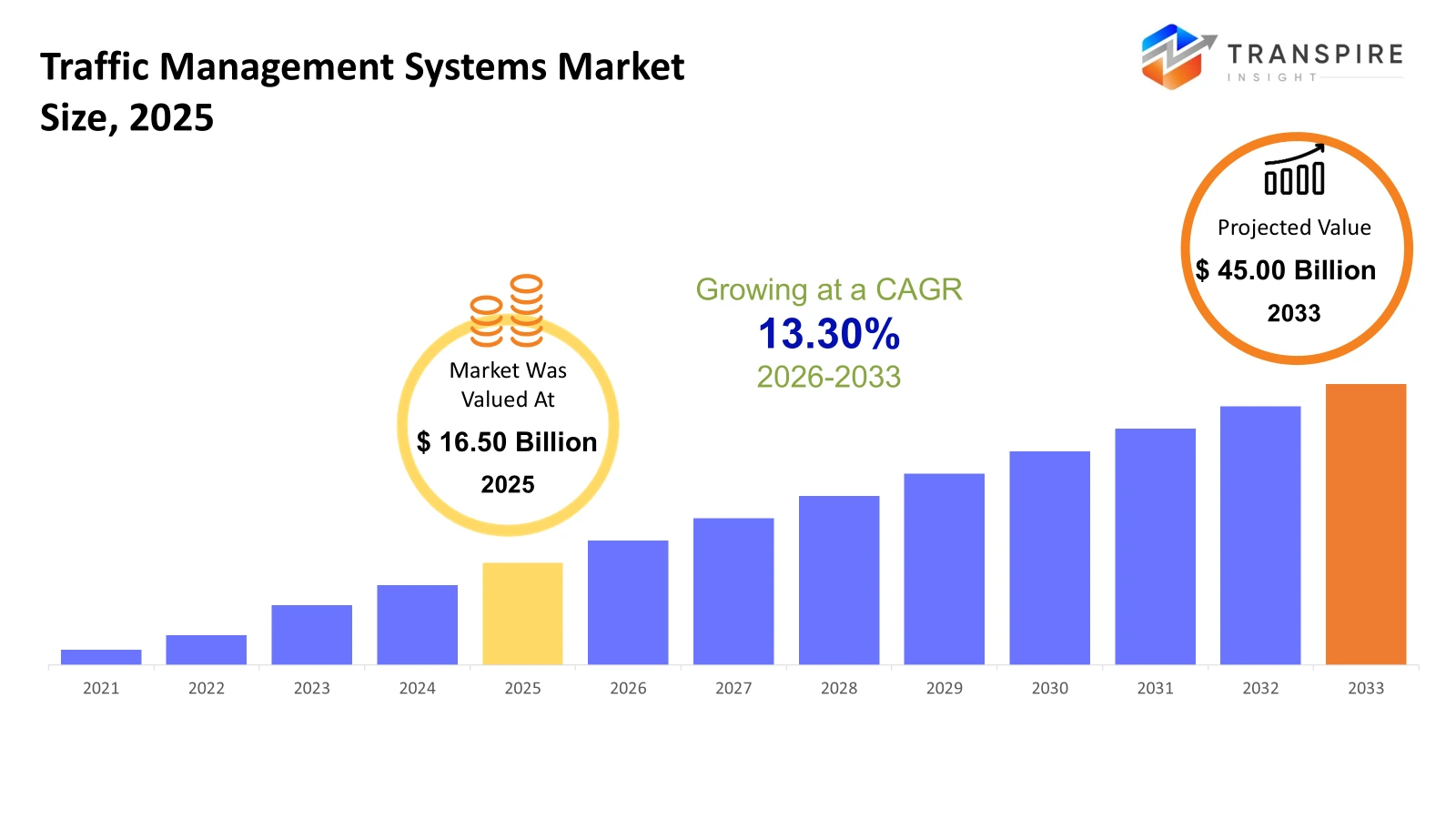
According to a research report published by Transpire Insight, the traffic management system market size is projected to grow from USD 57.00 billion in 2026 to USD 107.00 billion by 2035, at a CAGR of 14.24% during the forecast period 2026-2035. Automated traffic orchestration is required with spurting urbanization and exploding vehicle density worldwide. Moreover, the high investments in smart cities by the government and the speedy adoption of AI-based adaptive signaling signal a tremendous boost to industry growth.
Introduction
Rapid urbanization, along with the increasing number of vehicles on the roads, is making urban roadways more congested, which is driving the swift growth of the global Traffic Management System (TMS) market. This burden is causing traditional infrastructures to falter and is leading cities to invest heavily in smart city frameworks around the world. Today's traffic management systems are built using a mix of technologies, such as the Internet of Things (IoT) sensors, cloud computing, and artificial intelligence (AI), to help maximize city grid infrastructure. These configurations focus on commuter safety, minimize emissions, and streamline transit in dense urban systems.
Recent Development News
Stay Ahead of Emerging Opportunities with Expert Market Insights by Transpire Insight
Transpire Insight provides comprehensive, data-driven market intelligence to support smarter business decisions. Our research is rooted in comprehensive analysis, authoritative predictions, and industry expertise, enabling organizations to make informed decisions in rapidly evolving markets. In-depth analysis of market segmentation, competitive positioning, regional trends, and emerging investment opportunities in high-growth areas. We blend accuracy with actionable intelligence, empowering companies to uncover new avenues for growth, bolster strategic decision-making, and stay ahead in a dynamic global market.
Download the exclusive Traffic Management System Market sample report today to uncover expert insights, emerging trends, and the opportunities defining the future of the industry.
Traffic Management System Market Size & Statistics
Regional Growth and Demand Analysis by Transpire Insight:
North America is the dominant region in the traffic management system market. By geography, North America retained leadership with a 33.25% revenue share in 2025, owing to the availability of leading players in software development, adaptive signal control technology, and robust federal investment in transportation infrastructure. The United States is currently the largest contributor to the North American Traffic Management System market, with growth buoyed by Infrastructure Investment and Jobs Act allocations and state mandates specifying adaptive signal control on new corridors. As of 2026, several U.S. transportation agencies have undertaken large-scale rollouts of AI-driven predictive adaptive signal control across Sun Belt metros, aimed at reducing congestion and improving emergency-vehicle response times across major metropolitan corridors.
Asia-Pacific is anticipated to generate the fastest growth during the forecast period in the traffic management system market. It is expected that the Asia-Pacific region will witness the quickest CAGR of 11.98% during the forecast period, driven by rising urbanization, expanding vehicle fleets, and increasing government investment in intelligent transportation infrastructure. China, India, Japan, and South Korea are among the rapidly growing nations regarding smart-city and highway-monitoring activities that drive demand for advanced traffic surveillance and signal-control technologies. In 2026, China's nationwide automatic number-plate recognition mandate will have led to increased fleet modernization and enforcement-camera deployment programs across major metropolitan regions, aimed at strengthening real-time traffic monitoring and compliance systems.
Top 15 Trends in the Traffic Management System Market
Proceed to Checkout to purchase the exclusive Traffic Management System Market report and gain instant access to in-depth market intelligence, strategic analysis, and future growth opportunities.
AI-powered traffic analytics utilize real-time video feeds and sensors to detect vehicle patterns, predict congestion, and adjust signal timings dynamically, minimizing delays and improving overall network throughput continuously.
Software is emerging as the fastest-growing component as agencies shift from hardware-centric setups toward scalable, subscription-based platforms offering remote monitoring, analytics, and centralized command capabilities.
MaaS connects public transit, ride-sharing, and personal mobility services into a unified digital ecosystem, enabling coordinated traffic demand management and reducing overall vehicle volumes, improving sustainability outcomes citywide.
Machine learning-based intersection control now combines camera feeds, LiDAR, and road sensors to adjust signal timing dynamically based on live vehicle movement rather than fixed schedules.
Transportation authorities are deploying vehicle-to-infrastructure communication, intelligent tolling, and predictive congestion analytics to prepare road networks for autonomous vehicle integration and smart highway systems.
Government-backed smart city missions (India, EU sustainability directives, Middle East infrastructure programs) are driving large-scale ITS rollouts combining AI, cloud platforms, and digital surveillance infrastructure.
List of the Top 25 Companies Leading the Traffic Management System Market
Customize the exclusive Traffic Management System Market report today to receive tailored insights, country-specific analysis, and business-focused market intelligence.
1. Siemens AG
Orchestrates massive urban networks via the advanced cloud-integrated Sitraffic Concert architecture.
Founded: 1847 | HQ: Munich, Germany.
Why It Ranks: Unrivaled engineering footprint blending hardware innovations with AI predictive forecasting tools.
Regional Dominance: Strongly holds core markets throughout Western Europe and North America.
Product Line: Integrated urban traffic controllers, Sitraffic platforms, and edge-computing sensors.
2. Kapsch TrafficCom AG
Fact: Managed critical EcoTrafiX platform deployments inside major world capitals like Madrid.
Founded: 1892 | HQ: Vienna, Austria
Why It Ranks: Pioneer of open-road tolling and seamless vehicle-to-infrastructure (V2I) communication frameworks.
Regional Dominance: Commands vast transport networks spanning Europe and surging Latin American segments.
Product Line: Multi-lane free-flow tolling, EcoTrafiX urban suites, and connected V2X hardware.
3. Cubic Corporation (Cubic Transportation Systems)
Unifies city-wide automated fare collection systems directly with real-time transit telemetry.
Founded: 1951 | HQ: San Diego, California, USA.
Why It Ranks: Exceptional capability in maintaining dense, multimodal passenger and vehicle operations simultaneously.
Regional Dominance: Heavily anchors metropolitan transportation backbones across Anglo-America and Oceania.
Product Line: NextBus tracking, smart intersection analytics, and back-office transit data suites.
4. Thales Group
Deploys highly specialized AI-driven video analytics to recognize complex roadway incidents.
Founded: 2000 | HQ: Meudon, France.
Why It Ranks: Globally trusted for defense-grade cybersecurity integrations within mission-critical infrastructure networks.
Regional Dominance: Holds extensive administrative municipal footprints throughout Europe and the Middle Eastern corridors.
Product Line: Advanced incident detection systems, video surveillance software, and intersection controllers.
5. SWARCO AG
Maximizes inner-city grid operations through modular, energy-efficient intersection lighting technologies.
Founded: 1969 | HQ: Wattens, Austria.
Why It Ranks: Exceptional competency in backward-compatible hardware design for aging legacy municipal infrastructure.
Regional Dominance: Enjoys a deeply entrenched baseline throughout diverse European municipal districts.
Product Line: Smart LED signaling, adaptive software controllers, and integrated parking guides.
6. Cisco Systems, Inc.
Powers IoT highway sensory arrays using ruggedized industrial network hardware components.
Founded: 1884 | HQ: San Jose, California, USA.
Why It Ranks: The undisputed market standard for high-bandwidth, secure cloud data routing architectures.
Regional Dominance: Maintains top-tier digital infrastructure market share globally, primarily in North America.
Product Line: Connected Roadways routing nodes, IoT gateways, and kinetic data tracking.
7. Iteris, Inc.
Empowers transportation authorities via cloud-native predictive analytics modeling and data fusion.
Founded: 1987 | HQ: Santa Ana, California, USA.
Why It Ranks: Foremost specialist in machine learning software designed to predict micro-congestion hotspots.
Regional Dominance: Primarily captures high-revenue state and provincial DOT accounts across North America.
Product Line: ClearMobility platform, computational traffic sensors, and localized travel advisory networks.
8. Econolite Group, Inc.
Supports continuous city safety via highly modular, readily scalable system installations.
Founded: 1933 | HQ: Anaheim, California, USA.
Why It Ranks: Possesses nearly a century of foundational expertise in creating physical signaling equipment.
Regional Dominance: Highly prevalent across intersections scattered throughout municipalities in the United States.
Product Line: Centracs management software, physical cabinet enclosures, and rugged digital controllers.
9. IBM Corporation
Delivers powerful enterprise-level artificial intelligence integrations through their global computing assets.
Founded: 1911 | HQ: Armonk, New York, USA.
Why It Ranks: Integrates vast municipal operations using advanced Big Data computing and analytical algorithms.
Regional Dominance: Commands an expansive multinational corporate advisory presence across all continents.
Product Line: Intelligent Transportation suites, predictive AI modules, and hybrid cloud tools.
10. Q-Free ASA
Promotes eco-friendly city layouts through open-architecture vehicle tolling schemes globally.
Founded: 1984 | HQ: Trondheim, Norway.
Why It Ranks: Premier innovator of flexible, multi-vendor cooperative electronic tolling software ecosystems.
Regional Dominance: Deeply rooted across Northern Europe while expanding rapidly into emerging economies.
Product Line: Kinetic mobility platforms, automated license plate trackers, and parking management.
Schedule a meeting with our market experts to discuss the exclusive Traffic Management System Market report and identify the best research solution for your organization.
Conclusion
The Traffic Management System market is an integral part of smart cities' infrastructure development. The need to alleviate traffic congestion in urban areas has driven leading global companies to successfully transition cities from fixed, timetabled signaling to highly dynamic, machine-learning-driven environments. The capital setup demands and legacy equipment in use represent immediate adoption challenges, but constant innovations in 5G, edge networks and vehicle-to-infrastructure (V2I) connectivity will ensure continuous market growth and significantly enhance the safety and cleanliness of mobility networks around the world.


Send us a brief description of your challenge and we'll get back to you within 24 hours.

 inquiry@transpireinsight.com
 APAC:+91 7666513636
 Address


