
Jul 24, 2026
By Transpire Insight
Description
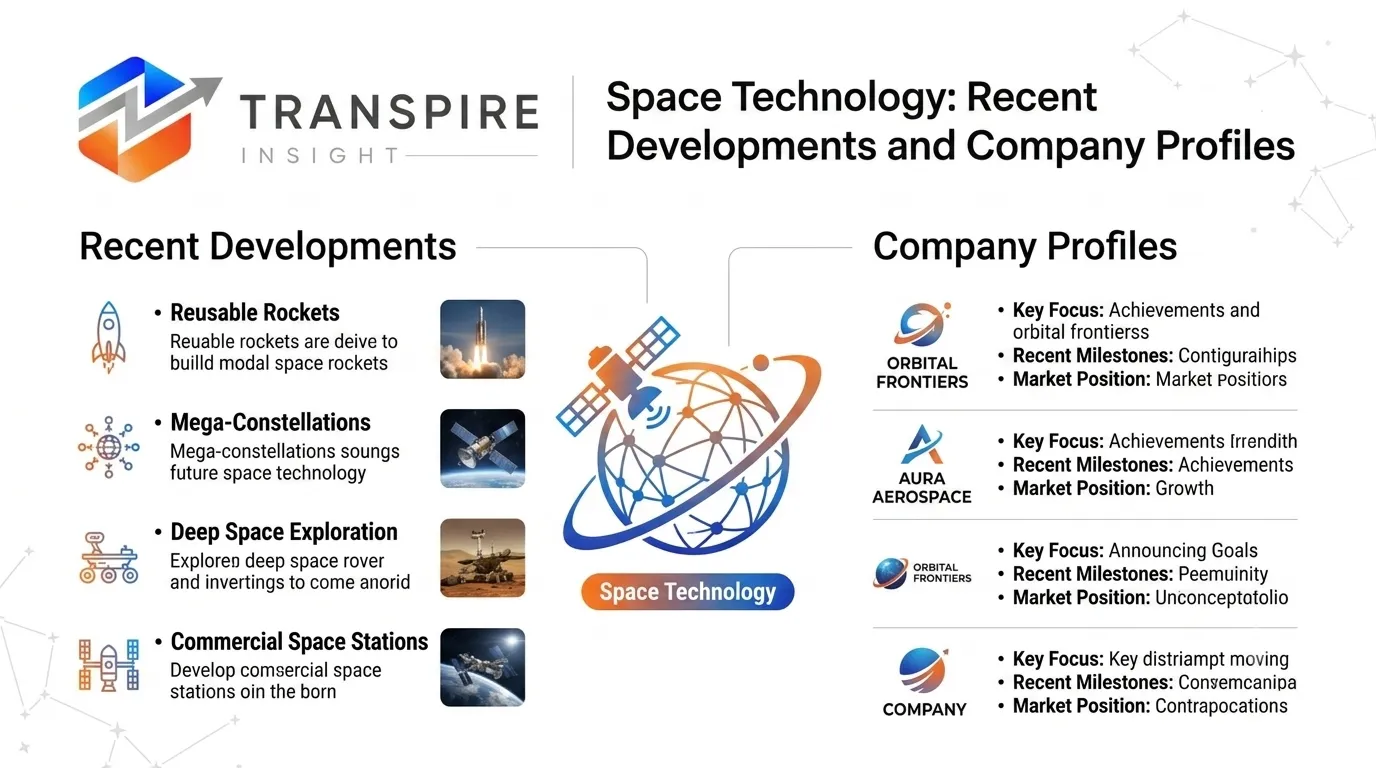
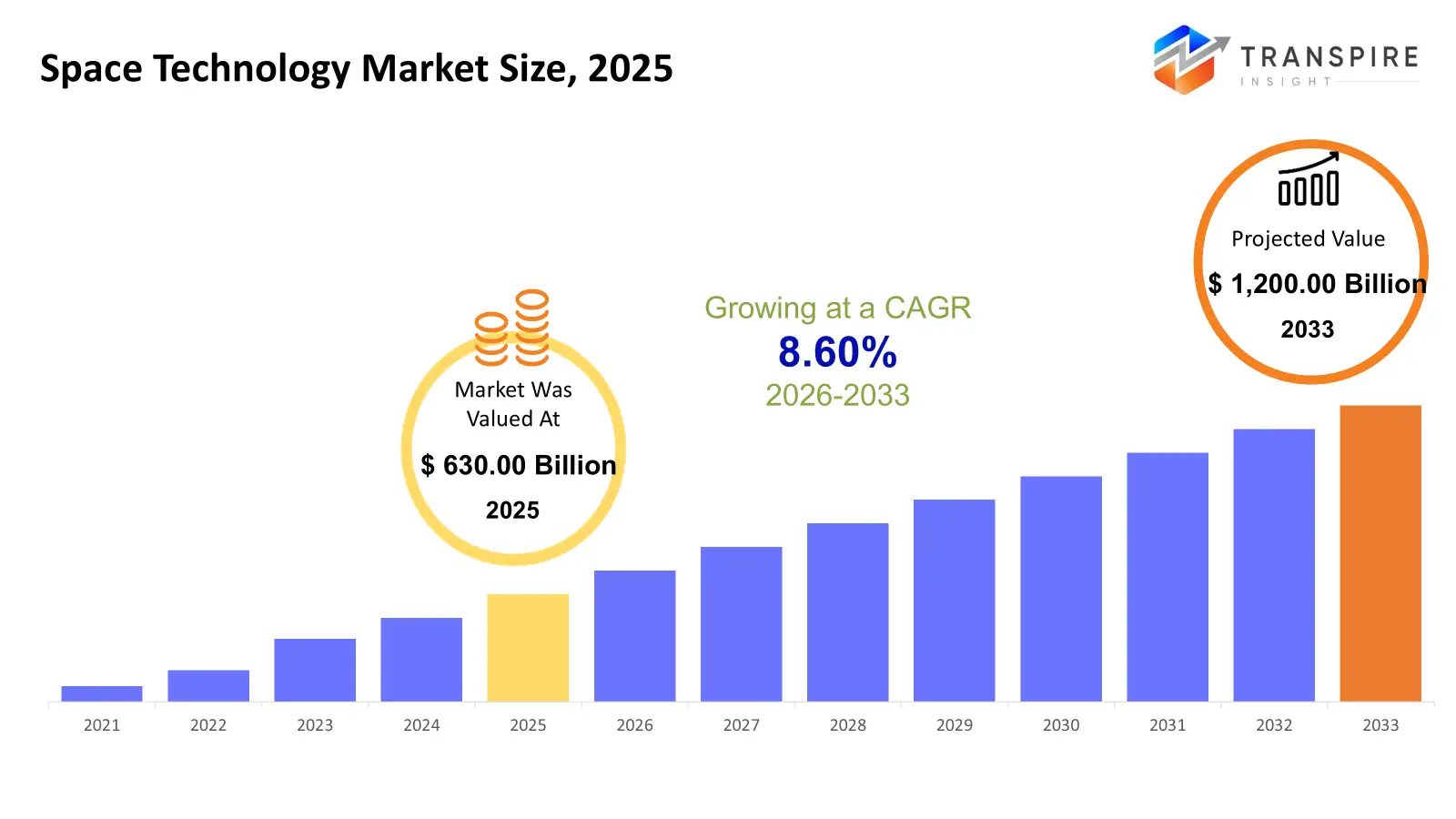
According to a research report published by Transpire Insight, the space technology market size is projected to grow from USD 680.00 billion in 2026 to USD 1300.00 billion by 2035, at a CAGR of 10.08% during the forecast period 2026-2035. The world space tech market is fueled by the rising trend of national sovereignty security needs, the proliferation of commercial LEO constellations, and big capital investment in the private sector, as well as substantial investments in security by the military.
Introduction
The world of space technology has reached a turning point in which vertical integration, direct-to-device telecommunications, and high-frequency orbital deployments are driving the new normal. The modern space economy is pushing away from historical government monopoly at a fast pace, driven by commercial activities, satellite data capabilities, and defense architecture of deep space exploration. Competition for the valuable real estate in orbit, to develop secure national security networks, and to develop new platforms for reusable heavy lift rockets that can substantially reduce launch costs is intense among the leading aerospace primes and emerging disruptive launch providers.
Recent Development News
Stay Ahead of Emerging Opportunities with Expert Market Insights by Transpire Insight
Transpire Insight provides comprehensive, data-driven market intelligence to support smarter business decisions. Our research is rooted in comprehensive analysis, authoritative predictions, and industry expertise, enabling organizations to make informed decisions in rapidly evolving markets. In-depth analysis of market segmentation, competitive positioning, regional trends, and emerging investment opportunities in high-growth areas. We blend accuracy with actionable intelligence, empowering companies to uncover new avenues for growth, bolster strategic decision-making, and stay ahead in a dynamic global market.
Download the exclusive Space Technology Market sample report today to uncover expert insights, emerging trends, and the opportunities defining the future of the industry.
Space Technology Market Size & Statistics
Regional Growth and Demand Analysis by Transpire Insight:
North America is estimated to generate the highest demand during the forecast period, holding a 55.67% market share in the space technology market. The dominant region in the space technology market is North America, owing to robust investments, technological innovation, and strategic partnerships, along with a vibrant private sector featuring companies like SpaceX, Blue Origin, and Lockheed Martin Space Systems, driving innovation. The United States is currently the biggest contributor to the North American space technology market, with the country's market estimated at USD 254.18 billion in 2025, projected to surpass USD 513.93 billion by 2035, considering factors such as NASA leading groundbreaking missions and cutting-edge research programs. As of 2026, U.S. Space Force procurement policy directs investment toward proliferated satellite constellations that spread capability across hundreds of units, and Astroscale's COSMIC mission is set to attempt magnetic docking and controlled re-entry for orbital debris removal, reflecting the region's continued leadership in both commercial and defense-driven space infrastructure.
Asia-Pacific is estimated to generate significant demand during the forecast period in the space technology market, growing at a CAGR of 10.5%. Asia-Pacific is expected to grow rapidly during the forecast period due to rising space programs and increasing demand for satellites, reflecting a robust commitment to enhancing national capabilities in space exploration and telecommunications. China is currently a major hub in the Asia-Pacific space technology market, having executed 67 orbital launches in 2024 and showcasing reusable booster technology, while maintaining the world's busiest launch schedule. India is also emerging as a key growth center, with NewSpace India Limited (NSIL) booking twelve small-satellite launches and maturing a reusable launch demonstrator aimed at halving per-kilogram launch prices; in January 2026, Azista Space announced the groundbreaking of a new electro-optical payload manufacturing facility in Gujarat to support Earth-observation satellite production. In Japan, the Japan Aerospace Exploration Agency (JAXA) has been actively pursuing international partnerships to bolster its satellite technology and launch capabilities, while South Korea's Nuri program builds sovereign launch capacity, together underscoring the region's rapid shift toward indigenous, technology-driven space capability.
Top 15 Trends in the Space Technology Market
Proceed to Checkout to purchase the exclusive Space Technology Market report and gain instant access to in-depth market intelligence, strategic analysis, and future growth opportunities.
Top 25 Companies Leading the Space Technology Market
Customize the exclusive Space Technology Market report today to receive tailored insights, country-specific analysis, and business-focused market intelligence.
1. SpaceX
Operates the world's largest commercial satellite constellation, providing global broadband internet.
Founded: 2002 | HQ: Hawthorne, California, USA.
Why It Ranks: Dominates global launch manifests via highly reusable Falcon 9 rockets.
Regional Dominance: North American market, widely expanding operations into international rural territories.
Product Line: Falcon rockets, Dragon capsules, Starlink internet systems, Starship launch vehicles.
2. The Boeing Company
Develops critical deep-space flight software and major planetary exploration structures.
Founded: 1916 | HQ: Arlington, Virginia, USA.
Why It Ranks: Serves as the primary contractor for NASA's Space Launch System.
Regional Dominance: Main provider for the United States civil space and defense agencies.
Product Line: Starliner spacecraft, Space Launch System rockets, complex government communication satellites.
3. Lockheed Martin Corporation
Builds advanced ballistic systems and specialized multi-mission military defense satellites.
Founded: 1995 | HQ: Bethesda, Maryland, USA.
Why It Ranks: Holds massive, long-term national security contracts with global military bodies.
Regional Dominance: Strongly dominant throughout the United States and allied Western nations.
Product Line: Orion deep-space capsules, GPS tracking networks, defense-centric surveillance infrastructure.
4. Airbus SE
Pioneers advanced commercial telecommunication spacecraft and specialized Earth-imaging platforms.
Founded: 2000 | HQ: Leiden, Netherlands (Operational: Toulouse, France).
Why It Ranks: Serves as the bedrock provider for European space exploration initiatives.
Regional Dominance: Holds clear industrial leadership across the entire European Union market.
Product Line: Eurostar satellite platforms, Pléiades Neo imaging systems, Ariane rocket components.
5. Northrop Grumman Corporation
Manufactured the complex James Webb Space Telescope optical and structural shields.
Founded: 1994 | HQ: Falls Church, Virginia, USA.
Why It Ranks: Leads crucial deep-space observation programs and national security space operations.
Regional Dominance: Deeply embedded across the United States federal and defense intelligence branches.
Product Line: Cygnus resupply vehicles, solid rocket boosters, military satellite data buses.
6. Blue Origin LLC
Develops reusable heavy-lift engines utilizing liquefied natural gas and oxygen.
Founded: 2000 | HQ: Kent, Washington, USA.
Why It Ranks: Secures massive funding for commercial lunar lander and launch infrastructure.
Regional Dominance: Expanding its operational footprint across massive new facilities in America.
Product Line: New Shepard tourist vehicles, New Glenn rockets, BE-4 rocket engines.
7. Rocket Lab USA Inc
Pioneered carbon-composite orbital rockets powered by unique electric-pump-fed engines.
Founded: 2006 | HQ: Long Beach, California, USA.
Why It Ranks: Delivers high-cadence small-satellite launches alongside integrated global communication platforms.
Regional Dominance: Holds a strong launch presence spanning both New Zealand and America.
Product Line: Electron small-lift rockets, Photon satellite buses, Neutron medium-lift vehicles.
8. Arianespace
Operates historic heavy-lift spaceports located directly along the equatorial belt.
Founded: 1980 | HQ: Évry-Courcouronnes, France.
Why It Ranks: Provides critical, independent sovereign orbital access for European institutional payloads.
Regional Dominance: Main launch operator across Europe, South America, and global institutional clients.
Product Line: Ariane heavy-lift rockets, Vega light launch systems, commercial launch logistics.
9. Maxar Technologies
Captures high-resolution geospatial imagery utilized extensively by global mapping platforms.
Founded: 1969 | HQ: Westminster, Colorado, USA.
Why It Ranks: Dictates international standards for commercial Earth intelligence and satellite manufacturing.
Regional Dominance: Supplies extensive spatial data networks across the Americas and Europe.
Product Line: WorldView imaging satellites, 1300-series spacecraft buses, 3D analytical geospatial software.
10. Thales Group
Delivers cutting-edge pressurized modules for the international orbital space laboratory.
Founded: 2000 | HQ: Paris, France.
Why It Ranks: Engineers elite defense electronics, payloads, and environmental monitoring space systems.
Regional Dominance: Anchors major civil space programs throughout Europe and the Middle East.
Product Line: Space-based radar arrays, pressurized cargo modules, environmental science payload systems.
Schedule a meeting with our market experts to discuss the exclusive Space Technology Market report and identify the best research solution for your organization.
Conclusion
The space technology market is on the verge of a fast, structural shift from small-scale government experiments to a large-scale, multi-billion-dollar commercial industry. Competition in heavy lift re-use, sovereign defense requirements, and direct-to-device (D2D) telecommunications operations around the world are shaping the strategic future of orbital infrastructure in these top ten companies. These industry giants are still uniquely capable of shaping human presence in low Earth orbit and out amongst the stars.


Send us a brief description of your challenge and we'll get back to you within 24 hours.

 inquiry@transpireinsight.com
 APAC:+91 7666513636
 Address


