
Jul 15, 2026
By Transpire Insight
Description
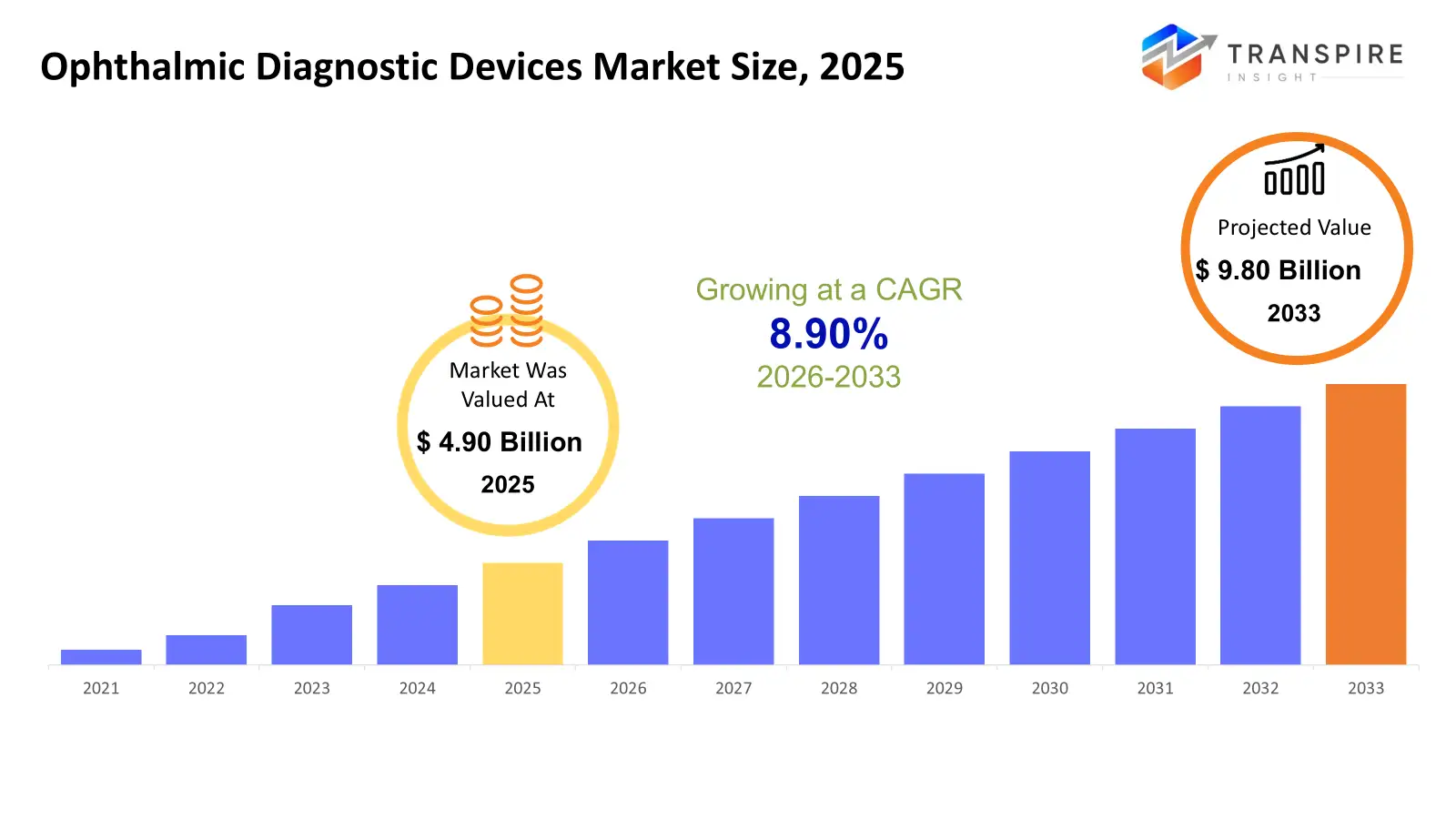
According to a research report published by Transpire Insight, the global ophthalmic diagnostic devices market size is projected to grow from USD 18.5 billion in 2026 to USD 33.12 billion by 2035, at a CAGR of 12.19% during the forecast period 2026-2035. The growing incidence of Age-Related Macular Degeneration, Glaucoma, and Diabetic Retinopathy is a major factor fuelling the global ophthalmic diagnostic devices market. Age-Related Macular Degeneration (ARMD), Glaucoma, and Diabetic Retinopathy are major factors driving the global ophthalmic diagnostic devices market. Furthermore, fast integration of automated AI-driven imaging software greatly speeds up the early detection pipeline.
Introduction
The global ophthalmic diagnostic devices market is seeing a sharp rise in growth, driven by a perfect storm of changing demographics and technological advances. The population of the old is increasing worldwide, and chronic diseases such as diabetes and hypertension are leading to an unprecedented number of cases of vision impairment. Eye care providers use sophisticated diagnostic suites to identify small changes in eye structure before any symptoms of disease can be felt. In the modern clinic, the use of Optical Coherence Tomography (OCT), fundus cameras, and automated perimeters is driving a shift from basic observation devices to sophisticated, digital imaging systems that can improve patient outcomes.
Recent Development News
Stay Ahead of Emerging Opportunities with Expert Market Insights by Transpire Insight
Transpire Insight provides comprehensive, data-driven market intelligence to support smarter business decisions. Our research is rooted in comprehensive analysis, authoritative predictions, and industry expertise, enabling organizations to make informed decisions in rapidly evolving markets. In-depth analysis of market segmentation, competitive positioning, regional trends, and emerging investment opportunities in high-growth areas. We blend accuracy with actionable intelligence, empowering companies to uncover new avenues for growth, bolster strategic decision-making, and stay ahead in a dynamic global market.
Download the exclusive Ophthalmic Diagnostic Devices Market sample report today to uncover expert insights, emerging trends, and the opportunities defining the future of the industry.
Ophthalmic Diagnostic Devices Market Size & Statistics
Regional Growth and Demand Analysis by Transpire Insight:
North America is expected to remain the dominant region during the forecast period in the ophthalmic diagnostic devices market. The region's leadership is supported by strong healthcare infrastructure, high healthcare spending, and early adoption of advanced imaging technologies such as OCT and AI-assisted retinal analysis. The United States is the largest contributor to regional demand, driven by a rising geriatric population, growing prevalence of diabetic retinopathy and glaucoma, and an FDA regulatory pathway that has increasingly streamlined clearances for AI-based diagnostic tools. In May 2026, AEYE Health received FDA clearance for what it describes as the first fully autonomous AI system for diabetic retinopathy screening usable with portable, handheld retinal cameras, achieving over 99% imageability without requiring pupil dilation, a signal of how point-of-care and primary-care settings are becoming viable new demand channels for diagnostic hardware beyond traditional ophthalmology clinics.
Asia-Pacific is anticipated to witness rapid growth during the forecast period in the ophthalmic diagnostic devices market. This growth is driven by the rising prevalence of ocular disorders tied to an aging population, rapid healthcare modernization, and rising demand for early screening services, with China and India leading the way through strategic healthcare investments and the development of specialized eye-care facilities in Tier-II and Tier-III cities. The region is also seeing accelerated adoption of AI-based retinal screening and portable diagnostic systems suited to remote and underserved areas, with diabetic retinopathy screening programs across India, China, and Southeast Asia targeting populations exceeding 500 million people with diabetes by 2030. A comparative regulatory review published in May 2026 mapped how ophthalmic AI and software-as-a-medical-device approval pathways are evolving in parallel across the US, China, Japan, and India, pointing to growing regulatory convergence that should ease cross-border deployment of screening technologies in the region going forward.
Top 15 Market Trends in the Ophthalmic Diagnostic Devices Market
Proceed to Checkout to purchase the exclusive Ophthalmic Diagnostic Devices Market report and gain instant access to in-depth market intelligence, strategic analysis, and future growth opportunities.
Top 25 Companies Leading the Ophthalmic Diagnostic Devices Market
Customize the exclusive Ophthalmic Diagnostic Devices Market report today to receive tailored insights, country-specific analysis, and business-focused market intelligence.
Top 25 Companies Leading the Ophthalmic Diagnostic Devices Market
1. Carl Zeiss Meditec AG
This company manufactures the widely utilized, industry-standard Humphrey Field Analyzer system.
Founded: 2002 | HQ: Jena, Germany.
Why It Ranks: It is the pioneer and global market leader in advanced OCT imaging.
Regional Dominance: Holds a commanding premium market share across Europe and North America.
Product Line: CIRRUS HD-OCT systems, VISUCAM fundus cameras, and Humphrey perimeters.
2. Topcon Corporation
They produce advanced robotic fundus cameras that automate complex retinal imaging.
Founded: 1932 | HQ: Tokyo, Japan.
Why It Ranks: Globally recognized for seamlessly integrating multi-modal diagnostic systems with AI software.
Regional Dominance: Exercises a highly dominant, pervasive influence across Asian and North American clinics.
Product Line: Maestro2 Robotic OCT-Fundus Cameras and TRC series specialized retinal systems.
3. NIDEK Co., Ltd.
This brand engineered the widely adopted, versatile auto refractor-keratometer combination series.
Founded: 1971 | HQ: Gamagori, Japan.
Why It Ranks: Highly acclaimed for manufacturing highly durable, ultra-precise clinical optometric hardware solutions.
Regional Dominance: Enjoys massive, deeply entrenched institutional market penetration across global eye clinics.
Product Line: Retina Scan Duo OCT systems and fully automated microperimeters.
4. Heidelberg Engineering GmbH
Their modular SPECTRALIS platform remains the benchmark for academic retinal research.
Founded: 1990 | HQ: Heidelberg, Germany.
Why It Ranks: Renowned for producing high-end confocal scanning laser ophthalmoscopes with unmatched resolution.
Regional Dominance: Strongly dominates premier academic research hospitals throughout Western European territories.
Product Line: SPECTRALIS multimodal imaging platforms and ANTERION high-resolution anterior segment diagnostics.
5. Canon Medical Systems Corporation
They leverage decades of photographic imaging expertise to build medical cameras.
Founded: 1930 | HQ: Otawara, Japan.
Why It Ranks: Excels in processing high-resolution, ultra-widefield fundus photography with exceptional chromatic clarity.
Regional Dominance: Maintains a robust operational footprint spanning Japanese and pan-Asian medical networks.
Product Line: Xephilio OCT-A systems and CR-2 Plus AF digital fundus cameras.
6. Haag-Streit Group
Their gold-standard Slit Lamp BM 900 revolutionized early microscopic eye evaluations.
Founded: 1858 | HQ: Köniz, Switzerland.
Why It Ranks: Considered the definitive world leader in optical biomechanics and manual biometry.
Regional Dominance: Unrivaled structural dominance across European and American private ophthalmology practices.
Product Line: BQ 900 Slit Lamps and Lenstar optical biometer suites.
7. Optovue, Inc.
This pioneer launched the world's first commercially viable optical coherence tomography angiography.
Founded: 2003 | HQ: Fremont, California, USA.
Why It Ranks: A critical developer driving non-invasive microvascular visualization without contrast dyes.
Regional Dominance: Anchored securely with robust operational sales across the United States.
Product Line: Avanti Widefield OCT and AngioVue OCT Angiography diagnostic systems.
8. Tomey Corporation
They specialize in high-frequency ultrasound and intricate corneal surface profile map engineering.
Founded: 1971 | HQ: Nagoya, Japan.
Why It Ranks: A leading manufacturer of automated diagnostic topography systems for refractive surgeries.
Regional Dominance: Holds substantial product distribution share across Asian and European territories.
Product Line: TMS-4 Corneal Topographers and CASia2 Fourier-Domain anterior segment OCT devices.
9. Optopol Technology Sp. z o.o.
They engineered the world's very first commercial Spectral Domain OCT system.
Founded: 1992 | HQ: Zawiercie, Poland.
Why It Ranks: Recognized for delivering high-speed, cost-effective, space-saving compact diagnostic imaging solutions.
Regional Dominance: Fast-growing market footprint expanding dynamically across Eastern Europe and emerging markets.
Product Line: REVO NX Spectral Domain OCT and PTS automated perimeter lines.
10. Ziemer Ophthalmic Systems AG
This innovator pairs diagnostic topography directly alongside high-precision refractive cutting lasers.
Founded: 1998 | HQ: Port, Switzerland.
Why It Ranks: Highly ranked for unifying anterior segment diagnostic mapping with premium surgical guidance.
Regional Dominance: Well-established, respected luxury footprint across Central European and North American clinics.
Product Line: GALILEI G4 Dual Scheimpflug Analyzers and specialized corneal biometers.
Schedule a meeting with our market experts to discuss the exclusive Ophthalmic Diagnostic Devices Market report and identify the best research solution for your organization.
Conclusion
In modern times, the ophthalmic diagnostic devices market has proven to be a key enabler in the vision preservation sector. With established clinical protocols and an increasing number of instances of age-related blindness, the change to multimodal-plus-cloud imaging systems is inevitable. Leading diagnostic companies are persistently driving innovation and cracking barriers, such as in the area of portable/handheld technology and cloud-based infrastructure for tele-ophthalmology. With the increasing accessibility and affordability of hardware, these sophisticated diagnostic suites will be more widely adopted across the globe, streamlining the providers' workflow, providing access to screening, and ensuring preventative eye intervention.


Send us a brief description of your challenge and we'll get back to you within 24 hours.

 inquiry@transpireinsight.com
 APAC:+91 7666513636
 Address


