
Jul 16, 2026
By Transpire Insight
Description
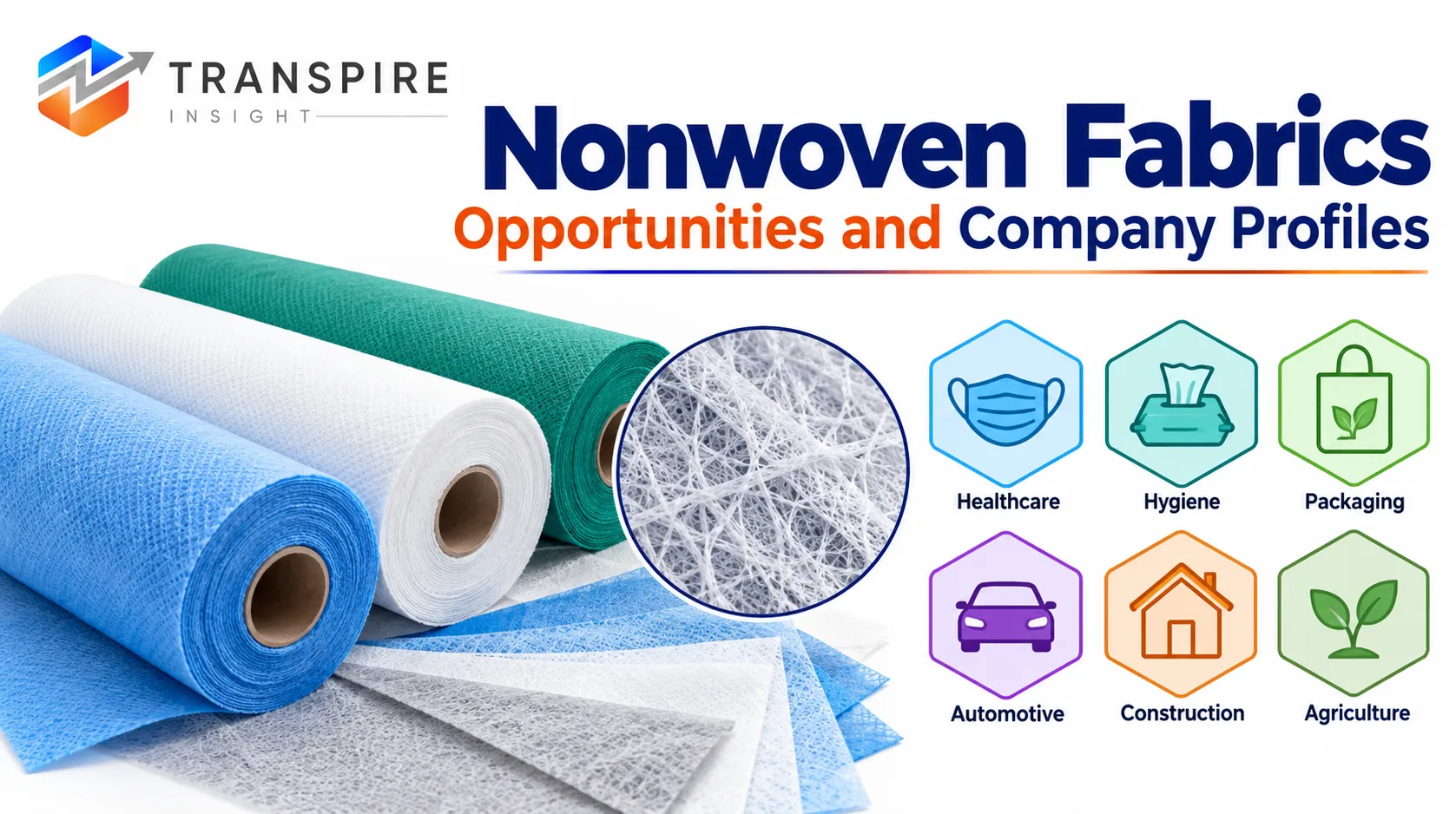
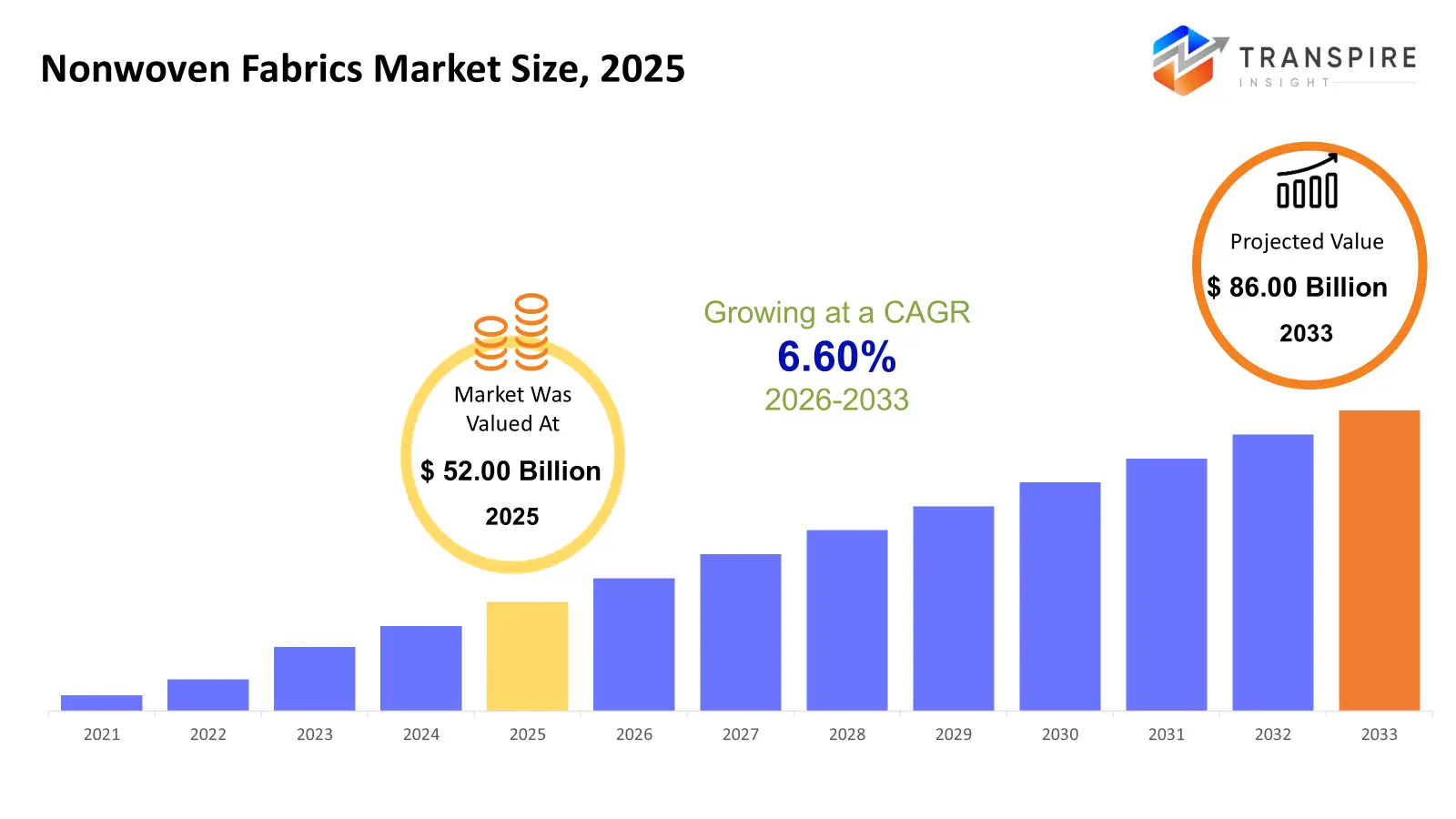
According to a research report published by Transpire Insight, the global nonwoven fabrics market size is projected to grow from USD 60.00 billion in 2026 to USD 96.00 billion by 2035, at a CAGR of 8.10% during the forecast period 2026-2035. Rapid growth of disposable personal hygiene products as a result of high birth rate and ageing population is a major driver of the global nonwoven fabrics market. Moreover, many medical infrastructure standards in the post-pandemic era drive material usage significantly, alongside the strict automotive emissions requirements for lightweighting.
Introduction
Nonwoven fabrics are fabrics created by mechanically, thermally, or chemically entangling fibers or filaments into a sheet that has structural integrity. They do not involve the process of yarn weaving or knitting, and can be manufactured at very high speeds and with very low costs, with even very tunable physical properties. Such versatility makes nonwovens essential structural components in a wide range of applications, including personal care, medical protection, automotive design, filtration networks and geopolitical infrastructure development, worldwide, where they provide a range of functional properties such as absorbency, liquid repellency, resilience, stretch, flame retardancy, and bacterial barriers.
Recent Development News
Stay Ahead of Emerging Opportunities with Expert Market Insights by Transpire Insight
Transpire Insight provides comprehensive, data-driven market intelligence to support smarter business decisions. Our research is rooted in comprehensive analysis, authoritative predictions, and industry expertise, enabling organizations to make informed decisions in rapidly evolving markets. In-depth analysis of market segmentation, competitive positioning, regional trends, and emerging investment opportunities in high-growth areas. We blend accuracy with actionable intelligence, empowering companies to uncover new avenues for growth, bolster strategic decision-making, and stay ahead in a dynamic global market.
Download the exclusive Nonwoven Fabrics Market sample report today to uncover expert insights, emerging trends, and the opportunities defining the future of the industry.
Nonwoven Fabrics Market Size & Statistics
Regional Growth and Demand Analysis by Transpire Insight:
The dominant region in the nonwoven fabrics market is Asia Pacific owing to the availability of large-scale spunbond and meltblown production capacity, deeply integrated regional supply chains linking propylene crackers, fiber spinning, and end-product assembly, and robust investment in hygiene and medical-grade manufacturing. China is currently the biggest producer in the Nonwoven Fabrics Market, considering factors such as extensive spunbond and meltblown production lines, rapidly expanding hygiene-product consumption, and continued growth in technical nonwoven applications for filtration and construction. As of 2025-2026, several Chinese nonwoven manufacturers have undertaken capacity expansion activities, adding over 450,000 tons of combined spunbond and meltblown capacity across nearly 32 new production lines to meet rising diaper, mask, and filtration demand.
North America is anticipated to grow the fastest during the forecast period in the nonwoven fabrics market. It is expected that the North American region will witness the highest growth rate during the forecast period due to the reshoring of critical medical PPE and battery-separator supply chains, rising filtration and healthcare applications, and significant capital investment in advanced, automation-driven production capacity. The United States, Canada, and Mexico are witnessing increased adoption of AI-enabled logistics and quality-control systems that strengthen domestic nonwoven manufacturing, while growing EV production is opening new demand for nonwoven battery separators. In 2025-2026, Kimberly-Clark advanced a USD 2 billion expansion across its Ohio and South Carolina facilities, incorporating AI-enabled logistics to support next-generation nonwoven hygiene and medical production capacity in the region.
Top 15 Trends in the Nonwoven Fabrics Market
Proceed to Checkout to purchase the exclusive Nonwoven Fabrics Market report and gain instant access to in-depth market intelligence, strategic analysis, and future growth opportunities.
Top 25 Companies Leading the Nonwoven Fabrics Market
Customize the exclusive Nonwoven Fabrics Market report today to receive tailored insights, country-specific analysis, and business-focused market intelligence.
1. Berry Global Inc.
Massive global infrastructure outputs optimized spunbond substrates for major consumer package brands.
Founded: 1967 | HQ: Evansville, Indiana, USA.
Why it Ranks: Dominant manufacturing scale guarantees reliable, high-volume production for international hygiene converters.
Regional Dominance: Vast multi-continental plant presence commands exceptional logistical advantages across the Western hemisphere.
Product Line: Spunbond, meltblown, and composite nonwovens engineered for specialty healthcare applications.
2. Freudenberg Group
Technical textile pioneer develops sophisticated, highly engineered fiber structures for industrial sectors.
Founded: 1849 | HQ: Weinheim, Germany.
Why it Ranks: Unrivaled research and development, continuous innovation dictate premium global performance standards.
Regional Dominance: Historic European manufacturing roots secure an unshakeable commercial monopoly across transatlantic regions.
Product Line: Performance-critical materials tailored for advanced automotive insulation, filtration, and apparel.
3. Ahlstrom
Advanced fiber-based solutions prioritize superior purification capabilities for global environmental filtration.
Founded: 1851 | HQ: Helsinki, Finland.
Why it Ranks: Specialized structural mastery enables highly precise particle separation across industrial applications.
Regional Dominance: Strategic European operations maintain a powerful, deeply integrated footprint across global markets.
Product Line: High-performance protective medical fabrics, industrial filter media, and sustainable wallcoverings.
4. Kimberly‑Clark Worldwide, Inc.
In-house proprietary substrate fabrication powers universally recognized, multi-billion-dollar personal hygiene brands.
Founded: 1872 | HQ: Dallas, Texas, USA.
Why it Ranks: Direct vertical consumer market integration secures unparalleled, stable baseline demand volumes.
Regional Dominance: Comprehensive domestic facility networks firmly anchor multi-decade market supremacy within North America.
Product Line: Soft, fluid-retaining proprietary nonwoven layers optimized for protective infant and adult care.
5. Fitesa S.A.
High-speed, dedicated manufacturing assets continuously generate advanced spunmelt materials for hygiene.
Founded: 1973 | HQ: Porto Alegre, Brazil.
Why it Ranks: Focused expertise in high-volume spunbond technologies commands vital supplier status globally.
Regional Dominance: Decisive Latin American production leadership dictates commercial supply dynamics across the southern hemisphere.
Product Line: Soft spunbond, carded, and custom composite webs designed for personal care.
6. DuPont de Nemours Inc.
Flash-spinning technology creates unmatched high-barrier protection substrates used in hostile environments.
Founded: 1802 | HQ: Wilmington, Delaware, USA.
Why it Ranks: Proprietary materials command absolute authority within global industrial and construction safety.
Regional Dominance: Elite engineering infrastructure maintains widespread commercial dominance throughout highly regulated Western economies.
Product Line: Tyvek protective garments, building wraps, medical packaging, and cargo covers.
7. Toray Industries, Inc.
Advanced synthetic polymer chemistry delivers elite polypropylene spunbond fabrics to converters.
Founded: 1926 | HQ: Tokyo, Japan.
Why it Ranks: High-precision manufacturing capabilities secure vital positions within technical industrial supply chains.
Regional Dominance: Massive localized production belts capture dominant revenue shares across East Asian territories.
Product Line: High-tensile spunbond sheets, multi-layered composites, and durable filtration components.
8. Suominen Corporation
Specialized fluid management design produces premium substrate materials for global wipe industries.
Founded: 1898 | HQ: Helsinki, Finland.
Why it Ranks: Global market leadership in nonwoven wipes sets international consumer quality standards.
Regional Dominance: Transatlantic manufacturing capabilities maintain a strong commercial supply presence in Europe and America.
Product Line: Hydraspun, spunlace, and composite roll goods tailored for household and medical wipes.
9. Johns Manville
Heavy industrial thermal bonding yields robust fiberglass and polyester mats for infrastructure.
Founded: 1858 | HQ: Denver, Colorado, USA.
Why it Ranks: Corporate backing from Berkshire Hathaway provides massive financial stability and market resilience.
Regional Dominance: Advanced domestic manufacturing lines securely control core building and roofing supply markets.
Product Line: Durable glass fiber nonwovens, roofing carrier mats, and high-efficiency air filters.
10. Avgol (Indorama Ventures)
Ultra-lightweight composite line installations drive material efficiency optimizations for personal hygiene.
Founded: 1953 | HQ: Tel Aviv, Israel.
Why it Ranks: Deep integration with Indorama Ventures guarantees steady, uninterrupted access to raw materials.
Regional Dominance: Global manufacturing footprint ensures rapid, flexible distribution across emerging and developing country markets.
Product Line: Next-generation spunmelt nonwovens, tailored baby care backsheets, and adult incontinence materials.
Schedule a meeting with our market experts to discuss the exclusive Nonwoven Fabrics Market report and identify the best research solution for your organization.
Conclusion
The nonwoven fabrics industry continues to be competitive, with high-volume consumer hygiene suppliers competing with highly innovative manufacturers of nonwoven industrial technical materials. Brands such as Berry Global and Fitesa provide significant scale economies for consumer packaged goods markets around the world, while industry leaders such as Freudenberg and DuPont secure high-margin, performance-driven applications such as filtration, automotive insulation, and aerospace protection. In the end, the global transition of textiles to the circular economy will be driven at a faster pace by the top ten industry leaders and their strategic positions in this region as the demographics of these regions grow and plastic regulations become stricter.


Send us a brief description of your challenge and we'll get back to you within 24 hours.

 inquiry@transpireinsight.com
 APAC:+91 7666513636
 Address


