
Jul 22, 2026
By Transpire Insight
Description
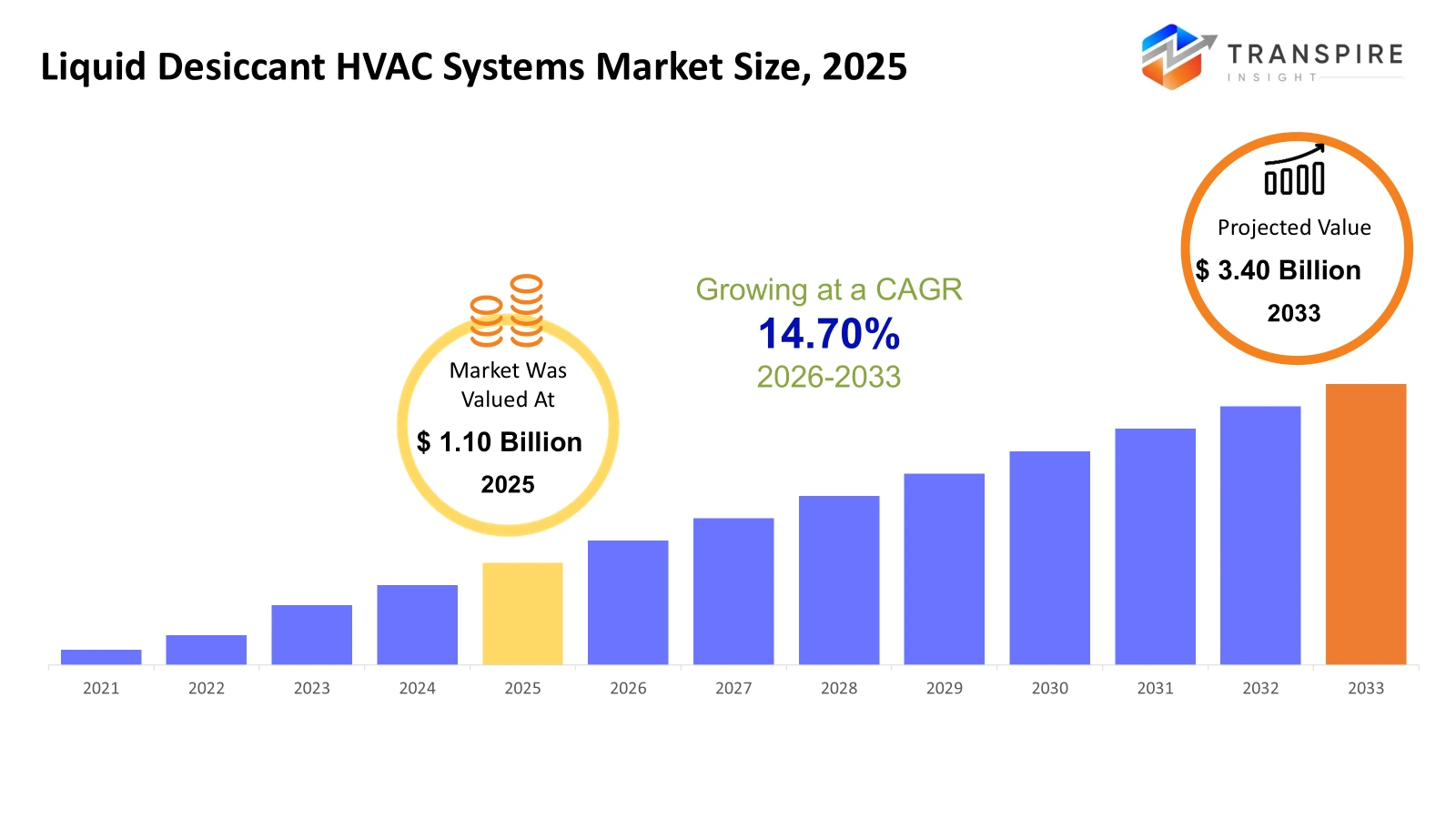
According to a research report published by Transpire Insight, The Global Liquid Desiccant HVAC Systems Market Size is projected to Grow from USD 1.95 Billion in 2026 to USD 5.90 Billion by 2035, at a CAGR of 16.32% during the forecast period 2026-2035. The growth in the market is fueled by the increased demand for energy-efficient HVAC systems, construction of green buildings, stringent environmental regulations, and heightened concerns about indoor air quality and humidity control. The progress in technology in the field of liquid desiccant, heat recovery systems, HVAC control systems, renewable energy, and building automation through IoT is helping improve the functioning of the systems even further. Apart from that, investment in commercial buildings, hospitals, pharmaceuticals, food production facilities, and data centers is set to provide considerable growth opportunities to the Global Liquid Desiccant HVAC Systems Market.
Introduction
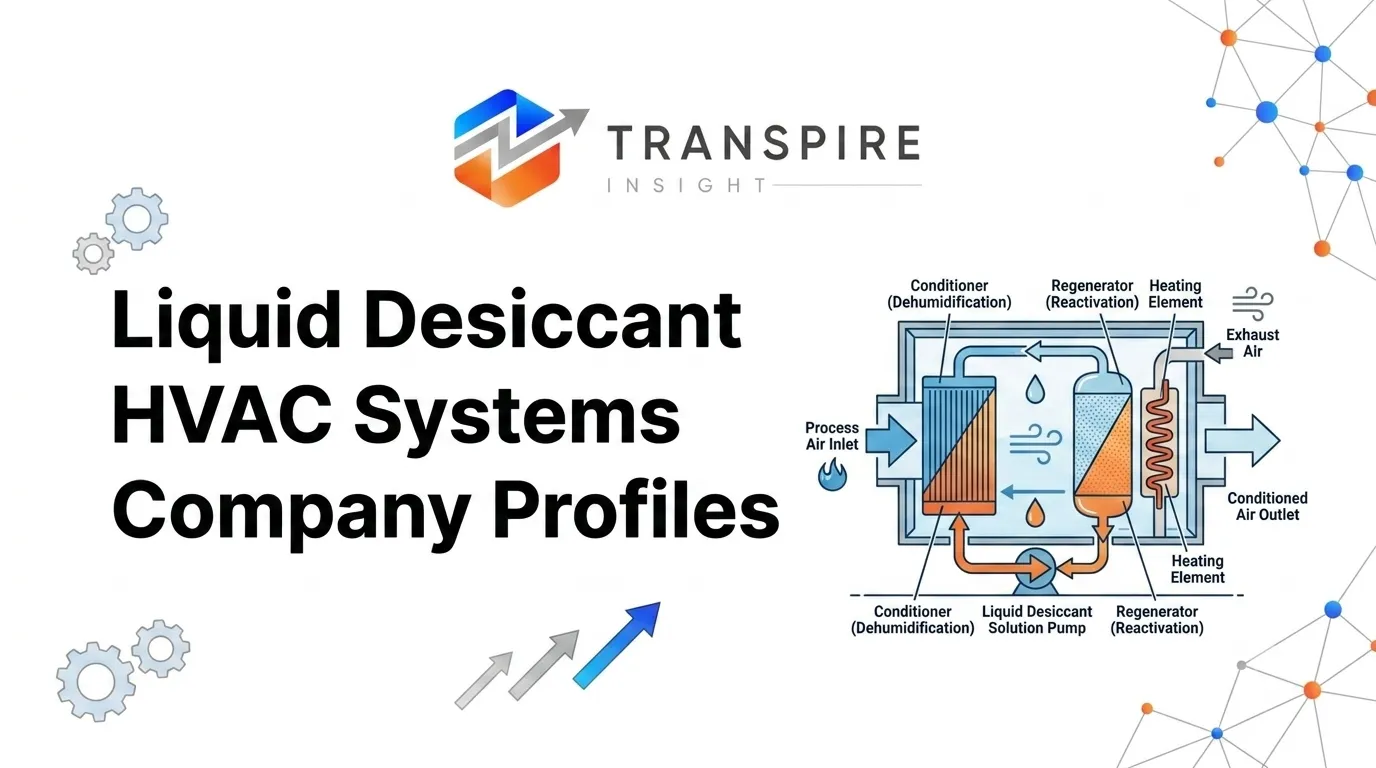
The Liquid desiccant HVAC systems market involves systems which involve use of liquid desiccants in order to improve the process of moisture removal from the air, and energy efficiency as well as improve the air quality. The system is increasingly being used in commercial buildings, healthcare facilities, industrial settings, data centers, educational institutions, the hospitality sector, as well as residential complexes, among other places, where there is a need to control the moisture levels in the air.
Recent Development News
Stay Ahead of Emerging Opportunities with Expert Market Insights by Transpire Insight
The insights that have been shared through this blog are based on intensive market research carried out by Transpire Insight, an advisor that works with many global organizations. Thanks to the analysis of extensive data, forecasts made by our specialists, and industry intelligence, our reports allow clients to find strategic growth opportunities in dynamically developing industries. For all those who would like to get more detailed information regarding market segmentation, competitive analysis, regional outlooks, and future investment tendencies, there is no doubt that our full report will be of great value.
Download the exclusive Liquid Desiccant HVAC Systems Market sample report today to uncover expert insights, emerging trends, and the opportunities defining the future of the industry.
Liquid Desiccant HVAC Systems Market Size & Statistics
Regional Growth and Demand Analysis by Transpire Insight:
North America dominates the Liquid Desiccant HVAC Systems Market, with around 37% of the market share in terms of value. The reason why North America dominates the market is its strict policies on energy efficiency, increased adoption of green building technologies, increased need for efficient humidity control systems, and usage of advanced HVAC systems in hospitals, data centers, commercial buildings, pharmaceutical industries, and educational institutes. North America is expected to maintain its position because of increased government regulation on sustainable construction, along with the presence of major HVAC solution providers in the region.
The Asia Pacific is anticipated to experience the highest growth rate during the forecast period, with an increase of about 34%. Reasons for the same include rapid urbanization, expansion of industrial and commercial infrastructure, increased investments in smart buildings, increased importance of IAQ, and increased need for energy-efficient climate control systems in China, India, Japan, South Korea, and Southeast Asia. Increasing construction activities in the region and increased adoption of environmentally sustainable HVAC technologies are expected to propel market growth.
Top 15 Trends in the Liquid Desiccant HVAC Systems Market
Proceed to Checkout to purchase the exclusive Liquid Desiccant HVAC Systems Market report and gain instant access to in-depth market intelligence, strategic analysis, and future growth opportunities.
1. Growing Adoption of Energy-Efficient Liquid Desiccant HVAC Systems
There is growing use of liquid desiccant heating, ventilation and air conditioning systems since they offer better humidity control while using much less power compared to traditional air-conditioning systems. They help cut down cooling loads, increase efficiency, reduce electrical bills and promote sustainability goals.
2. Increasing Integration with Smart Building Management Systems
The integration of Liquid Desiccant HVAC systems with smart building management systems is on the rise because they measure the temperature, humidity, ventilation, and presence of occupants on a constant basis. The use of automation technology helps regulate the climate, increase occupant comfort, lower energy consumption, and manage the building effectively.
3. Expansion of Green Building and Sustainable Construction Projects
The rapid proliferation of green building movements is driving the use of liquid desiccant HVAC systems due to the advantages that such systems provide in terms of increasing energy efficiency and being eco-friendly. Such technology assists in acquiring sustainability certification for buildings through reduced carbon emissions and improved indoor air quality.
4. Rising Demand for Advanced Indoor Air Quality Solutions
Increasing knowledge about indoor air quality is leading to the development of HVAC systems that can control humidity, minimize contaminants, mold, and microbial growth. The liquid desiccant system has improved the efficiency of ventilation systems, creating healthy indoor environments, especially in hospitals, laboratories, schools, hotels, and commercial buildings.
5. Growing Adoption of Renewable Energy-Powered HVAC Systems
More and more manufacturers are producing liquid desiccant HVAC systems that can work effectively using renewable energy sources such as solar thermal systems and waste heat recovery systems. Such an approach to utilizing renewable energy allows for reducing the use of conventional electrical power and ensures sustainability of building systems infrastructure.
6. Increasing Development of Low-Carbon Dehumidification Technologies
The constant evolution of the desiccants, heat exchangers, and eco-friendly refrigerants is leading to the creation of low carbon dehumidification methods. Such innovative systems can provide high-efficiency dehumidification while ensuring minimal harm to the environment, thus enabling organizations to meet their sustainable development targets without compromising climate control efficiency.
Top 25 Companies Leading the Liquid Desiccant HVAC Systems Market
Customize the exclusive Liquid Desiccant HVAC Systems Market report today to receive tailored insights, country-specific analysis, and business-focused market intelligence.
1. Munters Group AB
Munters Group is among the top companies globally providing efficient air treatment and climate control services particularly focusing on humidity control.
Founded:1955 | Headquarters: Stockholm, Sweden
Why It Ranks:Pioneered in the desiccant dehumidification and innovative humidity control solutions.
Regional Dominance: Strong presence across Europe, North America, Asia-Pacific, and the Middle East.
Product Line:Liquid desiccant HVAC systems, dehumidification, air handling systems, evaporative cooling systems, and climate control systems.
Recent Development:Added new products in its range of liquid desiccant air treatment systems with improved energy recovery.
2. Trane Technologies plc
Trane Technologies designs and manufactures efficient heating, ventilation, air conditioning, and cooling solutions for homes, offices, and industries.
Founded:2020 | Headquarters: Swords, Ireland
Why It Ranks: Pioneering company in efficient HVAC technology.
Regional Dominance: Strong presence across North America, Europe, Asia-Pacific, and Latin America.
Product Line: HVAC systems for commercial use, liquid desiccant dehumidification technologies, chillers, air handling units, and smart building technologies.
Recent Development:Developed new intelligent humidity control technologies with building automation systems.
3. Carrier Global Corporation
Carrier Global manufactures technologies related to heating ventilation and air conditioning (HVAC), refrigeration and healthy buildings.
Founded:2020 | Headquarters: Palm Beach Gardens, Florida, USA
Why It Ranks: Global leader in commercial air-conditioning and indoor environmental quality solutions.
Regional Dominance: Strong presence across North America, Europe, Asia-Pacific, and the Middle East.
Product Line: HVAC for commercial use, humidity control technologies, chillers, air handling systems and building automation technologies.
Recent Development: Introduced advanced humidity management solutions for health care and pharmaceutical sectors.
4. Johnson Controls International plc
Johnson Controls offers intelligent building technology, HVAC technology, fire protection, and building automation technology.
Founded:1885 | Headquarters: Cork, Ireland
Why It Ranks: A leading company in offering intelligent building management and climate control technology.
Market Strength: Dominance in North America, Europe, Asia-Pacific, and Middle East regions.
Product Line:HVAC technology, liquid desiccant humidity control technology, OpenBlue™ digital platform, building automation, and energy management technology.
Recent Development: Upgraded AI-driven humidity optimization technology via OpenBlue™ intelligent building platform.
5. Daikin Industries, Ltd.
Daikin Industries is among the largest producers of air conditioning, refrigeration, and HVAC technology in the world.
Founded:1924 | Headquarters: Osaka, Japan
Why It Ranks:Pioneer in advanced HVAC technologies around the world.
Regional Dominance: Strong presence across Asia-Pacific, North America, Europe, and the Middle East.
Product Line: Air-conditioning systems, liquid desiccant HVAC technologies, heat pumps, chillers, ventilation, and refrigeration technologies.
Recent Development:Increased its research and development efforts in green technologies for liquid desiccant air conditioning technology.
6. Condair Group AG
The Condair Company deals with commercial and industrial humidification, dehumidification, and evaporative cooling systems.
Founded:1948 | Headquarters: Pfäffikon, Switzerland
Why It Ranks: World leader in humidity control technologies.
Regional Dominance: Strong presence across Europe, North America, Asia-Pacific, and the Middle East.
Product Line: Desiccant liquid humidity control systems, humidifiers, dehumidifiers, evaporative cooling systems, and air treatments systems.
Recent Development: Developed liquid desiccant humidity control systems for hospitals and industries.
7. Desiccant Rotors International Pvt. Ltd. (DRI)
DRI develops air-conditioning systems using desiccant technology for industrial, commercial, and institutional uses.
Founded:1985 | Headquarters: Gurgaon, India
Why It Ranks: A major producer of air-conditioning and dehumidifying equipment using desiccants in Asia.
Regional Dominance: Strong presence across Asia-Pacific, the Middle East, Africa, and Europe.
Product Line: Liquid desiccant HVAC systems, dehumidifiers, fresh air systems, energy recovery systems, and air conditioning systems.
Recent Development:Increased production capacity of energy efficient desiccant air handling systems.
8. Kathabar (Subsidiary of SPX Technologies)
Kathabar is known for its liquid desiccant dehumidifier solutions that provide humidity control solutions for both industrial and commercial purposes.
Founded:1978 | Headquarters: Charlotte, North Carolina, USA
Why It Ranks: A leading company in providing liquid desiccant dehumidifier solutions.
Regional Dominance: Strong presence across North America, Europe, and Asia-Pacific.
Product Line:Liquid Desiccant HVAC systems, Industrial dehumidification systems, Humidity control solutions, Process air treatment solutions.
Recent Development:Improved the efficiency of liquid desiccant systems in pharmaceuticals and manufacturing industries.
9. TROX GmbH
TROX offers climate, ventilation, and air-conditioning technologies for commercial and industrial facilities.
Founded:1951 | Headquarters: Neukirchen-Vluyn, Germany
Why It Ranks: Market leader in state-of-the-art ventilation and air distribution systems.
Regional Dominance: Strong presence across Europe, Asia-Pacific, and the Middle East.
Product Line:Air handling units, ventilation systems, liquid desiccant HVAC systems, diffusers, and climate controls.
Recent Development: Developed energy efficient ventilation systems for eco-friendly commercial buildings.
10. FläktGroup
FläktGroup offers energy-saving ventilation, indoor air quality, and climate control systems for industrial and commercial use.
Founded:2016 | Headquarters: Herne, Germany
Why It Ranks:Leading global provider of premium indoor air and HVAC solutions.
Regional Dominance: Strong presence across Europe, the Middle East, Asia-Pacific, and North America.
Product Line: Air handling systems, ventilation equipment, humidity control technology, liquid desiccant HVAC systems, and cleanroom climate systems.
Recent Development:Development of sustainable air handling technologies to support green buildings and energy-efficient HVAC systems.
Schedule a meeting with our market experts to discuss the exclusive Liquid Desiccant HVAC Systems Market report and identify the best research solution for your organization.
Conclusion
The Liquid Desiccant HVAC Systems Market is anticipated to witness significant growth during the forecast period on account of growing need for efficient climate control solutions, stringent indoor air quality standards, increasing number of green buildings, and increasing adoption of sustainable HVAC technologies in commercial, industrial, healthcare, pharmaceuticals, and data center sectors. Recent technological developments like smart building integration, renewable energy driven HVAC systems, AI based climate control optimization, IoT enabled monitoring technology, heat recovery technology, and environmentally friendly desiccant material are contributing towards enhancing the efficiency of liquid desiccant HVAC systems. Key players such as Munters Group AB, Trane Technologies plc, Carrier Global Corporation, Johnson Controls International plc, Daikin Industries, Ltd., Condair Group AG, Desiccant Rotors International Pvt. Ltd. (DRI), Kathabar (SPX Technologies), TROX GmbH, and FläktGroup are consolidating their position in the market through consistent innovations and developments. With organizations giving importance to energy savings and environmental sustainability, the future outlook of the market is quite promising.


Send us a brief description of your challenge and we'll get back to you within 24 hours.

 inquiry@transpireinsight.com
 APAC:+91 7666513636
 Address


