
Jul 11, 2026
By Transpire Insight

Description
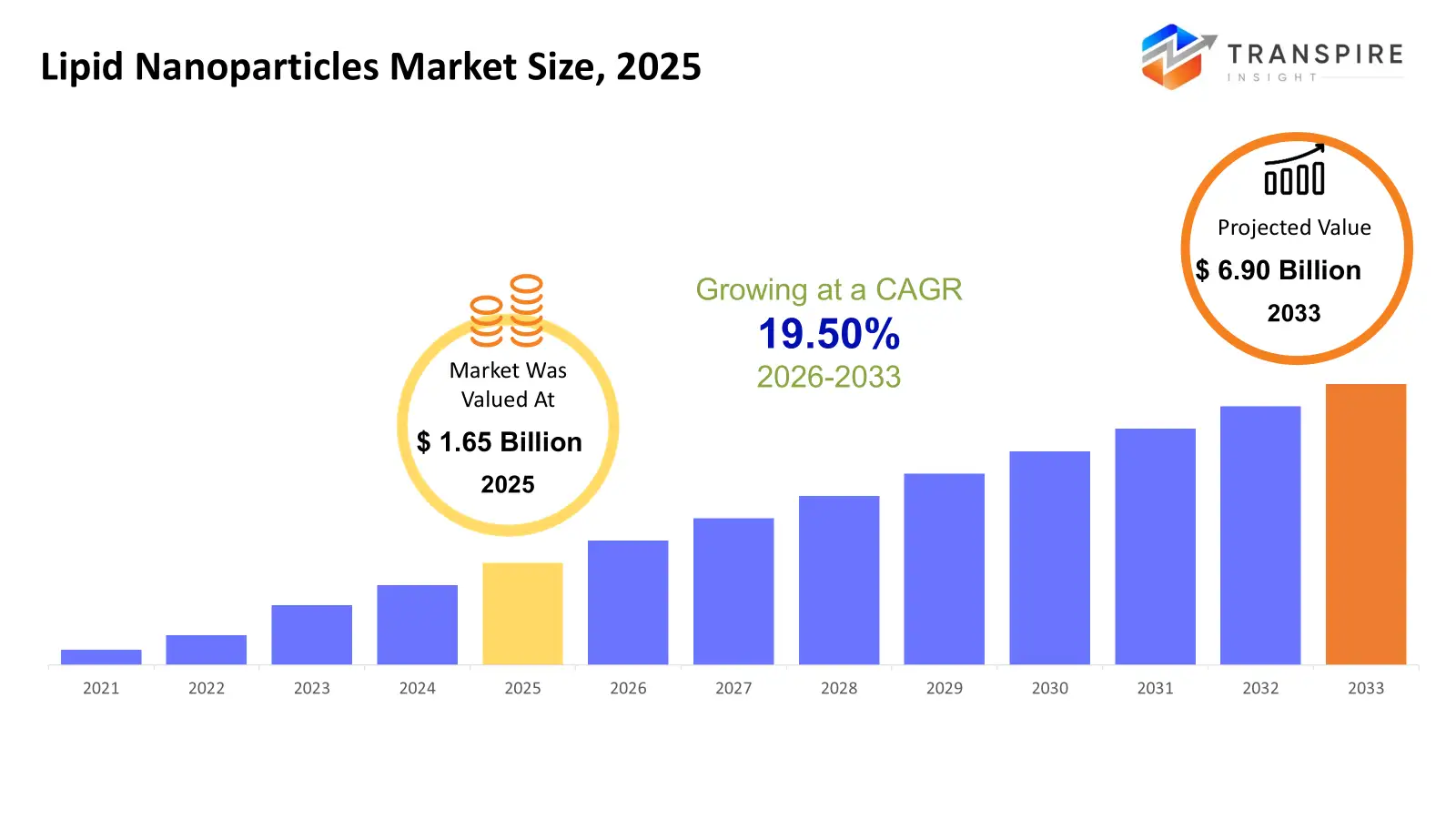
According to a research report published by Transpire Insight, The Global Lipid Nanoparticles Market Size is projected to Grow from USD 5.10 Billion in 2026 to USD 7.80 Billion by 2035, at a CAGR of 20.2% during the forecast period 2026-2035. Market expansion is being fueled by the growing development of mRNA vaccine and therapies, higher investments in gene editing and RNA interference (RNAi) technologies, increasing oncology R&D, and growing requirement for drug delivery platforms. Consistent innovation in lipid formulation technologies, personalized medicine, and nanomedicine, coupled with rising collaborations among pharmaceutical and biotechnology players, is further boosting the market expansion. Moreover, the increasing pipeline of nucleic acid-based therapies and support from regulators for advanced biologics will drive the global Lipid Nanoparticles Market in the coming years.
Introduction
The Lipid Nanoparticles (LNP) Market consists of nanoparticle-based delivery systems made up of lipids and are employed for carrying therapeutic agents like mRNA, siRNA, DNA, proteins, peptides, and small molecule drugs. The LNPs act as an important part of the modern drug delivery system as they enhance the stability, bioavailability, targeting and controlled release of therapeutic compounds. LNPs are utilized in the development of vaccines, gene therapies, oncology, rare diseases, and precision medicines.
Recent Development News
Stay Ahead of Emerging Opportunities with Expert Market Insights by Transpire Insight
The findings that have been featured in this blog post are based on extensive market research conducted by Transpire Insight, a reputable advisory company for some of the world’s most successful corporations. With the help of data analytics, expert forecasts, and industry intelligence, our research reports enable executives to uncover opportunities for growth in rapidly changing industries. The clients who are looking for information regarding market segments, competitor analysis, regional perspectives, and future investment prospects will benefit greatly from our full report.
Download the exclusive Lipid Nanoparticles Market sample report today to uncover expert insights, emerging trends, and the opportunities defining the future of the industry.
Lipid Nanoparticles Market Size & Statistics
Regional Growth and Demand Analysis by Transpire Insight:
The North American region is at the top position in the Lipid Nanoparticles Market. It holds a share of about 42% of the total global market share owing to its highly developed biopharmaceutical market, investment in mRNA therapeutics, gene therapy and RNA delivery technologies, along with established biotechnology and pharmaceutical industries in the region. Moreover, government agencies, research institutions and large-scale investment in precision medicine and vaccines contribute to the rapid development of the region's technology. In addition, the availability of prominent contract development and manufacturing organizations (CDMOs) in the region is another reason behind its dominant market position.
On the other hand, the Asia Pacific region is likely to become the fastest growing region during the forecast period owing to increased biopharmaceutical manufacturing capacity, investments in research and development, and clinical trial activities. Several countries including China, Japan, South Korea, and India are investing extensively in advanced drug delivery systems and biotechnology. Initiatives taken by governments for the development of life sciences, along with collaboration between global pharmaceutical companies and regional biotechnology firms, help in driving the adoption of lipid nanoparticle technology.
Top 15 Trends in the Lipid Nanoparticles Market
Proceed to Checkout to purchase the exclusive Lipid Nanoparticles Market report and gain instant access to in-depth market intelligence, strategic analysis, and future growth opportunities.
1. Growing Adoption of mRNA-Based Therapeutics
Development in mRNA technology has played a crucial role in increasing the demand for lipid nanoparticles because they have been identified as one of the most efficient carriers for RNA particles. With the success of mRNA vaccines, there has been increased development on mRNA therapies for other diseases such as infections, cancer, and genetic diseases. Therefore, there has been increased growth in the pipeline of mRNA therapies, and this calls for LNP technology.s
2. Expansion of Lipid Nanoparticle Applications in Gene Therapy
Lipid nanoparticles have become an increasingly common choice for gene therapy applications since they offer a safe and efficient way of transporting genetic cargo into targeted cells without the use of viruses. Scientists are now using lipid nanoparticles for developing delivery systems to treat hereditary and genetic diseases as well as neurological disorders.
3. Increasing Demand for Advanced RNA Drug Delivery Systems
Increased interest in RNA drugs, such as siRNA, mRNA, and antisense oligonucleotides, is driving the need for novel lipid nanoparticles to deliver these RNA therapeutics. LNPs provide protection against RNA degradation, increased cellular uptake, and better efficacy. Advances in lipid chemistry and formulation are continuously driving innovations in RNA drug delivery.
4. Rising Development of Personalized Medicine Platforms
Personalized medicine is one of the emerging trends in the pharmaceutical industry, where lipids nanoparticles play an important part by facilitating personalized genetic therapies that have been tailored to meet the needs of specific individuals. LNP technology helps deliver targeted delivery of therapeutic nucleic acids according to the genetic composition of the individual to improve efficacy while lowering the chances of adverse effects.
5. Growing Investment in Next-Generation Vaccine Technologies
There are significant investments being made in next generation vaccines by governments, biotechnology companies, and pharmaceutical companies that employ the use of lipid nanoparticles to deliver these vaccines. Apart from vaccines against infectious diseases, lipid nanoparticle vaccines are also being developed against cancers. Investment in vaccine research and production is increasing the potential of lipid nanoparticles in the market.
6. Expansion of Lipid Nanoparticles in Oncology Drug Delivery
Lipid nanoparticles have started gaining importance in targeted therapy for cancers due to their ability to deliver chemotherapy drugs, RNA drugs, and immunotherapy drugs specifically to tumor cells. Targeted therapy helps in improving the efficiency of treatment without damaging healthy tissues. With evolving research in the field of oncology, LNP drug delivery systems have the potential to contribute significantly towards the development of better treatment strategies against cancers.
Top 25 Companies Leading the Lipid Nanoparticles Market
Customize the exclusive Lipid Nanoparticles Market report today to receive tailored insights, country-specific analysis, and business-focused market intelligence.
1. Acuitas Therapeutics
Acuitas Therapeutics is an innovative biotech firm known for developing lipid nanoparticles (LNPs) for nucleic acid-based therapies.
Founded: 2009 | Headquarters: Vancouver, British Columbia, Canada
Why It Ranks: Pioneering development of novel lipid nanoparticle delivery systems for mRNA-based therapeutics.
Regional Dominance: Dominates the North American market with international collaborations in the field of biotechnologies.
Product Line: LNPs delivery systems, mRNA delivery systems, RNA-based therapeutics, and gene therapy technologies.
Recent Development: In 2025, Acuitas partnered in expanding their LNPs technology for future generation RNA-based therapeutics.
2. Precision NanoSystems Inc.
Precision NanoSystems designs nanomedicine manufacturing technology and lipid nanoparticle formulation platforms for genetic medicines.
Founded: 2010 | Headquarters: Vancouver, British Columbia, Canada
Why It Ranks: Market leader in scalable LNP manufacturing technology.
Regional Dominance: Major player in North America, Europe, and the Asia-Pacific regions.
Product Line: NanoAssemblr® system, LNP manufacturing systems, microfluidics mixers, and RNA delivery systems.
Recent Development: In 2025, the company introduced new capabilities into its NanoAssemblr® system for commercial-scale LNP manufacturing.
3. Evonik Industries AG
Evonik Industries is an international specialty chemical company producing pharmaceutical excipients, lipids, and innovative drug delivery substances.
Founded: 2007 | Headquarters: Essen, Germany
Why It Ranks: Large-scale producer of lipids used in LNP production.
Regional Dominance: High presence in Europe, North America, and Asia-Pacific regions.
Product Line: Lipids, lipid excipients, drug delivery substances, and manufacturing of gene therapy products.
Recent Development: Evonik increased its lipid production capacity in 2025 due to increasing demand for RNA medicines.
4. Merck KGaA
Merck KGaA is an international company offering life science, healthcare, and electronics products.
Founded: 1668 | Headquarters: Darmstadt, Germany
Why It Ranks: Major supplier of pharmaceutical raw material and lipid products.
Regional Dominance: Dominant in Europe, North America, and Asia-Pacific.
Product Line: Lipid products for pharmaceutical applications, mRNA production, bioprocessing, and life science reagents.
Recent Development: In 2025, Merck broadened its lipid product range to manufacture mRNA vaccines and therapies.
5. Cytiva
Cytiva manufactures life science products used in the research, development, and manufacturing of biopharmaceuticals.
Founded: 2020 | Headquarters: Marlborough, Massachusetts, USA
Why It Ranks: A leading manufacturer of LNP manufacturing systems.
Regional Dominance: Well-established in North America, Europe, and Asia-Pacific regions.
Product Line: LNP manufacturing systems, bioprocessing tools, chromatography solutions, and cell therapies.
Recent Development: In 2025, Cytiva developed innovative LNP manufacturing systems for commercial RNA therapeutics manufacturing.
6. Danaher Corporation
Danaher Corporation provides solutions in life sciences, diagnostics, and biotech to the pharmaceutical industry.
Founded: 1984 | Headquarters: Washington, D.C., USA
Why It Ranks: One of the main providers of bioprocessing technologies that help in LNP production.
Regional Dominance: Strong global presence throughout North America, Europe, and the Asia-Pacific regions.
Product Line: Bioprocessing technology, LNP technology, analytical equipment, and life sciences solutions.
Recent Development: In 2025, Danaher expanded its range of bioprocessing technology for LNP production.
7. Moderna, Inc.
Moderna is a leading biotech firm that specializes in developing mRNA vaccines and medicines.
Founded: 2010 | Headquarters: Cambridge, Massachusetts, USA
Why It Ranks: The leader of mRNA therapies in the world market via LNP delivery technology.
Regional Dominance: Well-established in North America and growing its operations worldwide.
Product Line: mRNA vaccines, mRNA therapies, LNP delivery technologies, and customized medicines.
Recent Development: In 2025, Moderna increased its mRNA therapy product pipeline through enhanced LNP delivery technology.
8. Pfizer Inc.
Description of Pfizer Company: Multinational pharmaceutical firm engaged in developing new medicines, vaccines, and biotechnologies.
Founded: 1849 | Headquarters: New York, USA
Why It Ranks: One of the major developers of mRNA-based vaccines via LNPs.
Regional Dominance: Global pharmaceutical leader.
Product Line: mRNA vaccines, biologics, oncology, rare diseases, and specialty medicines.
Recent Development: In 2025, Pfizer further extended RNA therapeutics development employing novel lipid nanoparticles technology.
9. BioNTech SE
BioNTech focuses on creating therapies for immunotherapy, mRNA therapies, and individualized cancer treatment.
Founded: 2008 | Headquarters: Mainz, Germany
Why It Ranks: Innovator of mRNA therapy through lipid nanoparticle delivery.
Regional Dominance: High impact in Europe and North America.
Product Line: mRNA vaccines, immunotherapies, LNP-based therapies, and precise medicine.
Recent Development: In 2025, BioNTech pushed several oncology products with next generation lipid nanoparticle delivery.
10. CordenPharma International
CordenPharma is a contract development and manufacturing organization that deals with complex pharmaceuticals and lipid technologies.
Founded: 2006 | Headquarters: Basel, Switzerland
Why It Ranks: Top CDMO that facilitates the manufacture of LNPs.
Regional Dominance: Significant presence in Europe and North America.
Product Line: Pharmaceutical lipids, GMP lipid manufacturing, RNA therapeutic manufacturing, and CDMO services.
Recent Development: In 2025, CordenPharma increased its GMP lipid manufacturing capabilities due to an increase in the manufacture of mRNAs and LNPs.
Schedule a meeting with our market experts to discuss the exclusive Lipid Nanoparticles Market report and identify the best research solution for your organization.
Conclusion
The Lipid Nanoparticles Market is rapidly witnessing growth because of the rising popularity of mRNA vaccines, gene therapies, and RNA therapies being used in the biopharmaceutical sector. Investment in precision medicines, developments in lipid formulation technologies, and increasing demand for effective delivery systems for nucleic acids are contributing factors in the expansion of this market. Innovations in scalable LNP production, delivery systems, and next-generation nanomedicines are boosting the commercial prospects of lipid nanoparticles even more. The key players operating in this market include companies like Acuitas Therapeutics, Precision NanoSystems Inc., Evonik Industries AG, Merck KGaA, Cytiva, Danaher Corporation, Moderna, Inc., Pfizer Inc., BioNTech SE, and CordenPharma International, who are investing in innovations in the development of RNA therapeutics. With the global pipeline of RNA therapies and gene-based medicines expanding, the Lipid Nanoparticles Market is expected to see robust growth for the foreseeable future.


Send us a brief description of your challenge and we'll get back to you within 24 hours.

 inquiry@transpireinsight.com
 APAC:+91 7666513636
 Address


