
Jul 15, 2026
By Transpire Insight
Description
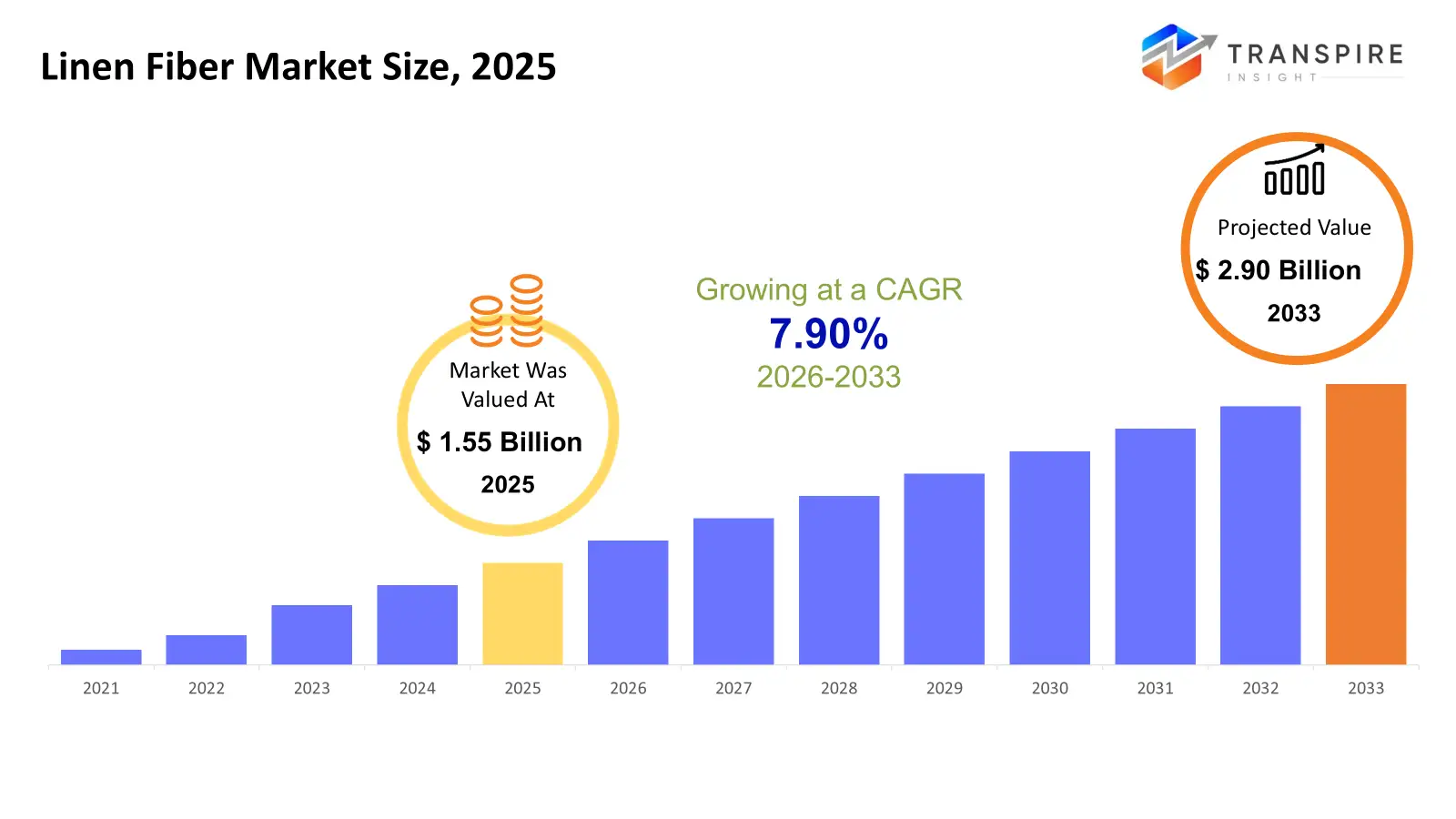
According to a research report published by Transpire Insight, The Global Linen Fiber Market Size is projected to Grow from USD 1.55 Billion in 2026 to USD 4.90 Billion by 2035, at a CAGR of 9.55 % during the forecast period 2026-2035. Market growth will be fueled by an increasing need for sustainable and degradable textile materials, greater usage of high-quality natural fibers in clothing and home textile, and increased usage in automotive composites and industrial fabrics. The improvement in cultivation techniques, fiber production technologies, and environment-friendly manufacturing processes will lead to improvements in quality and efficiency in production. In addition, increased focus on circular fashion, sustainability-related agricultural policies, and investment in green textiles will provide huge growth opportunities for the market in the forecast period.
Introduction
Linen Fiber Market includes the manufacturing, processing, and marketing of linen fiber, which is made mostly from the flax plant (Linum usitatissimum). These fibers are highly sought after due to their strength, breathability, moisture-wicking ability, biodegradability, and eco-friendliness, hence can be used in making textiles, apparels, home furnishings, technical fabric, composites, and speciality products. The increased consumer inclination towards natural fibers and green textiles and usage of linen in fashion and home furnishings is propelling the market.
Recent Development News
Stay Ahead of Emerging Opportunities with Expert Market Insights by Transpire Insight
The insights that have been shared through this blog are based on intensive market research carried out by Transpire Insight, an advisor that works with many global organizations. Thanks to the analysis of extensive data, forecasts made by our specialists, and industry intelligence, our reports allow clients to find strategic growth opportunities in dynamically developing industries. For all those who would like to get more detailed information regarding market segmentation, competitive analysis, regional outlooks, and future investment tendencies, there is no doubt that our full report will be of great value.
Download the exclusive Linen Fiber Market sample report today to uncover expert insights, emerging trends, and the opportunities defining the future of the industry.
Linen Fiber MarketSize & Statistics
Regional Growth and Demand Analysis by Transpire Insight:
The major regional segment of the Linen Fiber Market is Europe, which holds around 46% of the global market share. This dominance can be attributed to the established flax farming industry in the region, ideal climatic conditions for producing high-quality flax, and advanced textile manufacturing facilities. Nations like France, Belgium, the Netherlands, and Lithuania rank among the biggest producers and processors of flax fiber globally. Besides, other driving factors responsible for the dominance of Europe in the Linen Fiber Market include government initiatives to develop sustainable agriculture in the region, higher consumer preference for environment-friendly textiles, stringent environment regulations, and the existence of certification agencies for flax and linen products of Europe.
The Asia-Pacific region is forecasted to witness the fastest growth rate over the forecast period owing to the fast growth of the textile and apparel industry, increasing requirement for sustainable fabrics, growing disposable incomes of consumers, and increasing consumer awareness about environment-friendly products. Some of the major economies in the region such as China, India, Japan, Bangladesh, and Vietnam are making investments in flax fiber processing and linen textile manufacturing operations to cater to the rising demand from both domestic and international markets.
Top 15 Trends in the Linen Fiber Market
Proceed to Checkout to purchase the exclusive Linen Fiber Market report and gain instant access to in-depth market intelligence, strategic analysis, and future growth opportunities.
1. Growing Demand for Sustainable and Biodegradable Natural Fibers
There is an increase in the use of eco-friendly materials among consumers and textile manufacturers. This has seen linen become the most sought after natural material because of its environmentally friendly nature and less requirement for water and pesticides. Increased environmental consciousness is pushing the increased utilization of linen in clothing, home fabrics, and industrial uses.
2. Expansion of Eco-Friendly Fashion and Apparel Applications
As the need for environmentally-friendly fashion increases, more fashion companies are beginning to include linen in their premium fashion wear ranges. The ability of linen to be durable, breathable, moisture wicking, and look natural makes it very appealing in terms of sustainability especially for luxury, casual and summer fashion wears.
3. Increasing Adoption of Certified European Flax
Companies are now relying on the use of certified European flax because of their need to provide quality products that will also give them the needed traceability as well as proper agricultural practices. Some of the certifications include European Flax® and Masters of Linen®.
4. Rising Use of Linen Fiber in Home Textiles
The demand for linen fibers has risen due to their use in home furnishings like bed linens, curtains, upholsteries, table cloths, and decorative materials, owing to their durability, unique feel, and thermoregulatory characteristics. The rising preference among consumers for eco-friendly interior decorating and high-quality home furnishings has led to the demand for linen textiles.
5. Growing Integration of Linen Fiber in Automotive Composites
Linen fiber is being used by the auto industry to make lightweight composite materials that can be used to manufacture interior panels, door trims, and other structural components. The use of linen fiber provides an added benefit of being environmentally sustainable as well as lowering the weight of vehicles.
6. Expansion of Organic Flax Cultivation
The cultivation of flax organically is becoming increasingly popular as textile manufacturers look for sources that offer them a cleaner and greener way to obtain their raw materials. Growing flax organically avoids the use of artificial chemicals and fertilizers and increases soil fertility and biodiversity. The demand for organic textiles is driving growth in organic flax farming.
Top 25 Companies Leading the Linen Fiber Market
Customize the exclusive Linen Fiber Market report today to receive tailored insights, country-specific analysis, and business-focused market intelligence.
1. Safilin SA
Safilin SA is a renowned European manufacturer of top-quality flax and linen yarns, providing top-grade sustainable textile material to clothing, household textile, and industrial manufacturers around the globe.
Founded: 1778 | Headquarters: Sailly-sur-la-Lys, France
Why It Ranks: One of the oldest and most reputable manufacturers of premium linen yarn in the world.
Regional Dominance: Prominent market presence in Europe with exports to North America and Asia-Pacific.
Product Line: Linen yarns, flax fiber, blended yarns, textile spinning services, and sustainable textile material.
Recent Development: In 2025, the company increased investment in sustainable flax sourcing and energy efficient yarn manufacturing technology.
2. Libeco NV
Libeco NV is a company based in Belgium that produces high-quality linen materials and home furnishings through sustainable European flax farming.
Founded: 1858 | Headquarters: Meulebeke, Belgium
Why It Ranks: Known globally for its Belgian linen and sustainability.
Regional Dominance: Europe, North America, and other parts of the world where there is high-end textile market.
Product Line: Linen material, bed sheets, table cloth, upholstery, curtain, and home furnishing.
Recent Development: In 2025, Libeco diversified its range of sustainable European flax products.
3. Van de Bilt Zaden en Vlas B.V.
Van de Bilt Zaden en Vlas B.V. is a Netherlands-based company engaged in the breeding, growing, and production of high-quality flax fibers.
Founded: 1937 | Headquarters: Sluiskil, Netherlands
Why It Ranks: A prominent player in the market for flax seeds and superior quality flax fibers.
Regional Dominance: Europe and beyond with distribution into Asia-Pacific and North America regions.
Product Line: Flax seeds, flax fibers, linen raw materials, agricultural services, and superior flax varieties.
Recent Development: Van de Bilt Zaden en Vlas B.V. has enhanced its breeding program in 2025 for better quality and productivity of flax fibers.
4. Procotex Corporation SA
Procotex Corporation SA is a major processor and distributor of natural and recycled fibers for use in textiles, composites, automobiles, and industrial sectors.
Founded: 1974 | Headquarters: Dottignies, Belgium
Why It Ranks: A dominant international producer of processed flax fibers and sustainable natural fiber products.
Regional Dominance: Europe with excellent distribution networks in North America and the Asia-Pacific region.
Product Line: Flax fibers, hemp fibers, recycled fibers, natural fiber composites, and industrial fibers.
Recent Development: In 2025, Procotex increased production of sustainable fiber products in order to meet growing demands from the textile and composite manufacturing sectors.
5. Emmanuel Lang SAS
Emmanuel Lang SAS is a French textile company that makes high-quality natural fiber fabric, including linen, cotton, and blends for clothing and industrial use.
Founded: 1856 | Headquarters: Hirsingue, France
Why It Ranks: Known for sustainable manufacturing of European textiles and linen fabrics.
Regional Dominance: Europe with exports to North America and Asia-Pacific.
Product Line: Linen fabric, cotton fabric, blended fabric, fashion fabric, and technical fabric.
Recent Development: The company increased production of sustainable fabric made from European flax in 2025.
6. Northern Linen B.V.
Northern Linen B.V. is a Dutch-based company that provides high-quality linen fabrics and flax-based textile materials to the apparel and home furnishings industry.
Founded: 1998 | Headquarters: Netherlands
Why It Ranks: Popular supplier of premium European linen products.
Regional Dominance: Europe with growing exports overseas.
Product Line: Linen fabrics, flax textiles, home furnishings fabrics, apparel fabrics, and customized linen products.
Recent Development: In 2025, Northern Linen increased its range of sustainable linen products due to rising global demand for eco-friendly textiles.
7. John England (Banbridge) Ltd.
John England (Banbridge) Ltd. is a major producer and exporter of superior quality linen and natural textiles used in the fashion, interiors, and upholstery industry segments.
Founded: 1973 | Headquarters: Banbridge, Northern Ireland, United Kingdom
Why It Ranks: Long-established player in premium quality Irish linen and sustainable fabrics.
Regional Dominance: Europe, North America, and high-end textile markets.
Product Line: Linen fabrics, apparel fabrics, upholstery fabrics, furnishing fabrics, and other natural fibers.
Recent Development: In 2025, the firm launched its premium sustainable linen range globally for the fashion and interior design industries.
8. Siulas AB
Siulas AB is a Sweden-based company that engages in eco-friendly farming of flax and linen fiber processing for textiles.
Founded: 1994 | Headquarters: Sweden
Why It Ranks: Its strong commitment towards sustainability in flax farming and textile solutions.
Regional Dominance: Northern Europe.
Product Line: Flax fibers, linen yarns, sustainable textiles, agricultural flax, and natural fiber solutions.
Recent Development: Siulas in 2025 enhanced its sustainable flax farming activities.
9. Lanificio Luigi Ricceri S.p.A.
Description: Lanificio Luigi Ricceri S.p.A. is an Italian textiles firm that specializes in the production of recycled as well as natural fabrics.
Founded: 1974 | Headquarters: Prato, Italy
Why It Ranks: Innovator of recycled and sustainable textile manufacturing.
Regional Dominance: Europe; however, exports across luxury fashion markets around the world.
Product Line: Linen fabrics, recycled textiles, wool mixes, fashion fabrics, and sustainable textiles.
Recent Development: In 2025, the firm increased its production of recycled linen fabrics to enable circular textile manufacturing.
10. Grasim Industries Limited
Grasim Industries Limited, a leading company of the Aditya Birla Group, is a world manufacturer of textile fibers, chemicals, and sustainable raw materials for the textile industry.
Founded: 1947 | Headquarters: Mumbai, Maharashtra, India
Why It Ranks: Key player worldwide in the production of textile fibers with growing sustainable fibers programs.
Regional Dominance: Asia-Pacific with a significant global footprint.
Product Line: Textile fibers, blends with linen fibers, viscose fibers, specialty yarns, and sustainable textiles.
Recent Development: In 2025, Grasim expanded its portfolio of sustainable fibers by investing in sustainable textile production and raw materials.
Schedule a meeting with our market experts to discuss the exclusive Linen Fiber Market report and identify the best research solution for your organization.
Conclusion
The Linen Fiber Market experiences constant growth because of the increasing global demand for sustainable, biodegradable, and quality natural fibers in the clothing, home textiles, and industries. Rising awareness among consumers about green products, growing implementation of circular fashion business models, and the development of flax growing and fiber manufacturing technology help promote market development. Europe is still the dominant producer because of its developed flax industry and high sustainability requirements, while the Asia-Pacific region emerges as the most rapidly developing market on account of the rapid growth of the textile industry in the region. The main market players, including Safilin SA, Libeco NV, Van de Bilt Zaden en Vlas B.V., Procotex Corporation SA, Emmanuel Lang SAS, Northern Linen B.V., John England (Banbridge) Ltd., Siulas AB, Lanificio Luigi Ricceri S.p.A., and Grasim Industries Limited, keep investing into sustainable fiber sourcing, certification of flax production, and innovative solutions for the textile industry. Because of the rising importance of sustainability within the global textile industry, the future growth of the market can be assessed as rather strong.


Send us a brief description of your challenge and we'll get back to you within 24 hours.

 inquiry@transpireinsight.com
 APAC:+91 7666513636
 Address


