
Jul 20, 2026
By Transpire Insight
Description
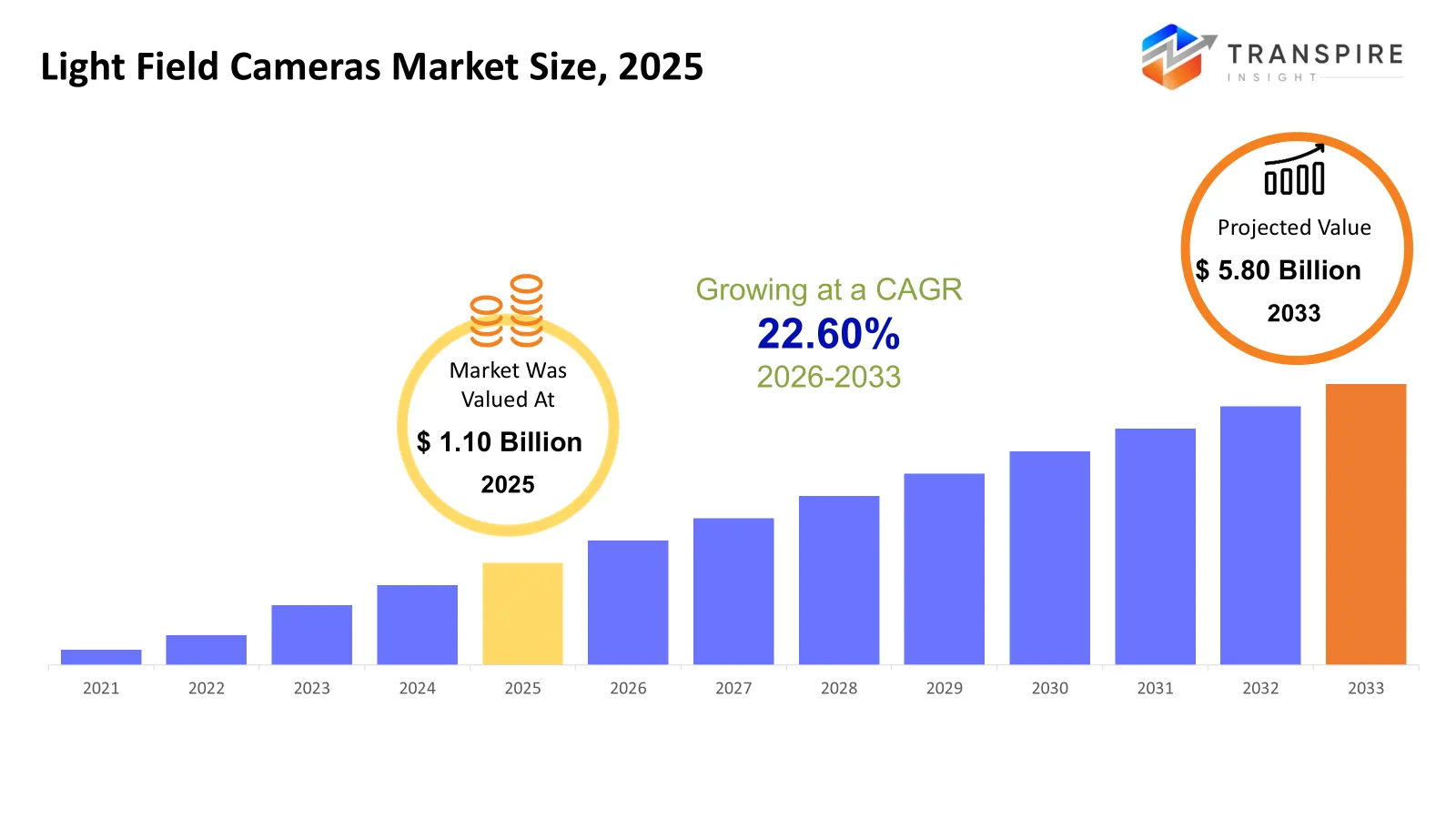
According to a research report published by Transpire Insight, the global light field cameras market size is projected to grow from USD 120.3 billion in 2026 to USD 564.09 billion by 2035, at a CAGR of 24.60% during the forecast period 2026-2035. The virtual reality environment is rapidly gaining momentum as a new hot spot for the VR industry, with automated AI depth awareness technology being integrated into industrial machine vision systems at an unprecedented pace, and 3D medical imaging with high precision advancing at a rapid rate, all of which are driving global market growth.
Introduction
The global light field cameras market is a huge paradigm shift from the traditional flat photographs to multidimensional spatial captures, and it has been an area of optical engineering. Plenoptic acquisitions enable modern industries by recording the absolute intensity and precise vector direction of the light rays cast by a virtual object onto a given surface. This high-tech feature enables post-capture refocusing, full-depth mapping and glasses-free 3D creation. The global market is propelled by a new, unified AI, stretching from high-impact areas such as consumer entertainment to immersive experiences in healthcare diagnostics and robotic autonomy.
Recent Development News
Stay Ahead of Emerging Opportunities with Expert Market Insights by Transpire Insight
Transpire Insight provides comprehensive, data-driven market intelligence to support smarter business decisions. Our research is rooted in comprehensive analysis, authoritative predictions, and industry expertise, enabling organizations to make informed decisions in rapidly evolving markets. In-depth analysis of market segmentation, competitive positioning, regional trends, and emerging investment opportunities in high-growth areas. We blend accuracy with actionable intelligence, empowering companies to uncover new avenues for growth, bolster strategic decision-making, and stay ahead in a dynamic global market.
Download the exclusive Light Field Cameras Market sample report today to uncover expert insights, emerging trends, and the opportunities defining the future of the industry.
Light Field Cameras Market Size & Statistics
Regional Growth and Demand Analysis by Transpire Insight:
North America continues to lead as OEMs and research labs expand across the U.S. and Canada to serve defense modernization, biomedical imaging, and AR/VR adoption, with regional supply chains integrating sensor design, computational-imaging software, and device assembly within proximity to minimize development cycles. The U.S. dominates through advanced research programs and rapid AR/VR technology adoption, while Canada contributes via research initiatives and investment in immersive learning and simulation platforms. Adobe's continued investment in light field software processing, alongside R&D-heavy device makers, is expected to strengthen the region's imaging and AR/VR supply base through the remainder of 2026.
Asia-Pacific is scaling fastest at a 17.1% CAGR, led by China, as growing use of medium density, office automation, robotics, and research is driving businesses to expand into media and entertainment, alongside strong consumer electronics manufacturing in Japan and South Korea. Indian players are expanding content creation and AR/VR capabilities under the Digital India push. VOMMA (Shanghai) Technology secured significant funding to expand its light field sensor manufacturing capacity, signaling strong investor confidence in the Asian market. Separately, Toshiba announced a strategic partnership with a leading automotive supplier to integrate light field sensors into next-generation driver-assistance systems, underscoring the region's shift from research-grade output toward automotive-grade volume production.
Top 15 Trends in the Light Field Cameras Market
Proceed to Checkout to purchase the exclusive Light Field Cameras Market report and gain instant access to in-depth market intelligence, strategic analysis, and future growth opportunities.
AI-driven light field image processing
AI enables automated 3D reconstruction, object recognition, and scene understanding from light field data, reducing manual processing and improving accuracy across VR and industrial uses.
Consumer smartphone integration
Phone and compact camera makers embed light field sensors to offer refocus-after-shooting, sharper 3D selfies, and better low-light performance, meeting rising consumer photography expectations.
Miniaturized microlens arrays
Sub-millimeter microlens designs keep devices compact while maintaining sharp image capture, making light field technology practical for portable, everyday consumer electronics rather than bulky rigs.
Hybrid imaging systems
Manufacturers combine light field capture with thermal or hyperspectral imaging, producing richer multi-dimensional data suited for specialized defense, medical, and industrial inspection applications.
On-device real-time processing
Advances in edge computing and specialized processors let cameras process light field data locally, cutting cloud dependency and enabling faster, real-time 3D scene analysis.
Industrial inspection adoption: Manufacturers use light field cameras for dimensional measurement, defect detection, and automated quality control, leveraging depth accuracy that standard 2D imaging cannot provide.
25 Companies Leading the Light Field Cameras Market
Customize the exclusive Light Field Cameras Market report today to receive tailored insights, country-specific analysis, and business-focused market intelligence.
1. Lytro
This pioneering brand revolutionized consumer photography by commercializing early computational light fields.
Founded: 2006 | HQ: Mountain View, California, USA.
Why It Ranks: Held foundational patents that established the earliest commercial consumer light field systems.
Regional Dominance: Historically dominated the entire North American digital imaging and computational photography sectors.
Product Line: Delivered groundbreaking consumer plenoptic cameras alongside highly advanced immersive virtual reality systems.
2. Raytrix GmbH
This specialized German engineering enterprise designs top-tier industrial plenoptic camera vision components.
Founded: 2009 | HQ: Kiel, Germany.
Why It Ranks: Leads global industrial verification metrics using highly precise live spatial depth measurements.
Regional Dominance: Captures a supreme market share within advanced automated manufacturing hubs all across Europe.
Product Line: Disseminates premium scientific plenoptic systems perfectly optimized for machine vision industrial inspection.
3. Pelican Imaging Corporation
This unique computational vision group engineered pioneering lens array sensors for smartphones.
Founded: 2008 | HQ: Santa Clara, California, USA.
Why It Ranks: Pioneered an array camera architecture that easily captures deep spatial images within smartphones.
Regional Dominance: Established a powerful licensing presence inside competitive North American mobile device ecosystems.
Product Line: Focused on software design modules and compact optical array imaging sensor technologies.
4. Stanford Computer Optics
This highly specialized manufacturer designs fast intensified cameras for critical scientific research.
Founded: 1989 | HQ: Berkeley, California, USA.
Why It Ranks: Provides unrivaled high-speed imaging capabilities vital for complex deep spatial calculations.
Regional Dominance: Supplies top research laboratories spanning North American and European academic markets heavily.
Product Line: Fabricates high-speed intensified CCD systems, optical gating modules, and spectroscopic equipment.
5. PlenOptika
This medical technology enterprise adapts wavefront imaging to deliver automated eye prescriptions.
Founded: 2014 | HQ: Boston, Massachusetts, USA.
Why It Ranks: Architected complex plenoptic wavefront sensing into highly portable handheld clinical diagnostic tools.
Regional Dominance: Expands very rapidly within emerging global healthcare sectors across southern Asia regions.
Product Line: Produces the portable QuickSee wave autorefractor device alongside advanced ocular health technologies.
6. Light Field Lab
This futuristic display company generates truly immersive visual holographic communication projection environments.
Founded: 2017 | HQ: San Jose, California, USA.
Why It Ranks: Drives massive modern breakthroughs in recreating solid-state light fields for visual display.
Regional Dominance: Commands deep venture investment capital backing directly inside Silicon Valley high-tech ecosystems.
Product Line: Features the SolidLight modular holographic display platform alongside spatial computing software systems.
7. Google (Project Tango)
This massive technology incubator spearheaded early space-aware depth-sensing computer vision systems.
Founded: 1998 | HQ: Mountain View, California, USA.
Why It Ranks: Standardized mobile environmental tracking layout configurations that directly enabled future ARCore adoption.
Regional Dominance: Exerts absolute operational ecosystem leverage across worldwide consumer mobile software delivery platforms.
Product Line: Provided mobile developer kits, specialized optical array smart devices, and mapping software.
8. Toshiba Corporation
This electronic engineering giant researched integrated light field arrays for industrial applications.
Founded: 1875 | HQ: Tokyo, Japan.
Why It Ranks: Utilized extensive optical manufacturing expertise to develop low-latency computational imaging models.
Regional Dominance: Maintained deep industrial ties across broad East Asian consumer electronics manufacturing sectors.
Product Line: Deploys diverse semiconductor chipsets, customized sensor arrays, and modern medical diagnostic hardware.
9. Sony Group Corporation
This entertainment giant leads global smartphone imaging using highly sophisticated multi-layer sensors.
Founded: 1946 | HQ: Tokyo, Japan.
Why It Ranks: Commands total global market dominance in mass-producing advanced CMOS image sensors.
Regional Dominance: Spans seamlessly across North American, European, and massive East Asian commercial markets.
Product Line: Manufactures professional Alpha system cameras, industrial vision arrays, and smartphone imaging sensors.
10. Panasonic Corporation
This electronic manufacturer develops advanced industrial automated imaging systems for the global automotive industry.
Founded: 1918 | HQ: Kadoma, Osaka, Japan.
Why It Ranks: Integrates rugged broadcast engineering with highly precise multi-angle depth mapping camera intelligence.
Regional Dominance: Exerts widespread commercial presence throughout global industrial automation and consumer electronics markets.
Product Line: Supplies Lumix digital cameras, automotive sensors, smart flight decks, and vision systems.
Schedule a meeting with our market experts to discuss the exclusive Light Field Cameras Market report and identify the best research solution for your organization.
Conclusion
The light field camera market is an example of a dramatic shift towards fully intelligent and multi-dimensional visual data capture. With continued miniaturization of hardware and the successful application of edge-computed AI to solve the early processing problems, plenoptic technology is likely to move beyond niche applications in specialized industrial settings into mainstream consumer systems. However, the continued challenge of manufacturing microlens arrays and increasing the global ecosystem of content is important for continued commercial success. In sum, these high-tech spatial platforms will be the foundation of future imaging, changing the ways in which spatial communication is experienced worldwide.


Send us a brief description of your challenge and we'll get back to you within 24 hours.

 inquiry@transpireinsight.com
 APAC:+91 7666513636
 Address


