
Jul 11, 2026
By Transpire Insight
Description
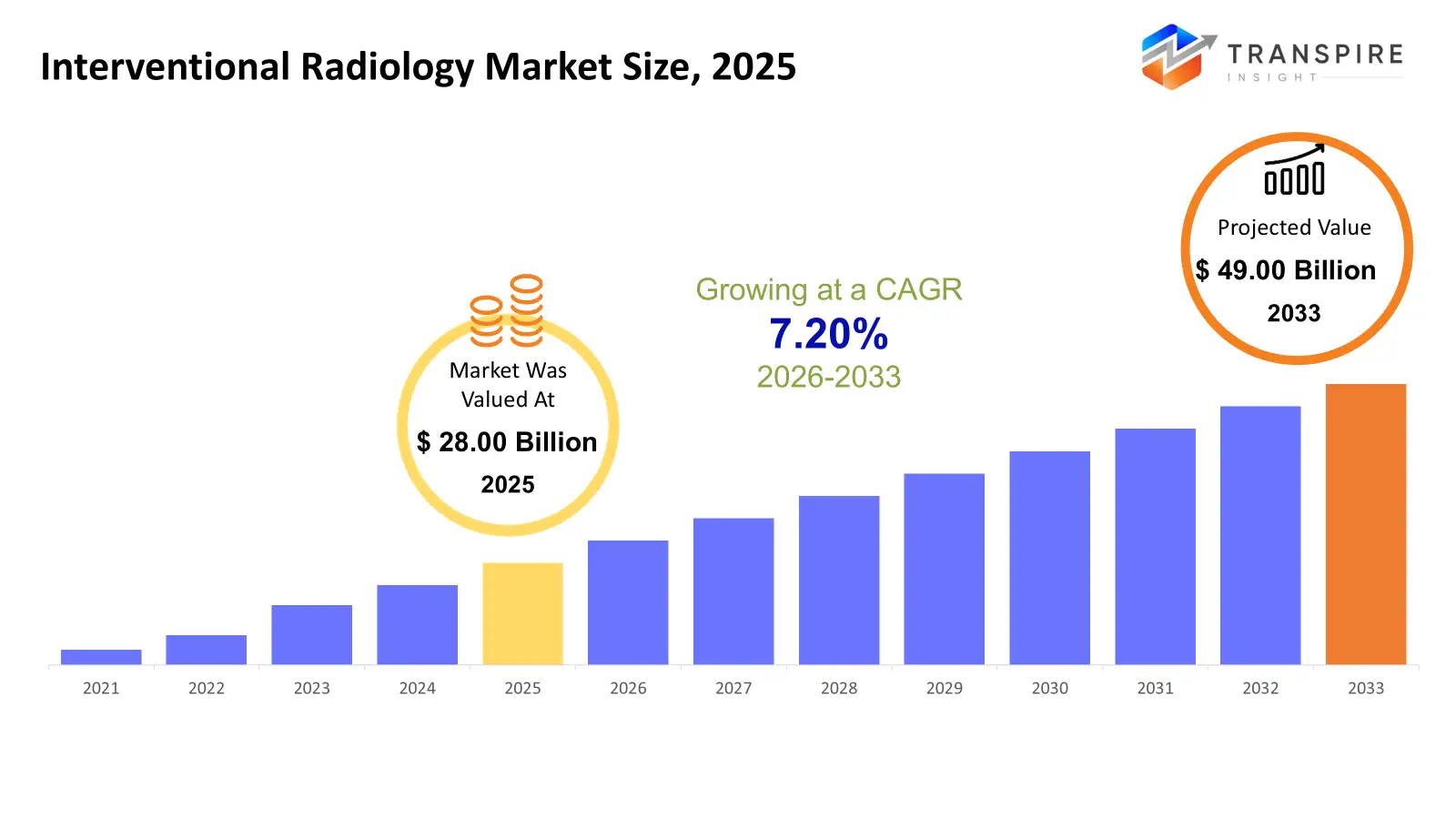
According to a research report published by Transpire Insight, the global interventional radiology market size is projected to grow from USD 33.5 billion in 2026 to USD 53.05 billion by 2035, at a CAGR of 9.20% during the forecast period 2026-2035. Rising prevalence of chronic diseases such as cancer and cardiovascular diseases, the fast-paced adoption of AI and robotics in image-guided procedures, and escalating global demand for minimally invasive interventions are all contributing to the market. Today's rapidly growing adoption of AI and robotics and the increasing prevalence of chronic diseases, including cancer and cardiovascular diseases, are driving the market.
Introduction
The interventional radiology market is a cutting-edge part of modern healthcare and deals with minimally invasive, image-guided therapies that are highly effective and can be used as an alternative to conventional open surgery procedures. Interventional radiologists are able to diagnose and treat these complex diseases at the source, using advanced imaging technology, including X-ray, computed tomography (CT), magnetic resonance imaging (MRI), and ultrasound. Structural changes are sweeping this market, fueled by value-based reimbursement models, an aging global population, and the transition of care to cost-effective outpatient ambulatory surgical centers.
Recent Development News
Stay Ahead of Emerging Opportunities with Expert Market Insights by Transpire Insight
Transpire Insight provides comprehensive, data-driven market intelligence to support smarter business decisions. Our research is rooted in comprehensive analysis, authoritative predictions, and industry expertise, enabling organizations to make informed decisions in rapidly evolving markets. In-depth analysis of market segmentation, competitive positioning, regional trends, and emerging investment opportunities in high-growth areas. We blend accuracy with actionable intelligence, empowering companies to uncover new avenues for growth, bolster strategic decision-making, and stay ahead in a dynamic global market.
Download the exclusive Interventional Radiology Market sample report today to uncover expert insights, emerging trends, and the opportunities defining the future of the industry.
Interventional Radiology Market Size & Statistics
Regional Growth and Demand Analysis by Transpire Insight:
North America is expected to hold the highest market share during the forecast period in the interventional radiology market. The dominant player in the Interventional Radiology Market is North America, owing to the availability of leading players in terms of medical device manufacturing companies, healthcare technology suppliers, and robust investment in outpatient surgical facilities. The United States is currently the biggest producer in the interventional radiology market, considering factors such as the presence of extensive commercial manufacturing operations, efforts toward modernizing hospital imaging systems, and continued advancement in medical robotics engineering. As of 2026, some of the medical technology companies in the United States have undertaken production activities aimed at manufacturing superior interventional imaging systems that would enhance next-generation clinical and surgical outcomes.
Asia Pacific is anticipated to register the highest growth rate during the forecast period in the interventional radiology market. It is expected that the Asia-Pacific region will witness the highest growth rate during the forecast period due to increasing demand for affordable healthcare, growing fleets of specialized medical centers, increased healthcare infrastructure purchasing programs, and significant investment in regional hospital systems. China, India, Japan, and South Korea are some of the rapidly growing nations regarding healthcare infrastructure activities that drive the demand for advanced interventional radiology technologies. In 2026, there will be an increase in the facility modernization programs by many hospital chains in China and India. This was done with the aim of ensuring energy-efficient interventional radiology systems.
Top 15 Trends in the Interventional Radiology Market
Proceed to Checkout to purchase the exclusive Interventional Radiology Market report and gain instant access to in-depth market intelligence, strategic analysis, and future growth opportunities.
Top 25 Companies Leading the Interventional Radiology Market
Customize the exclusive Interventional Radiology Market report today to receive tailored insights, country-specific analysis, and business-focused market intelligence.
Top 25 Companies Leading the Interventional Radiology Market
1. Boston Scientific Corporation
This firm excels in manufacturing advanced microcatheters for intricate peripheral vascular procedures.
Founded: 1979 | HQ: Marlborough, Massachusetts, USA.
Why It Ranks: Holds an expansive market share in specialized vascular devices and drug-eluting peripheral technologies.
Regional Dominance: Dominates North American and European clinical markets through extensive distribution networks.
Product Line: Microcatheters, guide wires, peripheral embolization devices, and specialized balloon catheters.
Medtronic plc
A global medical giant pioneering advanced stent grafts for complex aortic treatments.
Founded: 1949 | HQ: Dublin, Ireland.
Why It Ranks: Commands top positions in neurovascular intervention portfolios and high-margin consumable devices.
Regional Dominance: Secures heavy financial revenues across both mature Western and expanding emerging markets.
Product Line: Stents, embolization coils, neurovascular access devices, and continuous ablation systems.
3. Abbott Laboratories
Renowned for engineering elite vessel closure devices that speed post-procedure recovery times.
Founded: 1888 | HQ: Abbott Park, Illinois, USA.
Why It Ranks: Leads market sectors in vascular care therapies and structural heart solutions.
Regional Dominance: Asserts exceptional market control inside major hospital networks throughout North America.
Product Line: Vessel closure systems, diagnostic catheters, coronary stents, and peripheral guide wires.
4. Terumo Corporation
Globally celebrated for high-quality hydrophilic guide wires used in smooth radial access.
Founded: 1921 | HQ: Tokyo, Japan.
Why It Ranks: Unmatched operational reputation for precision manufacturing within the interventional access sector.
Regional Dominance: Maintains an absolute leading market stronghold throughout Japan and broader Asia-Pacific.
Product Line: Hydrophilic guide wires, angiographic catheters, radial access kits, and embolization beads.
5. Cook Medical
A family-owned pioneer dedicated entirely to evolving specialized minimally invasive medical products.
Founded: 1963 | HQ: Bloomington, Indiana, USA.
Why It Ranks: Respected globally for producing an incredibly vast catalog of niche components.
Regional Dominance: Enjoys highly stable, diversified institutional sales across hospitals globally.
Product Line: Vena cava filters, drainage catheters, diagnostic needles, and custom introducer sheaths.
6. Siemens Healthineers
Revolutionizing clinical operating environments through advanced AI-integrated multi-axis robotic angiography platforms.
Founded: 1847 | HQ: Erlangen, Germany.
Why It Ranks: Unrivaled engineering innovator in high-end hybrid operating room imaging infrastructure systems.
Regional Dominance: Commands undisputed market leadership across European hospital imaging system networks.
Product Line: Angiography systems, computed tomography scanners, C-arms, and advanced workflow software.
7. GE Healthcare
This powerhouse delivers elite cloud-based digital imaging solutions for real-time surgical support.
Founded: 1892 | HQ: Chicago, Illinois, USA.
Why It Ranks: Global imaging leader with unparalleled installed device bases across premium hospitals.
Regional Dominance: Generates heavy multi-billion-dollar sales volumes across North American and European territories.
Product Line: Interventional X-ray systems, digital ultrasound platforms, CT scanners, and software.
8. Philips Healthcare
Seamlessly integrating live ultrasound data into advanced X-ray screens for precision.
Founded: 1891 | HQ: Amsterdam, Netherlands.
Why It Ranks: Captures dominant global market shares within the specialized image-guided therapy segment.
Regional Dominance: Retains a massive commercial presence across major global healthcare delivery networks.
Product Line: Azurion image-guided platforms, intravascular ultrasound devices, and specialized interventional software.
9. Cardinal Health
Distributes foundational procedural accessories required globally for daily interventional radiology workflows.
Founded: 1971 | HQ: Dublin, Ohio, USA.
Why It Ranks: Critical supply chain partner providing indispensable standard operational inventory to clinics.
Regional Dominance: Possesses an extensive logistics and supply network spanning the United States.
Product Line: Fluid management tubing, compression devices, biopsy needles, and basic accessories.
10. Canon Medical Systems Corporation
Providing exceptional high-definition Alphenix imaging configurations designed for targeted oncological treatments.
Founded: 1930 | HQ: Otawara, Tochigi, Japan.
Why It Ranks: Renowned for delivering low-dose imaging hardware that maximizes critical patient safety.
Regional Dominance: Expands market footprint rapidly through strategic hospital sales in Asian markets.
Product Line: Angiography configurations, high-resolution CT platforms, ultrasound systems, and workstation software.
Schedule a meeting with our market experts to discuss the exclusive Interventional Radiology Market report and identify the best research solution for your organization.
Conclusion
The interventional radiology market is expected to experience strong growth as the market transitions to minimally invasive procedures and outpatient medical centers. The incorporation of artificial intelligence and robotics into surgery is an integration of unprecedented precision levels, which are considered gold standards in oncology and cardiology. Smart consumables and high-end imaging equipment will continue to blur the lines in an industry that will see sustainable growth over the years. This change will ultimately shape clinical therapy standards and optimise overall patient safety and throughput globally.


Send us a brief description of your challenge and we'll get back to you within 24 hours.

 inquiry@transpireinsight.com
 APAC:+91 7666513636
 Address


