
Jul 04, 2026
By Transpire Insight
Description
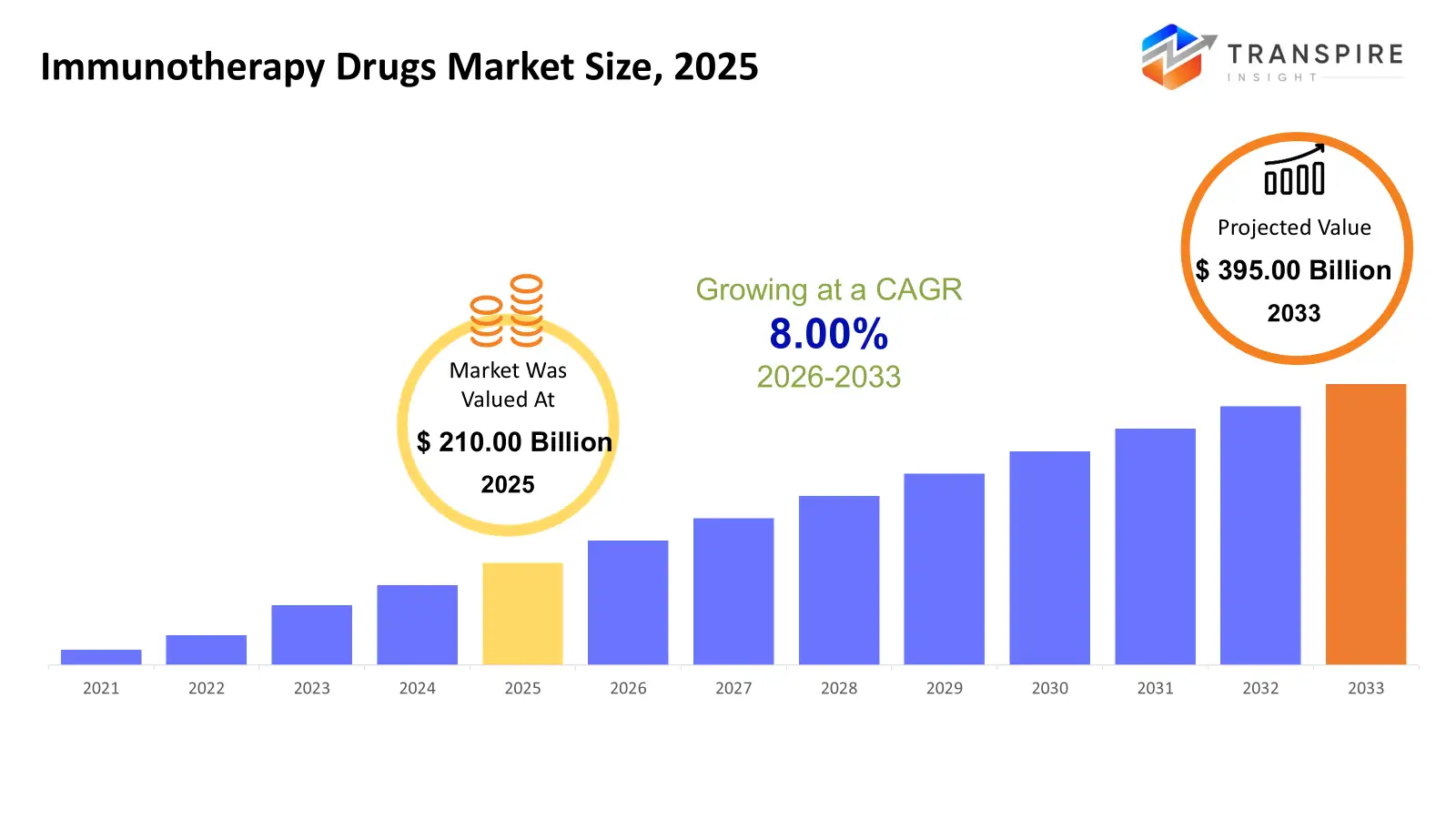
According to a research report published by Transpire Insight, The Global Immunotherapy Drugs Market Size is projected to Grow from USD 210.00 Billion in 2026 to USD 412.00 Billion by 2035, at a CAGR of 10% during the forecast period 2026-2035. Market growth is witnessing strong momentum because of the high incidence of cancers and autoimmune disorders around the world, growing utilization of immune checkpoint inhibitors and CAR-T cell treatments, constant developments in the field of precision medicines, and regulatory approvals of innovative biological drugs. Research on immuno-oncology, collaborations between biopharmaceutical firms, and development of next generation immunotherapy will drive market growth in the upcoming years.
Introduction
The Immunotherapy Drugs Market is witnessing robust growth owing to the rising incidence of cancer and other chronic ailments, the increasing popularity of personalized medicines, and innovations in biotechnology and immuno-oncology. Increased R&D activities, the emergence of new products through approvals, and increased demand for treatment options are contributing to market growth. Furthermore, collaborative efforts by pharmaceutical companies, the evolution of cell therapy and gene therapy, and the use of biomarker-based treatment options are some of the factors that are expected to significantly propel growth in the global Immunotherapy Drugs Market.
Recent Development News
April 2025: Keytruda was approved by the European Commission in combination with chemotherapy as a first-line treatment of unresectable malignant pleural mesothelioma, thus extending its immunotherapy applications in thoracic cancers.
Stay Ahead of Emerging Opportunities with Expert Market Insights by Transpire Insight
The insights that have been shared through this blog are based on intensive market research carried out by Transpire Insight, an advisor that works with many global organizations. Thanks to the analysis of extensive data, forecasts made by our specialists, and industry intelligence, our reports allow clients to find strategic growth opportunities in dynamically developing industries. For all those who would like to get more detailed information regarding market segmentation, competitive analysis, regional outlooks, and future investment tendencies, there is no doubt that our full report will be of great value.
Download the exclusive Immunotherapy Drugs Market sample report today to uncover expert insights, emerging trends, and the opportunities defining the future of the industry.
Immunotherapy Drugs Market Size & Statistics
Regional Growth and Demand Analysis by Transpire Insight:
The Immunotherapy Drugs Market in North America holds the maximum market share of around 45%. The factors that drive North America to hold the top spot include the high prevalence of cancer and autoimmune disease, the advanced healthcare infrastructure, acceptance of innovative oncology treatment, and high investment in biotechnology R&D. The factors which lead to North America being on the top position in the Immunotherapy Drugs Market include the presence of key players in the region, clinical trials, good regulatory environment, and high healthcare expenditure. Further, the early approval and high adoption of advanced technologies in immunotherapy drugs like immune checkpoint inhibitors, monoclonal antibodies, and CAR T-cell therapy help boost the market growth.
The Asia-Pacific region is expected to show a very high CAGR during the forecast period because of the high incidence of cancer, development of healthcare infrastructure, increase in health expenditure, and availability of advanced treatment. Some countries such as China, Japan, India, and South Korea are making heavy investments in biotechnology R&D and clinical trials and hence the adoption of immunotherapy drugs in these regions.
Top 15 Trends in the Immunotherapy Drugs Market
Proceed to Checkout to purchase the exclusive Immunotherapy Drugs Market report and gain instant access to in-depth market intelligence, strategic analysis, and future growth opportunities.
1. Increasing Adoption of Immune Checkpoint Inhibitors
Immune checkpoint inhibitors are becoming one of the most important growth drivers in the Immunotherapy Drugs Market due to their ability to activate the immune system against cancer cells. Drugs targeting PD-1, PD-L1, and CTLA-4 pathways are being increasingly adopted for treating cancers such as lung cancer, melanoma, kidney cancer, and bladder cancer. Continuous clinical success, expanding approvals, and improved patient survival outcomes are encouraging wider adoption of these therapies globally.
2. Growth of Personalized Immunotherapy Treatments
Personalized immunotherapy is gaining momentum as healthcare providers move toward precision medicine approaches. These treatments use patient-specific genetic information, tumor characteristics, and immune biomarkers to design more effective therapies. The increasing availability of advanced diagnostic tools and biomarker testing is helping physicians select appropriate immunotherapy options, improving treatment response and reducing unnecessary therapies.
3. Rising Demand for CAR-T Cell Therapy
CAR-T cell therapy is emerging as a revolutionary approach in cancer treatment by modifying a patient’s own immune cells to recognize and destroy cancer cells. The increasing approval of CAR-T therapies for blood cancers, along with ongoing research into solid tumors, is driving market expansion. Pharmaceutical companies are investing heavily in improving CAR-T manufacturing processes, reducing treatment costs, and increasing accessibility.
4. Expansion of Cancer Immunotherapy Applications
The application of immunotherapy drugs is expanding beyond traditional cancer treatments, with increasing research and approvals for multiple tumor types. Advances in immuno-oncology are enabling the development of therapies for solid tumors, gastrointestinal cancers, breast cancer, and other difficult-to-treat conditions. This broader application range is creating significant growth opportunities for pharmaceutical companies and healthcare providers.
5. Increasing Development of Combination Immunotherapies
Combination immunotherapy approaches are becoming increasingly popular as researchers aim to improve treatment effectiveness by combining immune checkpoint inhibitors with chemotherapy, targeted therapies, radiation, or other immunotherapies. These combinations can enhance immune activation, overcome treatment resistance, and provide better outcomes for patients with advanced cancers. Growing clinical trials and regulatory approvals are accelerating the adoption of combination therapies.
6. Growing Adoption of Biomarker-Based Treatment Approaches
Biomarker-driven treatment selection is becoming a key trend in the immunotherapy drugs market as it enables more accurate identification of patients who are likely to benefit from specific therapies. Biomarkers such as PD-L1 expression, tumor mutational burden (TMB), and microsatellite instability (MSI) help improve treatment precision and optimize clinical outcomes. Increasing investment in companion diagnostics is further supporting the adoption of personalized immunotherapy strategies.
Top 25 Companies Leading the Immunotherapy Drugs Market
Customize the exclusive Immunotherapy Drugs Market report today to receive tailored insights, country-specific analysis, and business-focused market intelligence.
1. Merck & Co., Inc.
Merck & Co., Inc. is a global pharmaceutical company based in Rahway. The company is an industry leader in oncology, vaccines, infectious diseases, and immunology. Within the Immunotherapy Drugs Market, Merck stands out with its top immune checkpoint inhibitor portfolio, including Keytruda® (pembrolizumab), which is one of the world’s most prescribed cancer immunotherapy drugs.
Founded: 1891 | Headquarters: Rahway, New Jersey, USA
Why It Ranks:
Merck is a leader within the Immunotherapy Drugs Market thanks to the high adoption rate of Keytruda, large-scale oncology research pipeline, various regulatory approvals, and growing use of immunotherapy in the treatment of different types of cancer.
Regional Dominance:
Wide presence in North America, Europe, Asia-Pacific, Latin America, and Middle East & Africa via its global commercialization and healthcare networks.
Product Line:
Keytruda® (pembrolizumab), immune checkpoint inhibitors, oncology biologics, developing cancer vaccines, immuno-oncology therapies, and combination therapies.
Recent Development:
In 2025, Merck extended clinical applications of Keytruda by gaining more regulatory approvals and combination therapy breakthroughs, reinforcing its leadership in lung cancer, gastrointestinal cancers, head and neck cancer, and other oncology indications.
2. Bristol Myers Squibb (BMS)
Roche Holding AG is a Swiss-based company involved in providing healthcare solutions and headquartered in Basel. The company provides pharmaceutical and diagnostic products with the main areas of interest including oncology and personalized healthcare. Roche holds a prominent position in immunotherapy through the portfolio of cancer drugs and biomarkers.
Founded: 1881 | Headquarters: Lawrence Township, New Jersey, USA
Why It Ranks:
The ranking of Roche is high because of the following reasons such as expertise in oncology, combining diagnostics and personalized immunotherapy, and development of immune-based cancer drugs pipeline.
Regional Dominance:
High visibility across Europe, North America, Asia-Pacific, Latin America, and the Middle East regions.
Product Line:
Tecentriq® (atezolizumab), immuno-oncology drugs, targeted cancer drugs, companion diagnostics, biomarkers testing platforms, and personalized medicine products.
Recent Development:
In 2025, Roche kept developing immunotherapy products by carrying out clinical trials for Tecentriq combinations and personalized oncology solutions incorporating diagnostics and immune-based drugs.
3. Roche Holding AG
Roche Holding AG is a Swiss-based company involved in providing healthcare solutions and headquartered in Basel. The company provides pharmaceutical and diagnostic products with the main areas of interest including oncology and personalized healthcare. Roche holds a prominent position in immunotherapy through the portfolio of cancer drugs and biomarkers.
Founded: 1896 | Headquarters: Basel, Switzerland
Why It Ranks:
The ranking of Roche is high because of the following reasons such as expertise in oncology, combining diagnostics and personalized immunotherapy, and development of immune-based cancer drugs pipeline.
Regional Dominance:
High visibility across Europe, North America, Asia-Pacific, Latin America, and the Middle East regions.
Product Line:
Tecentriq® (atezolizumab), immuno-oncology drugs, targeted cancer drugs, companion diagnostics, biomarkers testing platforms, and personalized medicine products.
Recent Development:
In 2025, Roche kept developing immunotherapy products by carrying out clinical trials for Tecentriq combinations and personalized oncology solutions incorporating diagnostics and immune-based drugs.
4. Novartis AG
Novartis AG is a multinational drug development company based in Basel. This company provides innovative drugs in various areas such as oncology, immunology, neuroscience, and cardiovascular diseases. Novartis is well known for the innovation in CAR-T cell therapy.
Founded: 1996 | Headquarters: Basel, Switzerland
Why It Ranks:
Novartis belongs to the top ranked immunotherapy companies because of their high-level capability in cell therapies, specialization in oncology and innovations in personalizing treatment.
Regional Dominance:
Presence across Europe, North America, Asia-Pacific, and other emerging countries.
Product Line:
Kymriah® CAR-T cell therapy, immuno-oncology drugs, targeted drugs, cell & gene therapies and personalized medicine products.
Recent Development:
Continuing in 2025, Novartis has been making efforts to enlarge its cell therapy pipeline and enhance manufacturing to make advanced immunotherapies more accessible.
5. Pfizer Inc.
Pfizer Inc. is an American pharmaceutical company that develops medicines in fields of oncology, vaccines, rare diseases and immunology. Pfizer has built up its oncological immunotherapy platform through acquisitions and innovative cancer drug discovery.
Founded: 1849 | Headquarters: New York City, USA
Why It Ranks:
Pfizer ranked because of its robust oncology portfolio, commercialization capacity worldwide, research spending and development of immune-based cancer drugs.
Regional Dominance:
Significant presence in North America, Europe, Asia-Pacific, Latin America and other emerging global regions.
Product Line:
Bavencio® (avelumab), immune-based cancer drugs, antibody-drug conjugates, oncology biologics and immuno-oncology product pipeline.
Recent development:
In 2025, Pfizer was further building its oncology pipeline by forming strategic alliances and conducting R&D projects on the next generation of cancer immunotherapies.
6. AstraZeneca plc
AstraZeneca plc is a British-Swedish multinational pharmaceutical company based in Cambridge. The company specializes in oncology, respiratory, cardiovascular and rare diseases.
Founded: 1999 | Headquarters: Cambridge, United Kingdom
Why It Ranks:
AstraZeneca scores well due to its oncology pipeline, immunotherapy combinations and constant commitment to cancer innovation.
Regional Dominance:
Presence in North America, Europe, Asia Pacific, and emerging regions.
Product Line:
Imfinzi® (durvalumab), immune check point inhibitors, cancer combinations therapies, oncology targeted treatments, biologic medicines.
Recent Development:
In 2025, AstraZeneca made immunotherapy uses wider thanks to its new findings and treatment approach with Imfinzi for various cancers.
7. Johnson & Johnson
Johnson & Johnson is a healthcare company operating around the world. The company is into developing innovative medicines in oncology, immunology, and specialties through its pharmaceuticals segment.
Founded: 1886 | Headquarters: New Brunswick, New Jersey, USA
Why It Ranks:
Johnson & Johnson ranks on account of its pharmaceutical expertise, oncology pipeline, global healthcare footprint, and immune-based treatment innovations.
Regional Dominance:
Footprint globally in North America, Europe, Asia Pacific, Latin America, and Africa.
Product Line:
CARVYKTI® CAR-T therapy, immunology drugs, oncology biologicals, antibodies, and targeted cancer treatments.
Recent Development:
For 2025, Johnson & Johnson further strengthened its CAR-T therapy offering through developments and commercialization of cellular immunotherapy solutions.
8. AbbVie Inc.
AbbVie Inc. is a global biopharmaceutical company. The company focuses on immunology, oncology, neuroscience, and aesthetics.
Founded: 2013 | Headquarters: North Chicago, Illinois, USA
Why It Ranks:
The ranking is justified by its excellent immunology product line, oncology research, and immune-based treatment solutions.
Regional Dominance:
Presence in North America, Europe, Asia-Pacific, and global markets.
Product Line:
Immunotherapeutics, monoclonal antibodies, oncology, targeted drugs, and immune-based medications.
Recent Development:
In 2025, AbbVie expanded their oncology and immunology pipeline through clinical research and developing new immune-based therapies.
9. Sanofi
Sanofi is an international drug company whose headquarters is in Paris, France. The company is involved in developing drugs for immunology, vaccines, rare diseases, and oncology.
Founded: 1973 | Headquarters: Paris, France
Why It Ranks:
Sanofi is ranked as one of the important immunotherapy companies based on its expertise in immunology, investment in biotechnology, and creation of immune-targeting drugs.
Regional Dominance:
Good domination across Europe, North America, Asia-Pacific, and developing countries.
Product Line:
Monoclonal antibodies, immunology drugs, vaccines, oncology drugs, and immune-targeting drugs.
Recent Development:
In 2025, Sanofi broadened its immunology portfolio by working with biotechnology firms and investing in advanced immune-targeted platforms.
10. Gilead Sciences, Inc.
Established in 1987, Gilead Sciences, Inc. is a biotech firm based in Foster City. The firm has expertise in antivirals, oncology drugs, and cell-based treatments.
Founded: 1987 | Headquarters: Foster City, California, USA
Why It Ranks:
Gilead ranks highly in the Immunotherapy Drugs Market because of its strong position in CAR-T cell therapy via Kite Pharma and emphasis on cellular immunotherapies.
Regional Dominance:
Well-established in North America, Europe, Asia-Pacific, and worldwide.
Product Line:
Yescarta® CAR-T therapy, Tecartus® CAR-T therapy, cell-based therapies, oncology immunotherapies, and future immune products.
Recent Development:
In 2025, Gilead further enhanced its CAR-T cell therapy pipeline through improvements in manufacturing and clinical trials for blood malignancies and solid tumors.
Schedule a meeting with our market experts to discuss the exclusive Immunotherapy Drugs Market report and identify the best research solution for your organization.
Conclusion
The Immunotherapy Drugs Market is seeing rapid growth owing to the increasing burden of cancer across the globe, increased use of precision medicines, and ongoing innovations in immune-based therapy technologies. The increasing use of immune checkpoint inhibitors, CAR-T cell therapy, monoclonal antibodies, bispecific antibodies, and personalized immunotherapy treatments is revolutionizing the field of oncology treatment. Some leading players operating in this market include Merck & Co., Bristol Myers Squibb, Roche, Novartis, Pfizer, AstraZeneca, Johnson & Johnson, AbbVie, Sanofi, and Gilead Sciences. They are expanding their market shares through robust research and development, collaboration, clinical trials, and regulatory approvals. With the increasing investment in biotechnology, drug discovery through artificial intelligence, and next-generation cell and gene therapies, the Immunotherapy Drugs Market is poised for significant growth in the coming years.


Send us a brief description of your challenge and we'll get back to you within 24 hours.

 inquiry@transpireinsight.com
 APAC:+91 7666513636
 Address


