
Jul 15, 2026
By Transpire Insight

Description
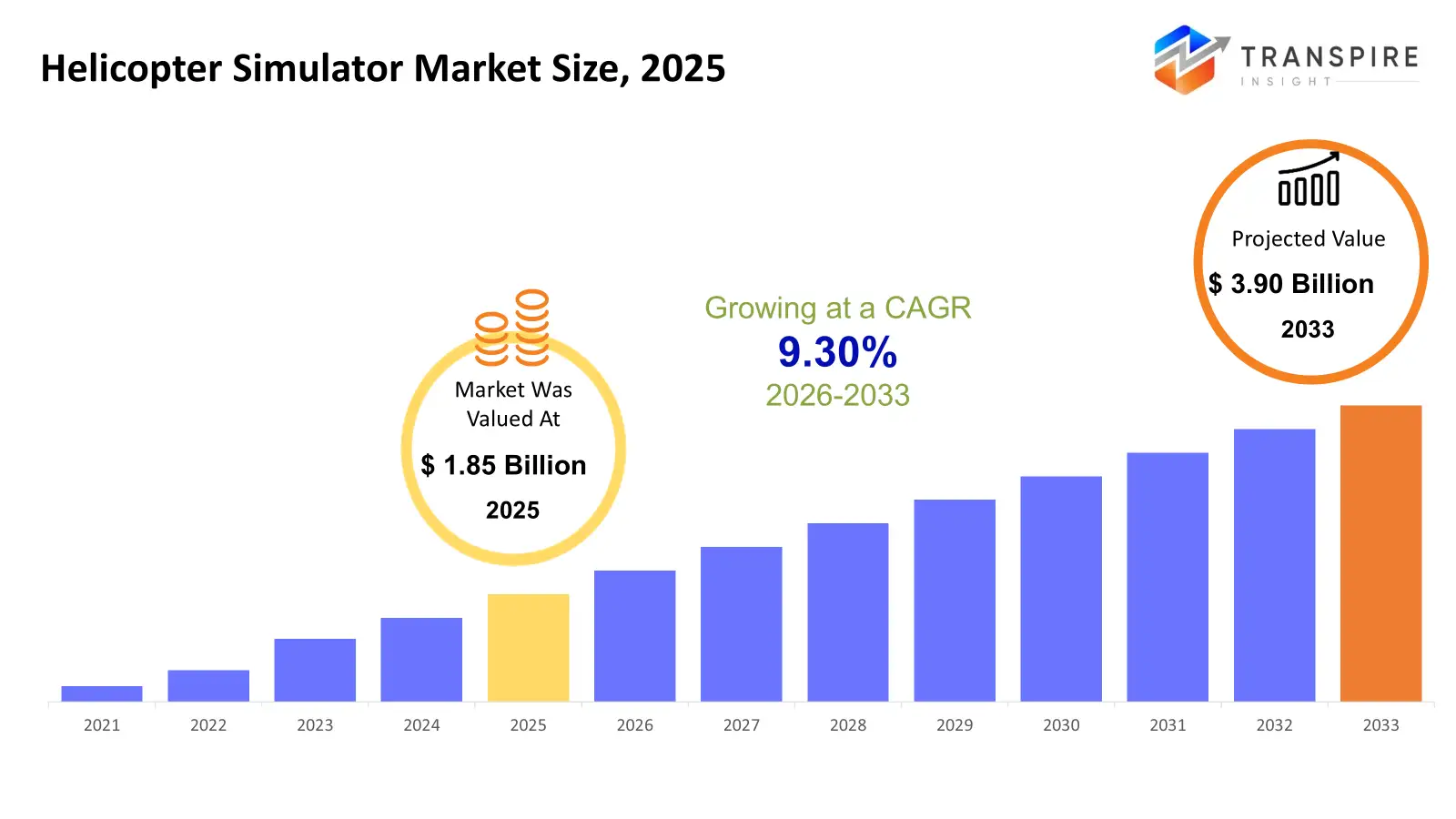
According to a research report published by Transpire Insight, the global helicopter simulator market size is projected to grow from USD 45.14 million in 2026 to USD 55.16 million by 2035, at a CAGR of 13.55 % during the forecast period 2026-2035. The global helicopter simulator market is heavily propelled by the absolute necessity for risk-free pilot training. Simulators drastically minimize live-flight fuel and maintenance costs while preparing crews for extreme, unpredictable weather and complex emergency procedures safely.
Introduction
The global helicopter simulator market is undergoing a profound transformation as both commercial aviation and military defense organizations prioritize safety and cost efficiency. Modern rotary-wing aircraft have evolved into highly complex systems, demanding advanced pilot capabilities. Traditional in-aircraft training introduces immense capital expenses, logistical downtime, and elevated operational risks. Helicopter simulators address these challenges by providing high-fidelity, immersive synthetic environments. Driven by breakthroughs in artificial intelligence, mixed-reality hardware, and dynamic flight physics modeling, these systems deliver repeatable, compliant, and deeply realistic mission scenarios worldwide.
Recent Development News
Stay Ahead of Emerging Opportunities with Expert Market Insights by Transpire Insight
Transpire Insight provides comprehensive, data-driven market intelligence to support smarter business decisions. Our research is rooted in comprehensive analysis, authoritative predictions, and industry expertise, enabling organizations to make informed decisions in rapidly evolving markets. In-depth analysis of market segmentation, competitive positioning, regional trends, and emerging investment opportunities in high-growth areas. We blend accuracy with actionable intelligence, empowering companies to uncover new avenues for growth, bolster strategic decision-making, and stay ahead in a dynamic global market.
Download the exclusive Helicopter Simulator Market sample report today to uncover expert insights, emerging trends, and the opportunities defining the future of the industry.
Helicopter Simulator Market Size & Statistics
Regional Growth and Demand Analysis by Transpire Insight:
North America is expected to remain the dominant region during the forecast period in the helicopter simulator market. The region's robust adoption of simulators is backed by mature aviation infrastructure, high defense spending, and government focus on certified pilot training, making it a stable revenue generator with steady procurement of advanced full-flight simulators. The United States leads Tier 1 demand, driven by large-scale military helicopter operations and OEM-supported pilot training facilities, with widespread adoption of motion-based and mission rehearsal simulators across military and commercial helicopter sectors, while Canada supports offshore and utility training requirements. In 2026, Airbus advanced North American training capacity by delivering the first H135 helicopter under Canada's Future Aircrew Training programme for the Royal Canadian Air Force, known in service as the CT-153 Juno, signaling how OEMs are embedding directly into national training pipelines rather than just supplying standalone simulator hardware.
Asia-Pacific is anticipated to witness rapid growth during the forecast period in the helicopter simulator market. This growth is supported by fleet expansion and rising pilot training requirements, with defense modernization programs significantly influencing simulator procurement and commercial helicopter operations for emergency response and logistics increasing simulator utilization. China contributes close to a tenth of the global market on its own, while Japan is emerging as a hub for precision, safety-oriented simulation demand. In May 2026, Loft Dynamics secured Japan Civil Aviation Bureau approval for its VR-based helicopter flight training device at Nagoya Airport, the first Level 7 VR helicopter simulator in Japan and the first of its kind in Asia-Pacific, marking a shift toward regulator-approved immersive training options in a region historically limited by access to high-fidelity full-flight simulators.
Top 15 Trends in the Helicopter Simulator
Proceed to Checkout to purchase the exclusive Helicopter Simulator Market report and gain instant access to in-depth market intelligence, strategic analysis, and future growth opportunities.
Top 25 Companies Leading the Helicopter Simulator Market
Customize the exclusive Helicopter Simulator Market report today to receive tailored insights, country-specific analysis, and business-focused market intelligence.
Top 25 Companies Leading the Helicopter Simulator Market
1. CAE Inc.
This company actively trains over 135,000 civil and defense pilots annually.
Founded: 1947 | HQ: Montreal, Canada.
Why It Ranks: It holds the world's largest commercially installed base of flight simulators.
Regional Dominance: Strongest market share across North America, Europe, and Asia-Pacific regions.
Product Line: 7000XR Series Full-Flight Simulators and CAE 3000 Series rotary wing trainers.
2. Thales Group
Their immersive visual technology trains European NATO forces on multi-role military platforms.
Founded: 2000 | HQ: Paris, France.
Why It Ranks: Renowned for high-tech digital systems and Level-D certified Reality H architectures.
Regional Dominance: Exercises commanding market presence throughout Western Europe and Middle Eastern networks.
Product Line: Reality H® Full Flight Simulators and tailored tactical military synthetic trainers.
3. FlightSafety International
They are the premier factory-authorized training provider for major global helicopter OEMs.
Founded: 1951 | HQ: Columbus, Ohio, USA.
Why It Ranks: Unmatched instructional footprint across corporate, commercial, and civilian rotorcraft training fields.
Regional Dominance: Holds a heavily dominant market share position across the United States.
Product Line: FS1000 Level-D full flight simulators and VITAL visual simulation systems.
4. L3Harris Technologies, Inc.
This firm seamlessly integrates complex defense avionics into highly specialized mission trainers.
Founded: 2019 (Merger) | HQ: Melbourne, Florida, USA.
Why It Ranks: A critical tier-one defense contractor specializing in collaborative, network-centric military flight training.
Regional Dominance: Heavily and deeply rooted in North American defense and allied global sectors.
Product Line: Military Rotary-Wing Mission Rehearsal Trainers and dynamic operational flight simulators.
5. Indra Sistemas S.A.
They developed the advanced simulated training infrastructure for the pan-European Eurofighter aircraft.
Founded: 1993 | HQ: Madrid, Spain.
Why It Ranks: A leading European supplier of custom defense electronics and sophisticated synthetic environments.
Regional Dominance: Extremely strong market presence in Europe and growing across Latin America.
Product Line: Level-D Helicopter Full Flight Simulators and generic mission-procedural flight trainers.
6. TRU Simulation + Training Inc.
Operating under Textron, they build highly customized simulators for Textron-owned aviation brands.
Founded: 2014 | HQ: Wichita, Kansas, USA.
Why It Ranks: Directly leverages internal OEM aircraft manufacturing data for superior cockpit replication.
Regional Dominance: Maintains a robust operational footprint throughout North American pilot academies.
Product Line: ProFlight series flight training devices and comprehensive full flight simulator architectures.
7. Frasca International Inc.
Over 3,000 of their flight training devices are active globally today.
Founded: 1958 | HQ: Urbana, Illinois, USA.
Why It Ranks: The undisputed market leader in modular, cost-efficient flight training devices worldwide.
Regional Dominance: Enjoys widespread market penetration across global flight academies and universities.
Product Line: Frasca 242 flight trainers and customizable Level-D rotary full flight simulators.
8. Airbus SE
They build simulators specifically optimized for their own globally deployed rotorcraft.
Founded: 1970 | HQ: Toulouse, France.
Why It Ranks: Commands structural advantages by embedding proprietary OEM flight data into systems.
Regional Dominance: Commands global aviation markets, anchored heavily by a massive European footprint.
Product Line: Helisim training center suites and integrated H145/H160 specific flight simulators.
9. Leonardo S.p.A.
Their "AW Family" training concept allows shared components across multiple simulator lines.
Founded: 1948 | HQ: Rome, Italy.
Why It Ranks: Masterfully blends advanced helicopter manufacturing with internally developed proprietary simulation assets.
Regional Dominance: Major market share in European defense, expanding into Anglo-American territories.
Product Line: AW139, AW169, and AW189 Full Flight Simulators and training devices.
10. Textron Inc.
They own Bell Helicopter and TRU Simulation, unifying aircraft and trainers.
Founded: 1923 | HQ: Providence, Rhode Island, USA.
Why It Ranks: A massive multi-industry conglomerate dictating global military and civil rotorcraft standards.
Regional Dominance: Exercises highly pervasive commercial and military dominance throughout global aerospace markets.
Product Line: Bell standard flight training devices and comprehensive synthetic unit defense systems.
Schedule a meeting with our market experts to discuss the exclusive Helicopter Simulator Market report and identify the best research solution for your organization.
Conclusion
The helicopter simulator market represents a critical pillar of modern aviation safety and pilot development. Driven by stringent international civil aviation mandates and expanding geopolitical defense requirements, the transition toward synthetic training environments remains irreversible. Top-tier manufacturers continue to innovate by integrating cloud computing, virtual reality, and artificial intelligence into standard flight devices. As acquisition costs stabilize, fixed-base and full-motion simulators will become increasingly accessible, ensuring optimal operational readiness, minimized environmental impact, and superior safety protocols globally.


Send us a brief description of your challenge and we'll get back to you within 24 hours.

 inquiry@transpireinsight.com
 APAC:+91 7666513636
 Address


