
Jul 22, 2026
By Transpire Insight
Description
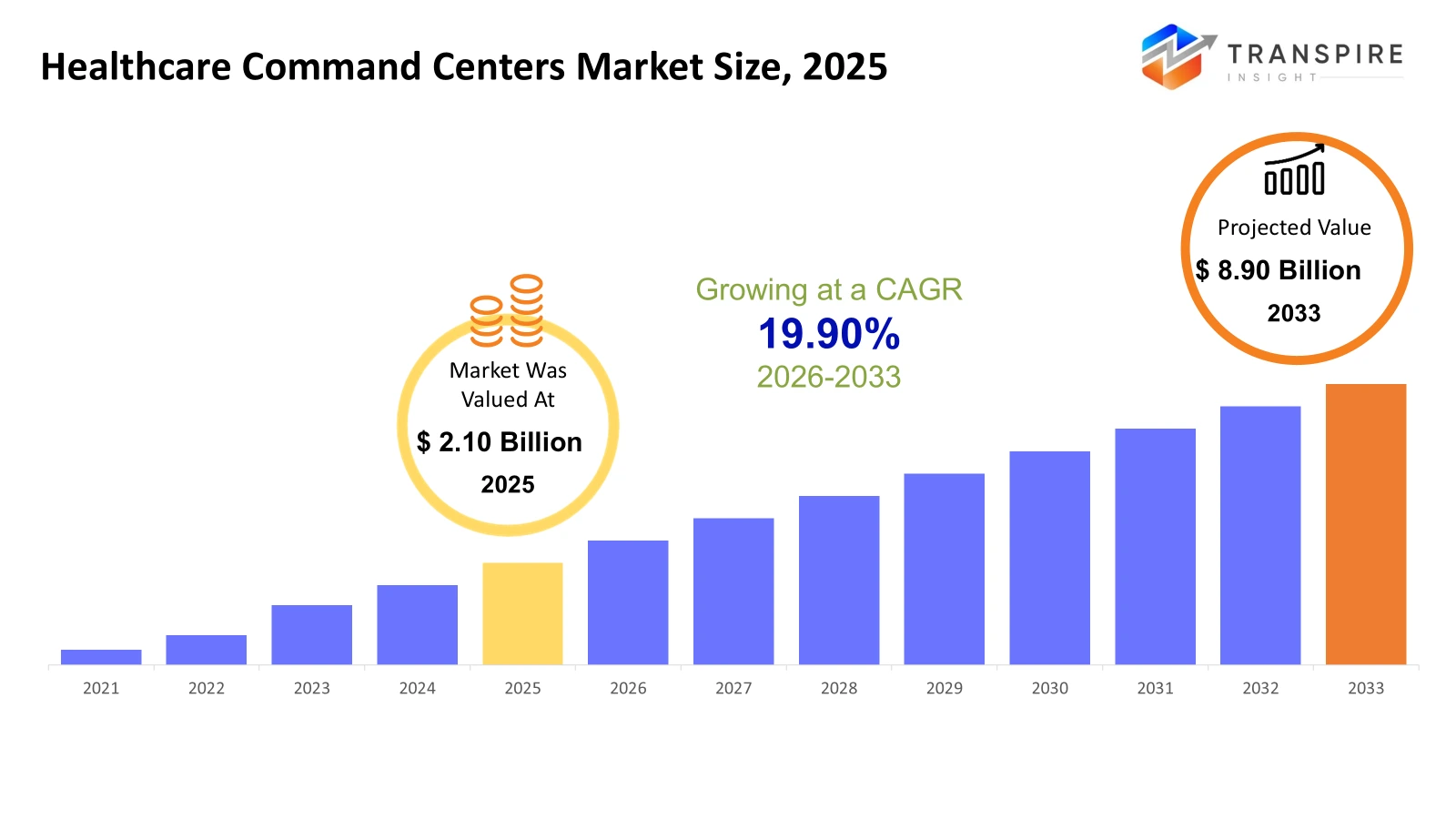
According to a research report published by Transpire Insight, the global healthcare command centers market size is projected to grow from USD 4.40 billion in 2026 to USD 9.89 billion by 2035, at a CAGR of 20.05% during the forecast period 2026-2035. The market is driven by escalating patient volumes, severe staffing shortages, and the pressing need to optimize hospital capacity. Accelerated digital transformation and the integration of predictive AI further fuel adoption globally.
Introduction
The global healthcare command centers market is expanding rapidly as health systems shift toward centralized, data-driven operational models. Serving as a hospital’s digital "mission control," these centers leverage artificial intelligence, real-time analytics, and machine learning to integrate disparate clinical data. By synthesizing patient flow, bed capacity, staffing schedules, and emergency dispatch, command centers eliminate institutional silos. This synchronization helps healthcare providers prevent bottlenecks, cut wait times, and significantly improve clinical outcomes.
Recent Development News
Download the exclusive Healthcare Command Centers Market sample report today to uncover expert insights, emerging trends, and the opportunities defining the future of the industry.
Healthcare Command Centers Market Size & Statistics
Regional Growth and Demand Analysis by Transpire Insight:
North America is expected to remain the dominant regional market for healthcare command centers, holding 40% of global market share, owing to mature healthcare IT infrastructure, robust reimbursement systems, and early adoption of AI-driven operational analytics. The United States remains the epicenter of enterprise-wide command center deployment, with large integrated delivery networks such as those using GE HealthCare, Oracle Health (Cerner), Epic Systems, and TeleTracking platforms expanding system-wide coordination hubs to optimize patient flow and minimize operational bottlenecks. Demand continues to be driven by hospital CFOs pushing for accelerated discharge and throughput automation amid shrinking operating margins, while CMS interoperability mandates and value-based care reimbursement models are reinforcing the shift toward centralized, data-driven hospital operations. Canada's growing digital health infrastructure investment and cross-border vendor presence (Qventus, LeanTaaS) further consolidate the region's leadership.
Asia-Pacific is anticipated to register the fastest growth rate during the forecast period, holding 20% of the market share, driven by rapid private hospital expansion, rising healthcare digitization, and formalizing regulatory frameworks around health data and interoperability. India stands out with a 14.8% CAGR, fueled by a leapfrog transition directly into digital health infrastructure and government-backed initiatives such as the Ayushman Bharat Digital Mission, strengthening centralized hospital data ecosystems. Japan and South Korea function as Tier 1 markets given their mature hospital IT environments and strong government push toward smart hospital adoption, while China, Australia, and Southeast Asian markets represent Tier 2 markets with increasing institutional command center investment. In the Middle East, GCC nations, driven by high-end healthcare tourism and new hospital infrastructure, are emerging as a meaningful regional hub, while Europe remains shaped by GDPR-driven data privacy requirements favoring secure hybrid or localized cloud deployments, with NHS England's capacity expansion programs anchoring regional demand.
Top 15 Trends in the Healthcare Command Centers Market
Proceed to Checkout to purchase the exclusive Healthcare Command Centers Market report and gain instant access to in-depth market intelligence, strategic analysis, and future growth opportunities.
Top 25 Companies Leading the Healthcare Command Centers Market
Customize the exclusive Healthcare Command Centers Market report today to receive tailored insights, country-specific analysis, and business-focused market intelligence.
1. GE HealthCare
Pioneers holistic digital twins and predictive analytics tiles for health system orchestration.
Founded: 1994 | HQ: Chicago, Illinois, USA.
Why It Ranks: Commands top market share through deeply integrated, custom-fitted clinical operations software.
Regional Dominance: Holds unrivaled market authority across North American tier-one hospital networks.
Product Line: Mural Virtual Care System, Command Center Software Tiles, Centricity solutions.
2. Koninklijke Philips N.V.
Integrates clinical command suites directly into advanced connected care and telemetry ecosystems.
Founded: 1891 | HQ: Amsterdam, Netherlands.
Why It Ranks: Excels at blending real-time patient monitoring with enterprise-wide logistical informatics.
Regional Dominance: Strongly established across European healthcare systems and expanding heavily in Asia-Pacific.
Product Line: Philips Electronic Patient Care Management, Patient Flow Capacity Suite, IntelliVue.
3. Siemens Healthineers
Links diagnostic imaging workflows with enterprise-scale digital health operations orchestration.
Founded: 1847 | HQ: Erlangen, Germany.
Why It Ranks: Leverages massive medical infrastructure footprint to embed operations management software seamlessly.
Regional Dominance: Maintains top-tier infrastructure dominance across Europe and Latin American markets.
Product Line: AI-Rad Companion, Syngo Virtual Cockpit, Medical Operations Center solutions.
4. TeleTracking Technologies
One-liner fact: Devoted exclusively to operational patient flow and hospital bed capacity management.
Founded: 1991 | HQ: Pittsburgh, Pennsylvania, USA.
Why It Ranks: Over three decades of hyper-focused expertise in reducing emergency department bottlenecks.
Regional Dominance: Commands an extensive footprint across hospitals in the United States and the UK.
Product Line: Capacity Management Suite, IQ Operational Command Center, TransferCenter software.
5. Qventus
Maximizes perioperative and inpatient capacity using autonomous, real-time AI machine learning.
Founded: 2012 | HQ: Oakland, California, USA.
Why It Ranks: Leads the market in AI-driven, actionable behavioral nudges for frontline caregivers.
Regional Dominance: Rapidly growing market share within major multi-hospital networks across North America.
Product Line: Qventus Optimization Platform, Inpatient Solution, OR Efficiency and Analytics Suite.
6. Epic Systems Corporation
Built directly into the world’s most widely adopted electronic health record.
Founded: 1979 | HQ: Verona, Wisconsin, USA.
Why It Ranks: Eliminates third-party software integration hurdles for existing Epic-based medical systems.
Regional Dominance: Heavily dominates large academic medical centers across the United States market.
Product Line: Epic Grand Central, Cheers CRM, Rover, Epic Monitor Command modules.
7. Oracle Health (formerly Cerner)
Combines enterprise EHR capabilities with Oracle's massive cloud computing database infrastructure.
Founded: 1979 | HQ: Austin, Texas, USA.
Why It Ranks: Delivers powerful cross-facility data synthesis using enterprise-grade cloud analytics engines.
Regional Dominance: Strong presence throughout North America, the Middle East, and the global public sector.
Product Line: Oracle Health Command Center, CareAware Capacity Management, Millennium platform.
8. LeanTaaS
Employs advanced predictive mathematical modeling to optimize constrained surgical and infusion schedules.
Founded: 2010 | HQ: Santa Clara, California, USA.
Why It Ranks: Maximizes asset utilization by turning complex asset queues into predictive, structured calendars.
Regional Dominance: Extensively embedded within top-tier cancer centers and health networks nationwide.
Product Line: iQueue for Operating Rooms, iQueue for Infusion Centers, Inpatient Beds.
9. ABOUT Healthcare Inc.
Orchestrates complex patient transitions, transfers, and out-of-network referrals across disparate systems.
Founded: 2005 | HQ: St. Paul, Minnesota, USA.
Why It Ranks: Unifies fragmented access center workflows to optimize regional health system patient routing.
Regional Dominance: Operates heavily across mid-to-large regional healthcare networks in North America.
Product Line: ABOUT Transfer, ABOUT Placement, Referral Management, Access Center Operational Analytics.
10. KenSci
Utilizes risk prediction models to forecast patient acuity and prevent costly readmissions.
Founded: 2015 | HQ: Seattle, Washington, USA.
Why It Ranks: Delivers exceptional predictive insights by analyzing clinical, operational, and financial data points.
Regional Dominance: Strong strategic presence across the US Pacific Northwest, with expansion into Southeast Asia.
Product Line: KenSci Clinical Analytics Platform, Patient Flow Predictor, Utilization Management Suite.
Schedule a meeting with our market experts to discuss the exclusive Healthcare Command Centers Market report and identify the best research solution for your organization.
Conclusion
The healthcare command centers market represents a vital evolution in response to modern operational strain, staffing deficits, and capacity crises. By centralizing data infrastructure, these platforms transform fragmented hospitals into highly responsive, unified systems. Industry leaders are continually driving efficiency gains by embedding predictive AI and digital twin simulations. As health systems prioritize long-term sustainability, command centers will transition from an elite, high-tech luxury into an essential foundation for global patient care logistics.


Send us a brief description of your challenge and we'll get back to you within 24 hours.

 inquiry@transpireinsight.com
 APAC:+91 7666513636
 Address


