
Jul 20, 2026
By Transpire Insight
Description
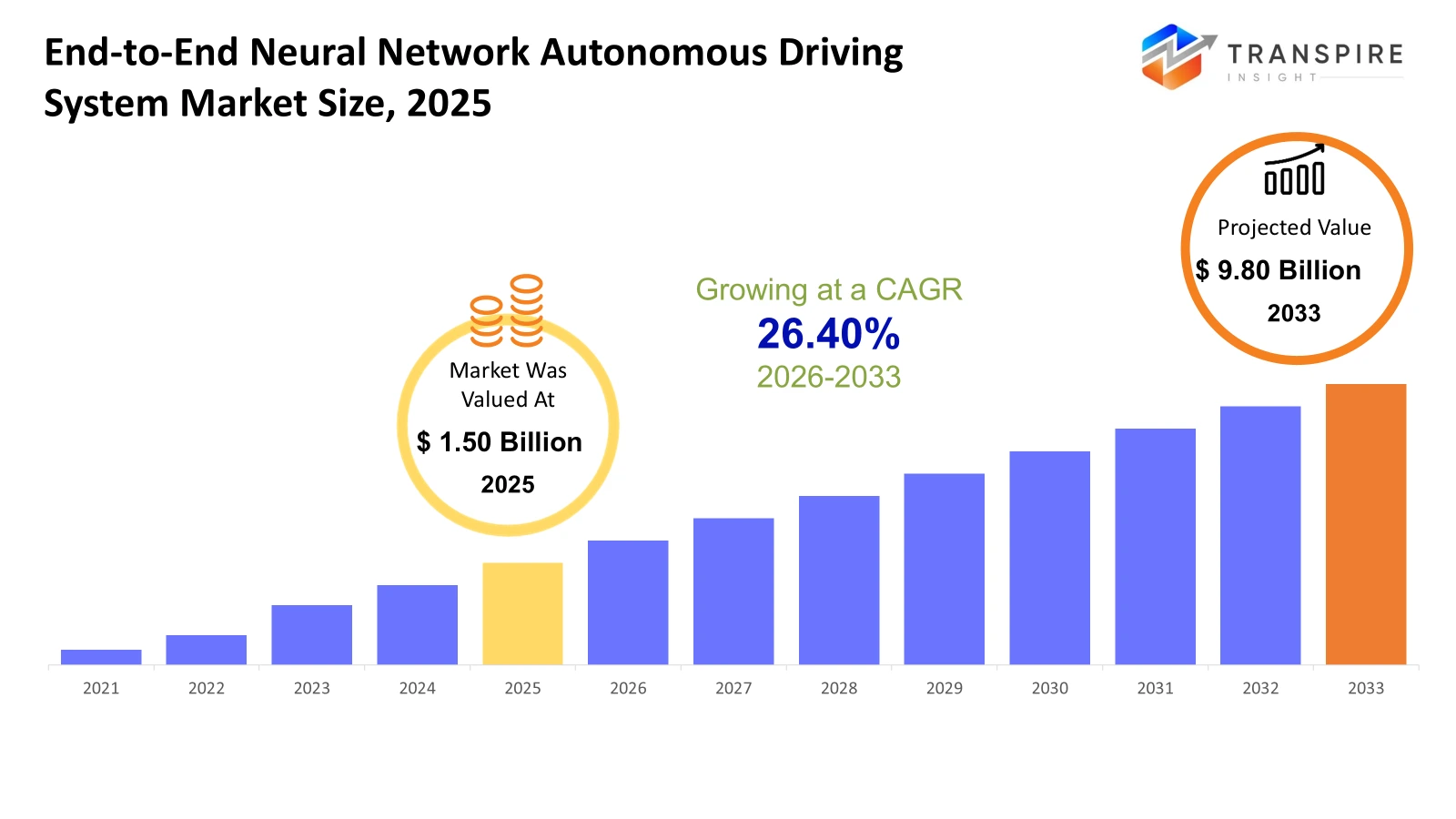
According to a research report published by Transpire Insight, The Global End-to-End Neural Network Autonomous Driving System Market Size is projected to Grow from USD 1.50 Billion in 2026 to USD 10.45 Billion by 2035, at a CAGR of 27.55% during the forecast period 2026-2035. The market is fueled by quick developments in artificial intelligence, deep learning, advanced automotive computing, edge AI processors, and autonomous driving. The growing investments from automotive OEMs and tech firms, deployment of robotaxis, development of Level 3 to Level 5 autonomous driving solutions, and constant improvement in neural networks through training on extensive driving data sets will propel market adoption. Additionally, favorable government policies, growing intelligent mobility needs, and innovation in generative AI and multimodal foundation models will offer substantial future growth prospects for the global End-to-End Neural Network Autonomous Driving System Market.
Introduction
The End-to-End Neural Network Autonomous Driving System Market is defined by AI-based solutions for autonomous driving where deep neural networks are employed to analyze data from sensors like cameras, LiDAR, radar, GPS, and ultrasonic sensors to come up with driving decisions on the go and not using the conventional rule-based software processes. Such autonomous driving systems are simplified by integrating perception, planning, and controls into a single neural network system. They are gaining increasing popularity in passenger cars, trucks, robotaxis, logistics, and advanced driver assistance systems (ADAS).
Recent Development News
Stay Ahead of Emerging Opportunities with Expert Market Insights by Transpire Insight
The insights that have been shared through this blog are based on intensive market research carried out by Transpire Insight, an advisor that works with many global organizations. Thanks to the analysis of extensive data, forecasts made by our specialists, and industry intelligence, our reports allow clients to find strategic growth opportunities in dynamically developing industries. For all those who would like to get more detailed information regarding market segmentation, competitive analysis, regional outlooks, and future investment tendencies, there is no doubt that our full report will be of great value.
Download the exclusive End-to-End Neural Network Autonomous Driving System Market sample report today to uncover expert insights, emerging trends, and the opportunities defining the future of the industry.
End-to-End Neural Network Autonomous Driving System Market Size & Statistics
Regional Growth and Demand Analysis by Transpire Insight:
North America holds the dominant position in the End-to-End Neural Network Autonomous Driving System Market by occupying around 42% market share. The dominance in the region is attributed to the presence of a robust ecosystem of autonomous driving system companies, investments in artificial intelligence, semiconductor development, and favorable testing conditions for autonomous vehicles. The presence of companies like Tesla, NVIDIA, Waymo, Aurora Innovation, Qualcomm, and General Motors in the region along with heavy funding on research & development and the adoption of autonomous mobility solutions further strengthen the dominance of North America.
The Asia-Pacific region is projected to be the fastest growing region during the forecast period, holding around 36% market growth share. Expansion in intelligent transportation systems, government assistance for deployment of autonomous vehicles, huge investments in AI, smart mobility solutions, and the presence of key players like Baidu, Huawei, XPeng, NIO, BYD, Pony.ai, and WeRide drive the regional market. Moreover, adoption of electric vehicles and large-scale pilot testing of autonomous driving in China, Japan, South Korea, and Singapore continue to bolster market growth.
Top 15 Trends in the End-to-End Neural Network Autonomous Driving System Market
Proceed to Checkout to purchase the exclusive End-to-End Neural Network Autonomous Driving System Market report and gain instant access to in-depth market intelligence, strategic analysis, and future growth opportunities.
1. Growing Adoption of End-to-End Deep Learning Driving Models
In recent years, the automotive industry has started moving towards using end-to-end learning models for autonomous driving, which directly transforms sensor inputs into vehicle actions. This type of system is simple in its design, lowers software complexity, enhances the flexibility of the system in adapting to real-world driving situations, and allows continual learning from massive driving datasets.
2. Increasing Integration of Multimodal Foundation AI Models
Foundation model development for multimodality has been revolutionizing the area of self-driving through the ability of the neural network to analyze data coming from cameras, LiDAR, radar, GPS, and car sensors at once. The advanced AI algorithms offer better perception of traffic scenarios and increased performance levels in terms of safety and decision making.
3. Expansion of Vision-Only Autonomous Driving Architectures
Increasingly, many autonomous vehicles are now using vision-based driving systems that use only a number of high-resolution cameras, instead of the expensive LiDAR sensors. Neural networks are used to analyze visual input in order to detect road users, traffic signs, lane markings, and obstacles. This not only helps reduce cost but also increases scalability of AVs.
4. Rising Deployment of AI Accelerators for In-Vehicle Computing
The increasing computational requirements of neural network architectures are leading to the implementation of AI accelerator chips and high-performance automotive processors. Such chips provide real-time inference, reduce latency, increase energy efficiency, and allow for the development of more advanced autonomous driving software that can process massive amounts of sensor data simultaneously.
5. Growing Adoption of Large-Scale Neural Network Training
Self-driving companies are pouring vast amounts of money into training neural networks on a grand scale using billions of miles of road test data along with simulators. Training models continuously increases driving precision, makes vehicles more adaptable to unusual traffic situations, increases safety, and facilitates the development of competent self-driving cars.
6. Increasing Development of Generative AI for Autonomous Driving
There are many advantages offered by generative AI, especially with regards to autonomous driving, where it can be used to create simulated driving situations, generate rare traffic events, improve simulations, and increase the efficiency of model training. This will enable the training of neural networks to experience more complex driving scenarios.
Top 25 Companies Leading the End-to-End Neural Network Autonomous Driving System Market
Customize the exclusive End-to-End Neural Network Autonomous Driving System Market report today to receive tailored insights, country-specific analysis, and business-focused market intelligence.
1. Tesla, Inc.
Tesla is an American multinational EV company known for developing autonomous driving technology through full self-driving (FSD).
Founded:2003 | Headquarters: Austin, Texas, USA
Why It Ranks: The industry leader in end-to-end AI-powered autonomous driving with the world's biggest data set from actual road conditions.
Regional Dominance: Strong presence across North America, Europe, and Asia-Pacific.
Product Line: FSD, Autopilot, AI chips, electric cars, Dojo supercomputer for AI processing, and Robotaxi services.
Recent Development: FSD v14 deployment and commercialization of the AI-powered Robotaxi platform.
2. NVIDIA Corporation
NVIDIA designs and manufactures state-of-the-art AI computing platforms, GPUs, automotive processors, and self-driving technologies for future automobiles.
Founded:1993 | Headquarters: Santa Clara, California, USA
Why It Ranks: World leader in manufacturing AI computing devices that drive autonomous driving cars.
Regional Dominance: Strong presence across North America, Europe, and Asia-Pacific.
Product Line: NVIDIA DRIVE Hyperion, DRIVE AGX, AI processors for automobiles, CUDA AI Platform, and Alpamayo AI Models.
Recent Development: Launched Alpamayo 2 Super and added to its DRIVE Hyperion family for Level 4 autonomous cars.
3. Waymo LLC
Waymo is an autonomous driving technology firm of Alphabet Inc. that specializes in fully automated robotaxi and autonomous vehicle technologies.
Founded:2009 | Headquarters: Mountain View, California, USA
Why It Ranks: The world leader in fully autonomous driving with large-scale commercial robotaxi deployments.
Regional Dominance: Strong presence across North America.
Product Line: Waymo Driver, autonomous mobility services, robotaxi technology, autonomous trucking, and artificial intelligence perception systems.
Recent Development: Launched its 6th Generation Waymo Driver system with improved AI and sensor fusion technology.
4. Mobileye Global Inc.
Mobileye is a leading company that provides various technologies based on artificial intelligence for autonomous driving, computer vision, and ADAS (advanced driver-assistance systems).
Founded:1999 | Headquarters: Jerusalem, Israel
Why It Ranks: Key provider of computer vision and autonomous driving technologies to automotive OEMs worldwide.
Regional Dominance: Strong presence across Europe, North America, and Asia-Pacific.
Product Line: EyeQ processors, SuperVision™, Chauffeur™, Drive™, and software for autonomous driving.
Recent Development: Autonomy collaborations with multiple global automotive OEMs.
5. Baidu, Inc.
Baidu is a prominent AI firm offering autonomous driving platforms, AI models, and intelligent mobility products.
Founded:2000 | Headquarters: Beijing, China
Why It Ranks: Leading supplier of autonomous driving technology in China with the help of Apollo platform.
Regional Dominance: Strong presence across China and Asia-Pacific.
Product Line: Apollo autonomous driving platform, AI cloud offerings, robotaxi products, and intelligent transport systems.
Recent Development: Commercial launch of Apollo Go robotaxi in major Chinese cities.
6. Huawei Technologies Co., Ltd.
Huawei is an international technology company focused on creating intelligent car solutions, artificial intelligence computing platforms, autonomous driving technologies, and smart vehicle ecosystems.
Founded:1987 | Headquarters: Shenzhen, China
Why It Ranks: Top supplier of autonomous driving platforms based on AI technology and intelligent vehicle solutions to automotive companies.
Regional Dominance: Strong presence across Asia-Pacific, with expanding partnerships in Europe and the Middle East.
Product Line: Autonomous Driving Solution (ADS) by Huawei, MDC intelligent computing platform, HarmonyOS for Smart Cockpit, LiDAR sensors, and intelligent vehicle cloud solutions.
Recent Development: Wider application of autonomous driving technology (ADS) solution by Huawei in several Chinese electric vehicles.
7. XPeng Inc.
XPeng is a Chinese company that produces electric cars with an emphasis on AI-driven smart mobility and autonomous driving technologies.
Founded:2014 | Headquarters: Guangzhou, China
Why It Ranks: A pioneer in using end-to-end neural network autonomous driving technologies in electric cars at mass production scale.
Regional Dominance: Strong presence across China, with growing expansion into Europe.
Product Line: XPilot autonomous driving system, XNGP (Navigation Guided Pilot) system, electric cars, AI computation technology, and intelligent cockpits.
Recent Development: Wider availability of its end-to-end XNGP autonomous driving technology in various Chinese cities.
8. Pony.ai, Inc.
Pony.ai creates self-driving tech for robotaxis, autonomous trucks, and smart mobility services with highly advanced artificial intelligence algorithms.
Founded:2016 | Headquarters: Fremont, California, USA
Why It Ranks: Top provider of Level 4 autonomous driving technology with robotaxi testing and deployment.
Regional Dominance: Strong presence across China and North America.
Product Line: PonyPilot self-driving system, robotaxi technology, autonomous trucking tech, artificial intelligence perception systems, and fleet management technology.
Recent Development: Expansion of autonomous taxi services and partnering with auto industry giants.
9. Momenta Group
Momenta is a company that develops self-driving car technology through the use of end-to-end deep learning techniques in cars and robotaxi services.
Founded:2016 | Headquarters: Beijing, China
Why It Ranks: A leader in data-driven autonomous driving technology thanks to massive neural network training.
Regional Dominance: A strong presence in China, and growing connections within the automotive industry abroad.
Product Line: Mpilot driving assistance, MSD (Momenta Self-Driving) technology, AI perception software, autonomous driving algorithms, and cloud training platforms.
Recent Development: Collaboration with international automobile OEMs to implement end-to-end autonomous driving technologies in production cars.
10. Zoox, Inc.
Zoox is an autonomous mobility startup company that belongs to Amazon and creates fully autonomous robotaxis designed for urban areas.
Founded:2014 | Headquarters: Foster City, California, USA
Why It Ranks: Developer of dedicated autonomous robotaxis with the use of sophisticated end-to-end AI driving technology.
Regional Dominance: Strong presence across North America.
Product Line: Autonomous robotaxis, AI driving systems, autonomous mobility platforms, fleet management software, and vehicle perception systems.
Recent Development: Expansion of tests and deployments of autonomous vehicles and robotaxis in major U.S. cities.
Schedule a meeting with our market experts to discuss the exclusive End-to-End Neural Network Autonomous Driving System Market report and identify the best research solution for your organization.
Conclusion
The End-to-End Neural Network Autonomous Driving System Market is set to witness impressive growth during the forecast period on account of fast-paced developments in artificial intelligence, deep learning, superior automotive computing power, and autonomous vehicles. Moving away from conventional rule-based autonomous driving system to end-to-end neural network autonomous driving systems will lead to improvements in perception, decision-making, vehicle control, and simplified software development. Major players including Tesla, NVIDIA, Waymo, Mobileye, Baidu, Huawei, XPeng, Pony.ai, Momenta, and Zoox are continuously contributing towards the evolution of the market through AI model training, strategic partnerships, and commercializing autonomous mobility systems. With increasing investments in intelligent transport systems and advanced autonomous vehicles by governments, automotive OEMs, and tech giants, the End-to-End Neural Network Autonomous Driving System Market is set to be one of the fastest-growing markets in the autonomous driving industry.


Send us a brief description of your challenge and we'll get back to you within 24 hours.

 inquiry@transpireinsight.com
 APAC:+91 7666513636
 Address


