
Jul 08, 2026
By Transpire Insight

Description
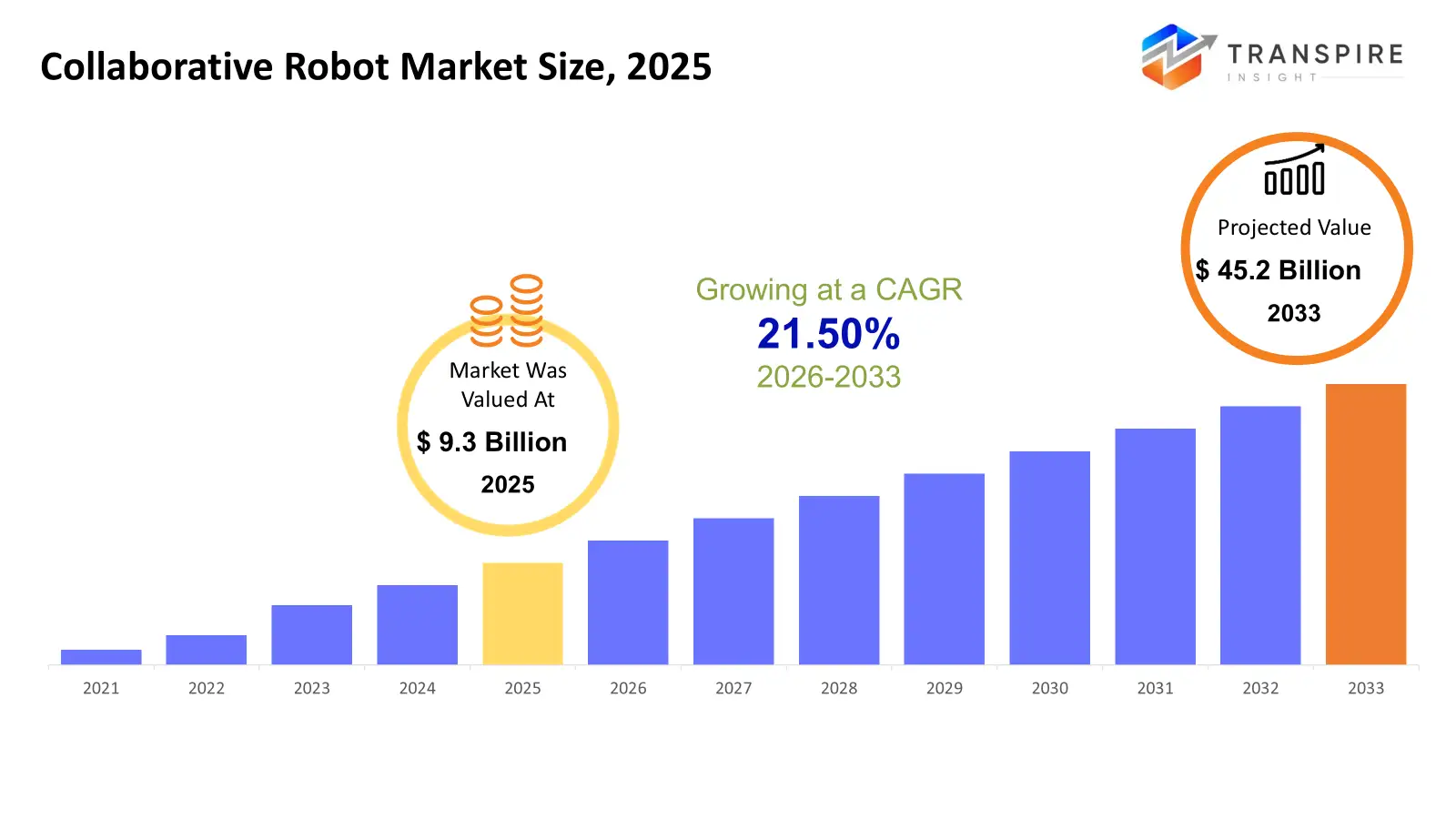
According to a research report published by Transpire Insight, the global collaborative robot market size is projected to grow from USD 12.5 billion in 2026 to USD 47.02 billion by 2035, at a CAGR of 22.55 % during the forecast period 2026-2035. Small, medium, and large businesses are aggressively seeking cage-free, collaborative, affordable automation solutions to address rising global labor shortages, rapidly increasing production costs, and the need for increased flexibility for low-volume and high-mix production.
Introduction
The collaborative robot market is in a transformation phase and has moved from its technical niche to becoming an inevitable part of modern industrial automation. Cobots are intentionally designed to operate side by side safely with a human worker without requiring physical cages. With the world's shortage of labor and the need for manufacturing agility, these flexible and easy-to-use robots allow small, medium, and large businesses to easily optimize their shop floor operations, improve productivity, and reduce overhead costs.
Recent Development News
March 2026: General Motors and NVIDIA announced a milestone collaboration to integrate advanced AI, simulation, and accelerated computing platforms (such as Omniverse and Cosmos) to plan next-generation smart factories and boost automated cobot learning.
May 2026: ABB officially expanded its high-performance automation portfolio by launching the SWIFTI CRB 1300 cobot, featuring lightweight, high-speed capabilities optimized for precise material handling and pick-and-place tasks within electronics and general industries.
Stay Ahead of Emerging Opportunities with Expert Market Insights by Transpire Insight
Transpire Insight provides comprehensive, data-driven market intelligence to support smarter business decisions. Our research is rooted in comprehensive analysis, authoritative predictions, and industry expertise, enabling organizations to make informed decisions in rapidly evolving markets. In-depth analysis of market segmentation, competitive positioning, regional trends, and emerging investment opportunities in high-growth areas. We blend accuracy with actionable intelligence, empowering companies to uncover new avenues for growth, bolster strategic decision-making, and stay ahead in a dynamic global market.
Download the exclusive Collaborative Robot Market sample report today to uncover expert insights, emerging trends, and the opportunities defining the future of the industry.
Aircraft Environmental Control Systems Market Size & Statistics
The market size for the collaborative robot is estimated to be worth USD 12.5 billion in 2026.
The market is going to expand at a CAGR of 22.55 % between 2026 and 2035.
The global collaborative robot market size is anticipated to reach USD 47.02 billion by 2035.
Asia-Pacific is estimated to generate the highest demand during the forecast period, with a growth of 51% in the collaborative Robot market.
Europe is projected to grow the fastest during the forecast period, at a growth rate of 23% in the collaborative robot market.
Regional Growth and Demand Analysis by Transpire Insight
Europe is expected to grow the fastest during the forecast period in the Collaborative Robot market. The dominant player in the Collaborative Robot Market is Europe, owing to the availability of leading players in terms of robot manufacturing companies, automation technology suppliers, and robust investment in Industry 4.0 initiatives. Germany is currently the biggest producer in Europe for the Collaborative Robot Market, considering factors such as the presence of extensive automotive manufacturing operations, efforts toward modernizing industrial assembly lines, and continued advancement in robotic engineering. As of 2025, some of the automation companies in Germany have undertaken production activities aimed at manufacturing superior safety-certified systems that would enhance next-generation manufacturing and industrial operations.
Asia-Pacific is anticipated to generate the highest demand during the forecast period in the Collaborative Robot market. It is expected that the Asia-Pacific region will witness the highest growth rate during the forecast period due to increasing demand for electronics assembly, growing fleets of smart factories, increased industrial purchasing programs, and significant investment in manufacturing infrastructure. China, Japan, South Korea, and India are some of the rapidly growing nations regarding commercial and industrial activities that drive the demand for advanced collaborative technologies. In 2025, there will be an increase in factory modernization programs by many manufacturing companies in China and India. This was done with the aim of ensuring energy-efficient, high-precision collaborative robot systems.
Top 15 Trends in the Collaborative Robot Market
AI-powered intelligent cobot systems.
Human-robot collaboration in factories.
Lightweight and compact robot designs.
Expansion in SMEs' manufacturing adoption.
Integration with Industrial IoT platforms.
Advanced vision and sensing technologies.
Flexible and modular robotic arms.
Increased use in electronics assembly.
Rising demand in the automotive sector.
Safety-enhanced collaborative robot systems.
Cloud-connected robot fleet management.
Low-cost cobot solutions emerging globally.
Growth in healthcare and lab automation.
Easy programming and no-code interfaces.
High precision in pick-and-place tasks.
Proceed to Checkout to purchase the exclusive Collaborative Robot Market report and gain instant access to in-depth market intelligence, strategic analysis, and future growth opportunities.
AI-Powered Intelligent Cobot Systems
AI enables cobots to learn tasks, adapt to environments, improve decision-making, and optimize workflows, increasing productivity and reducing human intervention in repetitive industrial operations.
Human-Robot Collaboration in Factories
Cobots work safely alongside humans, sharing tasks, improving efficiency, reducing workplace injuries, and enabling flexible production lines across manufacturing industries with higher operational adaptability.
Expansion in SMEs Manufacturing Adoption
Small and medium enterprises increasingly adopt cobots due to their affordability, ease of use, ability to boost productivity, reduce labor costs, and improve manufacturing competitiveness globally.
Advanced Vision and Sensing Technologies
Improved cameras and sensors help cobots detect objects accurately, avoid collisions, enhance precision tasks, and perform quality inspection in complex industrial environments efficiently.
Growth in Healthcare and Lab Automation
Cobots are widely used in healthcare for lab testing, sample handling, and surgery assistance, improving accuracy, reducing contamination risks, and supporting medical workforce efficiency.
Easy Programming and No-Code Interfaces
Modern cobots feature intuitive interfaces allowing non-experts to program tasks quickly, reducing training time, increasing deployment speed, and enabling faster industrial automation adoption.
Top 25 Companies Leading the Collaborative Robot Market
Universal Robots A/S
FANUC CORPORATION
ABB Group
TECHMAN ROBOT INC.
AUBO (BEIJING) ROBOTICS TECHNOLOGY CO.
LTD
KUKA AG
Doosan Robotics Inc.
DENSO CORPORATION
YASKAWA ELECTRIC CORPORATION
Epson Robots
Mitsubishi Electric
Franka Emika
Hanwha Robotics
Mecademic Robotics
Elite Robots
Estun Automation
Precise Automation
Agile Robots
Rethink Robotics, Inc.
OMRON Corporation
Kawasaki Heavy Industries, Ltd.
Stäubli International AG
Comau
Robot US Inc.
Customize the exclusive Collaborative Robot Market report today to receive tailored insights, country-specific analysis, and business-focused market intelligence.
Leading Collaborative Robot Companies
Top 25 companies dominating the collaborative robot market.
Universal Robots A/S
This pioneering Danish company created the world's very first commercial cobot.
Foundation: 2005 | HQ: Odense, Denmark.
Why It Ranks: It holds the top global market share via its UR+ ecosystem.
Regional Dominance: Maintains an incredibly strong, well-established foothold across Europe and North America.
Product Line: Features the globally renowned UR3e, UR5e, UR10e, UR16e, UR20, and UR30 series.
FANUC CORPORATION
Distinctly recognized globally for its signature, bright yellow-and-green high-reliability industrial robots.
Foundation: 1972 | HQ: Oshino, Yamanashi, Japan.
Why It Ranks: Leverages an unparalleled legacy of shipping over one million industrial systems.
Regional Dominance: Possesses massive, deep-rooted market penetration throughout Asian and North American factories.
Product Line: Focuses on the highly popular CR and CRX collaborative robot series.
ABB Group
A powerhouse undergoing a major multi-billion-dollar robotics division spinoff and restructuring.
Foundation: 1988 | HQ: Zürich, Switzerland.
Why It Ranks: Deep industrial heritage ensures elite precision, durability, and safety compliance standards.
Regional Dominance: Holds a highly commanding presence across the European automotive and electronics sectors.
Product Line: Celebrated for the dual-arm YuMi, GoFa, and SWIFTI collaborative series.
TECHMAN ROBOT INC.
Pioneered the market by embedding vision systems natively into the cobot structure.
Foundation: 2015 | HQ: Taoyuan, Taiwan.
Why It Ranks: Built-in smart vision drastically slashes integration time and total deployment costs.
Regional Dominance: Strongly competitive across major electronics manufacturing hubs throughout the Asia-Pacific region.
Product Line: Delivers the TM5, TM12, TM14, and the newer TM25 series.
AUBO (BEIJING) ROBOTICS TECHNOLOGY CO., LTD.
Proudly manufactures over ninety percent of its critical core components completely in-house.
Foundation: 2015 | HQ: Beijing, China.
Why It Ranks: Offers an exceptionally competitive cost-to-performance ratio for budget-conscious global system integrators.
Regional Dominance: Controls a highly dominant, rapidly expanding portion of China's domestic automation market.
Product Line: Supplies the diverse AUBO-i series covering a wide range of 3kg to 20kg payloads.
KUKA AG
A legendary German robotics pioneer owned by China’s Midea Group.
Foundation: 1898 | HQ: Augsburg, Germany.
Why It Ranks: Renowned for engineering advanced, highly sensitive, human-like seven-axis torque-controlled robotic joints.
Regional Dominance: Deeply integrated into premium European automotive original equipment manufacturer (OEM) networks.
Product Line: Centers on the highly advanced LBR iiwa and LBR iisy models.
Doosan Robotics Inc.
Represents a major South Korean heavyweight specializing in ultra-heavy palletizing cobot solutions.
Foundation: 2015 | HQ: Suwon, Gyeonggi-do, South Korea.
Why It Ranks: Leads the segment in manufacturing high-payload cobots exceeding twenty-five kilograms in capacity.
Regional Dominance: Possesses massive market authority in South Korea with growing Western market shares.
Product Line: Markets the comprehensive, high-torque M-SERIES, A-SERIES, H-SERIES, and E-SERIES cobots.
DENSO CORPORATION
Initially created advanced automation lines exclusively to serve its internal automotive needs.
Foundation: 1949 | HQ: Kariya, Aichi, Japan.
Why It Ranks: World-class precision engineering optimized perfectly for compact, high-speed, space-constrained electronics assembly lines.
Regional Dominance: Highly dominant across Japanese automotive parts and consumer electronics manufacturing ecosystems.
Product Line: Promotes the ultra-compact and exceptionally precise COBOTTA and COBOTTA PRO series.
YASKAWA ELECTRIC CORPORATION
Coined the famous engineering term "Mechatronics" way back in the year 1969.
Foundation: 1915 | HQ: Kitakyushu, Fukuoka, Japan.
Why It Ranks: Delivers industrial-grade durability blended seamlessly with extremely safe, cage-free collaborative operations.
Regional Dominance: Commands an extensive, long-standing industrial automation market share across global manufacturing facilities.
Product Line: Focuses heavily on the versatile MOTOMAN HC10 and HC20 collaborative series.
Schedule a meeting with our market experts to discuss the exclusive Collaborative Robot Market report and identify the best research solution for your organization.
Conclusion
The collaborative robot market has certainly reached the high-growth maturity stage, well beyond simple, light-duty uses. With advanced technologies such as AI integration, machine vision in native components, and high-power architectures, cobots are now achieving actual industrial-grade performance. With market pricing slowly being reduced and implementation difficulties decreasing, the cobots market adoption in small and medium-sized enterprises (SMEs) will continue to increase. Thus, flexible and human-robot collaboration will continue to be a key and constant component of the global industrial ecosystem.


Send us a brief description of your challenge and we'll get back to you within 24 hours.

 inquiry@transpireinsight.com
 APAC:+91 7666513636
 Address


