
Jul 04, 2026
By Transpire Insight

Description
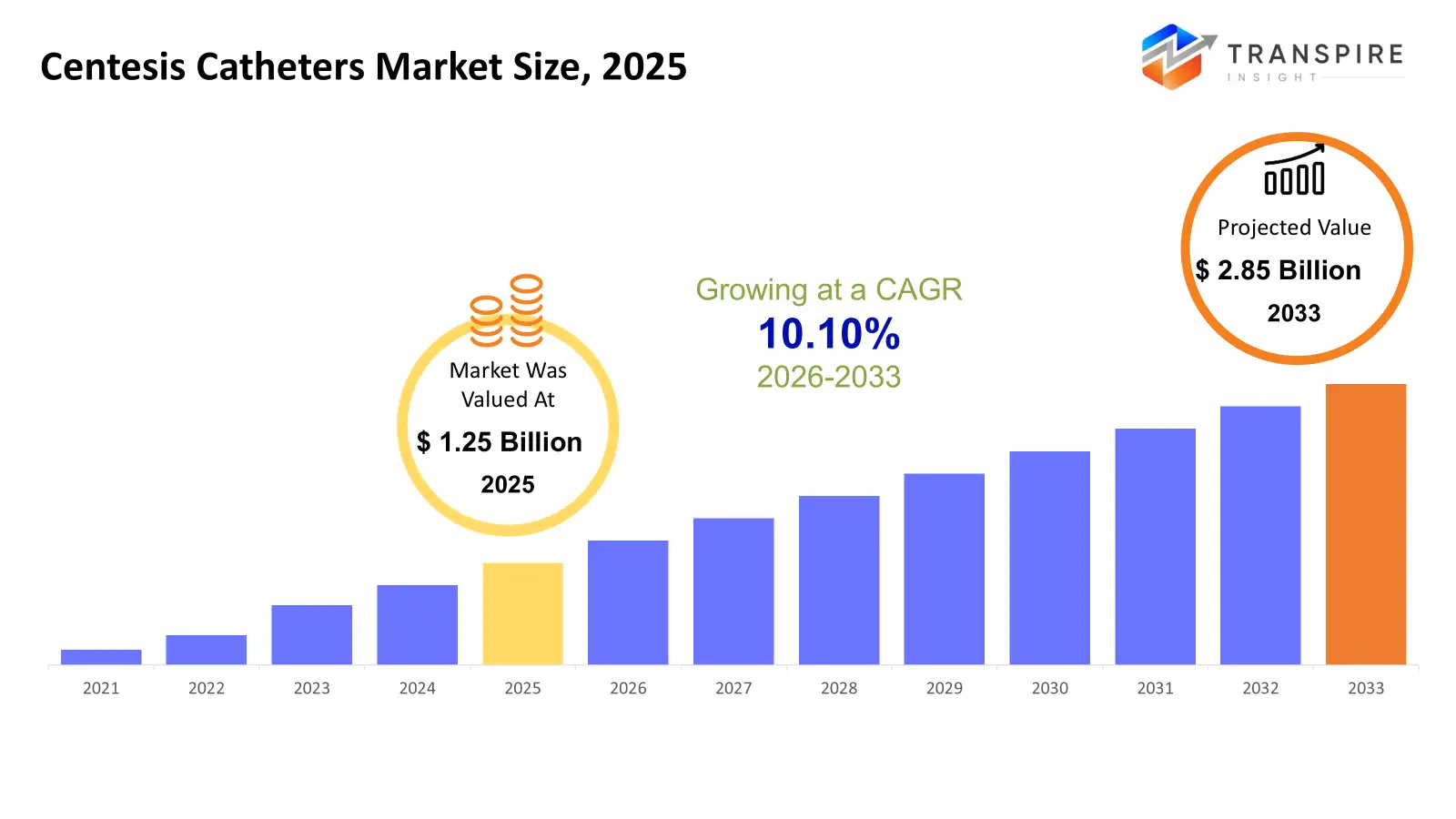
According to a research report published by Transpire Insight, the global centesis catheters market size is projected to grow from USD 534.64 billion in 2026 to USD 1211 billion by 2035, at a CAGR of 12.10% during the forecast period 2027-2035. The global centesis catheters market is primarily driven by the surging prevalence of target chronic conditions like liver cirrhosis, target cancers, and heart failure, which trigger recurrent fluid accumulation. Additionally, a strong clinical preference for ultrasound-guided, minimally invasive diagnostic and therapeutic drainage procedures significantly boosts product adoption.
Introduction
The centesis catheters market comprises specialized medical devices designed to safely remove abnormal fluid accumulations from a patient's body cavities, such as the pleural space or peritoneal cavity. These devices play an essential role in providing rapid therapeutic relief and critical diagnostic sampling for individuals suffering from conditions like ascites or pleural effusion. As healthcare delivery shifts toward ambulatory surgical centers and outpatient settings, the demand for ergonomic, kink-resistant, and small-bore catheters continues to expand, establishing these fluid-management systems as vital tools within critical care and interventional oncology workflows.
Recent Developments News
January 2026: Leading interventional oncology manufacturers introduced next-generation, echo-enhanced needle profiles for small-bore centesis kits. These systems improve real-time visibility under ultrasound guidance, allowing clinicians to perform bedside fluid drainage with significantly lower tissue trauma and a minimized risk of accidental organ puncture.
May 2026: Market leaders expanded the commercial availability of fully automated, closed-loop vacuum-assisted centesis drainage kits. This advancement addresses strict clinical sterility standards by optimizing high-volume fluid removal and minimizing handling contamination in busy intensive care units and tertiary liver clinics.
Stay Ahead of Emerging Opportunities with Expert Market Insights by Transpire Insight
Transpire Insight provides comprehensive, data-driven market intelligence to support smarter business decisions. Our research is rooted in comprehensive analysis, authoritative predictions, and industry expertise, enabling organizations to make informed decisions in rapidly evolving markets. In-depth analysis of market segmentation, competitive positioning, regional trends, and emerging investment opportunities in high-growth areas. We blend accuracy with actionable intelligence, empowering companies to uncover new avenues for growth, bolster strategic decision-making, and stay ahead in a dynamic global market.
Download the exclusive Centesis Catheters Market sample report today to uncover expert insights, emerging trends, and the opportunities defining the future of the industry.
Centesis Catheters Market Size & Statistics
Regional Growth and Demand Analysis by Transpire Insight:
North America is expected to dominate throughout the forecast period in the Centesis Catheters Market. North America leads regional contribution to market revenue with approximately 40% share, making it the largest regional market. North America dominated the market with a share of USD 540 million in 2024. The dominant position of North America in the Centesis Catheters Market is owing to its advanced healthcare infrastructure, high procedure volumes, and strong reimbursement mechanisms. The United States continues to dominate as the single biggest contributor due to high incidence rates of chronic liver diseases and oncology-related effusions, as well as access to advanced imaging and preferences from its physicians for safety-engineered centesis catheters. North America leads with high procedure penetration, strong ultrasound-guided practice adoption, and a preference for all-in-one kits, with health systems emphasizing staff training, needle-safety compliance, and supply assurance to support bedside care pathways. As of 2025, major companies in the centesis catheters market are increasingly focused on developing advanced solutions such as fluid drainage devices to enable continuous monitoring and effective management of fluid output, with January 2024 seeing Laborie Medical Technologies Inc. introduce the RenovaRP Centesis System, a next-generation fluid drainage device designed to be minimally invasive and improve patient comfort and recovery times.
Asia-Pacific is anticipated to generate the highest growth rate during the forecast period in the Centesis Catheters Market. The Asia-Pacific market is estimated to grow at the highest CAGR during the forecast period, driven by the presence of a large patient pool, increasing incidence and prevalence of target diseases, improving healthcare infrastructure in Asian countries, and favorable government initiatives for improving access to healthcare. Asia-Pacific represents the fastest-growing geography due to the expansion of healthcare infrastructure, the progress of health awareness regarding the need for interventions, and the burgeoning incidence of chronic diseases in large population bases of China and India. Asia-Pacific currently holds approximately 20% of global market revenue and is the fastest-growing region. In 2025, the Asia-Pacific region shows the fastest growth driven by expanding critical-care capacity and broadened access to point-of-care ultrasound (POCUS), with government-led healthcare reforms, increased public-private partnerships, and rising health insurance coverage further accelerating the adoption of centesis catheters across underserved regions.
Top 15 Trends in the Centesis Catheters Market
Proceed to Checkout to purchase the exclusive Centesis Catheters Market report and gain instant access to in-depth market intelligence, strategic analysis, and future growth opportunities.
Minimally invasive approaches reduce patient trauma, recovery time, and hospital stays, making centesis catheters increasingly preferred in modern healthcare systems worldwide.
Ultrasound and CT-guided procedures improve accuracy and safety, reducing complications during fluid drainage and driving adoption of advanced centesis catheter systems.
Hospitals increasingly prefer single-use catheters to prevent cross-contamination, reduce infection risks, and improve overall procedural hygiene and patient safety standards.
Cancer patients often develop pleural effusions or ascites, increasing demand for centesis catheters used in palliative and supportive oncology care settings.
Modern catheter designs include antimicrobial coatings and secure locking mechanisms, significantly lowering infection rates and improving procedural outcomes in clinical practice.
Healthcare systems are shifting toward outpatient settings, where centesis procedures can be performed efficiently, reducing hospital burden and lowering treatment costs overall.
Top 25 Companies Leading the Centesis Catheters Market
Customize the exclusive Centesis Catheters Market report today to receive tailored insights, country-specific analysis, and business-focused market intelligence.
Leading Centesis Catheters Companies to Watch Globally
Founded: 1988 | HQ: New York, USA.
Why It Ranks: Strong focus on vascular and oncology catheter innovation.
Regional Dominance: Widely used across North American hospital systems.
Product Line: Drainage catheters, vascular access, oncology devices.
Known for reliable critical care and surgical access technologies.
Founded: 1943 | HQ: Pennsylvania, USA.
Why It Ranks: Broad global presence in catheter-based medical devices.
Regional Dominance: Strong penetration in US and European hospitals.
Product Line: Central venous catheters, drainage systems, airway products.
Focuses on single-use interventional products for better safety.
Founded: 1987 | HQ: Utah, USA.
Why It Ranks: Leading player in interventional disposable devices.
Regional Dominance: Strong US base with growing Asia adoption.
Product Line: Centesis kits, drainage catheters, embolotherapy tools.
One of the oldest and most diversified medical device companies.
Founded: 1897 | HQ: New Jersey, USA.
Why It Ranks: Global leader in medical technology and diagnostics.
Regional Dominance: Extensive worldwide hospital and lab presence.
Product Line: Injection systems, vascular access, safety catheters.
Family-owned company known for innovation in interventional medicine.
Founded: 1963 | HQ: Indiana, USA
Why It Ranks: Pioneer in minimally invasive interventional procedures
Regional Dominance: Strong adoption in US and European hospitals
Product Line: Drainage systems, stents, interventional radiology tools
Invests heavily in advanced surgical and therapeutic device innovation.
Founded: 1949 | HQ: Dublin, Ireland.
Why It Ranks: Largest global medical technology company by reach.
Regional Dominance: Strong footprint across all major healthcare markets.
Product Line: Cardiovascular catheters, surgical, and drainage systems.
Emerged from a spinoff focused on patient-centric therapeutic devices.
Founded: 2018 | HQ: Georgia, USA.
Why It Ranks: Specialized focus on chronic care and pain management.
Regional Dominance: Strong presence in North American hospital networks.
Product Line: Feeding tubes, pain solutions, drainage catheters.
Plays a key role in the hospital supply chain and logistics support.
Founded: 1971 | HQ: Ohio, USA.
Why It Ranks: Major distributor and manufacturer of medical supplies.
Regional Dominance: Strong US healthcare supply chain leadership.
Product Line: Surgical consumables, catheters, and procedural kits.
Family-owned German firm with long-standing medical engineering expertise.
Founded: 1839 | HQ: Melsungen, Germany.
Why It Ranks: Strong European leader in infusion and hospital systems.
Regional Dominance: Europe and expanding presence in Asia-Pacific.
Product Line: Infusion therapy, surgical instruments, drainage systems.
Continuously develops high-end solutions for complex medical procedures.
Founded: 1949 | HQ: Dublin, Ireland.
Why It Ranks: Deep R&D strength in interventional medical technologies.
Regional Dominance: Global distribution across advanced healthcare markets.
Product Line: Cardiac catheters, drainage systems, neurosurgical devices.
Schedule a meeting with our market experts to discuss the exclusive Centesis Catheters Market report and identify the best research solution for your organization.
Conclusion
The centesis catheters market is moving toward clinical workflows focused on patient safety, operational efficiency, and reduced infection risks. Driven by a rising global burden of chronic liver and respiratory diseases, manufacturers are successfully introducing advanced closed-loop and image-guided drainage systems. While North America continues to leverage its strong network of established medical device innovators, the Asia-Pacific region represents a massive volume opportunity due to widespread hospital modernization. Ultimately, ongoing technological breakthroughs in catheter materials and specialized outpatient kits will remain central to shaping the future of fluid drainage interventions.


Send us a brief description of your challenge and we'll get back to you within 24 hours.

 inquiry@transpireinsight.com
 APAC:+91 7666513636
 Address


