
Jul 02, 2026
By Transpire Insight

Description
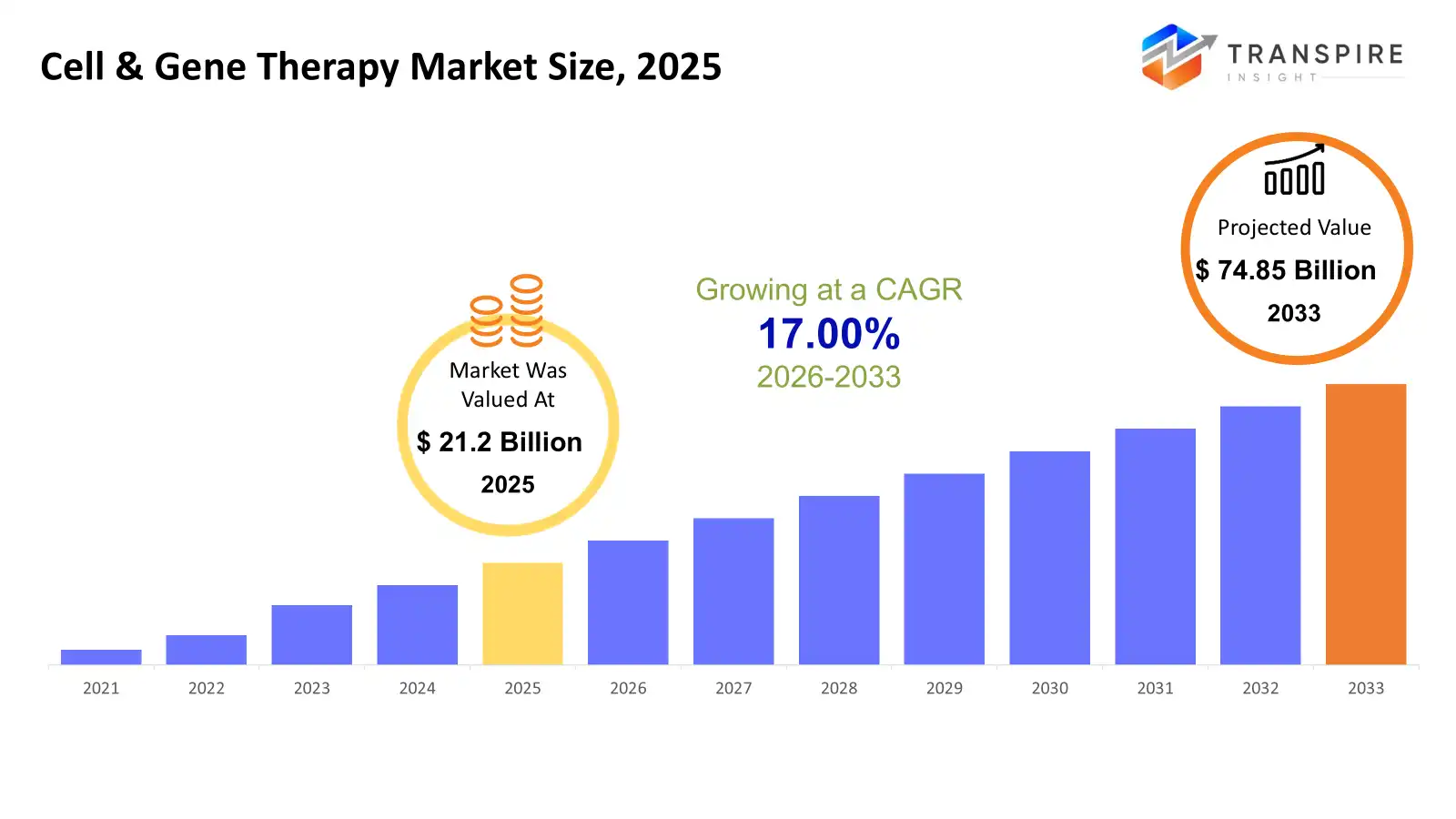
According to a research report published by Transpire Insight, the global cell & gene therapy market size is projected to grow from USD 26 billion in 2026 to USD 80.1 billion by 2035, at a CAGR of 20% during the forecast period 2026-2035. Innovations in genomic science, including the use of CRISPR gene editing and new viral vector systems, have significantly improved the precision and safety of therapies, leading to faster clinical success. In addition, increasing dedicated resources and facilities, such as cancer treatment facilities, and a dramatic increase in public-private financing are driving rapid commercialization and clinical uptake.
Introduction
Cell & Gene Therapy (CGT) is a paradigm shift in the healthcare industry, moving beyond the classification of disease management towards highly targeted and curative treatments, and is a global market. As advanced therapeutics become commercially available, the market includes genetically modified cell therapies (such as CAR-T), stem cell therapies, and in vivo gene therapies. These modalities treat the root of the biological processes instead of addressing symptoms. Supported by growing clinical pipelines, strong investor interest, and a changing regulatory landscape, this area is reshaping the healthcare landscape worldwide in oncology, rare disease, and chronic genetic diseases.
Recent Development News
February 2026: Sarepta Therapeutics, in partnership with Chugai Pharmaceutical, announced the official commercial launch of Elevidys (delandistrogene moxeparvovec) in Japan. Marking a major milestone for international patient access, this is the first-ever gene therapy approved in Japan for ambulatory patients with Duchenne muscular dystrophy (DMD) between the ages of 3 and 8 who meet specific exon deletion criteria.
February 2026: FDA Launches "Plausible Mechanism Framework" to Accelerate Gene Therapies for Ultra-Rare Diseases WASHINGTON, D.C. The U.S. Food and Drug Administration (FDA) officially released a groundbreaking draft guidance establishing the Plausible Mechanism Framework. This new regulatory structure is designed specifically to speed up the development and approval of individualized RNA-based and genome-editing therapies targeting ultra-rare genetic disorders.
Stay Ahead of Emerging Opportunities with Expert Market Insights by Transpire Insight
Transpire Insight provides comprehensive and data-driven market intelligence that can help with smarter business decisions. Our research is rooted in comprehensive analysis, authoritative predictions, and industry knowledge, enabling organizations to make informed decisions in fast-evolving markets. In-depth analysis of market segmentation, competitive positioning, regional trends, and emerging investment opportunities in high-growth areas. We blend accuracy with actionable intelligence, empowering companies to uncover new avenues for growth, bolster strategic decision-making, and stay ahead in a dynamic global market.
Download the exclusive Cell & Gene Therapy Market today to uncover expert insights, emerging trends, and the opportunities defining the future of the industry.
Cell & Gene Therapy Market Size & Statistics
Regional Growth and Demand Analysis
North America is expected to grow the fastest during the forecast period in the cell & gene therapy market. The dominant player in the cell & gene therapy market is North America, owing to the availability of leading players in terms of biotechnology companies, advanced healthcare infrastructure, and robust investment in medical research. The United States is currently the biggest producer in the Cell & Gene Therapy Market, considering factors such as the presence of extensive commercial manufacturing operations, efforts toward personalizing medicine, and continued advancement in genetic engineering. As of 2026, some of the biopharmaceutical companies in the United States have undertaken production activities aimed at manufacturing superior advanced therapies that would enhance next-generation oncology and rare disease patient care.
Asia-Pacific is anticipated to generate the highest demand during the forecast period in the cell & gene therapy market. It is expected that the Asia-Pacific region will witness a massive surge in growth rate during the forecast period due to increasing demand for advanced therapeutics, growing healthcare infrastructure, increased healthcare purchasing programs, and significant investment in biotechnology. China, India, Japan, and South Korea are some of the rapidly growing nations regarding biomanufacturing activities that drive the demand for advanced gene and cell technologies. In 2026, there will be an increase in clinical trial modernization programs by many biotechnology firms in China and India. This was done with the aim of ensuring scalable, localized, and affordable advanced therapeutic systems.
Top 15 Trends in the Cell & Gene Therapy Market
Download the exclusive Cell & Gene Therapy Market today to uncover expert insights, emerging trends, and the opportunities defining the future of the industry.
Precision treatments are being designed with individual genetic profiles, improving the precision, efficiency, and long-term outcomes for people with complex genetic and chronic diseases.
The genetic engineering tools are allowing for more and more exact DNA modifications, which could be used to cure inherited diseases by fixing the source of faulty genes with greater accuracy and safety.
Engineered immune cells are becoming a more popular way to target and kill cancer in blood cancers and are now beginning to be developed for solid tumors.
Improved viral vectors are making it more efficient and safe to deliver therapeutic genes into patient cells, in order to produce long-lasting effects.
Advances in production techniques aid efforts to upscale cell and gene therapies, mitigate bottlenecks, produce more uniform products, and facilitate greater commercial availability of advanced therapies.
There is a growing interest in rare genetic disorders that are the target of new therapies that would be helpful for diseases that have few, if any, current treatment options.
Top 25 Companies Leading the Cell & Gene Therapy Market
Download the exclusive Cell & Gene Therapy Market today to uncover expert insights, emerging trends, and the opportunities defining the future of the industry.
Leading Cell & Gene Therapy Companies
The top 10 companies dominating the cell & gene therapy market.
A Swiss pharmaceutical company that is a leader in the field of gene therapies and cutting-edge oncological treatments.
Founded: 1996 | HQ: Basel, Switzerland.
Why It Ranks: First to receive FDA approval for a commercial CAR-T cell therapy.
Regional Dominance: Strong commercial reach spanning across North America, Europe, and the Asia-Pacific markets.
Product Line: Features revolutionary products like Kymriah for leukemia and Zolgensma for spinal atrophy.
A strategic commercial scaler in the field of cell-based oncology treatments in a large biopharmaceutical industry.
Founded: 1987 | HQ: Foster City, California, USA.
Why It Ranks: Makes huge multi-billion dollar revenues annually in the top market in oncology cell therapies.
Regional Dominance: Primarily commands the highly profitable healthcare markets across the United States.
Product Line: Commercialized blockbuster cell treatments led by Yescarta and Tecartus for lymphomas.
A global medicine innovator with a multi-product clinical immunotherapy pipeline, consistently seeking to tackle the disease.
Founded: 1887 | HQ: Princeton, New Jersey, USA.
Why It Ranks: Has a diversified portfolio with multiple approved next-generation CAR-T therapeutic platforms.
Regional Dominance: Maintains high commercial penetration across North American and European specialized oncology centers.
Product Line: Markets commercial cell lines Breyanzi and Abecma targeting severe hematologic malignancies.
A dedicated biotechnology company that specializes exclusively in the treatment of severe genetic disorders and rare diseases.
Founded: 1992 | HQ: Somerville, Massachusetts, USA.
Why It Ranks: Pioneered the deployment of lentiviral vector systems for complex ex vivo gene editing.
Regional Dominance: Holds highly specialized treatment access networks concentrated primarily across North America.
Product Line: Delivers transformative gene therapies, including Zynteglo for beta-thalassemia and Skysona for CALD.
An independent operating subsidiary of Gilead dedicated solely to engineering immune cell therapies.
Founded: 2009 | HQ: Santa Monica, California, USA.
Why It Ranks: It sets the benchmark for global standards for industrial-scale autologous cell therapy manufacturing and quick turnaround.
Regional Dominance: Controls advanced manufacturing facilities servicing patients globally from the United States.
Product Line: Focuses exclusively on chimeric antigen receptor and T-cell receptor cancer therapies.
A clinical-stage biotechnology pioneer specializing in genomic editing and genomic medicines.
Founded: 1995 | HQ: Richmond, California, USA.
Why It Ranks: Recognized globally for inventing zinc finger cluster technologies for therapeutic gene regulation.
Regional Dominance: Operates key collaborative development hubs situated across America and Western Europe.
Product Line: Developing pipeline candidates for hemophilia, Fabry disease, and neurological genetic conditions.
An RNA therapeutics leader in the field of messenger RNA in genetic diseases and cancer.
Founded: 2010 | HQ: Cambridge, Massachusetts, USA.
Why It Ranks: Tuned the stage for the revolution of medicine by delivering the proof of scalable clinical success of lipid nanoparticle mRNA delivery.
Regional Dominance: Commands an expansive global footprint with extensive supply chains across major continents.
Product Line: Expanding pipelines into personalized cancer vaccines and specialized intra-tumoral immuno-oncology therapies.
A genome editing company focused on translating CRISPR technology into transformative medicines.
Founded: 2013 | HQ: Cambridge, Massachusetts, USA.
Why It Ranks: Owns basic intellectual property patents of CRISPR-Cas9 and CRISPR-Cas12a editing platforms.
Regional Dominance: Maintains the lion's share of its clinical research and early commercialization in North America.
Product Line: Advancing cell-based medicines for sickle cell disease and transfusion-dependent beta-thalassemia.
An early-stage biopharmaceutical company developing gene-edited allogeneic CAR-T immunotherapies.
Founded: 1999 | HQ: Paris, France.
Why It Ranks: First to introduce off-the-shelf, universal cell therapy products using the pioneering TALEN gene-editing technology.
Regional Dominance: Bridges European research innovation with extensive clinical trial operations inside North America.
Product Line: Pipeline features UCART candidates targeting acute myeloid leukemia and multiple myeloma indications.
A global leader specializing in hematopoietic stem cell gene therapies for rare diseases.
Founded: 2015 | HQ: London, United Kingdom.
Why It Ranks: Successfully developed and commercialized the first-ever gene therapy for metachromatic leukodystrophy.
Regional Dominance: Exerts strong regulatory and commercial leadership across European and United States markets.
Product Line: Features Libmeldy alongside a deep pipeline for severe inherited metabolic diseases.
Download the exclusive Cell & Gene Therapy Market today to uncover expert insights, emerging trends, and the opportunities defining the future of the industry.
Conclusion
The cell & gene therapy sector has now gone from an experimental science to a highly commercialized therapeutic ecosystem with a multi-billion-dollar market value. The industry's future is assured by ongoing automation advances in bioprocessing and flexible pricing models, even as initial expenses and supply chain challenges persist. In the future, strategic partnerships between biopharma industry leaders and the regulatory agencies around the world will play a crucial role. In conclusion, these cutting-edge treatments have the potential to revolutionize healthcare outcomes and personalized treatment approaches worldwide.


Send us a brief description of your challenge and we'll get back to you within 24 hours.

 inquiry@transpireinsight.com
 APAC:+91 7666513636
 Address


