
Jun 27, 2026
By Transpire Insight
Description
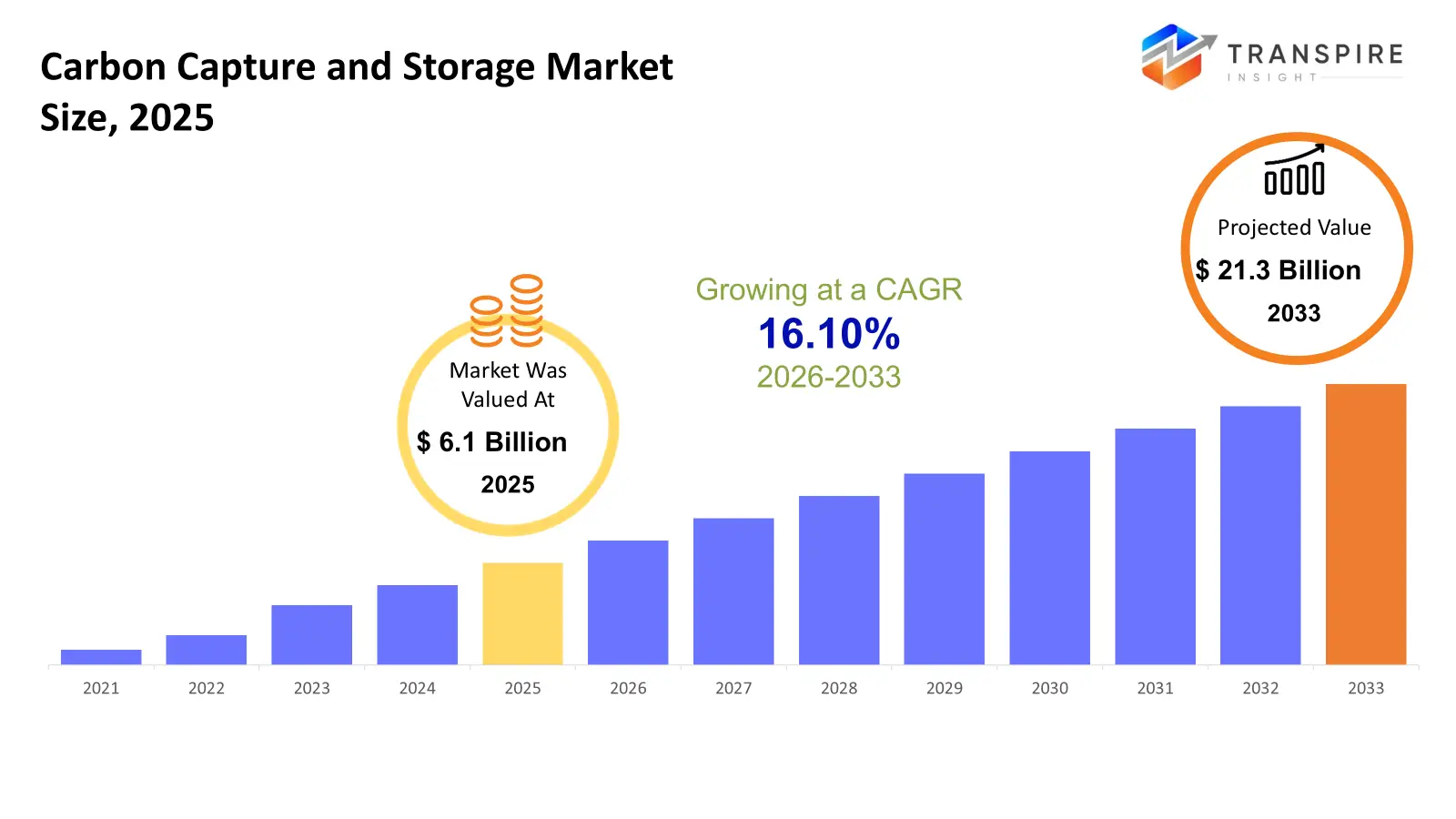
According to a research report published by Transpire Insight, the global carbon capture and storage market size is projected to grow from USD 7.8 billion in 2026 to USD 23.3 billion by 2035, at a CAGR of 18.10% during the forecast period 2026-2035. The market is a growing one, as major industries in the carbon-intensive sector seek to decarbonize operations by investing in advanced carbon capture technology, with aggressive global net-zero targets and stringent carbon emission penalties providing the impetus.
Introduction
The global Carbon Capture and Storage (CCS) market is an important part of the environmental technology industry, which involves capturing and transporting CO₂ emissions from power generation and industrial processes for permanent storage. The market is worth billions of dollars and is important in reducing the risks of greenhouse gases.
Recent Development News:
February 2026: The European Union sets up the first-ever legally binding voluntary carbon removal certification system. The methodology sets clear rules for Direct Air Capture with Carbon Storage (DACCS) and BioCCS, addressing existing regulatory uncertainty and giving immediate legal clarity to open up significant private investment opportunities in Europe.
February 2026: During the Union Budget address in February 2026, the Indian government announced a major step with a dedicated amount of $2.4 billion (₹20,000 crore) for the fast advancement of Carbon Capture, Utilization, and Storage (CCUS) infrastructure. The huge investment is for commercial-scale installations, and is intended to massively decarbonise the country's most polluting industries, including steel, cement, and chemicals.
Stay Ahead of Emerging Opportunities with Expert Market Insights by Transpire Insight
Transpire Insight provides comprehensive and data-driven market intelligence that can help with smarter business decisions. Our research is rooted in comprehensive analysis, authoritative predictions, and industry knowledge, enabling organizations to make informed decisions in fast-evolving markets. In-depth analysis of market segmentation, competitive positioning, regional trends, and emerging investment opportunities in high-growth areas. We blend accuracy with actionable intelligence, empowering companies to uncover new avenues for growth, bolster strategic decision-making, and stay ahead in a dynamic global market.
Download the exclusive Carbon Capture and Storage Market today to uncover expert insights, emerging trends, and the opportunities defining the future of the industry.
Carbon Capture and Storage Market Size & Statistics
Regional Growth and Demand Analysis by Transpire Insight
North America is expected to dominate the market share during the forecast period in the Carbon Capture and Storage market. North America has the largest market share in Carbon Capture and Storage (CCS) because of strong regulatory support, substantial infrastructure development for EOR, and huge public funding. In the United States, opportunities for the development of federal CCS tax credits, large-scale Department of Energy funding grants, and active carbon-pipeline development make the U.S. the largest producer in the Carbon Capture and Storage market. Among the leading energy and engineering companies in the USA, some large project activities have been launched that aim to build high-capacity hub structures for next-generation industrial facilities.
Asia-Pacific is anticipated to witness the highest growth rate during the forecast period in the Carbon Capture and Storage market. The Asia-Pacific region is expected to witness fast growth, driven by the rising rate of industrialization, increased dependency on fossil fuels, and newly emerging National climate pledges. Some of the fastest-growing countries in terms of commercial manufacturing and power generation activities are in China, India, Japan, and South Korea, and these are the countries where the demand for advanced carbon abatement technologies is seeing rapid growth. In China and India, there has been a rise in larger-scale pilot and feasibility projects by state-owned enterprises. This was to ensure integration of energy-efficient post-combustion capture technology in high-polluting steel, cement, and coal power generation units.
Top 15 Trends in the Carbon Capture and Storage Market
Download the exclusive Carbon Capture and Storage Market today to uncover expert insights, emerging trends, and the opportunities defining the future of the industry.
Faster uptake of CCS systems in industries like power generation, chemical, and cement. Large-scale installations are taking place in high-emission industrial facilities around the world, with emission regulations and the push towards decarbonization as the motivation.
Depleted oil fields and saline aquifer offshore storage sites are becoming more significant. These sites have reduced land constraints, enhanced ability to store CO2, and secure, long-term containment.
Governments are implementing carbon pricing, tax credits, and subsidies. The financial premiums are helping to generate economic profitability and extending the reach of CCS projects from developed to emerging economies.
The use of CCS is crucial to the production of blue hydrogen, as it captures emissions from natural gas reforming. The integration enables more environmentally friendly hydrogen fuel production and enhances the global efforts towards a low-carbon energy transition.
The direct air capture systems are being developed to efficiently extract CO2 directly from the air. Technology advancements are decreasing energy usage and making large-scale deployment possible for negative emissions targets.
Investments in CCS are large by energy companies and industrial conglomerates. The commercialization, development, and innovation of large-scale carbon capture solutions are moving quickly with the support of venture capital and strategic partnerships.
Top 25 Companies Leading the Carbon Capture and Storage Market
Download the exclusive Carbon Capture and Storage Market today to uncover expert insights, emerging trends, and the opportunities defining the future of the industry.
Shell actively develops large-scale carbon capture infrastructure to achieve absolute net-zero emissions.
Founded: 1907 | HQ: London, United Kingdom.
Why It Ranks: It leads through multi-million-ton megaprojects like the Northern Lights storage network.
Regional Dominance: Dominates the European North Sea corridor and is expanding heavily across North America.
Product Line: Focuses on CANSOLV amine technologies for high-efficiency post-combustion industrial carbon capture.
ExxonMobil captures more human-made carbon dioxide globally than any other operating enterprise.
Founded: 1999 | HQ: Spring, Texas, USA.
Why It Ranks: Possesses unparalleled subterranean geological knowledge and massive deep-well carbon storage capacity.
Regional Dominance: Holds absolute market dominance across the massive United States Gulf Coast region.
Product Line: Offers commercial-scale deep geological injection, transport pipelines, and advanced point-source capture.
Chevron aggressively scales up massive carbon storage investments across global industrial hubs.
Founded: 1879 | HQ: San Ramon, California, USA.
Why It Ranks: Operates Gorgon, one of the world's largest integrated industrial carbon capture facilities.
Regional Dominance: Exercises major industrial influence over the Asia-Pacific region and Western Australia.
Product Line: Deploys large-scale deep reservoir injection, carbon engineering solutions, and pipeline transport.
Equinor pioneered the world's longest-running offshore carbon storage operations under the ocean.
Founded: 1972 | HQ: Stavanger, Norway
Why It Ranks: Holds decades of unmatched expertise in safely storing carbon beneath continental shelves.
Regional Dominance: Commands absolute leadership over Norway and the surrounding European North Sea.
Product Line: Specializes in offshore saline aquifer storage, cross-border transport, and industrial decarbonization.
TotalEnergies allocates significant capital toward multi-user carbon transport and storage infrastructure hubs.
Founded: 1924 | HQ: Courbevoie, France.
Why It Ranks: Integrates carbon abatement directly into massive international liquefied natural gas projects.
Regional Dominance: Strongly established across Western Europe while expanding operations into South America.
Product Line: Provides extensive hub storage solutions, post-combustion gas separation, and geological monitoring.
Aker Solutions engineers modular, compact carbon capture plants for diverse industrial applications.
Founded: 1841 | HQ: Fornebu, Norway.
Why It Ranks: Delivers proven Just Catch modular tech in major Nordic decarbonization initiatives.
Regional Dominance: Maintains strong technical dominance across Scandinavian and wider European industrial sectors.
Product Line: Offers turnkey amine-based capture systems, modular processing units, and offshore structures.
MHI supplies highly efficient, proprietary carbon capture technologies used worldwide across sectors.
Founded: 1884 | HQ: Tokyo, Japan.
Why It Ranks: Boasts the world’s largest market share for operational commercial flue-gas capture.
Regional Dominance: Holds dominant market presence across Asia-Pacific countries and North American utilities.
Product Line: Deploys Advanced KM CDR chemical solvent processes and commercial compact capture systems.
Siemens Energy integrates carbon capture directly into heavy power generation turbine systems.
Founded: 2020 | HQ: Munich, Germany.
Why It Ranks: Leverages massive global market presence in thermal power plant technology installations.
Regional Dominance: Commands a highly influential market share throughout Europe and Middle Eastern nations.
Product Line: Engineers advanced gas turbine integration, amine-based capture, and compression technology solutions.
Fluor provides world-class engineering and construction services for complex carbon capture facilities.
Founded: 1912 | HQ: Irving, Texas, USA.
Why It Ranks: Utilizes Econamine FG Plus technology for high-volume, cost-effective industrial carbon extraction.
Regional Dominance: Maintains a massive engineering footprint across major North American industrial complexes.
Product Line: Delivers full engineering-procurement-construction services, solvent systems, and clean energy designs.
Linde dominates carbon dioxide purification, compression, and global distribution logistics infrastructure.
Founded: 1879 | HQ: Woking, United Kingdom.
Why It Ranks: Possesses vast chemical processing experience handling gases safely at extreme scales.
Regional Dominance: Operates a truly ubiquitous, highly integrated industrial gas network across global markets.
Product Line: Manufactures cryogenic separation systems, high-pressure compressors, and carbon dioxide recycling units.
Download the exclusive Carbon Capture and Storage Market today to uncover expert insights, emerging trends, and the opportunities defining the future of the industry.
Conclusion
The global Carbon Capture and Storage (CCS) market is at a critical junction, moving from localized pilot projects to interwoven, gigaton-scale commercial systems, in a short period of time. Adhering to the requirement of regions and countries to decarbonize, the high cost of retrofit measures, such as North America's tax credits, combined with the growth and development of the hard-to-abate sectors of the Asia-Pacific industry, has made CCS an essential component of global decarbonization efforts. The market is expected to see strong growth, with infrastructure hubs continuing to expand and capture costs becoming more affordable, as it becomes a key component in the journey towards a net-zero future.


Send us a brief description of your challenge and we'll get back to you within 24 hours.

 inquiry@transpireinsight.com
 APAC:+91 7666513636
 Address


