
Jul 09, 2026
By Transpire Insight
Description
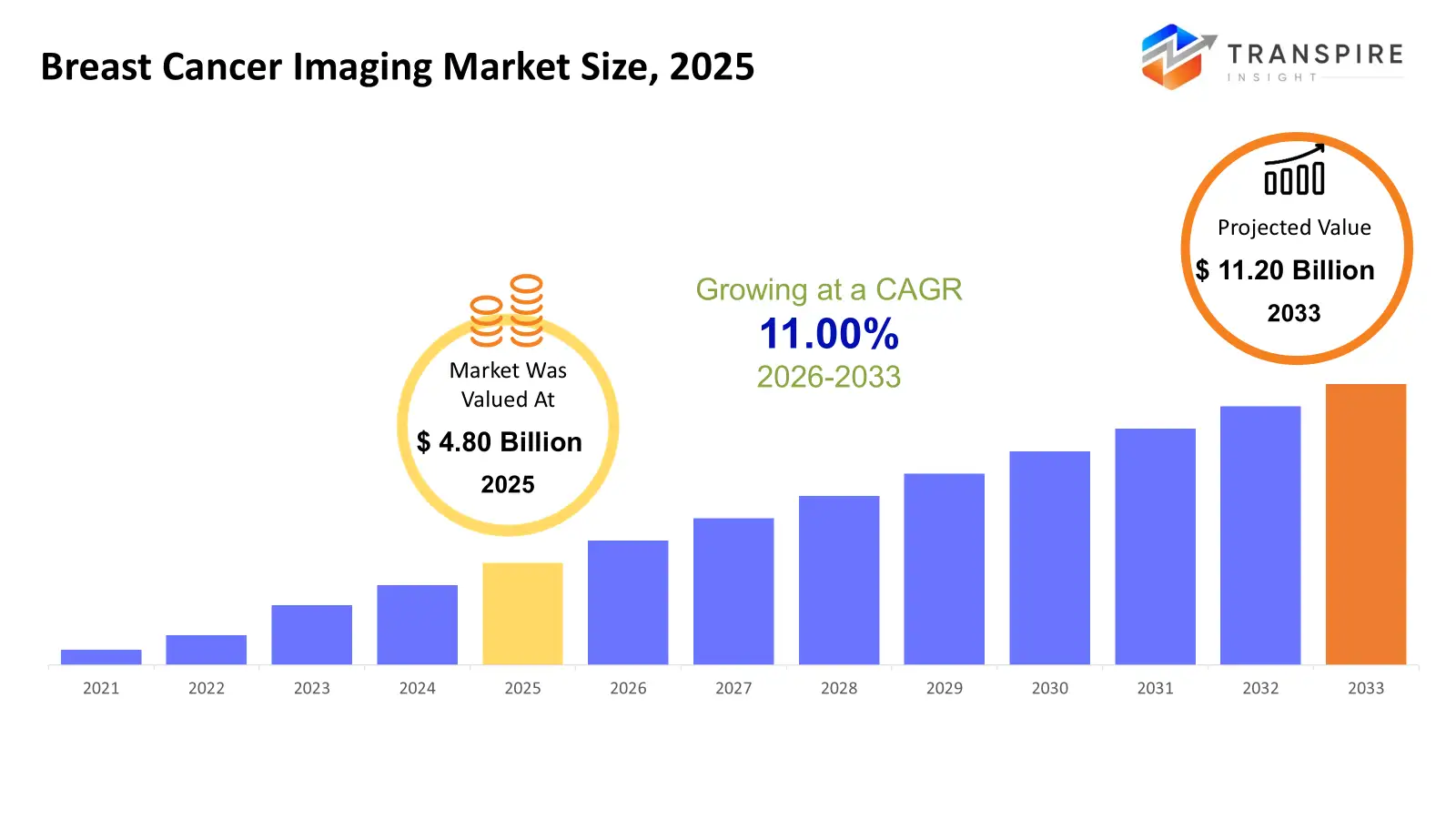
According to a research report published by Transpire Insight, the global breast cancer imaging market size is projected to grow from USD 7.73 billion in 2026 to USD 13.20 billion by 2035, at a CAGR of 12.20% during the forecast period 2026-2035. The major one is the rising rate of breast cancer worldwide. In addition, ongoing technological advancements, including 3D digital breast tomosynthesis and increasing screening programs, help drive market growth.
Introduction
Breast cancer imaging is playing a crucial role in women's healthcare as a first line of defense against the early detection of tumors and diagnostic monitoring. The need for precision imaging modalities has surged, spurred by a growing need to accommodate an aging world population and increased clinical awareness. Currently, the market is evolving from traditional 2D mammography to more advanced technologies such as automated whole breast ultrasound (ABUS), high-field breast MRI, and AI-powered diagnostic tools, which will decrease false-positive rates and streamline clinical workflows all over the world.
Recent Development News
February 2026: Industry reports revealed a severe, growing shortage of breast imaging specialists globally, with only four radiologists available per 100,000 women over forty. This structural deficit is rapidly accelerating clinical adoption of AI-automated workflows and whole-breast ultrasound devices to balance capacity.
June 2026: A prominent clinical review highlighted that AI-assisted mammography successfully detected 29% more breast cancers than conventional reader methods without increasing false-positive rates. Additionally, it optimized workflow efficiency by lowering radiologist reading times by approximately 40%.
Stay Ahead of Emerging Opportunities with Expert Market Insights by Transpire Insight
Transpire Insight provides comprehensive, data-driven market intelligence to support smarter business decisions. Our research is rooted in comprehensive analysis, authoritative predictions, and industry expertise, enabling organizations to make informed decisions in rapidly evolving markets. In-depth analysis of market segmentation, competitive positioning, regional trends, and emerging investment opportunities in high-growth areas. We blend accuracy with actionable intelligence, empowering companies to uncover new avenues for growth, bolster strategic decision-making, and stay ahead in a dynamic global market.
Download the exclusive Breast Cancer Imaging Market sample report today to uncover expert insights, emerging trends, and the opportunities defining the future of the industry.
Breast Cancer Imaging Market Size & Statistics
Regional Growth and Demand Analysis by Transpire Insight:
North America is expected to hold the largest market share during the forecast period in the global breast cancer imaging market. The dominant player in the Breast Cancer Imaging Market is North America, owing to the availability of leading players in terms of diagnostic imaging manufacturing companies, healthcare technology suppliers, and robust investment in medical oncology and research. The United States is currently the biggest producer in the Breast Cancer Imaging Market, considering factors such as the presence of extensive digital mammography manufacturing operations, efforts toward modernizing clinical diagnostic networks, and continued advancement in biomedical engineering. As of 2026, some of the healthcare technology companies in the United States have undertaken production activities aimed at manufacturing superior digital breast tomosynthesis (3D screening) systems that would enhance next-generation commercial hospital and diagnostic center networks.
Asia Pacific is anticipated to generate the highest growth rate during the forecast period in the global breast cancer imaging market. It is expected that the Asia-Pacific region will witness the highest growth rate during the forecast period due to increasing demand for early cancer screening, growing density of diagnostic labs, increased healthcare purchasing programs, and significant public-private investment in healthcare infrastructure. China, India, Japan, and South Korea are some of the rapidly growing nations regarding healthcare delivery activities that drive the demand for advanced cancer detection and screening technologies. In 2026, there will be an increase in facility modernization and screening programs by many healthcare companies and hospital systems in China and India. This was done with the aim of ensuring energy-efficient and highly precise automated breast imaging systems.
Top 15 Trends in theBreast Cancer Imaging Market
Proceed to Checkout to purchase the exclusive Breast Cancer Imaging Market report and gain instant access to in-depth market intelligence, strategic analysis, and future growth opportunities.
Widespread AI adoption is accelerating reading times in mammography, helping radiologists identify abnormalities faster while reducing false positives and unnecessary follow-ups for patients.
Three-dimensional digital breast tomosynthesis leads growth with a 12.38% CAGR through 2031, as it reduces overlapping tissue problems typical of traditional mammography, lowering false positives.
Evolving FDA Mammography Quality Standards Act regulations require dense-breast notifications, pushing providers toward supplemental imaging technologies for patients with dense breast tissue.
Non-ionizing technologies like MRI and ultrasound are seeing rising adoption due to radiation safety concerns, making them ideal for younger patients and frequent screenings.
Healthcare providers increasingly adopt personalized breast screening strategies based on age, genetics, and breast density, enhancing early cancer detection across diverse risk profiles.
Outpatient imaging centers scale rapidly as payers push care into lower-cost settings and patients seek convenience, even as hospitals remain the core delivery foundation.
Top 25 Companies Leading the Breast Cancer Imaging Market
Customize the exclusive Breast Cancer Imaging Market report today to receive tailored insights, country-specific analysis, and business-focused market intelligence.
Top 25 Companies Leading the Breast Cancer Imaging Market
1. Hologic, Inc.
Pioneered 3D mammography systems that drastically improve invasive cancer detection.
Founded: 1985 | HQ: Marlborough, Massachusetts, United States.
Why It Ranks: Holds the dominant market share globally in digital breast tomosynthesis technology.
Regional Dominance: Strongly commands the North American public and private diagnostic facility networks.
Product Line: Premium 3D Mammography systems, interventional breast biopsy, and specimen imaging.
2. GE HealthCare
Integrates advanced artificial intelligence solutions natively into modern breast ultrasound platforms.
Founded: 1994 | HQ: Chicago, Illinois, United States.
Why It Ranks: Offers an exceptionally diverse multimodal imaging portfolio across all clinical tiers.
Regional Dominance: Main market leader across major European and North American hospital systems.
Product Line: Contrast-enhanced mammography, breast ultrasound, automated whole-breast ultrasound, and diagnostic MRI.
3. Siemens Healthineers
Offers high-resolution wide-angle tomosynthesis systems for superior diagnostic clarity.
Founded: 1847 | HQ: Erlangen, Germany.
Why It Ranks: Renowned for engineering high-end, innovative hardware alongside advanced digital software.
Regional Dominance: Holds substantial market equity across European Union healthcare delivery networks.
Product Line: Digital mammography, high-field breast MRI scanners, and automated breast ultrasound solutions.
4. Koninklijke Philips N.V.
Focuses heavily on patient comfort during scans to lower screening anxiety.
Founded: 1891 | HQ: Amsterdam, Netherlands.
Why It Ranks: Unmatched integration capability with hospital enterprise imaging informatics and workflows.
Regional Dominance: Strong market presence spanning Western Europe and expanding into Latin American sectors.
Product Line: Advanced diagnostic ultrasound systems, dedicated breast coils, and enterprise informatics.
5. FUJIFILM Holdings Corporation
Utilizes proprietary flat-panel detectors for low-dose, high-definition diagnostic imaging.
Founded: 1934 | HQ: Tokyo, Japan.
Why It Ranks: Delivers exceptional digital mammography cost-efficiency without compromising sharp image resolution.
Regional Dominance: Captures an expansive footprint across major hospitals in Asia-Pacific territories.
Product Line: Amulet mammography series, portable ultrasound systems, and medical PACS software.
6. Canon Medical Systems Corporation
Delivers ultra-high-resolution dynamic microvascular imaging techniques for precise tumor vascularity.
Founded: 1930 | HQ: Otawara, Tochigi, Japan.
Why It Ranks: World leader in manufacturing highly precise, high-definition premium diagnostic ultrasound.
Regional Dominance: Deeply entrenched market share within Japanese and broader Asian clinical environments.
Product Line: Premium diagnostic ultrasound machines, CT scanners, and advanced clinical workstation software.
7. Konica Minolta, Inc.
Specializes in primary dynamic digital radiography tech visualizing tissue motion cleanly.
Founded: 1873 | HQ: Tokyo, Japan.
Why It Ranks: Excels at producing lightweight, reliable, high-resolution digital radiography solutions.
Regional Dominance: Maintains a highly resilient client base within rural community hospitals.
Product Line: Digital radiography retrofits, specialized ultrasound transducers, and healthcare IT systems.
8. Planmed Oy
Designs highly ergonomic mammography systems that specifically minimize patient physical discomfort.
Founded: 1989 | HQ: Helsinki, Finland.
Why It Ranks: Globally recognized for elegant, compact product designs fitting small screening spaces.
Regional Dominance: Enjoys consistent growth across Scandinavian and specialized European boutique clinics.
Product Line: Digital mammography units, breast tomosynthesis platforms, and orthopedic extremity scanners.
9. Delphinus Medical Technologies, Inc.
Developed SoftVue, a unique whole-breast ultrasound system for dense tissue.
Founded: 2009 | HQ: Novi, Michigan, United States.
Why It Ranks: Spearheads innovative, operator-independent dense breast screening using unique sound velocity.
Regional Dominance: Rapidly gaining clinical traction in specialized dense breast clinics nationwide.
Product Line: SoftVue automated whole-breast ultrasound systems and related clinical configuration accessories.
10. Aurora Imaging Technology, Inc.
Manufactures the only FDA-cleared dedicated 1.5T MRI system built for breasts.
Founded: 1993 | HQ: North Andover, Massachusetts, United States.
Why It Ranks: Purely specialized focus on dedicated high-resolution, bilateral 3D breast MRI.
Regional Dominance: Holds highly targeted deployment across specialized, elite breast oncology centers.
Product Line: Dedicated 1.5T Breast MRI systems, breast biopsy guidance, and CAD software.
Schedule a meeting with our market experts to discuss the exclusive Breast Cancer Imaging Market report and identify the best research solution for your organization.
Conclusion
Breast cancer imaging is undergoing a fundamental transformation, with rapid adoption of technology and the needs of the patient driving change. However, with the global healthcare environment placing greater emphasis on early diagnostic testing, industry leaders are effectively implementing intelligent software and automated modalities to help alleviate existing staffing challenges. The strengthening reimbursement initiatives and increased investments in dense tissue screening technologies will continue to support the growth of the market, which will give clinicians valuable tools needed to provide highly accurate, personalized, and efficient oncology treatment for the next few years.


Send us a brief description of your challenge and we'll get back to you within 24 hours.

 inquiry@transpireinsight.com
 APAC:+91 7666513636
 Address


