
Jul 13, 2026
By Transpire Insight
Description
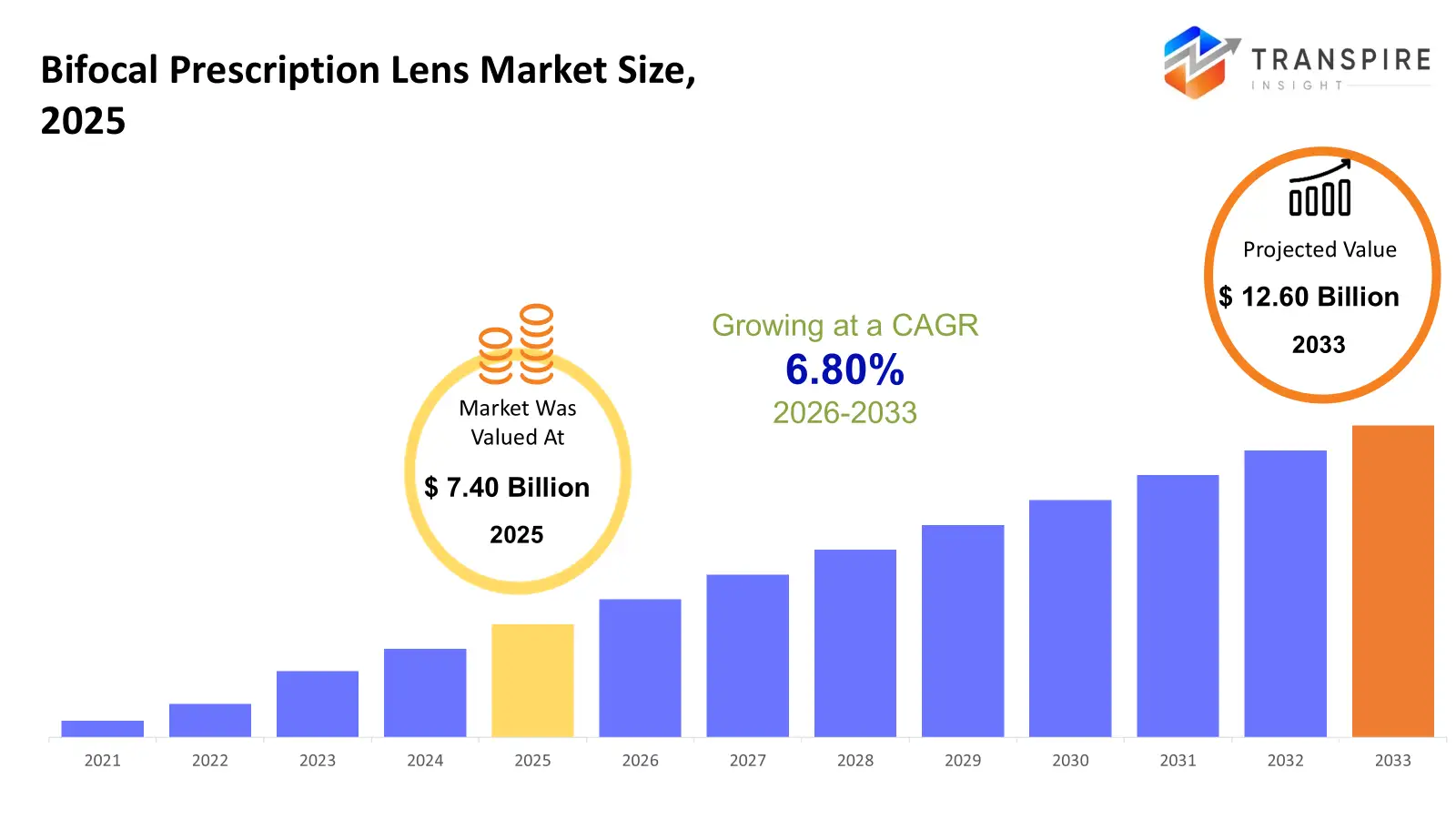
According to a research report published by Transpire Insight, the global bifocal prescription lens market size is projected to grow from USD 8.90 billion in 2026 to USD 15.60 billion by 2035, at a CAGR of 14.60% during the forecast period 2026-2035. The major factor driving the bifocal prescription lens market is the growing geriatric population, suffering from presbyopia in the global region. Moreover, with the surge in consumer demand for more budget-friendly and simple multifocal vision correction options compared to high-end progressives and more screen time exposure causing greater eye strain, there is continued solid market potential.
Introduction
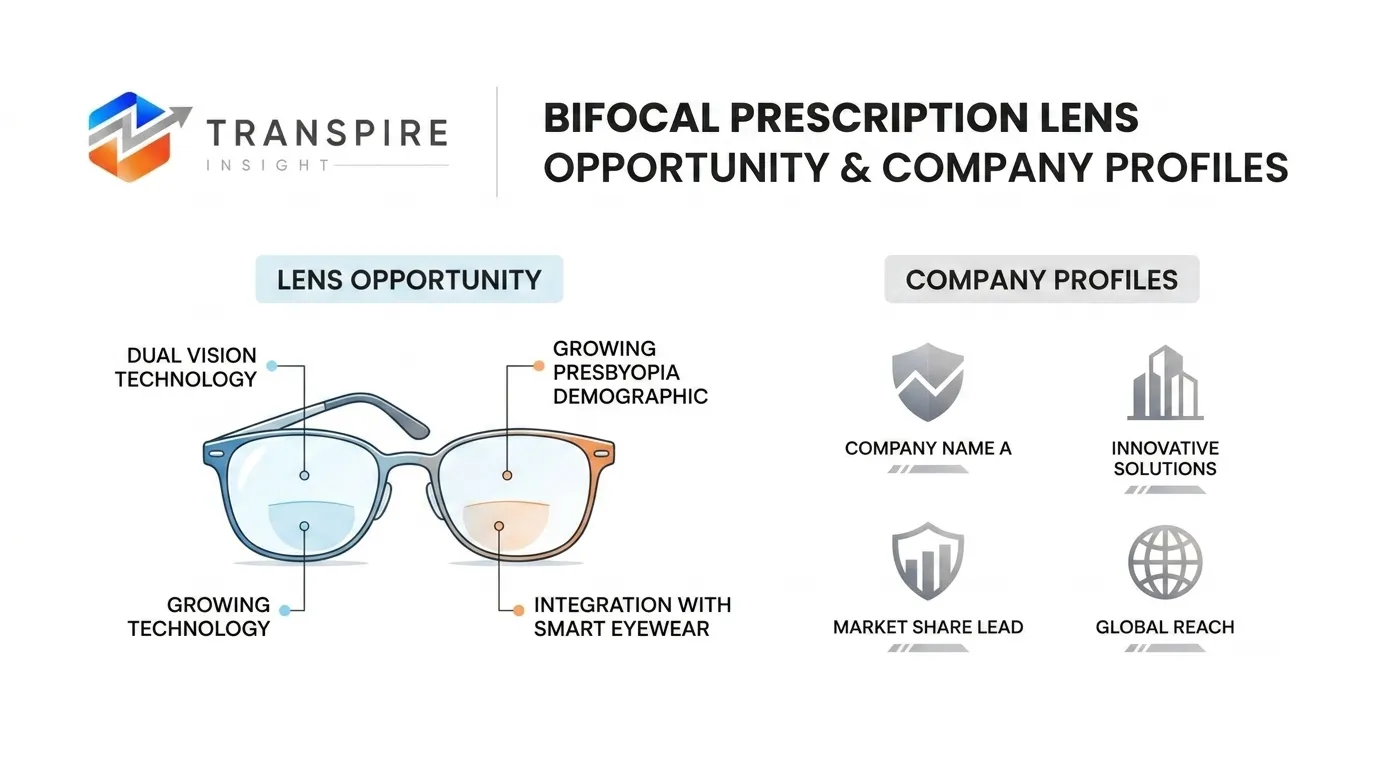
The global bifocal prescription lens market is resilient and is a key segment of the vision care market that offers a dual-focus correction solution for patients with both presbyopia and refractive errors. These lenses have unique near/distance viewing zones and are still popular for their affordability and minimal complexity. Although seamless progressive lenses fill the premium end of the market, the same innovations in material science that keep driving the modernization of progressive lenses, including lightweight polycarbonates and anti-reflective, blue-light-blocking coatings, keep making the lenses more and more relevant in both the traditional and consumer tech retail channels.
Recent Development News
Stay Ahead of Emerging Opportunities with Expert Market Insights by Transpire Insight
Transpire Insight provides comprehensive, data-driven market intelligence to support smarter business decisions. Our research is rooted in comprehensive analysis, authoritative predictions, and industry expertise, enabling organizations to make informed decisions in rapidly evolving markets. In-depth analysis of market segmentation, competitive positioning, regional trends, and emerging investment opportunities in high-growth areas. We blend accuracy with actionable intelligence, empowering companies to uncover new avenues for growth, bolster strategic decision-making, and stay ahead in a dynamic global market.
Download the exclusive Bifocal Prescription Lens Market sample report today to uncover expert insights, emerging trends, and the opportunities defining the future of the industry.
Bifocal Prescription Lens Market Size & Statistics
Regional Growth and Demand Analysis by Transpire Insight:
Regional Growth and Demand Analysis by Transpire Insight: Asia-Pacific is expected to grow the fastest during the forecast period in the Bifocal Prescription Lens market. The dominant player in the Bifocal Prescription Lens market is Asia-Pacific owing to the massive consumer base, presence of leading manufacturing infrastructure, expanding retail optical chains, and rising awareness regarding vision care. China and India are currently the largest consumer drivers in the Bifocal Prescription Lens market, considering factors such as extensive local lens fabrication operations, efforts toward modernizing managed vision care, and a rapidly expanding geriatric demographic. As of 2026, major optical hubs in this region have undertaken production activities aimed at manufacturing superior dual-focus correction systems that enhance affordability for next-generation commercial eyewear.
North America is anticipated to generate highly stable demand during the forecast period in the Bifocal Prescription Lens market, commanding a prominent 26.3% global revenue share. It is expected that the North American region will witness sustained value growth during the forecast period due to a highly established optometry ecosystem, rising prevalence of age-related presbyopia, and significant investment in specialized lens coating technologies. The United States and Canada are rapidly growing in terms of premium-tier customized lens activities that drive the demand for advanced ophthalmic engineering. In 2026, there will be an increase in retail modernization programs by many eyewear companies across the United States. This was done to ensure energy-efficient digital freeform surfacing and highly customized prescription systems.
Top 15 Trends in the Bifocal Prescription Lens Market
Proceed to Checkout to purchase the exclusive Bifocal Prescription Lens Market report and gain instant access to in-depth market intelligence, strategic analysis, and future growth opportunities.
Top 25 Companies Leading the Bifocal Prescription Lens Market
Customize the exclusive Bifocal Prescription Lens Market report today to receive tailored insights, country-specific analysis, and business-focused market intelligence.
Top 25 Companies Leading the Bifocal Prescription Lens Market
1. EssilorLuxottica SA
A vertically integrated French-Italian powerhouse controlling major global retail networks and premium lens brands.
Founded: 2018 | HQ: Charenton-le-Pont, France.
Why It Ranks: Holds unparalleled scale through strategic mergers and an expansive global retail network.
Regional Dominance: Exercises absolute market dominance across North American and European commercial channels.
Product Line: Offers highly diverse options spanning premium Varilux down to standard bifocals.
2. Carl Zeiss AG
A legendary German manufacturer world-renowned for absolute clarity and high-precision medical lens engineering.
Founded: 1846 | HQ: Oberkochen, Germany.
Why It Ranks: Leads through premier optical clarity algorithms and cutting-edge anti-reflective surface coatings.
Regional Dominance: Holds structural dominance across European clinical networks and advanced laboratories.
Product Line: Features high-grade glass, lightweight polycarbonates, and specialized clear-view multifocal designs.
3. HOYA Corporation
A dominant Japanese optical innovator specializing in advanced glass melting and impact-resistant substrate technologies.
Founded: 1941 | HQ: Tokyo, Japan.
Why It Ranks: Commands top positions via patented premium scratch-resistant substrate treatment technologies.
Regional Dominance: The main industrial stronghold spans major urban centers across the Asia-Pacific region.
Product Line: Specializes in impact-resistant materials, tailored flat-top segments, and digital freeform lenses.
4. Rodenstock GmbH
A premium German pioneer focusing on customized biometric parameters for individual vision correction needs.
Founded: 1877 | HQ: Munich, Germany.
Why It Ranks: Drives customer loyalty through individualized DNEye scanner technology system integration.
Regional Dominance: Maintains an exceptionally high market volume within German-speaking European territories.
Product Line: Supplies premium customized lenses that seamlessly adapt to individual wearer vision profiles.
5. Seiko Optical Products Co., Ltd.
An engineering trailblazer celebrated for developing exceptionally thin, lightweight, and high-index prescription lenses.
Founded: 1921 | HQ: Tokyo, Japan.
Why It Ranks: Highly regarded for introducing ultra-high-index materials that decrease overall lens thickness.
Regional Dominance: Enjoys robust commercial distribution pipelines across Asian and American retailers.
Product Line: Promotes highly durable, slimline bifocal styles alongside advanced multifocal solutions.
6. Shamir Optical Industry Ltd.
An Israeli leader recognized for advanced freeform design geometries that match natural human eye movements.
Founded: 1972 | HQ: Kibbutz Shamir, Israel.
Why It Ranks: Celebrated for translating complex eye movement mathematics into comfortable lens designs.
Regional Dominance: Captures strong niche segments within competitive global boutique optometry clinics.
Product Line: Delivers occupational-specific lenses, blended lines, and highly specialized outdoor bifocals.
7. Nikon Corporation
A Japanese consumer favorite leveraging legendary camera optics expertise to maximize contrast and light transmission.
Founded: 1917 | HQ: Tokyo, Japan.
Why It Ranks: Leverages photography lens innovation to create sharper contrast for prescription wearers.
Regional Dominance: Retains immense consumer brand equity across Japanese and North American markets.
Product Line: Produces high-transmittance double-focus options alongside high-definition single and multifocal lenses.
8. Tokai Optical Co., Ltd.
A dedicated Japanese manufacturer pushing optical boundaries with the world's thinnest plastic organic materials.
Founded: 1939 | HQ: Aichi, Japan.
Why It Ranks: Ranks highly by offering the world's absolute thinnest plastic lens index.
Regional Dominance: Maintains secure, independent optical retail alignments primarily across East Asian nations.
Product Line: Markets specialized wellness lenses, ultra-thin profiles, and specialized near-vision bifocals.
9. Vision Ease (Younger Optics)
A specialized American developer leading the functional polarized, photochromic, and safety prescription lens sectors.
Founded: 1930 | HQ: Torrance, California, USA.
Why It Ranks: Commands leadership within the functional polarized and photochromic prescription glass segments.
Regional Dominance: Possesses wide laboratory networks spanning both North and South American territories.
Product Line: Known for NuPolar lenses, polycarbonate segmented bifocals, and tough safety eyewear.
10. Fielmann Group AG
A major European omnichannel retail giant operating integrated manufacturing chains alongside extensive consumer brick-and-mortar storefronts.
Founded: 1972 | HQ: Hamburg, Germany. Anchors the direct consumer retail vertical.
Why It Ranks: Controls the supply chain from manufacturing straight to extensive brick-and-mortar storefronts.
Regional Dominance: Presides as the primary corporate optical provider across Central and Western Europe.
Product Line: Sells an array of budget-friendly consumer bifocals, house-brand frames, and contact packages.
Schedule a meeting with our market experts to discuss the exclusive Bifocal Prescription Lens Market report and identify the best research solution for your organization.
Conclusion
The global bifocal prescription lens market will remain a significant part of the ophthalmic market, providing comprehensive vision correction for the growing presbyopic population at an affordable price with reliability. Progressive technologies are the high-end segment, but bifocals still have a solid market share due to their high performance and adaptability to space. The segment is poised to sustain long-term economic growth, which is expected to be resilient, owing to ongoing innovation by the key players in North America and the infrastructure expansion in the Asia-Pacific region.


Send us a brief description of your challenge and we'll get back to you within 24 hours.

 inquiry@transpireinsight.com
 APAC:+91 7666513636
 Address


