
Jul 23, 2026
By Transpire Insight
Description
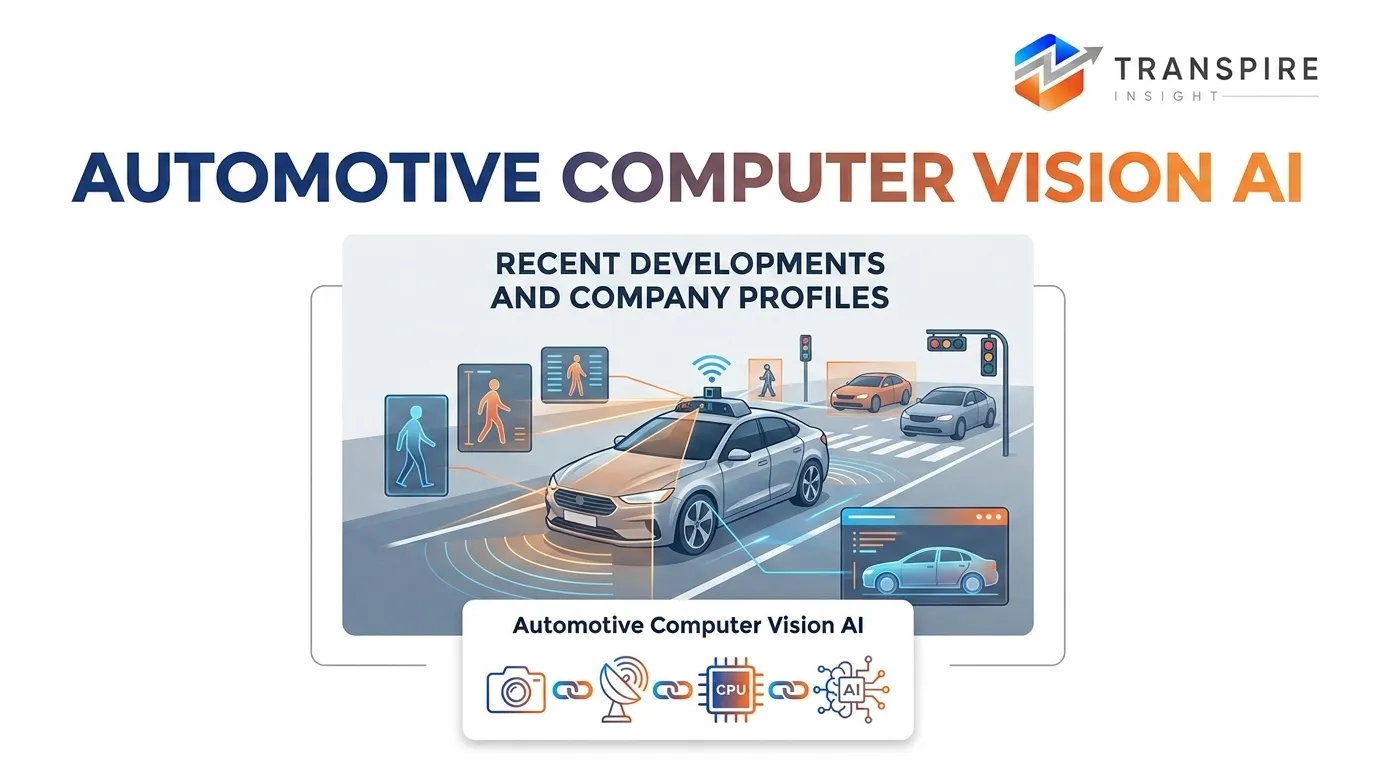
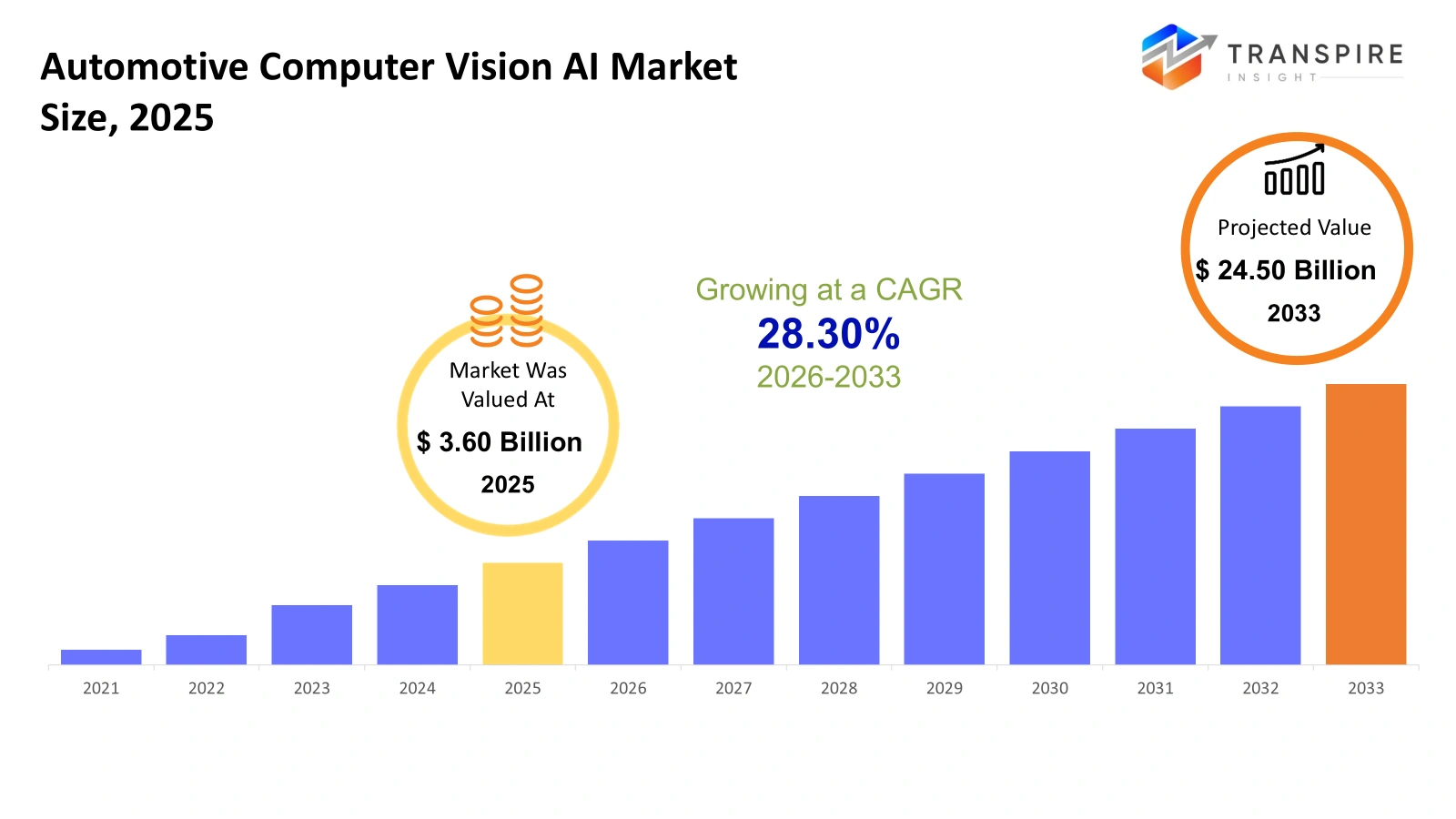
According to a research report published by Transpire Insight, the automotive computer vision AI market size is projected to grow from USD 5.40 billion in 2026 to USD 25.50 billion by 2035, at a CAGR of 30.33% during the forecast period 2026-2035. The regulatory pressure for advanced driver-assistance systems (ADAS), along with the growing worldwide demand for in-cabin occupant monitoring, hands-free highway cruising, and automated emergency braking, is driving the automotive computer vision AI market to grow at a rapid pace.
Introduction
Computer vision AI is the fundamental sensory base of smart mobility systems in automotive electronics, giving computers much of the ability to interpret the visual content in optical video signals and translate that into real-time spatial data for use. These sophisticated systems use complex deep learning architectures and powerful neural processing units to dynamically understand complex driving environments. The computer vision software allows for active monitoring by identifying objects quickly, tracking the lanes with great accuracy, and analyzing pedestrian behavior to the point of predicting it. This essential technology is a must for safe operation of vehicles on the roads of today and, at the very least, meets the rigorous structural constraints necessary for the levels of autonomy that have been established.
Recent Development News
Stay Ahead of Emerging Opportunities with Expert Market Insights by Transpire Insight
Transpire Insight provides comprehensive, data-driven market intelligence to support smarter business decisions. Our research is rooted in comprehensive analysis, authoritative predictions, and industry expertise, enabling organizations to make informed decisions in rapidly evolving markets. In-depth analysis of market segmentation, competitive positioning, regional trends, and emerging investment opportunities in high-growth areas. We blend accuracy with actionable intelligence, empowering companies to uncover new avenues for growth, bolster strategic decision-making, and stay ahead in a dynamic global market.
Download the exclusive Automotive Computer Vision AI Market sample report today to uncover expert insights, emerging trends, and the opportunities defining the future of the industry.
Automotive Computer Vision AI Market Size & Statistics
Regional Growth and Demand Analysis by Transpire Insight:
Asia-Pacific is estimated to generate the highest demand during the forecast period, holding a 41% market share in 2026 in the automotive computer vision AI market. The dominant region in the automotive computer vision AI market is Asia-Pacific owing to the region's leadership in global automotive production of over 50 million vehicles annually, supportive government policies, rapid electric vehicle adoption, and significant technology investments. China is currently the biggest producer in the Automotive Computer Vision AI Market, holding 38% of the regional share in 2026, considering factors such as a strong domestic AI chip supply chain (Horizon Robotics, Black Sesame Technologies), extensive real-world data collection from millions of vehicles, and continued advancement in autonomous driving pilots. As of 2026, some Chinese manufacturers have undertaken production activities aimed at integrating vision-based systems as standard features across mass-market vehicle segments.
North America is estimated to generate significant demand during the forecast period in the automotive computer vision AI market, growing at a CAGR of 15.1% between 2026 and 2034. North America is expected to grow steadily during the forecast period due to rising consumer acceptance of semi-autonomous features, insurance telematics programs incentivizing ADAS-equipped vehicles, and one of the world's most active autonomous vehicle testing ecosystems. The United States is currently a major hub in the automotive computer vision AI market, considering factors such as extensive autonomous vehicle testing programs (Waymo, Cruise, Aurora, Zoox), continued advancement in in-house vision-stack development (Tesla FSD, GM Ultra Cruise, Mercedes-Benz DRIVE PILOT), and Canada's growing automotive technology cluster in Ontario and Quebec supported by federal innovation funding. As of 2026, technology companies in the United States have undertaken engineering headcount build-up aimed at developing proprietary, full-stack vision intelligence as a core competitive differentiator.
Top 15 Trends in the Automotive Computer Vision AI Market
Proceed to Checkout to purchase the exclusive Automotive Computer Vision AI Market report and gain instant access to in-depth market intelligence, strategic analysis, and future growth opportunities.
Top 25 Companies Leading the Automotive Computer Vision AI Market
Customize the exclusive Automotive Computer Vision AI Market report today to receive tailored insights, country-specific analysis, and business-focused market intelligence.
1. Intel Corporation
They engineer foundational x86 compute silicon powering diverse automotive edge ecosystems.
Founded: 1968 | HQ: Santa Clara, California, United States.
Why It Ranks: Deep industrial micro-architecture expertise ensures they sustain an exceptionally high industry rank.
Regional Dominance: Extensive global semiconductor foundries anchor their strong operational influence throughout Western markets.
Product Line: Intelligent in-vehicle infotainment chipsets, programmable logic devices, and localized processing hardware.
2. Mobileye
Their EyeQ chipsets process visual data for millions of passenger vehicles.
Founded: 1999 | HQ: Jerusalem, Israel.
Why It Ranks: Dominant algorithmic camera-first perception market share validates their premium global ranking.
Regional Dominance: Widespread supply agreements establish their deep technological penetration into global automotive markets.
Product Line: EyeQ vision system-on-chips, crowd-sourced mapping software, and autonomous driving stacks.
3. Qualcomm Incorporated
Their Snapdragon Ride platform drives scalable computer vision within connected cars.
Founded: 1985 | HQ: San Diego, California, United States.
Why It Ranks: Leading mobile telematics integration capabilities drive their high competitive industry placement.
Regional Dominance: Dominant wireless chip footprints solidify their major market share across Asian ecosystems.
Product Line: Automotive system-on-chips, integrated cellular-V2X communication modules, and digital cockpit solutions.
4. Robert Bosch GmbH
This Tier-1 titan builds smart multi-purpose camera systems for advanced vehicle safety.
Founded: 1886 | HQ: Stuttgart, Germany.
Why It Ranks: Decades of deep hardware integration trust with global OEMs secure their position.
Regional Dominance: Impeccable automotive history anchors their undisputed market leadership throughout the European continent.
Product Line: Intelligent forward-facing camera modules, mid-range radar systems, and automated parking software.
5. Continental AG
They deliver cutting-edge radar and camera-fused vision suites to global automakers.
Founded: 1871 | HQ: Hanover, Germany.
Why It Ranks: Comprehensive vehicle dynamics and environmental sensing software mastery ensure its top rank.
Regional Dominance: Deep institutional ties to European automakers support their massive localized commercial control.
Product Line: High-resolution surround-view camera systems, holistic sensor fusion units, and electronic control modules.
6. Valeo
Their SCALA LiDAR and camera networks provide superior near-field vehicle protection.
Founded: 1923 | HQ: Paris, France.
Why It Ranks: Pioneer engineering in automated driving perception arrays guarantees their top-tier market ranking.
Regional Dominance: Strong manufacturing distribution networks ensure their widespread leadership across European and Asian sectors.
Product Line: Advanced driver monitoring cameras, ultrasonic sensors, and localized vision processing software.
7. Aptiv PLC
They design the intricate electrical architectures that route high-speed camera data.
Founded: 1994 | HQ: Dublin, Ireland.
Why It Ranks: Mastery over the physical and digital vehicle architecture boundaries dictates their rank.
Regional Dominance: Dual operational footprints secure immense commercial influence across North America and Europe.
Product Line: Smart vehicle central compute nodes, advanced ADAS software, and active safety sensors.
8. Magna International Inc.
This manufacturing leader seamlessly integrates advanced vision sensors directly into vehicle trim.
Founded: 1957 | HQ: Aurora, Canada.
Why It Ranks: Massive global vehicle assembly scale allows them to effortlessly implement vision technology.
Regional Dominance: Extensive production plants anchor their dominant market share across North American facilities.
Product Line: ClearView digital rearview mirrors, complete driving assistance packages, and integrated structural modules.
9. Texas Instruments Incorporated
Their specialized Jacinto processors optimize cost-efficient vision processing at the edge.
Founded: 1930 | HQ: Dallas, Texas, United States.
Why It Ranks: High reliability standards and robust analog semiconductor portfolios secure their elite standing.
Regional Dominance: Highly diversified global supply chains ensure their resilient leadership across international borders.
Product Line: Automotive-grade vision SoCs, highly efficient power management circuits, and signal conditioners.
10. NXP Semiconductors
They deliver secure S32 processors that safely isolate automated vision decisions.
Founded: 2006 | HQ: Eindhoven, Netherlands.
Why It Ranks: Absolute focus on functional vehicle safety microcontrollers drives their high industry rank.
Regional Dominance: Pervasive automotive network chip placement secures their dominant position across global markets.
Product Line: Functional safety microcontrollers, radar front-end chipsets, and secure in-vehicle network processors.
Schedule a meeting with our market experts to discuss the exclusive Automotive Computer Vision AI Market report and identify the best research solution for your organization.
Conclusion
A complete shift has taken place from an experimental engineering innovation to an essential requirement for modern vehicle safety in the automotive computer vision AI market. As technology regulations continue to change and software-driven vehicle architectures rapidly gain popularity, visual perception software continues to be a major source of investment. These top-tier enterprises can overcome high data computational latency by working across semiconductor, tier-one, and assembly lines together. The consistent technological path guarantees that vision-based intelligence will continue to be the main purpose of future autonomous mobility platforms.


Send us a brief description of your challenge and we'll get back to you within 24 hours.

 inquiry@transpireinsight.com
 APAC:+91 7666513636
 Address


