
Jul 09, 2026
By Transpire Insight
Description
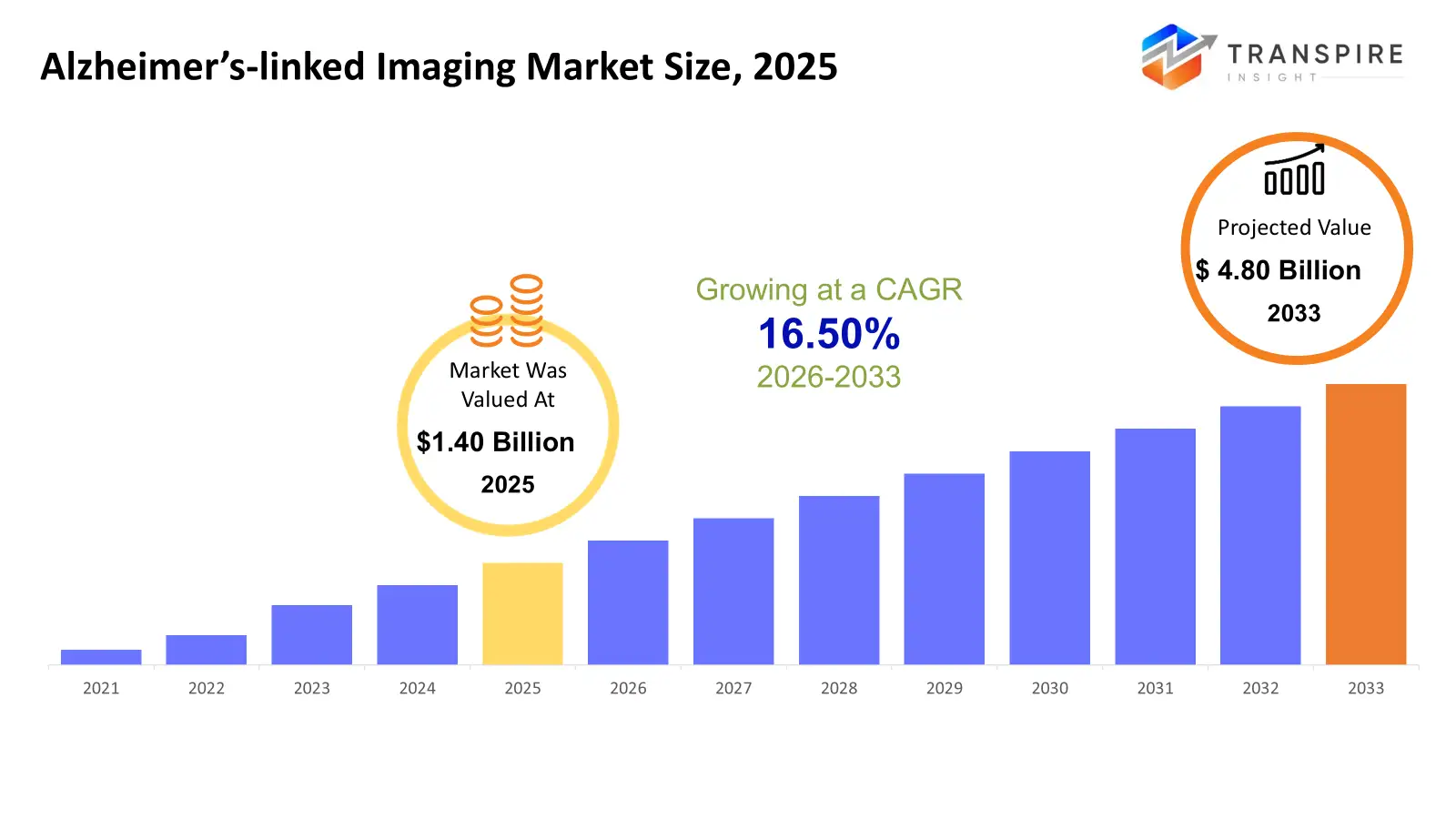
According to a research report published by Transpire Insight, the global Alzheimer’s-linked imaging market Size is projected to grow from USD 2.5 billion in 2026 to USD 5.02 billion by 2035, at a CAGR of 17.2% during the forecast period 2027-2035. The global aging population and growing clinical need for confirmation of amyloid plaques and tau tangles for novel, targeted therapies are expected to be the primary force driving the Alzheimer's related imaging market, along with key advancements in image interpretation using artificial intelligence.
Introduction
The imaging market for Alzheimer's is undergoing dramatic change, with a growing worldwide emphasis on the first biological detection of neurodegenerative diseases. The industry plays a vital role in the diagnosis of cognitive decline before it becomes apparent from a clinical standpoint, from traditional clinical observation to advanced molecular visualization. The use of high-resolution imaging technologies is crucial for the identification of specific pathological biomarkers, for guiding personalized treatment plans, for surveillance of patients receiving disease-modifying treatments, and to ultimately enhance clinical outcomes and change the face of long-term dementia management globally.
Recent Development News
May 2026: High-Impact Phase 2 Biomarker Data Revealed: Topline imaging and clinical biomarker data were announced for the investigational tau-targeting antisense oligonucleotide diranersen. Utilizing advanced Tau-PET imaging scans to monitor the reduction of abnormal tau accumulation inside neurons, the clinical findings provide vital confirmation of structural disease stabilization in early-stage patients.
Investor Relations | Biogen
June 2026: Regulatory Milestones in AI Neuro-Informatics: Leading medical imaging vendors secured key regulatory clearances for deep-learning software suites designed to automate structural brain atrophy tracking on MRI. These AI integrations address the global shortage of specialized neuroradiologists by reducing inter-reader variability and accelerating hospital diagnostic throughput.
Download the exclusive Alzheimer’s-linked Imaging Market sample report today to uncover expert insights, emerging trends, and the opportunities defining the future of the industry.
Alzheimer’s-linked Imaging Market Size & Statistics
The market size for Alzheimer’s-linked imaging is estimated to be worth USD 2.5 billion in 2026.
The market is going to expand at a CAGR of 17.2% between 2026 and 2035.
The global Alzheimer’s-linked Imaging market Size is anticipated to reach USD 5.02 billion by 2035.
North America is estimated to generate the highest revenue share during the forecast period at 47.5% in the Alzheimer’s-linked imaging market.
Asia-Pacific is projected to grow the fastest during the forecast period at a compound annual growth rate CAGR of 16% in the Alzheimer’s-linked imaging market.
Regional Growth and Demand Analysis by Transpire Insight:
North America is expected to dominate the market share during the forecast period in the Alzheimer’s-linked imaging market. The dominant player in the Alzheimer’s-linked imaging market is North America, owing to the availability of leading players in terms of radiopharmaceutical production companies, diagnostic technology suppliers, and robust investment in clinical neuroscience research. The United States is currently the biggest producer in the Alzheimer’s-linked imaging market, considering factors such as the presence of extensive commercial diagnostic laboratory operations, efforts toward modernizing dementia screening frameworks, and continued advancement in molecular imaging engineering. As of 2026, some of the healthcare companies in the United States have undertaken production activities aimed at manufacturing superior positron emission tomography (PET) tracers that would enhance next-generation commercial and research clinical trials.
Asia-Pacific is anticipated to generate the highest growth rate during the forecast period in the Alzheimer’s-linked imaging market. It is expected that the Asia-Pacific region will witness the highest growth rate during the forecast period due to increasing demand for neurodegenerative testing, growing fleets of advanced diagnostic scanners, increased imaging equipment purchasing programs, and significant investment in healthcare infrastructure. China, India, Japan, and South Korea are some of the rapidly growing nations regarding commercial diagnostic activities that drive the demand for advanced neurological visualization technologies. In 2026, there will be an increase in infrastructure modernization programs by many hospital networks in China and India. This was done with the aim of ensuring highly accurate, scalable imaging systems for automated patient screening.
Top 15 Trends in the Alzheimer’s-linked Imaging Market
PET imaging dominates for amyloid and tau detection.
Tau PET adoption is growing alongside amyloid PET scans.
Shift toward earlier, pre-symptomatic Alzheimer's detection.
AI-integrated platforms are transforming imaging interpretation and reporting.
Compact, lower-cost PET systems are entering smaller clinics.
Rising scanner utilization drives new equipment installations.
Expansion of PET/MRI hybrid imaging investments.
Imaging plays a larger role in clinical trial enrollment.
Blood biomarkers complement, not replace, brain imaging.
North America leads; Asia-Pacific grows fastest.
Governments fund early screening and diagnostic infrastructure.
Imaging increasingly used for treatment response monitoring.
New radiotracers sharpen amyloid plaque visualization.
Multimodal AI combines speech analysis with MRI data.
Diagnostic imaging centers emerge as primary assessment sites.
Proceed to Checkout to purchase the exclusive Alzheimer’s-linked Imaging Market report and gain instant access to in-depth market intelligence, strategic analysis, and future growth opportunities.
PET Imaging Dominance
PET holds the largest modality share, valued for spotting amyloid and tau changes early, giving clinicians precise, disease-specific visual evidence ahead of symptom onset.
Tau PET Adoption Growing
Newer tau-targeted PET tracers complement established amyloid imaging, helping track disease progression and measure how well emerging therapies affect underlying brain biology over time.
AI-Integrated Diagnostic Platforms
AI tools like Mayo Clinic's StateViewer analyze single PET scans to detect multiple dementia types, speeding interpretation and improving diagnostic accuracy for clinicians.
Compact, Lower-Cost PET Systems
Devices like Positrigo's NeuroLF bring ultra-compact brain PET scanning to smaller facilities, widening access beyond major hospitals and specialized neurology centers.
Rising Scanner Utilization
Imaging centers report scanners running near full capacity, prompting facilities to invest in additional MRI and PET units to meet growing diagnostic demand.
Imaging in Clinical Trials
PET scans help select trial participants, confirm drugs reach intended targets, and monitor patient response, making imaging essential to Alzheimer's drug development pipelines.
Top 25 Companies Leading the Alzheimer’s-linked Imaging Market
GE Healthcare
Siemens Healthineers
Lantheus Holdings
Curium Pharma
Jubilant Radiopharma
Cardinal Health
Advanced Accelerator Applications (Novartis)
Life Molecular Imaging
Cerveau Technologies
SOFIE Biosciences
Blue Earth Diagnostics
Invicro (Konica Minolta)
Eli Lilly and Company
Avid Radiopharmaceuticals
Canon Medical Systems Corporation
Philips Healthcare
Fujifilm Holdings Corporation
Bracco Imaging
Guerbet
Bayer AG
Roche Diagnostics
Telix Pharmaceuticals
Mallinckrodt Pharmaceuticals
Revvity
Shimadzu Corporation
Customize the exclusive Alzheimer’s-linked Imaging Market report today to receive tailored insights, country-specific analysis, and business-focused market intelligence.
Leading Alzheimer’s-linked Imaging Companies to Watch Globally
Top 25 companies dominating the Alzheimer’s-linked imaging market.
Life Molecular Imaging
Focused explicitly on developing molecular imaging tracers to address critical neurodegenerative diseases.
Founded: 2012 | HQ: Berlin, Germany.
Why It Ranks: Holds global intellectual rights to key FDA-approved amyloid-beta PET targeting agents.
Regional Dominance: Broad global commercial reach via extensive tracer manufacturing licensing agreements worldwide.
Product Line: Neuraceq (Florbetaben F18) injection and novel alpha-synuclein-targeted clinical tracers.
Cerveau Technologies
Dedicated to providing customized imaging biomarkers for evaluating diverse neurodegenerative tau pathologies.
Founded: 2017 | HQ: Boston, Massachusetts, USA.
Why It Ranks: Vital academic partner supporting global multi-center pharmaceutical clinical trials for Alzheimer's.
Regional Dominance: Expanding research-site cross-collaborations across North America, Europe, and major Asian hubs.
Product Line: MK-6240 research tracer manufacturing relationships and custom neurological image analysis protocols.
SOFIE Biosciences
Combines radiopharmaceutical production engineering with specialized contract manufacturing for novel imaging tracers.
Founded: 2008 | HQ: Dulles, Virginia, USA.
Why It Ranks: Strong growth driven by centralized contract manufacturing support for emerging diagnostic developers.
Regional Dominance: Controls multiple strategically located radiopharmacy cyclotrons throughout the United States network.
Product Line: Elixys radiosynthesizer platforms, custom radioligands, and clinical manufacturing diagnostic services.
Blue Earth Diagnostics
A molecular imaging company specialized in developing precision targeted radiopharmaceuticals for complex diagnostics.
Founded: 2014 | HQ: Oxford, United Kingdom.
Why It Ranks: Recognized for rapid commercial scaling of highly precise diagnostic imaging agents.
Regional Dominance: Expanding commercialization structures are driving quick adoption across the United Kingdom and European clinics.
Product Line: Axumin imaging kits, radiohybrid PET technology platforms, and investigational neurology biomarkers.
Invicro (Konica Minolta)
Leading global provider of quantitative imaging biomarker services and custom informatics software.
Founded: 2008 | HQ: Needham, Massachusetts, USA.
Why It Ranks: Industry-standard provider of data analysis platforms for complex neuroimaging clinical trials.
Regional Dominance: Serves top global biopharmaceutical sponsors throughout North America, Europe, and Japan.
Product Line: VivoQuant image processing software, core laboratory data management, and predictive informatics.
Eli Lilly and Company
Pharmaceutical giant integrating advanced diagnostic imaging agents directly into targeted therapeutic pipelines.
Founded: 1876 | HQ: Indianapolis, Indiana, USA.
Why It Ranks: Pioneering role in creating certified clinical methods to observe biological disease progression over time.
Regional Dominance: Extensive worldwide healthcare dominance backed by global clinical and commercial infrastructure investments.
Product Line: Amyvid (Florbetapir F18) diagnostic scan kits, Tauvid (Flortaucipir F18), and therapeutics.
Avid Radiopharmaceuticals
Wholly owned subsidiary of Eli Lilly specializing in researching pioneering molecular tracers.
Founded: 2004 | HQ: Philadelphia, Pennsylvania, USA.
Why It Ranks: Created the first FDA-approved companion diagnostic agent visualizing beta-amyloid brain plaque.
Regional Dominance: Highly integrated within the clinical trial framework of the United States.
Product Line: Pre-commercial molecular brain tracers, companion diagnostic assays, and neurodegenerative diagnostic research.
Canon Medical Systems Corporation
Leading developer of ultra-high-resolution diagnostic CT and diagnostic ultrasound medical systems.
Founded: 1930 | HQ: Otawara, Tochigi, Japan.
Why It Ranks: Deep engineering expertise in low-dose scanning algorithms and structural neuroimaging platforms.
Regional Dominance: Dominates hardware distribution networks throughout Japan and across fast-growing Asian economies.
Product Line: Aquilion CT scanners, Vantage MRI systems, and advanced clinical image post-processing.
Philips Healthcare
Global health technology leader focusing on integrated diagnostic workflows and helium-free MRI.
Founded: 1891 | HQ: Amsterdam, Netherlands.
Why It Ranks: Highly regarded for patient-centric scanner designs and unified hospital informatics ecosystems.
Regional Dominance: Holds deep market penetration across European and North American healthcare networks.
Product Line: Ingenia digital MRI, Vereos digital PET/CT, and IntelliSpace Portal imaging suites.
Fujifilm Holdings Corporation
Provider of innovative medical imaging hardware and comprehensive Synapse enterprise PACS software.
Founded: 1934 | HQ: Tokyo, Japan.
Why It Ranks: Combines structural digital radiography breakthroughs with scalable cloud-based medical imaging informatics.
Regional Dominance: Commandingly strong commercial enterprise footprint throughout the Asia-Pacific healthcare ecosystem.
Product Line: Echelon MRI systems, Synapse PACS platforms, and custom AI diagnostic software.
Schedule a meeting with our market experts to discuss the exclusive Alzheimer’s-linked Imaging Market report and identify the best research solution for your organization.
Conclusion
The Alzheimer's imaging market is at a pivotal moment, directly connecting the dots between molecular discovery and clinical practice. High-resolution PET and MRI technologies will be increasingly needed as new disease-modifying treatments are developed that require objective evidence of brain pathology. The market is expected to continue growing in the global market due to demographic changes and the use of automated artificial intelligence workflows. In the near term, partnerships between hardware companies and radiopharmaceutical developers will continue to be a cornerstone of precision neuro-diagnostics.


Send us a brief description of your challenge and we'll get back to you within 24 hours.

 inquiry@transpireinsight.com
 APAC:+91 7666513636
 Address


