
Jul 08, 2026
By Transpire Insight

Description
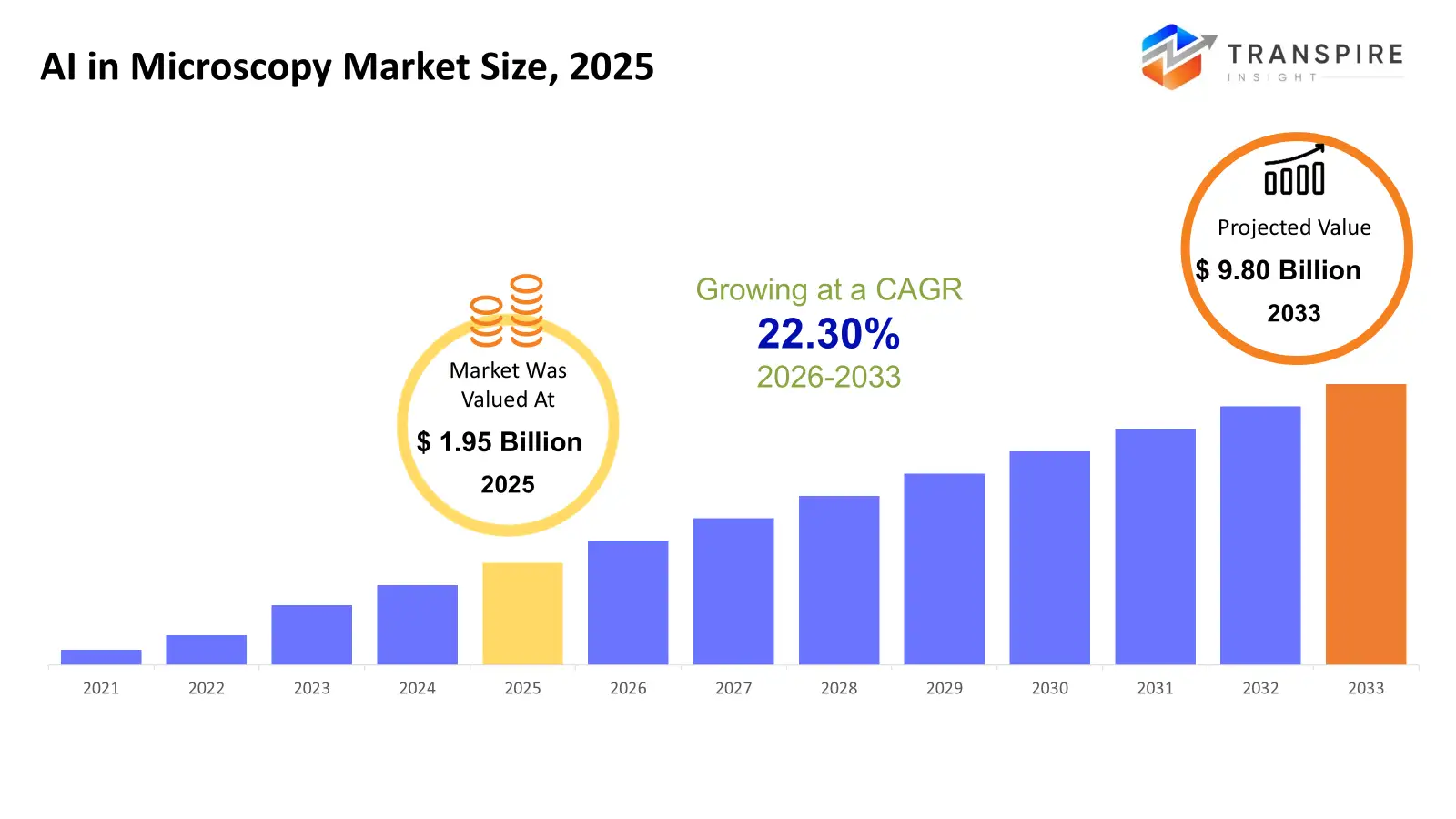
According to a research report published by Transpire Insight, The Global AI in Microscopy Market Size is projected to Grow from USD 1.95 Billion in 2026 to USD 12.50 Billion by 2035, at a CAGR of 29.12% during the forecast period 2026-2035. The global AI in Microscopy market is witnessing fast growth owing to the increasing use of AI technologies in biomedical research, growing demand for automated image analysis software solutions, and widening applications in precision diagnostics and drug discovery. The developments in deep learning algorithms, cloud computing, highly sensitive imaging devices, and digital pathology solutions are paving the way for improved image analysis at higher speed and accuracy. Growing investments in life sciences research, increasing prevalence of chronic diseases, expanding activities in pharmaceutical R&D, and high throughput laboratory requirements are further aiding market growth. Moreover, the combination of AI with advanced microscopy solutions is enhancing laboratory productivity, minimizing diagnostic errors, and aiding personalized medicine development, thus making AI-enabled microscopy an integral part of future research.
Introduction
The Artificial Intelligence in Microscopy Market is centered around the use of artificial intelligence technology together with microscopy solutions to automate image capture, analysis, interpretation, and diagnosis in various fields, such as life sciences, healthcare, material sciences, and industry R&D. By integrating machine learning, deep learning, computer vision, and image processing capabilities, AI-based microscopy provides increased precision, shorter manual analysis duration, and faster high-throughput imaging. Intelligent microscopy solutions are becoming increasingly popular in digital pathology, cell biology, drug discovery, cancer diagnostics, neuroscience, semiconductor inspection, and quality control, among other areas.
Recent Development News
May 2026: Launched a strategic partnership between MVTec HALCON machine vision technology and ZEISS Blockwise, which is a new artificial intelligence system for automated electron microscopy and semiconductor inspection.
February 2026: Initiated the development of BactoSiA, which is an AI-powered tuberculous smear microscopy software that automates the detection and grading of acid-fast bacilli (AFB).
Stay Ahead of Emerging Opportunities with Expert Market Insights by Transpire Insight
The insights that have been shared through this blog are based on intensive market research carried out by Transpire Insight, an advisor that works with many global organizations. Thanks to the analysis of extensive data, forecasts made by our specialists, and industry intelligence, our reports allow clients to find strategic growth opportunities in dynamically developing industries. For all those who would like to get more detailed information regarding market segmentation, competitive analysis, regional outlooks, and future investment tendencies, there is no doubt that our full report will be of great value.
Download the exclusive AI in Microscopy Market sample report today to uncover expert insights, emerging trends, and the opportunities defining the future of the industry.
AI in Microscopy Market Size & Statistics
Market Size of the AI in Microscopy Market was projected to be USD 1.95 billion in 2026.
The Market is Expected to Grow at a CAGR of 29.12% from 2026 to 2035.
The Market Size of the Global AI in Microscopy Market Size is expected to be USD 12.50 billion in 2035.
North America is expected to have the maximum share, contributing around 52.7% in the overall global market for Artificial Intelligence in Microscopy in 2025. Its domination is mainly due to its investment in biomedical research, adoption of digital pathology, superior healthcare infrastructure, funding in AI-based lab technology, and presence of major microscopy and life sciences companies.
Asia Pacific is expected to witness high growth in the forecast period on account of increased healthcare digitization, rise in pharmaceuticals and biotechnology research, increased use of AI-based diagnostics, and growing government interest in precision medicines and life sciences in countries like China, Japan, South Korea, and India.
Regional Growth and Demand Analysis by Transpire Insight:
North America has been dominating the AI in Microscopy Market with approximately 52.7% share in terms of global market share. The dominance of the region in the market is because of its established health care infrastructure, heavy investment in biomedical and life sciences, and advanced use of artificial intelligence techniques in medical imaging and laboratory processes. Some of the most renowned microscopes, AI technologies, and pharmaceutical companies can be found in the regions of US and Canada. Moreover, the presence of prestigious universities and other research centers further adds strength to the position of North America in the AI in Microscopy Market.
Asia-Pacific is estimated to grow at the fastest rate during the forecast period. The rapid growth in biotech and pharma industry along with increased healthcare digitalization in addition to investments in artificial intelligence and diagnostics technologies is expected to drive the market growth in countries such as China, Japan, South Korea, and India. The governments have been backing up researches in the field of precision medicine, while hospitals, academic institutes, and laboratories are also incorporating AI-based microscopes for enhanced accuracy and efficiency in image analysis and productivity of laboratorie.
Top 15 Trends in the AI in Microscopy Market
Growing Adoption of AI-Powered Image Analysis
Increasing Integration of Deep Learning Algorithms in Microscopy
Expansion of Digital Pathology and AI-Assisted Diagnostics
Rising Demand for Automated Cell Identification and Classification
Growing Use of AI in Drug Discovery and Biomedical Research
Development of Real-Time Intelligent Microscopy Platforms
Increasing Adoption of Cloud-Based Microscopy Data Management
Expansion of High-Throughput Automated Microscopy Systems
Growing Integration of AI with Electron and Fluorescence Microscopy
Advancements in 3D Imaging and AI-Based Image Reconstruction
Rising Adoption of AI for Cancer Detection and Precision Medicine
Increasing Use of Explainable AI in Clinical Microscopy Applications
Expansion of AI-Enabled Quality Control in Industrial Microscopy
Growing Investments in Smart Laboratory Automation
Rising Development of Multi-Modal AI Imaging Platforms
Proceed to Checkout to purchase the exclusive AI in Microscopy Market report and gain instant access to in-depth market intelligence, strategic analysis, and future growth opportunities.
1. Growing Adoption of AI-Powered Image Analysis
Artificial intelligence is transforming microscopy by automating the analysis of complex microscopic images with exceptional speed and accuracy. AI-powered software can identify cells, tissues, microorganisms, and structural abnormalities while minimizing human error and significantly reducing analysis time. This capability is improving laboratory productivity and enabling researchers and clinicians to process large imaging datasets more efficiently across life sciences, pathology, and materials science applications.
2. Increasing Integration of Deep Learning Algorithms in Microscopy
Deep learning models are increasingly being integrated into microscopy platforms to recognize intricate image patterns that are difficult to detect using conventional analytical methods. These algorithms continuously improve through training on extensive image datasets, enabling highly accurate classification, segmentation, and quantification of biological structures. As computational capabilities advance, deep learning is becoming a core technology for next-generation intelligent microscopy systems.
3. Expansion of Digital Pathology and AI-Assisted Diagnostics
The growing adoption of digital pathology is driving demand for AI-enabled microscopy solutions that support automated disease detection and clinical decision-making. AI algorithms assist pathologists by rapidly identifying cancer cells, tissue abnormalities, and biomarkers from digitized slides, improving diagnostic consistency and reducing workload. This trend is accelerating the use of precision diagnostics in hospitals, research laboratories, and pharmaceutical companies worldwide.
4. Rising Demand for Automated Cell Identification and Classification
Researchers are increasingly utilizing AI-powered microscopy to automate cell counting, identification, and classification in biomedical research and clinical laboratories. Intelligent image recognition algorithms can distinguish between healthy and abnormal cells with high precision while handling large sample volumes. This automation enhances reproducibility, supports high-throughput screening, and accelerates research in oncology, immunology, stem cell biology, and infectious disease studies.
5. Growing Use of AI in Drug Discovery and Biomedical Research
Pharmaceutical and biotechnology companies are integrating AI-powered microscopy into drug discovery workflows to analyze cellular responses, monitor molecular interactions, and evaluate treatment effectiveness more efficiently. AI enables rapid interpretation of high-content imaging data, allowing researchers to identify promising drug candidates while reducing development time and research costs. This trend is supporting faster innovation in precision medicine and therapeutic development.
6. Development of Real-Time Intelligent Microscopy Platforms
Modern microscopy systems are increasingly incorporating real-time AI capabilities that provide instant image enhancement, automated object recognition, and live analytical insights during imaging procedures. These intelligent platforms enable researchers and clinicians to make immediate decisions without lengthy post-processing, improving workflow efficiency and experimental accuracy. Continuous advancements in AI hardware, edge computing, and high-speed imaging technologies are further expanding the capabilities of real-time intelligent microscopy.
Top 25 Companies Leading the AI in Microscopy Market
Carl Zeiss AG
Olympus Corporation
Nikon Corporation
Leica Microsystems
Thermo Fisher Scientific Inc.
Bruker Corporation
Oxford Instruments plc
Hitachi High-Tech Corporation
JEOL Ltd.
Keyence Corporation
Andor Technology
Hamamatsu Photonics K.K.
Motic Instruments Inc.
Media Cybernetics, Inc.
Aiforia Technologies Plc
Paige AI, Inc.
PathAI, Inc.
Deep Bio Inc.
Indica Labs, Inc.
Visiopharm A/S
Huron Digital Pathology Inc.
OptraSCAN
Evident Corporation
NanoEntek Inc.
Delmic B.V.
Customize the exclusive AI in Microscopy Market report today to receive tailored insights, country-specific analysis, and business-focused market intelligence.
1. Carl Zeiss AG
Carl Zeiss AG is a multinational technology company with its headquarters located in Oberkochen. Carl Zeiss AG is one of the leaders when it comes to providing optical systems, microscopy, and artificial intelligence-based imaging solutions in such spheres as life sciences, healthcare, and industry.
Founded: 1846 | Headquarters: Oberkochen, Germany
Why It Ranks:
ZEISS is one of the market leaders in artificial intelligence-based microscopy, digital pathology, and advanced imaging systems with a significant impact on biomedical research and semiconductor testing.
Regional Dominance:
Europe, North America, Asia-Pacific, and Latin America.
Product Line:
Light microscopes, electron microscopes, digital pathology solutions, AI imaging software, and industrial microscopy.
Recent Development:
In 2025, ZEISS cooperated with Alpenglow Biosciences to provide AI-powered 3D pathology solutions and launched ZEN core software for assisted microscopy workflows.
2. Olympus Corporation
Olympus Corporation is a global manufacturing firm located in Tokyo. The firm produces cutting-edge microscopic technologies and medical innovations and life sciences imaging systems.
Founded: 1919 | Headquarters: Tokyo, Japan
Why It Ranks:
The firm is known for its superior digital microscopes and artificial intelligence-based imaging systems employed in biomedical research and diagnostics.
Regional Dominance:
Asia-Pacific, North America, Europe, and Latin America.
Product Line:
Biological microscopes, digital microscopes, confocal microscopes, imaging software, and clinical microscopes.
Recent Development:
Olympus expanded its range of AI-enabled digital imaging systems in 2025.
3. Nikon Corporation
Nikon Corporation is a multinational organization that specializes in optics and imaging products and is based out of Tokyo. The company specializes in the manufacture and distribution of highly sophisticated microscope and precision imaging products.
Founded: 1917 | Headquarters: Tokyo, Japan
Why It Ranks:
Nikon is among the leaders when it comes to AI-based microscopes and fluorescence imaging and live cell imaging.
Regional Dominance:
Asia-Pacific region, North America, Europe, and the Middle East.
Product Line:
Optical Microscopes, Confocal Microscopes, Super Resolution Imaging Systems, AI Imaging Software, and Digital Pathology.
Recent Development:
In 2025, Nikon made upgrades to its AI-based imaging software.
4. Leica Microsystems
Leica Microsystems is an international microscope firm headquartered in Wetzlar. It is part of Danaher Corporation that creates sophisticated microscopes and scientific imaging technology.
Founded: 1997 | Headquarters: Wetzlar, Germany
Why It Ranks:
Leica Microsystems is known for its top-of-the-line microscopes combined with artificial intelligence-based imaging and digital pathology.
Regional Dominance:
Europe, North America, Asia-Pacific, and Latin America.
Product Line:
Optical microscopes, confocal microscopes, electron microscopy sample preparation systems, digital pathology systems, and AI imaging software.
Recent Development:
In 2025, Leica introduced intelligent digital microscopy technology to automate biomedical research processes.
5. Thermo Fisher Scientific Inc.
Thermo Fisher Scientific Inc. is a multinational life sciences corporation that was founded in Waltham. This corporation manufactures scientific instruments, analytical devices, and AI-assisted microscopy systems.
Founded: 2006 | Headquarters: Waltham, Massachusetts, USA
Why It Ranks:
Thermo Fisher is one of the top companies in the field of electron microscopy and AI-assisted imaging technology for pharmaceutical companies, biotech firms, and universities.
Regional Dominance:
North America, Europe, Asia-Pacific, and Latin America.
Product Line:
Electron microscopes, cryo-electron microscope systems, AI-based imaging software, analytical instruments, and life science research solutions.
Recent Development:
In 2025, the corporation expanded its range of AI-enabled cryo-electron microscopy systems for structural biology studies.
6. Bruker Corporation
Bruker Corporation is an instrumentation firm based in Billerica. The firm produces high-end microscopy and analytical equipment used in life sciences and materials sciences research.
Founded: 1960 | Headquarters: Billerica, Massachusetts, USA
Why It Ranks:
It is famous for high-resolution microscopy solutions coupled with AI analytical software.
Regional Dominance:
North America, Europe, and Asia-Pacific.
Product Line:
Atomic force microscopes, fluorescence microscopes, electron microscope systems, analytical systems, and AI-enabled image software.
Recent Development:
Bruker Corporation improved its automated imaging technology in 2025 for advanced medical and nanotechnology research.
7. Oxford Instruments plc
Oxford Instruments plc is an instrumentation technology company, whose corporate headquarters are located in Abingdon. The company produces analytical equipment and artificial intelligence enabled microscopy technologies.
Founded: 1959 | Headquarters: Abingdon, England, United Kingdom
Why It Ranks:
Oxford Instruments is a renowned supplier of advanced microscope technologies for use in semiconductors, materials, and life sciences.
Regional Dominance:
Europe, North America, and Asia-Pacific.
Product Line:
Accessories for electron microscopy, detectors, imaging software, spectroscopy systems, and AI-powered imaging technologies.
Recent Development:
In 2025, the company launched its intelligent microscopy technologies for automated materials characterization.
8. Hitachi High-Tech Corporation
Hitachi High-Tech Corporation is an international technology company based out of Tokyo. Hitachi High-Tech produces state-of-the-art analytical devices and electron microscopy systems.
Founded: 1947 | Headquarters: Tokyo, Japan
Why It Ranks:
Hitachi High-Tech is one of the major suppliers of AI-enabled electron microscopes to the healthcare sector, semiconductor production, and industrial testing.
Regional Dominance:
Asia-Pacific, North America, and Europe.
Product Line:
Scanning electron microscopes, transmission electron microscopes, analytical equipment, and AI enabled imaging systems.
Recent Development:
Hitachi High-Tech added AI-enabled automated testing functions to its range of electron microscopes in 2025.
9. JEOL Ltd.
JEOL Ltd. is an instrument manufacturer that produces electron microscope and analytical technologies.
Founded: 1949 | Headquarters: Tokyo, Japan
Why It Ranks:
JEOL is known worldwide for manufacturing high-quality electron microscope systems that find use in research and medical studies as well as semiconductor manufacturing.
Regional Dominance:
Asia-Pacific, North America, Europe, and the Middle East.
Product Line:
Transmission electron microscopes, scanning electron microscopes, electron beam instrumentation, analytical systems, and AI-based imaging technologies.
Recent Development:
JEOL introduced automated analysis capabilities of electron microscopy using artificial intelligence in 2025.
10. Keyence Corporation
Keyence Corporation is an international firm operating in automation and sensing technologies, which is based in Osaka.
Founded: 1974 | Headquarters: Osaka, Japan
Why It Ranks:
Keyence ranks among the top innovators in the field of digital microscopes, automated inspection and AI-enabled industrial imaging.
Regional Dominance:
Asia Pacific, North America, Europe, and Latin America
Product Line:
Digital microscopes, Industrial imaging systems, Machine Vision, Measuring Instruments, and Automated inspection software using AI.
Recent Development:
In 2025, Keyence launched new AI-enabled digital microscopy systems with advanced capabilities of automated measurement and defect detection.
Schedule a meeting with our market experts to discuss the exclusive AI in Microscopy Market report and identify the best research solution for your organization.
Conclusion
The Artificial Intelligence in Microscopy Market is witnessing tremendous growth because of the application of AI in the technology which makes microscopy an intelligent technique that can be used in analysis, diagnosis, and discoveries. The adoption of AI-enabled imaging technology, digital pathology, deep learning software, and real-time microscopy is improving the accuracy, efficiency, and minimizing the need for manual analysis in healthcare, life sciences, pharmaceutical research, and industries. Precision medicine, drug discovery, biotech, and laboratory automation have also helped boost the adoption of AI in microscopy. Among the leading companies in this sector are Carl Zeiss AG, Olympus Corporation, Nikon Corporation, Leica Microsystems, Thermo Fisher Scientific Inc., Bruker Corporation, Oxford Instruments plc, Hitachi High-Tech Corporation, JEOL Ltd., and Keyence Corporation, which have been contributing to the growth of the market through innovations and advanced imaging systems with the application of AI. As the development of AI, cloud computing, and high-resolution imaging technologies continues, the AI in Microscopy Market will continue to become significant within the next ten years.


Send us a brief description of your challenge and we'll get back to you within 24 hours.

 inquiry@transpireinsight.com
 APAC:+91 7666513636
 Address


