
Sep 19, 2026
By Transpire Insight
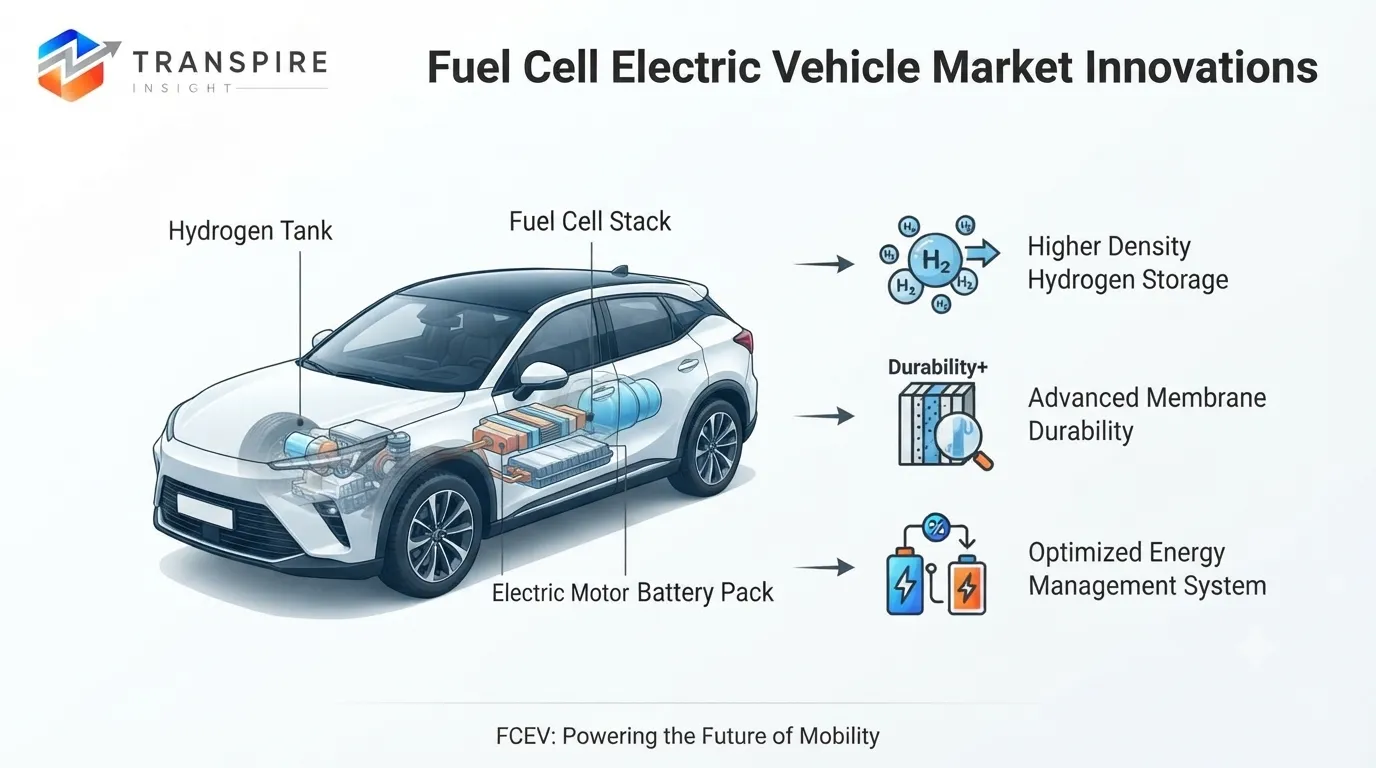
Fuel cell electric vehicles are moving toward a broader commercial opportunity as automakers, fleet operators, governments, and energy companies invest in hydrogen mobility, particularly for applications where long driving range and rapid refueling remain important.
Fuel cell electric vehicles, or FCEVs, convert hydrogen into electricity through a fuel-cell system that powers an electric drivetrain. Unlike conventional battery-electric vehicles, FCEVs generate electricity onboard rather than relying exclusively on stored battery energy.
The technology is attracting interest across passenger vehicles, buses, trucks, logistics fleets, and other commercial transportation applications.
According to recent market research, the global fuel cell electric vehicle market was valued at approximately USD 6 billion in 2025 and is projected to reach around USD 57.6 billion by 2035, expanding at a CAGR of approximately 26.6%. For editorial presentation, the market can be rounded to approximately USD 6.2 billion in 2025 and USD 59 billion by 2035, representing growth of roughly 27% annually.
Fuel Cell Electric Vehicle Market Growth Drivers
Long-Range Transportation Demand
One of the primary advantages of fuel cell vehicles is their potential to combine long driving ranges with comparatively fast refueling.
This characteristic makes hydrogen particularly relevant for heavy-duty transportation, long-distance fleets, buses, and logistics applications.
Expansion of Hydrogen Infrastructure
Hydrogen fueling infrastructure is essential for large-scale FCEV adoption.
Governments and energy companies are investing in hydrogen production, storage, transportation, and fueling networks, particularly in regions developing dedicated hydrogen corridors.
Government Support
Clean-transport policies, subsidies, incentives, emissions regulations, and hydrogen strategies are supporting investment in fuel-cell mobility.
Policy support is especially important because the economics of hydrogen vehicles depend heavily on fuel availability and infrastructure scale.
Fuel Cell Electric Vehicle Market Trends
Growth of Commercial Vehicles
Commercial transportation represents one of the most important opportunities for fuel-cell technology.
Heavy trucks and buses can benefit from high utilization rates, long operating ranges, and rapid refueling, potentially making hydrogen more attractive than large battery systems in selected applications.
Proton Exchange Membrane Fuel Cells
PEM fuel cells remain the dominant technology for automotive applications.
Recent market analysis indicates that PEM fuel cells represented approximately 62% of the FCEV market in 2025 and are expected to expand rapidly through 2035.
Passenger Vehicle Development
Passenger vehicles remain an important technology-development area.
Toyota, Hyundai, Honda, and other manufacturers continue to develop hydrogen-powered passenger and commercial platforms, although adoption remains dependent on vehicle cost, hydrogen availability, infrastructure, and regional policy.
Hydrogen Ecosystem Integration
The market is increasingly being viewed as an ecosystem rather than simply a vehicle business.
Hydrogen production, electrolyzers, storage, transportation, fueling stations, fuel-cell systems, vehicle manufacturing, and fleet operations must develop together for large-scale adoption.
Fuel Cell Electric Vehicle Market Challenges
The largest challenge remains hydrogen infrastructure.
FCEV adoption cannot scale rapidly without sufficient fueling stations, while hydrogen infrastructure investment is difficult to justify without a large vehicle base.
Vehicle and fuel costs are also important challenges. Fuel-cell systems remain technologically complex, while green hydrogen production can be expensive in markets where renewable electricity and electrolyzer capacity are limited.
Competition from battery-electric vehicles is another major factor. Battery technology continues to improve, particularly for passenger cars and shorter-distance commercial applications.
Fuel Cell Electric Vehicle Market Competitive Landscape
The market includes automotive manufacturers, commercial-vehicle companies, fuel-cell system providers, and hydrogen technology companies.
Recent industry analysis identifies Toyota Motor, Honda Motor, Hyundai Motor Company, Cummins, and Daimler among the leading participants, with the top five collectively holding approximately 48% of the market in 2025.
Other participants include Ballard Power Systems, Plug Power, BMW Group, Hyundai Mobis, and other automotive and fuel-cell technology companies.
Top 10 Companies in the Fuel Cell Electric Vehicle Market
Company Profiles
Toyota Motor Corporation
Toyota has been one of the most prominent automotive companies in hydrogen mobility and has developed fuel-cell passenger vehicles and commercial applications.
Its experience across fuel-cell systems, hydrogen technologies, and vehicle platforms provides a strong foundation as hydrogen infrastructure expands.
Hyundai Motor Company
Hyundai has invested heavily in fuel-cell technology across passenger vehicles, buses, trucks, and other mobility applications.
Its focus on commercial transportation gives the company an opportunity to participate in applications where long range, high utilization, and rapid refueling are particularly important.
Honda Motor Co., Ltd.
Honda has maintained a long-term focus on hydrogen fuel-cell technology and has developed fuel-cell vehicles and related technologies.
The company's approach combines fuel-cell technology with electrified vehicle platforms, creating opportunities in passenger mobility and commercial applications.
Cummins Inc.
Cummins participates across engines, power systems, hydrogen technologies, and fuel-cell-related solutions.
Its established relationships with commercial vehicle and industrial customers provide opportunities to expand hydrogen power technologies beyond passenger vehicles.
Daimler Truck AG
Daimler Truck is an important participant in hydrogen-powered heavy transportation.
The company's focus on long-haul and commercial vehicles positions it in an application where hydrogen's range and refueling characteristics could provide advantages for selected routes.
Outlook
The global fuel cell electric vehicle market has the potential to experience very rapid expansion through 2035, but its growth will depend heavily on infrastructure development and hydrogen economics.
Passenger vehicles will remain part of the market, but buses, heavy trucks, logistics fleets, and high-utilization commercial vehicles could become especially important growth areas.
The long-term market opportunity will depend on the development of affordable low-carbon hydrogen, expanded fueling infrastructure, lower fuel-cell system costs, and supportive government policy.
FCEVs are unlikely to replace battery-electric vehicles across every transportation category. Instead, the two technologies are likely to develop complementary roles, with battery-electric systems remaining highly competitive for many passenger and short-range applications while hydrogen may become increasingly relevant for heavier and longer-distance transportation.
Overall, fuel cell electric vehicles could enter a broader commercial phase as the hydrogen ecosystem develops, creating opportunities across vehicle manufacturing, fuel-cell systems, hydrogen production, fueling infrastructure, and fleet operations.


Send us a brief description of your challenge and we'll get back to you within 24 hours.

 inquiry@transpireinsight.com
 APAC:+91 7666513636
 Address


