
Oct 05, 2026
By Transpire Insight
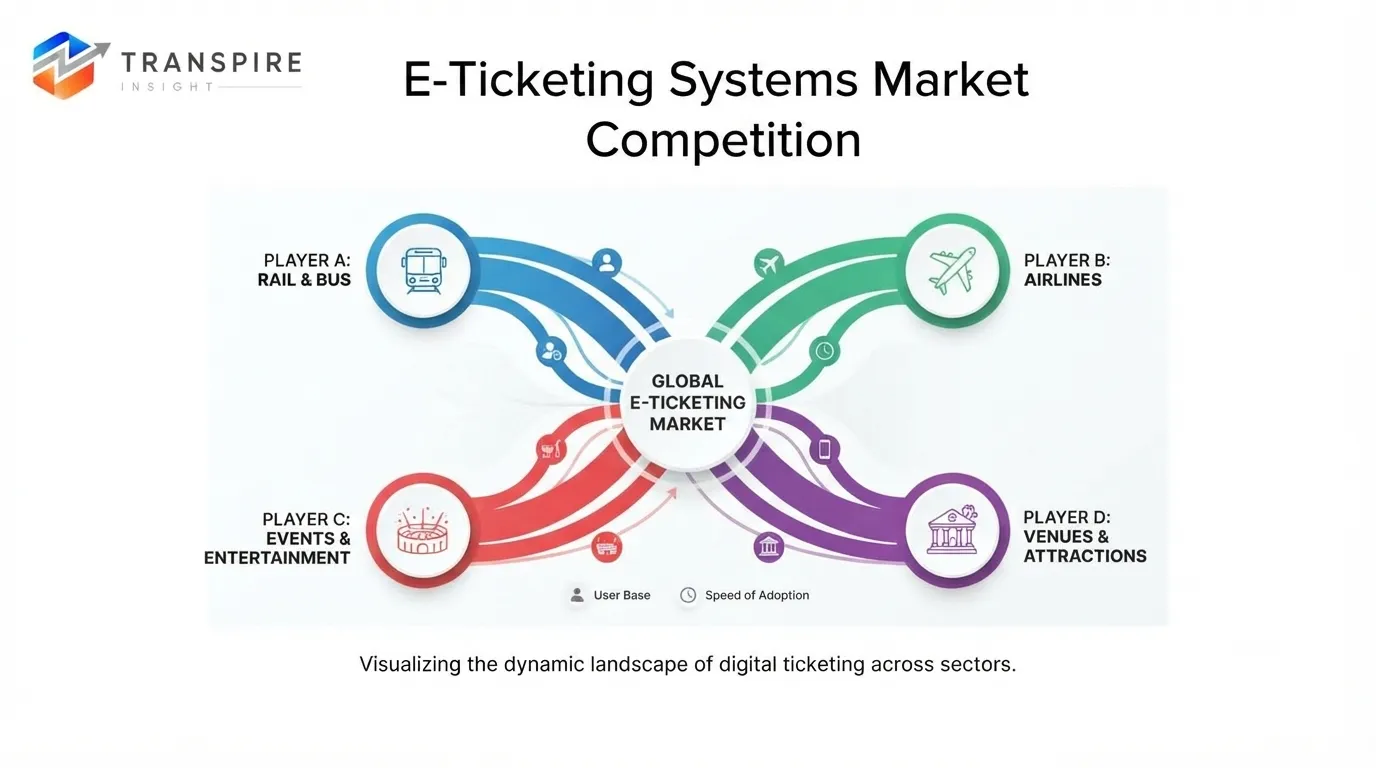
E-ticketing systems are becoming a central part of the global shift toward digital, contactless, and automated ticket management. Transport authorities, airlines, entertainment companies, sports organizations, and event operators are replacing traditional paper-based processes with mobile tickets, QR codes, NFC credentials, smart cards, cloud platforms, and account-based ticketing systems. The transition is improving convenience for passengers while helping operators streamline ticket distribution, fare collection, validation, customer management, and revenue protection.
The evolution of smartphones, digital wallets, cloud computing, contactless payments, artificial intelligence, and real-time data analytics is accelerating this transformation. Modern e-ticketing platforms increasingly operate as integrated digital ecosystems rather than simple ticket-purchase applications, connecting payment gateways, identity management, validators, customer accounts, transport networks, and mobility services through centralized platforms.
Market Size
The global E-Ticketing Systems Market is estimated at approximately USD 10.8 billion in 2025 and is expected to reach approximately USD 27.5 billion by 2033, registering a CAGR of about 12.44% during 2026–2033.
The market is developing as organizations move away from paper tickets and manually operated entry systems toward digitally generated and electronically validated credentials. An e-ticket can be delivered through a website, smartphone application, email, digital wallet, QR code, NFC-enabled device, smart card, or other digital channel.
Transportation represents one of the most important applications because railways, metros, buses, airports, and other mobility providers are increasingly adopting digital fare collection and automated validation.
The technology is also expanding beyond transportation. Stadiums, concerts, amusement parks, cinemas, sports venues, exhibitions, and other high-volume locations are using digital tickets to simplify access management and improve visitor data collection.
Smartphone Adoption Accelerates E-Ticketing
The widespread availability of smartphones is one of the strongest structural drivers of the e-ticketing industry.
Consumers increasingly use smartphones for banking, shopping, identity verification, travel planning, and digital payments. Ticketing naturally fits into this mobile ecosystem.
Mobile applications allow users to purchase tickets, store them digitally, receive notifications, manage bookings, and present QR codes or NFC credentials at entry points.
For operators, mobile ticketing reduces dependence on physical ticket distribution infrastructure and creates opportunities for direct communication with customers.
Grand View Research identifies e-tickets as the largest product segment within the broader smart-ticketing industry in 2025, with growth supported by mobile-first ticketing, QR codes, mobile applications, and integration with account-based ticketing.
QR Codes Expand Digital Ticket Access
QR-code ticketing has become one of the most accessible forms of electronic ticketing.
Unlike some specialized contactless technologies, QR codes can be displayed on conventional smartphones and scanned using compatible readers or cameras.
This makes QR-based ticketing particularly useful for transportation networks, entertainment venues, conferences, sporting events, and tourism attractions.
QR tickets can also be generated dynamically, allowing operators to implement security measures such as time restrictions, encrypted information, rotating codes, or account-linked validation.
The relatively low infrastructure requirements of QR-based systems make them attractive to organizations transitioning from paper tickets.
NFC Enables Contactless Travel
Near-field communication is another major technology supporting the development of e-ticketing systems.
NFC enables users to authenticate travel or access rights by tapping a compatible card, smartphone, wearable, or other device against a reader.
The technology is particularly valuable for high-volume transportation networks because passengers can pass through validation points quickly.
Grand View Research notes that NFC is projected to experience significant growth in smart ticketing because of its ability to support fast and frictionless validation.
NFC can also work with open-payment systems, allowing passengers to use contactless bank cards and mobile wallets instead of purchasing a separate transit card.
Account-Based Ticketing Is Reshaping Fare Management
Account-based ticketing is changing the architecture of digital fare collection.
In conventional systems, fare information may be stored directly on a physical ticket or smart card. In account-based systems, the passenger's travel rights, payment information, and fare calculations can be managed through a centralized backend.
This architecture allows passengers to use multiple forms of media, including mobile phones, bank cards, smart cards, and other contactless credentials.
Scheidt & Bachmann's FareGo platform, for example, supports account-based ticketing, open payments, mobile ticketing, contactless media, validators, fare gates, and traditional sales channels.
Account-based systems can also support sophisticated fare policies such as fare capping, concessions, loyalty programs, transfers, and multimodal journeys.
Open Payments Reduce Barriers for Passengers
Open-loop payment systems allow passengers to use existing bank cards or mobile wallets rather than obtaining a dedicated transit ticket or card.
This can simplify the passenger experience, especially for tourists and occasional travelers.
A passenger arriving in a new city may not know which transport card to purchase or where to obtain it. With an open-payment system, the passenger can potentially tap a bank card or supported mobile wallet directly at the gate or validator.
Masabi's Justride platform supports open payments, mobile ticketing, smart cards, barcode ticketing, and account-based ticketing through an integrated platform.
The development of open payments is therefore reducing the distinction between payment and ticketing.
Public Transportation Remains a Major Application
Public transportation is one of the largest applications for electronic ticketing systems.
Large metropolitan areas process enormous passenger volumes every day, creating strong demand for fast and reliable fare collection.
Electronic ticketing can reduce queues at ticket counters, improve boarding efficiency, automate fare validation, and provide transport authorities with better information about travel patterns.
Grand View Research estimates that transportation accounted for the largest end-use share within the smart ticketing market in 2025.
Railways and metros are particularly suitable for digital ticketing because passengers frequently pass through controlled entry and exit points.
Buses are also adopting mobile ticketing, validators, contactless cards, and account-based fare collection.
India's Digital Railway Ticketing Transformation
India is becoming an important market for digital ticketing because of its enormous passenger base, expanding metro systems, growing digital-payment adoption, and railway modernization.
Indian Railways has steadily increased the proportion of tickets purchased through digital channels.
Government data published in 2026 stated that between June 2025 and June 2026, 57.90 crore reserved tickets, or approximately 89% of the 65.08 crore reserved tickets booked through the Passenger Reservation System, were booked online.
The introduction of RailOne has further expanded the digital railway-service ecosystem by bringing ticket booking, train tracking, platform tickets, PNR information, and other passenger services together.
Recent reporting indicates that digital booking is also increasing for unreserved tickets at smaller railway stations.
India's smart-ticketing market is projected to grow rapidly, supported by urban transit expansion and digital payment adoption.
Cloud-Based Ticketing Improves Scalability
Cloud deployment is increasingly important for modern e-ticketing systems.
Traditional ticketing infrastructure can require significant on-premise hardware, software maintenance, and local data management.
Cloud-based platforms can centralize ticketing functions while allowing operators to manage multiple stations, routes, venues, or locations through a unified environment.
Cloud systems can also simplify software updates and enable new services to be deployed without replacing the entire physical infrastructure.
Masabi describes its Justride platform as cloud-native and designed to scale for large and complex transit systems.
Scheidt & Bachmann similarly provides cloud-based data management and account-based fare collection through its FareGo portfolio.
Artificial Intelligence Can Improve Ticketing Operations
Artificial intelligence is beginning to influence electronic ticketing in several areas.
AI can be used to analyze passenger demand, identify unusual transaction patterns, support fraud detection, improve customer service, forecast congestion, and optimize staffing.
Machine-learning models can analyze historical travel patterns and help operators understand demand across different times, routes, stations, and events.
AI-powered customer-service tools can also answer routine booking and ticket-related questions.
As ticketing platforms accumulate more transaction and mobility data, analytics will become increasingly important to operational decision-making.
Digital Ticketing Strengthens Revenue Protection
Fraud prevention is a major consideration for ticketing operators.
Paper tickets can be lost, duplicated, altered, or transferred improperly. Digital systems can implement encrypted credentials, unique ticket identifiers, QR validation, account authentication, and transaction monitoring.
Real-time verification allows operators to determine whether a ticket is valid, expired, already used, or associated with another customer.
For transportation networks, stronger revenue protection can reduce losses from unauthorized travel.
For entertainment and sports venues, digital verification can also prevent duplicate ticket entry and improve control over access.
E-Ticketing Supports Multimodal Mobility
Modern cities are increasingly moving toward mobility-as-a-service ecosystems.
Instead of treating buses, metro systems, trains, bike sharing, parking, and other transportation services as separate systems, MaaS platforms can integrate them into a unified digital experience.
Electronic ticketing is essential to this model because a passenger may need to purchase or validate multiple transport services during a single journey.
Masabi states that its platform supports mobility-as-a-service integration through APIs and SDKs.
Open APIs are therefore becoming a major requirement for ticketing platforms.
Event and Entertainment Ticketing Creates Additional Demand
E-ticketing is not limited to transportation.
Concerts, sports competitions, exhibitions, cinemas, theme parks, museums, conferences, and other venues are increasingly using digital admission systems.
Electronic tickets allow event organizers to distribute tickets quickly, manage capacity, communicate schedule changes, and collect customer information.
Mobile tickets also make it easier to support last-minute purchases and digital transfers.
High-volume events particularly benefit from QR and NFC validation because attendees can be processed rapidly at entry points.
Digital Wallet Integration Is Expanding
Mobile wallets are becoming an important part of the electronic ticketing ecosystem.
Users can store tickets alongside payment cards, loyalty credentials, boarding passes, and other digital documents.
This creates a convenient environment where passengers do not need to open a separate application each time they travel.
Integration with Apple Pay, Google Wallet, regional digital wallets, and other payment ecosystems can help ticketing providers reach a broader customer base.
The expansion of digital wallets also supports the development of account-based ticketing and open-payment models.
Security and Data Protection Are Critical
The increasing digitization of ticketing creates new cybersecurity requirements.
E-ticketing platforms process payment information, customer identities, travel data, booking information, and access credentials.
A security breach could therefore affect both customers and operators.
Companies are investing in encryption, tokenization, authentication, fraud monitoring, secure APIs, and other technologies to protect transactions.
Data privacy regulations are also becoming increasingly important as operators collect detailed information about passenger behavior.
Future ticketing systems will need to balance personalization and analytics with responsible data management.
Regional Outlook
North America
North America is an important market for electronic ticketing because of substantial investment in public transit modernization, contactless payments, mobile ticketing, and open-payment infrastructure.
Major metropolitan transport authorities are upgrading legacy fare collection systems to support contactless bank cards, mobile wallets, account-based ticketing, and cloud platforms.
The region also has strong demand from sports, entertainment, airports, and event venues.
Cubic, Conduent, Masabi, INIT, and other technology companies are involved in the development of digital fare collection and ticketing systems.
Europe
Europe is a highly developed market for smart and electronic ticketing.
The region has extensive rail, metro, bus, tram, and multimodal transportation networks.
European transport operators are increasingly moving toward integrated ticketing, contactless payments, account-based systems, and multimodal mobility.
Mordor Intelligence estimates that Europe represented 34.53% of global smart-ticketing revenue in 2025, supported by mature public transport infrastructure and digital ticketing programs.
Scheidt & Bachmann, Thales, Vix Technology, Flowbird, and other established suppliers are active across the region.
Asia Pacific
Asia Pacific represents one of the fastest-developing markets for electronic ticketing.
Rapid urbanization, large passenger populations, expanding metro networks, smartphone adoption, and digital payment ecosystems are supporting market growth.
China, India, Japan, Singapore, South Korea, and Australia have developed extensive digital and contactless transportation initiatives.
Mordor Intelligence identifies Asia Pacific as the fastest-growing major region in smart ticketing, with a projected 8.96% CAGR through 2031 in its market framework.
India is particularly significant because of rapid metro expansion and high adoption of mobile and digital payment services.
Latin America
Latin American cities are modernizing legacy fare collection infrastructure.
Transport authorities are moving from traditional cash and closed-loop cards toward mobile ticketing, QR codes, NFC, and bank-card payments.
Large metropolitan systems in Brazil, Mexico, Chile, Colombia, and other countries are creating opportunities for digital ticketing providers.
Cost-effective cloud solutions are particularly relevant because they can help smaller transport authorities modernize without deploying extensive proprietary infrastructure.
Middle East & Africa
The Middle East is investing in smart-city infrastructure, automated public transportation, airports, and tourism facilities.
Countries including Saudi Arabia and the United Arab Emirates are developing digitally connected mobility ecosystems.
E-ticketing systems can support metro networks, airports, tourism attractions, stadiums, events, and integrated mobility platforms.
Africa also offers long-term opportunities as cities modernize public transportation and introduce digital payment systems.
Competitive Landscape
The E-Ticketing Systems Market includes global technology companies, payment technology providers, transport specialists, smart-card manufacturers, cloud ticketing companies, and specialized software providers.
Competition increasingly centers on open architecture, cloud deployment, account-based ticketing, contactless payments, mobile integration, cybersecurity, interoperability, scalability, and lifecycle support.
Research and Markets identifies major participants including Cubic, Conduent, Thales, Vix Technology, HID Global, Giesecke+Devrient, Indra, NEC, Scheidt & Bachmann, Flowbird, Masabi, INIT, IDEMIA, AEP Ticketing Solutions, and others.
The competitive environment is shifting from traditional ticket machines and proprietary smart cards toward software-led platforms capable of supporting multiple payment and ticketing methods.
Top 10 Companies in E-Ticketing Systems Market
1. Cubic Corporation
Cubic is one of the established technology providers in transportation ticketing and automated fare collection.
Its transportation business has historically focused on fare management, payment, ticketing, and intelligent transportation solutions.
Cubic's technology supports transport agencies seeking to modernize fare collection and connect different modes of public transportation.
Its broad experience with metropolitan transportation networks provides an important competitive advantage in large-scale projects.
2. Thales Group
Thales is a major global technology company with extensive capabilities in transportation, digital identity, cybersecurity, and ticketing.
The company provides solutions for public transportation, including fare collection, ticketing, passenger information, and related digital infrastructure.
Its combination of transportation technology and cybersecurity capabilities is particularly relevant as ticketing platforms become increasingly connected.
Thales serves transport operators and infrastructure organizations across numerous international markets.
3. Conduent Incorporated
Conduent provides transportation and mobility solutions that include fare collection and electronic payment technologies.
The company works with public transportation agencies on systems designed to simplify payment and improve operational management.
Its technology portfolio addresses automated fare collection, electronic payment, transit management, and customer-facing services.
Conduent's experience with large public-sector deployments supports its position in the e-ticketing ecosystem.
4. Vix Technology
Vix Technology specializes in smart mobility, transit ticketing, payments, and transportation technology.
Its solutions support account-based ticketing, mobile ticketing, contactless payments, and integrated transport systems.
The company's technology is designed to help public transport operators move toward more flexible and connected fare collection.
Its international customer base provides exposure to multiple regional ticketing modernization programs.
5. Scheidt & Bachmann
Scheidt & Bachmann is a major provider of fare collection systems for public transportation.
Its FareGo portfolio includes account-based ticketing, smart-card systems, open payments, mobile ticketing, validators, fare gates, sales devices, and cloud-based data management.
The company has decades of experience in fare collection and operates across international transportation markets.
Its ability to combine physical validation equipment with cloud software provides an integrated approach to electronic ticketing.
6. Masabi
Masabi is a specialist in cloud-based fare payments and public transport ticketing.
Its Justride platform supports account-based ticketing, mobile ticketing, barcode ticketing, open payments, smart cards, and mobility-as-a-service integration.
The company has expanded its presence through partnerships and deployments with transportation agencies.
In 2026, Masabi also acquired Passenger Technology Group, expanding its capabilities in passenger-facing digital services and ticketing.
7. Flowbird
Flowbird provides mobility payment and ticketing technology for transportation and urban mobility.
Its solutions cover parking, public transportation payments, digital services, and related mobility applications.
The company's focus on cashless and digital payment experiences positions it within the broader transition toward smart urban mobility.
Integration across transportation and parking can also support cities developing unified mobility platforms.
8. INIT
INIT is a transportation technology company focused on public transit operations and intelligent transportation systems.
Its capabilities include electronic ticketing and payment solutions alongside scheduling, fleet management, passenger information, and operational technologies.
This integrated approach enables transport authorities to connect fare collection with broader transit operations.
INIT's experience with public transportation agencies provides opportunities as operators move toward digital and account-based ticketing.
9. IDEMIA
IDEMIA specializes in digital identity, authentication, payment technology, and secure credential solutions.
Its expertise in identity and secure transaction technologies is relevant to electronic ticketing systems.
The company's capabilities can support secure passenger identification, payment authentication, smart cards, and digital credentials.
As ticketing becomes increasingly linked with digital identity and mobile wallets, secure credential technology is expected to remain important.
10. NEC Corporation
NEC is a major Japanese technology company with capabilities spanning information technology, digital identity, biometrics, transportation, and public infrastructure.
The company participates in smart transportation and ticketing projects, particularly in markets pursuing integrated digital mobility.
NEC's expertise in biometric identification, cloud technology, data analytics, and infrastructure systems creates opportunities for next-generation ticketing solutions.
The company is particularly relevant to projects where ticketing needs to integrate with broader smart-city infrastructure.
Market Challenges
The E-Ticketing Systems Market faces several challenges as operators replace traditional systems.
Cybersecurity risks are increasing because digital ticketing platforms handle payment credentials, passenger accounts, and transaction data.
Legacy infrastructure integration can also be difficult. Many transport authorities operate systems that were installed decades ago and were not designed to communicate with modern cloud platforms.
High initial investment can slow adoption, particularly among smaller transport agencies and event operators.
Interoperability is another challenge. Passengers increasingly expect one payment method to work across multiple transport operators and regions, but different networks may use different standards and technologies.
Digital exclusion must also be considered. Not every passenger owns a smartphone, has reliable internet access, or can use digital payment services. Transport operators therefore need to maintain inclusive alternatives while expanding digital channels.
Future Outlook
The global E-Ticketing Systems Market is entering a period of substantial technological development as transportation, entertainment, sports, aviation, and other industries accelerate their transition from physical tickets to digital credentials.
The market is projected to increase from approximately USD 10.8 billion in 2025 to USD 27.5 billion by 2033, reflecting a CAGR of approximately 12.44% from 2026 to 2033.
The next generation of e-ticketing will increasingly combine mobile applications, QR codes, NFC, open-loop payments, account-based ticketing, digital wallets, cloud computing, AI, data analytics, and cybersecurity.
Account-based ticketing is expected to remain particularly important because it allows transport operators to separate the passenger's fare account from a specific physical ticket.
Open payment systems will also continue expanding as travelers become more comfortable using bank cards and mobile wallets directly at transportation gates and validators.
For cities, electronic ticketing can become more than a payment mechanism. It can form part of a broader mobility platform connecting buses, trains, metro systems, parking, shared mobility, and other transportation services.
Event organizers are also likely to increase adoption of mobile and contactless ticketing as they seek better crowd management, fraud prevention, personalized communication, and faster entry.
The competitive landscape will increasingly favor technology providers that can offer secure, scalable, interoperable, cloud-based, and multimodal platforms rather than isolated ticketing products.
As digital payments become embedded into everyday transportation and consumers increasingly expect immediate, contactless access, e-ticketing systems are positioned to become a fundamental component of modern mobility and digital access infrastructure.


Send us a brief description of your challenge and we'll get back to you within 24 hours.

 inquiry@transpireinsight.com
 APAC:+91 7666513636
 Address


