
Oct 02, 2026
By Transpire Insight
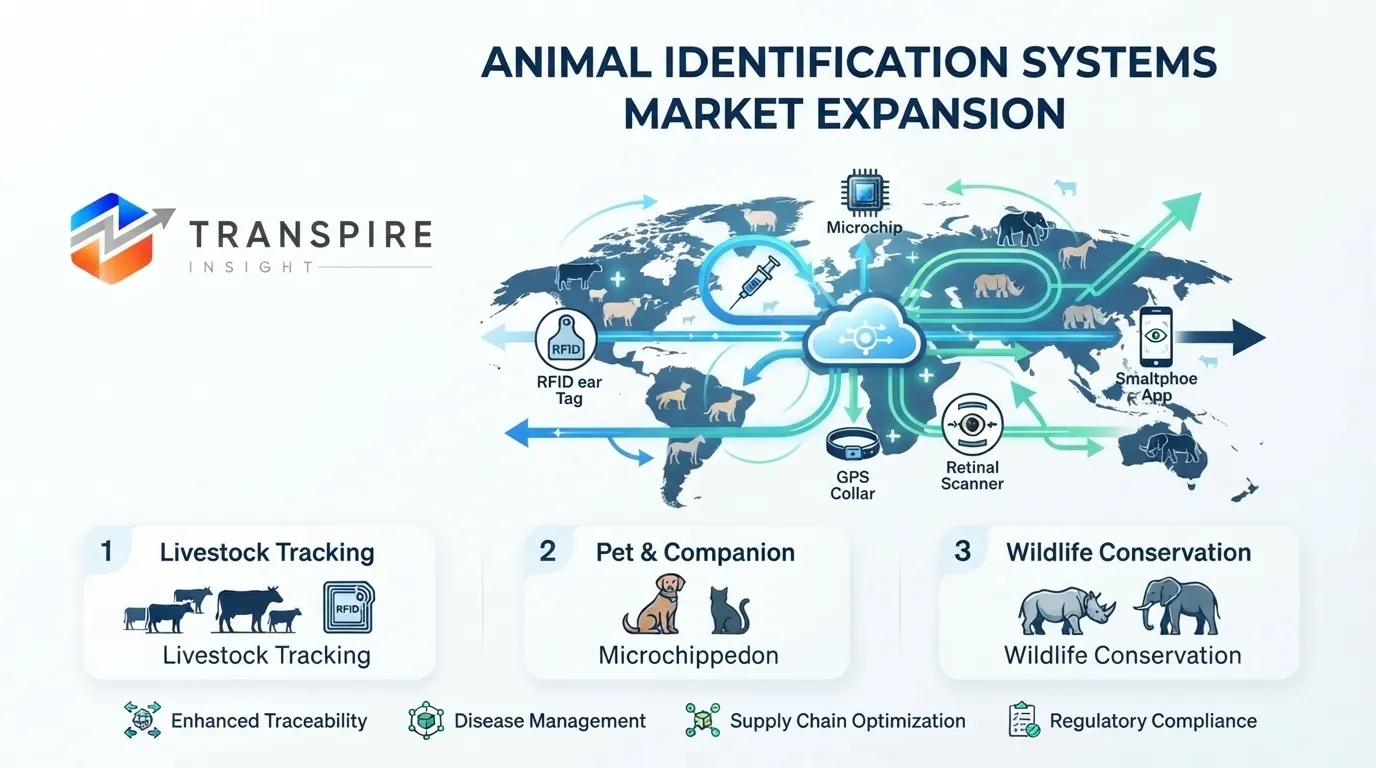
Modern livestock production is increasingly dependent on accurate identification, traceability and health monitoring. As governments, farmers, food processors and veterinary organizations place greater emphasis on disease control and supply-chain transparency, animal identification systems are evolving from simple identification tags into connected digital management tools.
RFID, electronic identification, microchips, biometric technologies and cloud-based livestock-management platforms are creating new opportunities for automated animal tracking and data-driven farm management.
September 2026: Animal identification systems provide methods for uniquely identifying individual animals or groups of animals throughout their lifecycle. Technologies include visual ear tags, electronic identification tags, RFID systems, injectable microchips, boluses, biometric identification and associated software platforms.
These systems are becoming increasingly important in livestock production because farmers need reliable information about animal health, movement, breeding, vaccination, ownership and production performance.
The technology also supports traceability across the food chain. When animals move between farms, markets, transportation facilities and processing plants, digital identification can help create an auditable record.
Increasing concerns surrounding livestock diseases are another important factor. Accurate identification allows authorities and producers to trace affected animals and identify potentially exposed populations more efficiently.
Market Size
The global animal identification systems market was estimated at approximately USD 3.9 billion in 2025 and is projected to reach around USD 7.3 billion by 2034, expanding at a CAGR of approximately 7.1% during 2026–2034.
Market estimates vary because some studies include only identification systems, while broader definitions include animal tracking, software, services and related monitoring technologies. One 2025 estimate places the market at USD 3.6 billion and forecasts USD 6.8 billion by 2034, while another 2026 estimate places the 2025 market considerably higher at USD 4.8 billion.
North America remains a major market because of established livestock-management infrastructure, while Asia Pacific is expected to experience strong growth as livestock production becomes increasingly digitized.
Traceability Is Becoming a Core Requirement
Food traceability is one of the strongest market drivers.
Consumers, retailers and food processors increasingly want greater visibility into the origin of meat, dairy and other animal-derived products.
Identification systems can connect an animal to its farm, movement history, health records and production information.
This improves transparency throughout the supply chain.
Traceability can also support faster responses to disease outbreaks.
When an infectious disease is detected, authorities need to identify potentially exposed animals quickly.
Digital identification reduces dependence on paper records and manual tracking.
RFID Technology Expands Across Livestock Operations
RFID is one of the most important technologies in the market.
RFID tags allow animals to be identified electronically using radio-frequency signals.
The technology can be incorporated into ear tags, injectable transponders and other identification formats.
Unlike manual identification, electronic systems can automatically capture information when an animal passes through a reader.
This reduces labor requirements.
Large farms can therefore process significant numbers of animals more efficiently.
RFID also creates opportunities for integration with weighing systems, feeding systems and automated livestock-management platforms.
Electronic Identification Supports Automation
Electronic identification is becoming increasingly important as farms adopt automation.
Automated milking systems, feeding equipment and sorting gates can use animal identification information to personalize operations.
For example, a dairy-management system can identify individual animals and retrieve their production history.
This can support feeding decisions, breeding management and health monitoring.
The technology therefore becomes part of a broader farm-management ecosystem.
Disease Surveillance Creates Additional Demand
Animal diseases can cause significant economic losses.
Identification systems help farmers maintain records that can be used for disease surveillance.
When combined with veterinary databases, identification information can support vaccination records and treatment histories.
Governments can also use identification systems to monitor animal movements.
This becomes particularly important during outbreaks.
Accurate identification can help limit unnecessary restrictions by identifying affected animals more precisely.
Livestock Represents a Major Application
Livestock remains one of the largest application areas.
Cattle, sheep, goats, pigs and other farm animals require identification for breeding, ownership, movement and traceability.
Cattle identification is particularly important in markets with established animal-traceability programs.
The increasing scale of commercial livestock farms is encouraging automated identification.
Companion Animals Create Another Opportunity
Pet identification is also contributing to market growth.
Microchips can help identify lost animals and connect them to owners.
Veterinary clinics increasingly use digital records linked to unique animal identifiers.
Pet adoption is also expanding in several markets.
The Business Research Company identifies increasing companion-animal adoption as one factor supporting growth in animal identification systems.
Biometric Identification Is an Emerging Trend
Biometric technologies represent an emerging segment.
Facial recognition, iris recognition and other biological characteristics can potentially identify animals without physical tags.
This could be useful when tags are lost or damaged.
AI-based image recognition may also allow cameras to identify animals based on facial patterns, body characteristics or markings.
Although adoption remains less mature than RFID and traditional tags, advances in computer vision could create new opportunities.
Cloud Platforms Add Value to Identification Hardware
Identification hardware is increasingly connected to software.
Cloud platforms can store animal records and make information accessible across farms, veterinarians and supply-chain organizations.
This allows farmers to analyze animal histories from smartphones or computers.
Data integration can also support herd-level analytics.
The value proposition is therefore moving from identification alone toward identification plus actionable information.
Smart Farming Supports Long-Term Growth
Precision livestock farming is gaining attention.
Sensors can measure animal activity, temperature, feeding behavior and movement.
Identification systems provide the foundation for connecting these observations to individual animals.
This allows farmers to distinguish normal behavior from unusual patterns.
The result can be earlier identification of illness or production problems.
North America Maintains a Strong Position
North America represents an important market due to its developed livestock industry and adoption of agricultural technology.
The United States and Canada have extensive cattle, dairy and livestock operations.
Traceability, food safety and farm productivity remain major priorities.
The region also has a mature ecosystem of technology providers, veterinary organizations and agricultural equipment companies.
Grand View Research identifies North America as the largest regional market in 2025, with approximately 35.1% share in the broader animal-identification market.
Europe Emphasizes Traceability
Europe has strong requirements around livestock traceability and food safety.
Electronic identification is increasingly integrated into livestock-management systems.
The region's focus on animal welfare and regulatory compliance creates sustained demand for reliable identification technologies.
Asia Pacific Offers Significant Growth Potential
Asia Pacific is expected to be one of the fastest-growing markets.
Large livestock populations in China, India and Southeast Asia create a substantial addressable market.
Farm modernization is encouraging the adoption of digital tools.
Government programs focused on livestock disease management can further support adoption.
India represents an especially important opportunity because of its large dairy and livestock population.
Competitive Landscape
The market includes RFID specialists, animal-health companies, agricultural technology providers and identification-system manufacturers.
Major participants include Avery Dennison, Microchip Technology, MSD Animal Health, HID Global, Neogen, Gallagher, Datamars, Nedap, AEG ID and Y-Tex. Research sources also identify Agrident, Avid Identification Systems, Allflex-related operations and other specialist providers.
Top 10 Companies in Animal Identification Systems Market
Headquarters: Rahway, New Jersey, USA
MSD Animal Health develops animal-health products and technologies for livestock and companion animals.
Its broad animal-health ecosystem gives the company exposure to digital identification, traceability and livestock-management applications.
Headquarters: Rahway, New Jersey, USA
Merck Animal Health provides products and technologies designed to improve animal health.
Its livestock-focused portfolio allows it to participate in the broader transition toward digitally managed animal production.
Headquarters: Lamone, Switzerland
Datamars specializes in animal identification, RFID and related tracking technologies.
Its solutions support livestock, companion animals and animal-management applications.
The company is particularly relevant to the shift toward electronic identification.
Headquarters: Hamilton, New Zealand
Gallagher provides livestock-management and animal-identification technologies.
Its portfolio includes electronic identification and systems designed to improve livestock handling and farm productivity.
Headquarters: Groenlo, Netherlands
Nedap develops livestock-management technology, including systems for dairy and animal identification.
Its solutions connect identification with herd-management processes.
Headquarters: Lansing, Michigan, USA
Neogen provides food-safety and animal-safety technologies.
Its livestock-related products and identification capabilities support traceability and animal-management applications.
Headquarters: Austin, Texas, USA
HID Global specializes in identification technologies.
Its RFID and identity-management expertise provides exposure to animal identification applications.
Headquarters: Chandler, Arizona, USA
Microchip Technology develops microcontrollers, RFID-related technologies and electronic components.
Its identification technologies can support animal microchipping and tracking applications.
Headquarters: Mentor, Ohio, USA
Avery Dennison provides labeling, RFID and identification technologies.
Its expertise in RFID enables applications across multiple industries, including animal identification and traceability.
Headquarters: Cody, Wyoming, USA
Y-Tex develops livestock identification products including ear tags and related animal-management solutions.
Its specialization in livestock identification supports agricultural traceability requirements.
Outlook: Could Animal Identification Become the Digital Foundation of Livestock Management?
Animal identification is increasingly becoming more than a compliance requirement.
The technology can provide the foundation for connected livestock management.
When identification is combined with sensors, AI, cloud software and automated farm equipment, farmers can create detailed digital records for individual animals.
This could support disease detection, breeding decisions, nutrition management and productivity improvement.
Future systems are likely to become increasingly automated.
Computer vision could reduce dependence on physical tags, while RFID and connected sensors will continue supporting large-scale livestock operations.
The strongest long-term opportunity is likely to come from integrated platforms that combine identification, traceability and animal-health intelligence.
As food-supply chains become more transparent and agriculture becomes more data-driven, animal identification systems could become an increasingly important component of modern livestock infrastructure.


Send us a brief description of your challenge and we'll get back to you within 24 hours.

 [email protected]
 APAC:+91 7666513636
 Address


