
Oct 02, 2026
By Transpire Insight
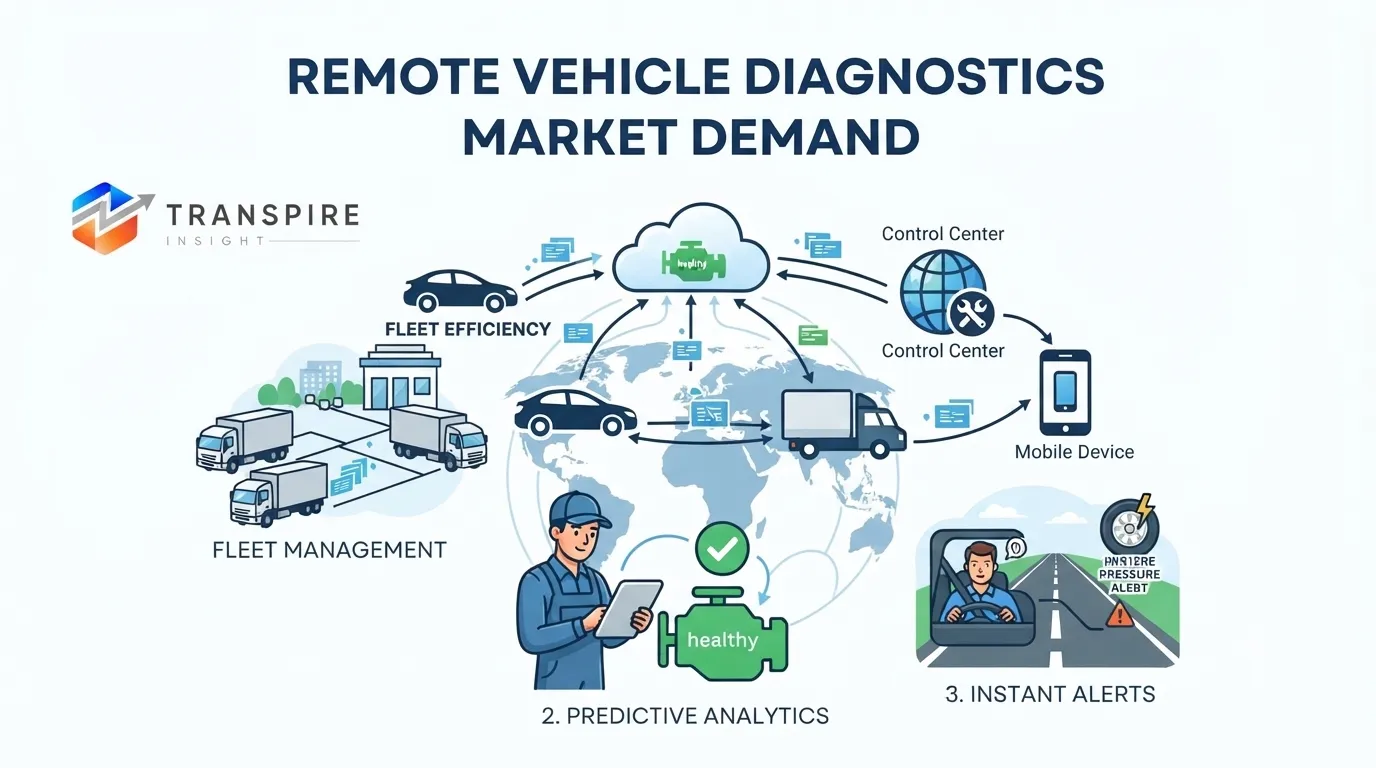
Vehicles are becoming increasingly connected, software-defined and electronically complex. As modern cars incorporate hundreds of sensors, electronic control units and connected systems, remote vehicle diagnostics is becoming an important technology for monitoring vehicle health without requiring every issue to be identified during a physical service visit.
The combination of telematics, cloud computing, artificial intelligence, 5G connectivity and over-the-air technologies is creating new opportunities for predictive maintenance and continuous vehicle-health monitoring.
September 2026: Remote vehicle diagnostics allows vehicle information to be collected through connected systems and analyzed remotely.
The technology can monitor fault codes, battery health, engine performance, transmission behavior, emissions systems and other vehicle parameters.
Instead of waiting for a driver to notice a problem, connected diagnostic systems can identify potential issues and send alerts.
This can reduce downtime and improve maintenance planning.
The technology is particularly important for commercial fleets because vehicle downtime can directly affect operating costs and delivery schedules.
Market Size
The global remote vehicle diagnostics market was estimated at approximately USD 16.8 billion in 2025 and is projected to reach around USD 67 billion by 2034, expanding at a CAGR of approximately 16.5% during 2026–2034.
Global Market Insight estimates USD 16.5 billion in 2025 and USD 64.8 billion by 2034 at a 16.4% CAGR.
Another 2025 estimate places the market at USD 17.0 billion and projects USD 78.1 billion by 2035 at 16.5% CAGR.
These estimates reflect the rapid expansion of connected vehicles and predictive-maintenance technologies.
Connected Vehicles Are the Main Driver
The number of connected vehicles is increasing worldwide.
Vehicles increasingly communicate with cloud platforms through embedded telematics systems.
This connectivity allows manufacturers and fleet operators to monitor vehicle performance.
Remote diagnostics can use this connection to identify faults.
As connectivity becomes standard rather than optional, the addressable market for remote diagnostics is expanding.
Predictive Maintenance Reduces Downtime
Predictive maintenance is one of the most important applications.
Traditional maintenance is often scheduled according to time or mileage.
Predictive systems use actual vehicle data to determine when components may require attention.
This can reduce unnecessary maintenance.
It can also help prevent unexpected failures.
For commercial fleets, even a small reduction in downtime can create significant financial benefits.
Artificial Intelligence Improves Fault Detection
AI and machine learning are becoming increasingly important.
Modern vehicles generate enormous amounts of data.
AI systems can analyze this information to identify patterns associated with component degradation.
A vehicle may show subtle changes in temperature, vibration or electrical behavior before a component fails.
AI can identify these patterns earlier than traditional diagnostic methods.
This can allow maintenance teams to act proactively.
Electric Vehicles Create New Diagnostic Requirements
EVs require different diagnostic capabilities.
Battery health is particularly important.
Remote systems can monitor battery temperature, charging behavior, voltage and other parameters.
Battery-health monitoring can help identify potential degradation.
Electric vehicles also have sophisticated power electronics and thermal-management systems.
These systems create additional diagnostic requirements.
Over-the-Air Updates Complement Diagnostics
Remote diagnostics increasingly works alongside OTA software updates.
When a software problem is detected, an automaker may be able to correct it remotely.
This reduces the need for a physical dealership visit.
The combination of diagnostics and OTA updates is therefore becoming an important part of connected-vehicle architecture.
Commercial Fleets Represent a Major Opportunity
Fleet operators have strong incentives to adopt remote diagnostics.
Truck, bus and delivery fleets depend on vehicle availability.
Unexpected failures can disrupt schedules.
Remote diagnostics allows fleet managers to monitor multiple vehicles from a centralized platform.
They can prioritize maintenance based on vehicle condition.
This improves operational efficiency.
Passenger Vehicles Expand Consumer Adoption
Passenger vehicles are also becoming increasingly connected.
Drivers can receive warnings through smartphone applications.
Automakers can monitor vehicle systems remotely.
Dealerships can receive diagnostic information before a vehicle arrives for service.
This can improve service efficiency.
Research identifies passenger cars as a leading segment, with one 2025 estimate placing their share at 54.6%.
5G Connectivity Supports Real-Time Monitoring
5G networks can improve connectivity.
Higher bandwidth and lower latency allow vehicles to transmit information more efficiently.
This is particularly useful for large fleets generating continuous data.
However, 4G and other connectivity technologies will remain important because vehicles have long operating lifetimes.
Cybersecurity Becomes Essential
Connected diagnostics creates cybersecurity risks.
Vehicle data can include sensitive information.
Unauthorized access to connected systems could potentially create safety problems.
Automakers and technology suppliers therefore need strong authentication, encryption and security architectures.
Cybersecurity will increasingly become a competitive requirement.
OEMs Are Expanding Connected Services
Automakers are increasingly developing connected-service platforms.
These systems can provide diagnostics, maintenance reminders, emergency assistance and remote-control functions.
The growing importance of software-defined vehicles will likely increase the role of remote diagnostics.
North America Leads the Market
North America represents a major market.
The United States has high connected-vehicle adoption and a large commercial-fleet industry.
Global Market Insight identifies North America as the largest regional market.
The region also has a strong ecosystem of telematics and automotive technology companies.
Europe Has Strong Regulatory and Technology Drivers
Europe is an important market because of advanced automotive manufacturing and environmental regulations.
Connected diagnostics can help manufacturers monitor vehicle performance and emissions.
Europe also has a mature commercial-vehicle market.
Asia Pacific Provides Strong Growth
Asia Pacific is expected to record rapid growth.
China, Japan, South Korea and India are expanding connected-vehicle adoption.
China has a large EV market, while India is rapidly digitizing its automotive ecosystem.
The combination of EV adoption, fleet expansion and smartphone connectivity creates strong opportunities.
Competitive Landscape
The market includes automotive suppliers, telematics companies, OEM technology platforms and fleet-management providers.
Major companies include Bosch, Continental, Denso, Geotab, Verizon Connect, ZF, Harman, GM/OnStar, Valeo and Omnitracs.
Top 10 Companies in Remote Vehicle Diagnostics Market
Headquarters: Hanover, Germany
Continental provides automotive electronics, telematics and connected-vehicle technologies.
Its diagnostic capabilities are integrated into broader vehicle intelligence systems.
One market estimate identifies Continental as the leading company, with more than 10.8% market share in 2024.
Headquarters: Gerlingen, Germany
Bosch provides automotive diagnostic hardware, software and electronic systems.
Its extensive relationships with automakers and aftermarket customers support its position in remote diagnostics.
Headquarters: Kariya, Japan
Denso develops automotive components and electronic systems.
Its expertise in sensors, control systems and vehicle electronics provides a strong foundation for connected diagnostics.
Headquarters: Oakville, Canada
Geotab provides connected-fleet management and telematics technologies.
Its cloud platform can collect vehicle information and support predictive maintenance.
Headquarters: Atlanta, Georgia, USA
Verizon Connect provides fleet-management and telematics solutions.
Its connected-vehicle infrastructure supports vehicle monitoring, fleet visibility and maintenance management.
Headquarters: Friedrichshafen, Germany
ZF develops automotive systems for passenger and commercial vehicles.
Its electronic and connected technologies support vehicle health monitoring and predictive maintenance.
Headquarters: Stamford, Connecticut, USA
Harman develops connected automotive technologies, including infotainment and telematics-related systems.
Its expertise supports the transition toward software-defined and connected vehicles.
Headquarters: Detroit, Michigan, USA
OnStar provides connected-vehicle services within General Motors' ecosystem.
Services include diagnostics, vehicle health information and emergency assistance.
Headquarters: Paris, France
Valeo develops automotive electronics, sensors and driver-assistance technologies.
Its technology portfolio provides exposure to connected diagnostics and vehicle-health monitoring.
Headquarters: Dallas, Texas, USA
Omnitracs provides fleet-management and connected-vehicle technologies.
Its solutions help commercial fleets monitor vehicle performance and improve operational efficiency.
Outlook: Could Remote Diagnostics Become Standard Vehicle Infrastructure?
Remote diagnostics is becoming increasingly integrated into vehicle architecture.
Future systems will likely combine telematics, AI, battery monitoring, cybersecurity and OTA updates.
The transition toward software-defined vehicles will further increase the importance of remote monitoring.
Instead of treating diagnostics as an occasional service activity, automakers and fleet operators can use continuous vehicle-health data.
AI could predict component failures before warning lights appear.
For EVs, battery-health analytics could become particularly important.
The market's long-term development will therefore depend on connected-vehicle penetration, cybersecurity, data management and the ability of manufacturers to turn vehicle information into actionable maintenance decisions.
As vehicles become increasingly digital, remote diagnostics could become a foundational element of automotive service and fleet management.


Send us a brief description of your challenge and we'll get back to you within 24 hours.

 inquiry@transpireinsight.com
 APAC:+91 7666513636
 Address


