
Sep 14, 2026
By Transpire Insight
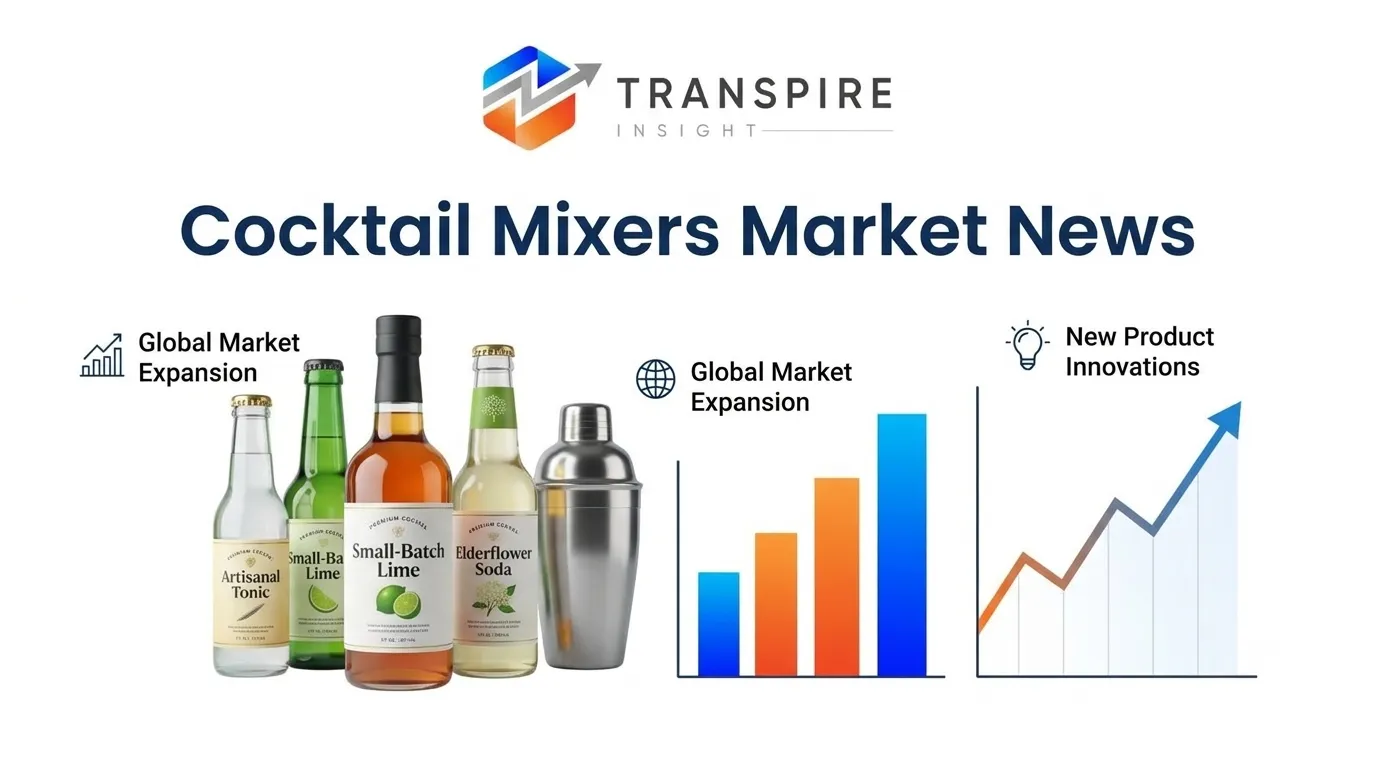
The global cocktail mixers market is entering a broader phase of development as consumers increasingly seek premium flavors, convenient cocktail preparation, artisanal ingredients and more sophisticated non-alcoholic beverage experiences. Tonic water, syrups, cordials, ginger ale, club soda and specialty mixers are benefiting from the continued popularity of home bartending and cocktail culture, while organic, botanical, low-calorie and premium formulations are creating new opportunities for manufacturers. Recent beverage trends also show growing interest in lighter drinking occasions and sophisticated adult soft drinks, expanding the role of mixers beyond traditional alcoholic cocktails.
Cocktail Mixers Market Advances with Growing Demand for Premium and Convenient Beverage Solutions
The global cocktail mixers market is developing rapidly as cocktail culture expands across restaurants, bars, hotels, events and household consumption. Cocktail mixers have evolved from basic supporting ingredients into differentiated beverage products featuring botanical extracts, exotic fruits, natural flavors, low-sugar formulations and premium carbonation. The expansion of home mixology is also encouraging consumers to experiment with professional-style cocktails without requiring extensive bartending skills.
According to Transpire Insight, the global cocktail mixers market is estimated at approximately USD 12.9 billion in 2025 and is expected to reach around USD 13.8 billion in 2026, with the market projected to approach USD 22.4 billion by 2033, representing an estimated CAGR of approximately 7.17% during 2026–2033. Current market assessments similarly indicate sustained expansion, with Grand View Research estimating the market at USD 12.7 billion in 2025 and USD 13.5 billion in 2026, while projecting USD 21.7 billion by 2033 at a 7.1% CAGR.
Premium Mixers Strengthen the Cocktail Experience
Premiumization is becoming one of the most important trends within the cocktail mixers market as consumers increasingly seek ingredients capable of improving the taste, appearance and overall experience of cocktails. Premium tonic waters, craft syrups, botanical sodas and specialty cordials are increasingly being positioned as products with distinctive flavor profiles rather than simple beverage additives.
Consumers are showing greater willingness to explore unusual combinations involving herbs, spices, citrus, berries and botanical ingredients. This trend is particularly visible within the home-mixology segment, where consumers are attempting to recreate restaurant and cocktail-bar experiences.
Recent market analysis identifies premium and artisanal mixer products as important contributors to market expansion, with consumers seeking unique flavors, organic ingredients and higher-quality formulations.
The growing sophistication of cocktail menus is also encouraging bars and restaurants to experiment with specialty mixers that can help differentiate signature drinks and create recognizable beverage identities.
At-Home Mixology Expands Retail Demand
The popularity of preparing cocktails at home continues to create opportunities for cocktail mixer manufacturers. Consumers can create margaritas, mojitos, gin and tonics, bloody marys, cosmopolitans and other beverages by combining spirits with ready-to-use mixers, reducing preparation time and the need to purchase multiple ingredients.
Retail channels are benefiting from this behavior as supermarkets, hypermarkets, specialty stores and online retailers expand their selections of cocktail mixers. Current market research indicates that the retail segment is expected to grow faster than food service during the forecast period, reflecting consumers' continued interest in recreating bar-quality beverages at home.
Cocktail kits, seasonal products and themed mixer collections are also creating additional opportunities for brands to increase consumer engagement around holidays, celebrations and social gatherings.
Low-Alcohol and Adult Non-Alcoholic Options Broaden Mixer Applications
Changing drinking habits are creating an additional growth opportunity for cocktail mixer manufacturers. Consumers increasingly want lighter beverages, reduced alcohol consumption and sophisticated non-alcoholic alternatives without abandoning the social and sensory experience associated with cocktails.
The shift is encouraging mixer companies to develop products that can be consumed with or without alcohol. Fever-Tree, for example, recently expanded its Australian and New Zealand portfolio with Lemon Lime & Bitters, positioning the product within the premium adult soft-drink category as consumer preferences move toward lighter and more mindful drinking occasions.
This development demonstrates how traditional mixer brands can expand their addressable market beyond alcoholic cocktails by offering products that function equally well as standalone adult beverages or cocktail ingredients.
Innovative Flavors Create New Product Opportunities
Flavor innovation is becoming increasingly important as manufacturers attempt to attract consumers seeking differentiated cocktail experiences. Botanical, citrus, tropical, spicy, herbal and floral profiles are gaining attention across premium mixer categories.
The current cocktail culture is also encouraging the adoption of flavors associated with specific regional and cultural drinking traditions. In 2026, Alpine-inspired flavors featuring botanical, herbaceous and pine-like characteristics have become increasingly visible across syrups, sodas, liqueurs and cocktails.
Such developments are encouraging manufacturers to use seasonal, regional and unconventional ingredients to create distinctive products that stand out on retail shelves and cocktail menus.
Why do Cocktail Mixers Matter?
Cocktail mixers have direct implications for beverage quality, convenience, product differentiation and consumer experience. They allow consumers and food-service operators to produce consistent drinks while reducing the preparation complexity associated with individual ingredients.
For bars and restaurants, premium mixers can help create differentiated cocktail menus and signature beverages. For households, ready-to-use mixers make cocktail preparation more accessible by simplifying recipes and reducing the number of ingredients required.
Mixers are also increasingly important within the broader moderation movement because many products can be combined with low-alcohol or non-alcoholic spirits. This allows consumers to participate in cocktail occasions while controlling the alcohol content of their drinks.
The category therefore extends beyond traditional cocktail preparation and increasingly intersects with premium soft drinks, mocktails, wellness-oriented beverages and experiential consumption.
Digital Retail and Beverage Culture Support Market Expansion
The development of the cocktail mixers market is increasingly connected with changes in retail and consumer discovery. Social-media platforms, recipe content, influencer marketing and online shopping are allowing consumers to discover new cocktail recipes and specialty mixer brands more easily.
The popularity of home entertaining has also encouraged consumers to invest in barware, cocktail ingredients and premium beverages. Brands can use digital platforms to demonstrate recipes and communicate the origin, ingredients and recommended applications of their mixers.
At the same time, food-service operators are using visually distinctive cocktails to create social-media-friendly menu items. This encourages demand for mixers with vibrant colors, unusual flavor combinations and premium presentation.
Key Trends in the Cocktail Mixers Market
Premium tonic waters, botanical beverages, craft syrups and specialty cordials are gaining popularity as consumers increasingly seek higher-quality cocktail ingredients. Product differentiation through ingredients, flavor complexity and packaging is becoming an important competitive strategy.
Consumers are increasingly recreating bar-style beverages at home, supporting demand for convenient ready-to-use mixers. The continued popularity of home entertaining is expected to maintain retail demand for premium and specialty products.
Mixer manufacturers are increasingly developing products suitable for mocktails and low-alcohol drinks. This trend is expanding the category's consumer base as moderation becomes more prominent in beverage consumption.
Botanical extracts, herbs, spices, natural flavors and fruit-based ingredients are becoming important tools for product differentiation. Consumers are increasingly interested in recognizable ingredients and more sophisticated flavor profiles.
Unconventional combinations and regional flavor influences are creating new opportunities for innovation. Alpine-inspired flavors, floral ingredients, spicy profiles and tropical combinations demonstrate the industry's movement toward more distinctive beverage experiences.
Regional Development
The development of the global cocktail mixers market varies across regions because of differences in cocktail culture, disposable income, hospitality infrastructure, consumer preferences and retail development. North America remains one of the largest regional markets, supported by strong home-mixology culture, premium beverage consumption and a developed bar and restaurant industry. Grand View Research estimates that North America accounted for approximately 37.4% of global cocktail mixers revenue in 2025.
Europe represents another major market, supported by established cocktail traditions, premium beverage consumption and strong demand for tonic waters, syrups, cordials and specialty mixers. Fortune Business Insight estimates that Europe held approximately 35.61% of the global market in 2025, making it the leading region under its market methodology.
Asia Pacific is expected to experience strong growth as cocktail culture expands across urban markets and consumers increasingly experiment with premium beverages. China, India, Japan and Australia are becoming increasingly important markets as hospitality development, premiumization and modern retail create greater access to specialty mixer products.
The region also provides opportunities for localized flavors and botanical ingredients, allowing manufacturers to adapt international cocktail formats to local consumer preferences.
Challenges & Restraints
Despite strong growth opportunities, the cocktail mixers market faces several challenges. Competition is intensifying as established beverage companies, specialist mixer brands and emerging craft producers introduce increasingly differentiated products.
Raw-material costs can also affect manufacturers because premium products frequently depend on fruits, botanicals, herbs, spices and other ingredients whose prices can fluctuate according to agricultural conditions and supply availability.
Health-conscious consumers are another consideration. Traditional mixers can contain substantial amounts of sugar, while increasing demand for lower-calorie and low-sugar beverages is encouraging manufacturers to reformulate products. Developing reduced-sugar formulations without compromising flavor remains an important technical challenge.
Packaging sustainability is also becoming increasingly relevant. Brands are under pressure to reduce packaging waste and improve recyclability while maintaining carbonation, shelf stability and product protection.
In addition, the category is closely connected to alcohol consumption trends. Although mixers are increasingly being used in non-alcoholic beverages, changes in alcohol consumption can affect demand for traditional cocktail applications. Recent industry reporting highlights a broader shift toward moderation and lower alcohol consumption among consumers, increasing the importance of versatile mixer products.
Competitive Landscape
The global cocktail mixers ecosystem includes beverage companies, specialist mixer manufacturers and producers of tonic water, syrups, cordials, sodas and other cocktail ingredients. Major participants include Fever-Tree, Keurig Dr Pepper, The Coca-Cola Company, The London Essence Company, Three Cents, Fentimans, Thomas Henry, East Imperial, Britvic, Q MIXERS, Master of Mixes and other regional producers.
Competition is increasingly based on flavor innovation, premium positioning, natural ingredients, packaging design and versatility across alcoholic and non-alcoholic applications.
Companies are also attempting to expand beyond traditional mixer categories by developing adult soft drinks and products that can be consumed independently. This strategy can increase the addressable market while reducing dependence on conventional cocktail consumption.
Fever-Tree is one of the most prominent premium mixer companies and has built its position around tonic waters, ginger beers, sodas and other premium cocktail ingredients.
The company is increasingly extending its positioning beyond traditional spirit mixers. In Australia and New Zealand, Fever-Tree recently launched Lemon Lime & Bitters as part of a broader move toward premium adult soft drinks. The product achieved approximately 10% share at Coles within 13 weeks of launch and subsequently expanded into additional retail channels, demonstrating the opportunity for premium mixer brands to reach consumers outside conventional cocktail occasions.
Keurig Dr Pepper participates in the beverage market through a broad portfolio of carbonated beverages, mixers and related products. Its scale provides access to extensive distribution networks across retail and food-service channels.
The company's position across multiple beverage categories provides opportunities to respond to changing consumer preferences for convenient, flavored and lower-calorie beverages.
The Coca-Cola Company participates in the broader mixer and beverage ecosystem through carbonated beverages, tonic products and other drink categories used in cocktail and non-alcoholic applications.
Its global distribution infrastructure provides significant reach across developed and emerging markets. The company's scale also enables it to respond to evolving consumer preferences around flavor, convenience and beverage occasions.
The London Essence Company focuses on premium mixers designed for cocktail and sophisticated non-alcoholic beverage applications. Its portfolio emphasizes refined flavor combinations, botanical ingredients and premium positioning.
The company reflects the growing trend toward mixers being treated as standalone premium beverages rather than simply secondary ingredients in cocktails.
Fentimans is known for botanical beverages, ginger beer and premium mixers that combine distinctive flavors with a craft-oriented positioning.
Its portfolio aligns with growing consumer interest in botanical ingredients and sophisticated beverage experiences. The company's positioning also demonstrates the increasing overlap between premium mixers, adult soft drinks and non-alcoholic consumption.
Market Expert View
As per industry analysis, the next phase of the cocktail mixers market is likely to be shaped by the convergence of premiumization, home mixology, moderation, flavor innovation and premium non-alcoholic beverages
Current beverage developments demonstrate that mixer brands are increasingly expanding beyond their traditional role. Fever-Tree's move into premium adult soft drinks shows how companies can use existing mixer expertise to target consumers who want sophisticated beverages without necessarily consuming alcohol.
At the same time, the popularity of lighter cocktails and spritz-style beverages is influencing flavor and serving occasions. Recent UK data showed a sharp increase in Hugo spritz sales, with sales up 196% year over year in the three months through June 2026, while Aperol spritz sales increased 13%. The trend reflects growing consumer interest in lighter, afternoon-oriented drinking occasions.
Industry participants are therefore expected to prioritize natural ingredients, reduced sugar, botanical profiles, premium packaging, versatile formulations and products suitable for both alcoholic and non-alcoholic applications. The ability to deliver distinctive flavor while matching changing consumer expectations around moderation and convenience will remain a major competitive factor.
Conclusion
The global cocktail mixers market is entering a broader stage of development as premiumization, home mixology, flavor experimentation and changing drinking habits reshape consumer demand. Cocktail mixers are increasingly evolving from basic beverage components into differentiated products that can enhance cocktails, mocktails and standalone adult beverage experiences.
The expansion of premium tonic waters, craft syrups, botanical mixers, low-sugar formulations and specialty flavor profiles is expected to support market development through the coming years. At the same time, manufacturers will need to address sugar reduction, raw-material volatility, packaging sustainability and changing alcohol-consumption patterns
Recent developments across the beverage industry indicate that the future of cocktail mixers will not be limited to traditional bar applications. The growth of premium adult soft drinks, lighter cocktails, at-home mixology and sophisticated non-alcoholic beverages is expanding the category's addressable market. As consumers increasingly seek convenience, quality, personalization and more mindful drinking experiences, cocktail mixers are expected to become an increasingly important component of the global premium beverage ecosystem.


Send us a brief description of your challenge and we'll get back to you within 24 hours.

 inquiry@transpireinsight.com
 APAC:+91 7666513636
 Address


