
Sep 23, 2026
By Transpire Insight
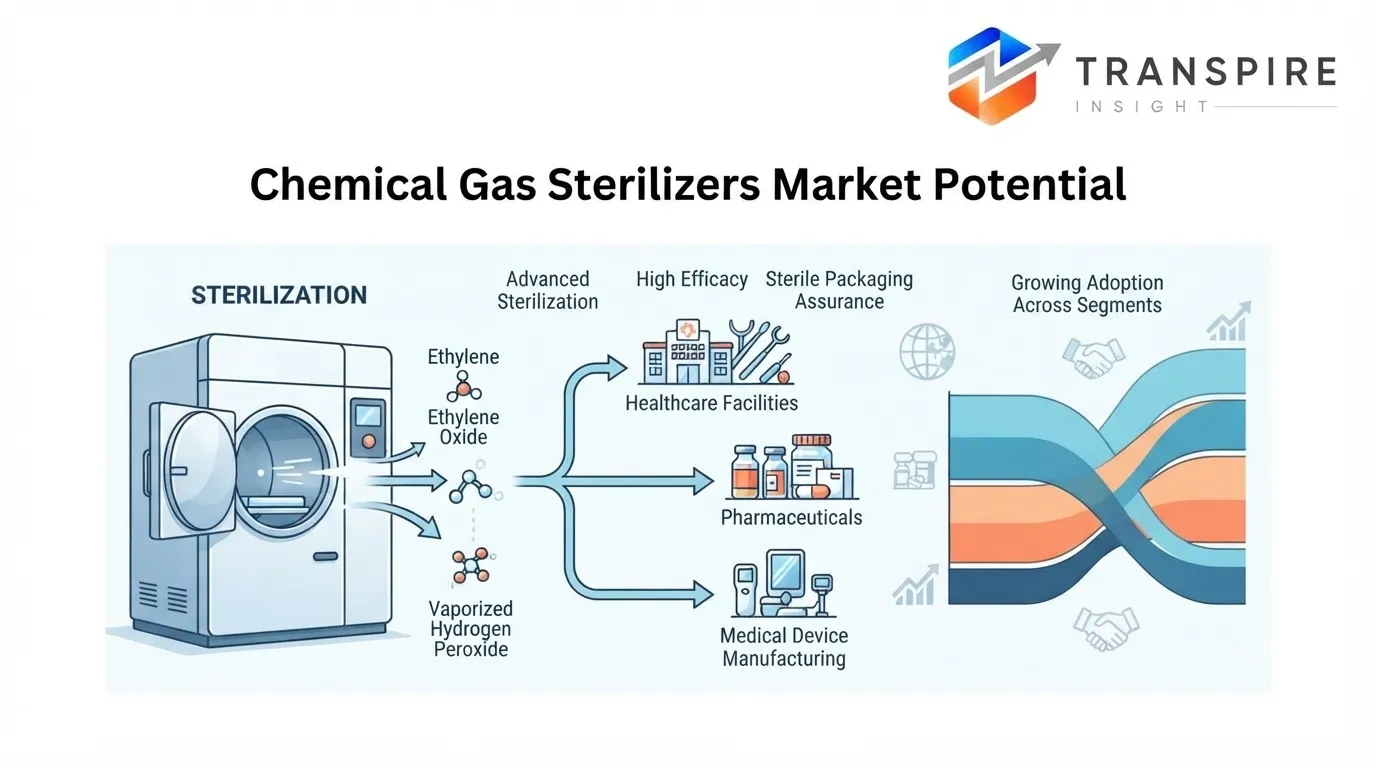
Healthcare providers and medical-device manufacturers are facing increasing pressure to maintain high sterilization standards while processing increasingly complex instruments and materials. Chemical gas sterilization provides an important low-temperature alternative for devices that cannot tolerate conventional steam-based sterilization.
The expansion of minimally invasive procedures, single-use medical products, pharmaceutical manufacturing and advanced polymer-based devices is creating new opportunities for chemical and gas sterilization technologies.
September 2026: Sterilization remains a fundamental requirement across hospitals, medical-device manufacturing, pharmaceutical production, laboratories and other healthcare-related facilities. As medical instruments become more sophisticated, traditional high-temperature sterilization methods are not suitable for every application.
Chemical gas sterilizers address this requirement by using gaseous sterilizing agents to eliminate microorganisms from heat-sensitive and moisture-sensitive products.
Growing healthcare infrastructure, increasing surgical volumes, stricter infection-control practices and demand for sterile medical products are supporting continued adoption of these systems.
Market Size
The global chemical gas sterilizers market was estimated at approximately USD 1.56 billion in 2025 and is projected to reach around USD 2.43 billion by 2035, expanding at a CAGR of approximately 4.6% during 2026–2035.
North America remains the leading regional market because of its established healthcare infrastructure, stringent sterilization requirements and large medical-device manufacturing base. Asia Pacific is expected to record strong growth as healthcare infrastructure and pharmaceutical production expand across China, India and other emerging economies.
Recent market studies place the 2025 market in a broadly similar range, although estimates differ depending on the sterilization technologies and applications included in the market definition.
Rising Demand for Low-Temperature Sterilization
The growing use of heat-sensitive medical products is one of the most important factors supporting the market.
Modern medical devices increasingly contain polymers, electronics, adhesives, optical components and other materials that may be damaged by high temperatures or excessive moisture.
Chemical gas sterilization allows manufacturers and healthcare facilities to process such products without exposing them to the extreme conditions associated with conventional steam sterilization.
Hydrogen peroxide, ethylene oxide and other chemical sterilization technologies therefore continue to occupy an important position in the sterilization ecosystem.
The shift toward minimally invasive surgical equipment is further supporting demand because many of these instruments have narrow channels, complex geometries and sensitive materials.
Medical Device Manufacturing Remains a Major Application
Medical-device manufacturing represents a significant share of demand for chemical gas sterilizers.
Manufacturers of catheters, implantable components, surgical instruments, diagnostic equipment and disposable medical products require validated sterilization processes before products can reach healthcare facilities.
The growing adoption of single-use devices is particularly relevant. Single-use products reduce the need for repeated cleaning and sterilization at hospitals but increase the importance of reliable industrial sterilization during manufacturing.
As device designs become more complicated, manufacturers are increasingly evaluating sterilization compatibility during the early stages of product development.
Hydrogen Peroxide Technologies Gain Attention
Hydrogen peroxide-based sterilization technologies are gaining greater attention because they offer low-temperature processing and can be suitable for a wide range of medical equipment.
The technology is also associated with shorter processing requirements in some applications and avoids some of the environmental and occupational concerns associated with traditional sterilization chemistries.
However, the selection of sterilization technology depends heavily on device design, material compatibility, packaging requirements and regulatory validation.
Ethylene oxide remains important because of its ability to penetrate complex device geometries and packaging. Nevertheless, regulatory and environmental considerations are encouraging manufacturers to examine alternative sterilization technologies.
Pharmaceutical and Biotechnology Applications Expand
Chemical gas sterilization is not limited to hospitals and medical-device manufacturers.
Pharmaceutical and biotechnology facilities require controlled environments and sterile processing for specialized equipment, production areas and sensitive products.
The expansion of biologics, advanced therapies and sterile pharmaceutical manufacturing is increasing the importance of contamination-control systems.
As pharmaceutical production becomes more automated and specialized, sterilization equipment is increasingly expected to provide reliable process control, documentation and traceability.
Digital monitoring and automated validation systems could therefore become more important competitive factors.
Infection-Control Requirements Support Market Growth
Healthcare-associated infections continue to create pressure for stronger sterilization and infection-prevention practices.
Hospitals need reliable sterilization systems for surgical instruments and medical equipment, particularly as procedure volumes increase.
The focus is also shifting from simply owning sterilization equipment to demonstrating consistent sterilization performance.
This is creating opportunities for systems equipped with automated monitoring, cycle documentation, alarms and data-management capabilities.
Sterilization equipment providers that can combine hardware with digital monitoring and service support may therefore gain a competitive advantage.
North America Maintains Market Leadership
North America is expected to remain the largest chemical gas sterilizers market through the forecast period.
The region benefits from advanced healthcare infrastructure, strong medical-device manufacturing capabilities and strict infection-control standards.
The United States represents the largest national market in the region because of its extensive hospital network and major medical-device industry.
Europe also represents an important market, supported by established healthcare systems and regulatory emphasis on medical-device safety.
Asia Pacific is expected to demonstrate stronger long-term growth as healthcare expenditure rises and pharmaceutical and medical-device manufacturing capacity expands.
Competitive Landscape
The chemical gas sterilizers market includes established sterilization-equipment manufacturers, healthcare technology companies and specialized sterilization providers.
Competition is based on sterilization effectiveness, equipment reliability, cycle time, operating cost, regulatory compliance, safety and technical support.
STERIS and Getinge are among the major companies identified in current market research, while Andersen Sterilizers, Noxilizer, Advanced Sterilization Products and other specialized suppliers also participate in the market.
Top 10 Companies in Chemical Gas Sterilizers Market
1. STERIS
Headquarters: Mentor, Ohio, USA
STERIS is a major healthcare technology company providing sterilization, infection-prevention and surgical solutions. Its broad product portfolio allows it to serve hospitals, pharmaceutical manufacturers and medical-device companies.
2. Getinge
Headquarters: Gothenburg, Sweden
Getinge provides infection-control and healthcare technology solutions, including sterilization and reprocessing equipment. Its international presence supports demand from hospitals and healthcare institutions.
3. Advanced Sterilization Products
Headquarters: Irvine, California, USA
Advanced Sterilization Products specializes in sterilization and low-temperature reprocessing technologies. Its solutions are focused heavily on healthcare applications involving heat-sensitive medical devices.
4. 3M
Headquarters: St. Paul, Minnesota, USA
3M has historically maintained a significant presence in healthcare sterilization and infection-prevention technologies. Its broader healthcare portfolio provides access to hospitals and medical-device manufacturers.
5. Andersen Sterilizers
Headquarters: Haw River, North Carolina, USA
Andersen Sterilizers specializes in ethylene oxide sterilization systems and related equipment. The company serves applications requiring sterilization of heat-sensitive medical products.
Outlook: Could Advanced Sterilization Become More Digital?
The future of chemical gas sterilization is likely to involve greater automation, digital monitoring and process traceability.
Healthcare facilities and manufacturers are increasingly looking for sterilization equipment that can document each cycle, identify abnormalities and support regulatory compliance.
At the same time, environmental and occupational considerations could accelerate the transition toward safer and more efficient sterilization technologies.
As medical-device designs become increasingly complex, chemical gas sterilizers are likely to remain an important component of the global sterilization ecosystem.


Send us a brief description of your challenge and we'll get back to you within 24 hours.

 inquiry@transpireinsight.com
 APAC:+91 7666513636
 Address


